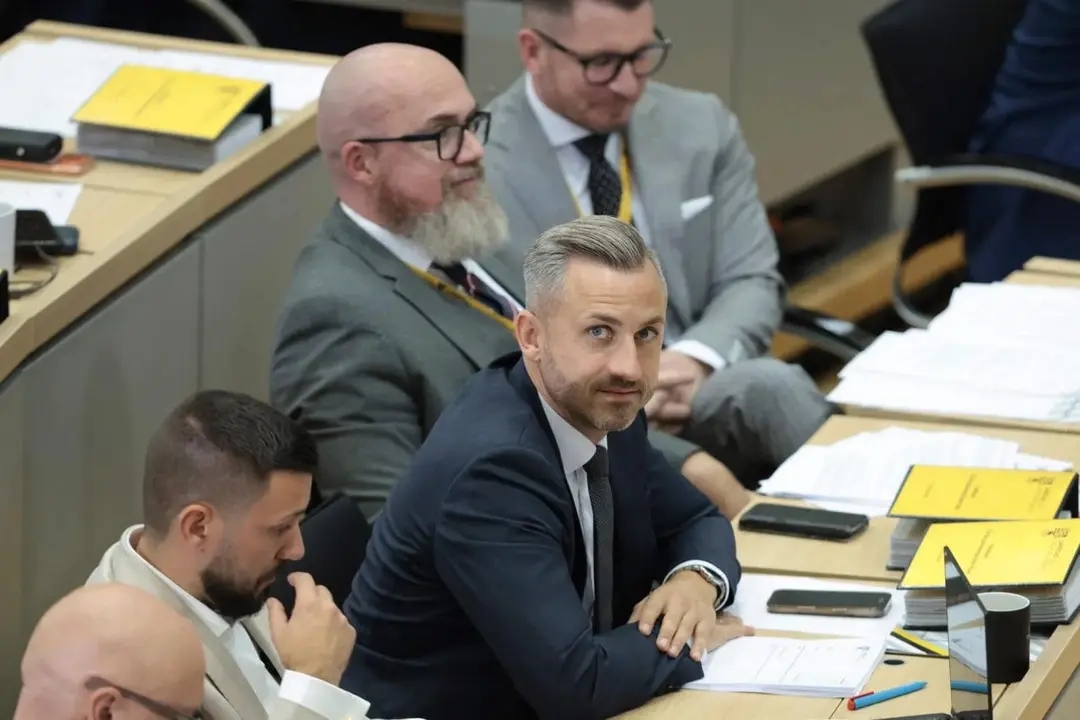
The far-right Alternative for Germany (AfD) and the left-wing populist Sahra Wagenknecht Alliance (BSW) have introduced a resolution in the Saxony-Anhalt state parliament calling for an end to aid for Ukraine and the lifting of economic sanctions against Russia. Regional AfD leader Ulrich Siegmund, who is seeking to become the state’s premier, posted a video on social media outlining the proposal. Political scientists interviewed by The Insider said the resolution has no legal force because Germany’s federal states do not have authority over foreign policy.
AfD and BSW lawmakers submitted the resolution to the Saxony-Anhalt Landtag (state parliament), calling for an end to military deliveries to Ukraine and the lifting of sanctions on Russia. The document states:
“The policy of sanctions against Russia, economic embargoes, and arms deliveries and financial aid to Ukraine has failed. The West’s one-sided partisanship in the war in Ukraine has not helped to end the war; rather, it prolongs the suffering of the population and increases the risk of the war spreading to other countries. The energy and economic war directed against Russia is causing massive damage to industry, commerce, and trade in Germany, as well as to our citizens.”
In the resolution, AfD and BSW call for diplomacy to become the main focus, for sanctions against Russia to be lifted immediately, and for financial and military support for Ukraine to end at once. The authors also call for Ukraine to retain neutral-state status while urging the Saxony-Anhalt government to “use all means at its disposal…to launch a corresponding initiative in the Bundesrat,” the German federal government’s upper legislative chamber.
Local AfD leader Ulrich Siegmund wrote on X:
“Not even 24 hours have passed since the constituting session [the first meeting of the newly elected parliament], and we are already getting to work. We are applying for a peace initiative and a special session of the state parliament. End the war, end the payments to Ukraine!”
German political scientist Alex Yusupov, the head of the Russia Program at the Friedrich Ebert Foundation (FES), told The Insider that, from a legal standpoint, the resolution introduced by the far right and populist left has no force. He said the fact that AfD and BSW made foreign policy, rather than regional problems, the first initiative of the new state parliament shows that both parties “continue to pursue a public relations strategy rather than practical policymaking.”
“It is simply a resolution, meaning a public statement of the Landtag’s position, nothing more and nothing less. It is a call to action and an appeal,” Yusupov added.
Dimitri Stratievski, director of the Berlin Center for East European Studies, told The Insider that all the issues raised in the resolution fall exclusively under the authority of Germany’s federal government, meaning AfD and BSW have no ability to carry out what they are demanding. He said:
“This is a populist move. But it is notable that, for their first test initiative, they chose an issue that has nothing to do with state-level politics. I think that was deliberate, because no concrete decisions are expected here and there is no political responsibility attached. Voters cannot hold these two parties accountable for promises they fail to keep. At the same time, AfD and BSW need to send signals to their voters.
As a rule, voters for right-wing and left-wing populists are not especially familiar with how powers are divided among different levels of government. And even if some are, it is not particularly important to them. They want the sense that their representatives in government are dealing with major issues. Ending weapons deliveries to Ukraine is also important to them because they believe it would save federal budget money at a difficult time.
In addition, to form a government in Saxony-Anhalt, AfD would have to enter a coalition with the Sahra Wagenknecht Alliance. And they very much do not want to do that. The far right is not enthusiastic about the prospect of partnering with people who spent a long time in the left-wing party and are supposed to be strong opponents of the right. BSW does not look like a reliable coalition partner for AfD. But a joint statement like this on Ukraine — which cannot have concrete political consequences — is a trial balloon and an attempt to demonstrate some common ground and pull the two parties closer together.”
Stratievski noted that Ulrich Siegmund is already presenting himself as the leader of Saxony-Anhalt, framing his statements as though they were being made on behalf of the state even though he has not yet become its premier:
“Siegmund is behaving like a state official without having any authority to do so, but he has repeatedly said that he will become the state premier in December. He is doing this deliberately. On the one hand, he is mobilizing supporters. On the other, he is trying to impose on his political opponents a sense that it is inevitable that he, Ulrich Siegmund, will become the next premier of Saxony-Anhalt. It is a psychological and political tactic designed to convey the idea that ’the matter is settled, and I am already behaving like the acting head of the state.’”
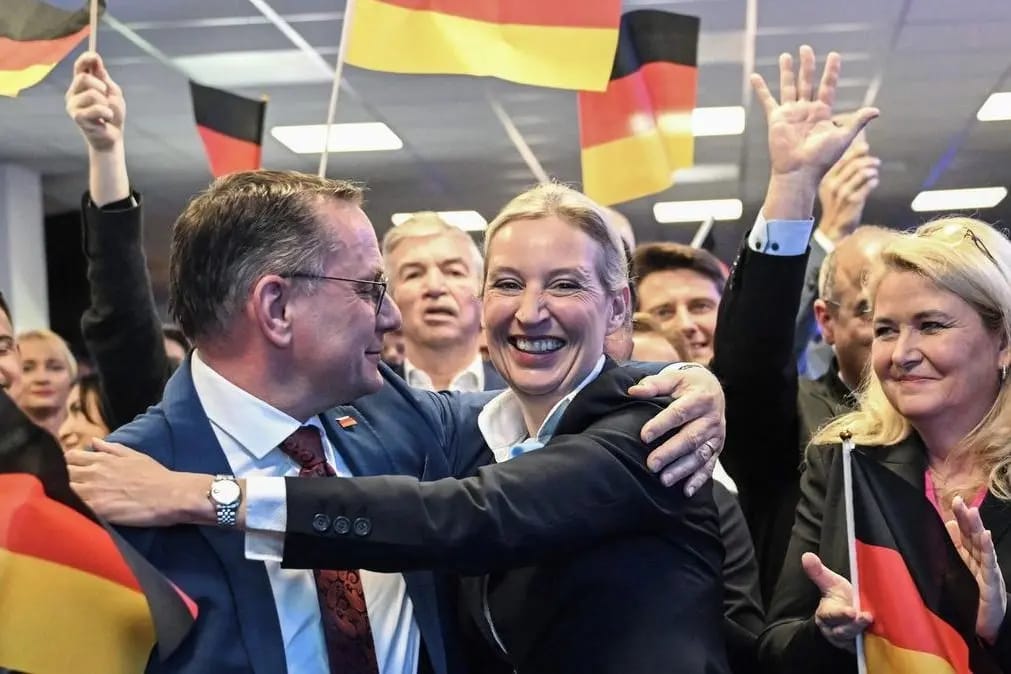
In early September, AfD finished first in Saxony-Anhalt’s state election with nearly 44% of the vote. The far-right party won 39 of the Landtag’s 83 seats. The left-populist Sahra Wagenknecht Alliance won five seats and said it was prepared to cooperate with AfD.
On Oct. 6, AfD lawmaker Tobias Rausch, 35, became the first far-right politician in postwar German history to be elected speaker of a state parliament, taking the top post in the Saxony-Anhalt Landtag by a vote of 48-34. AfD and BSW together controlled 44 votes, meaning Rausch received support from at least four lawmakers outside either party. Because the ballot was secret, it is unclear who backed him, though speculation in Germany has focused on members of the CDU, the party of Chancellor Friedrich Merz. The other parties in the Landtag had said they would not support Rausch.