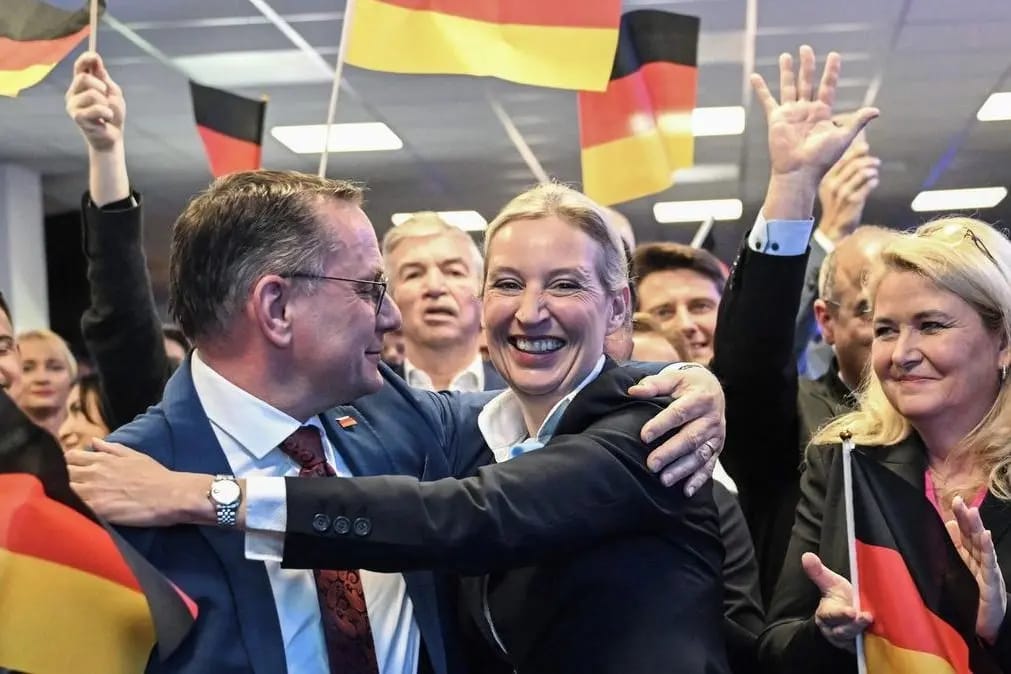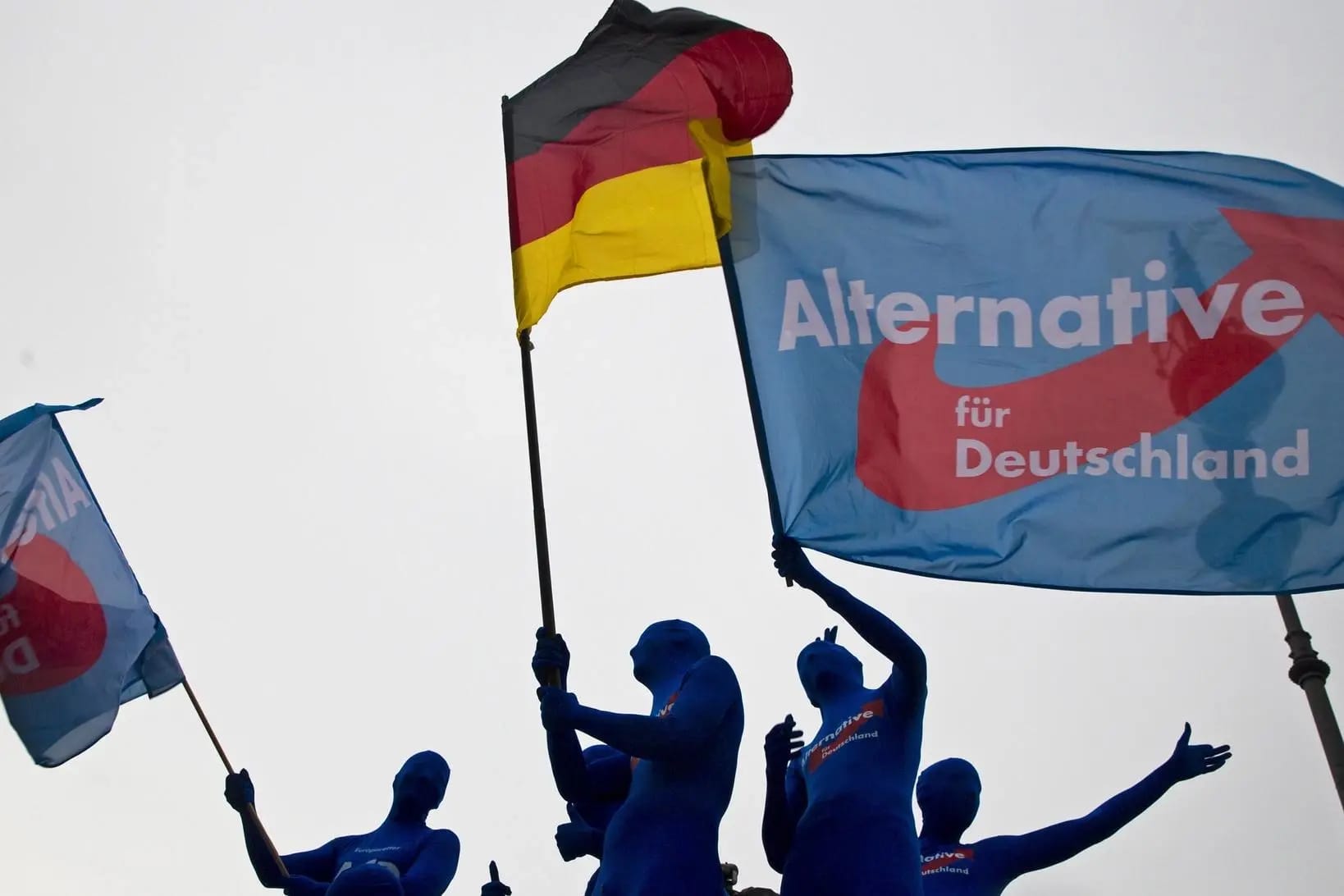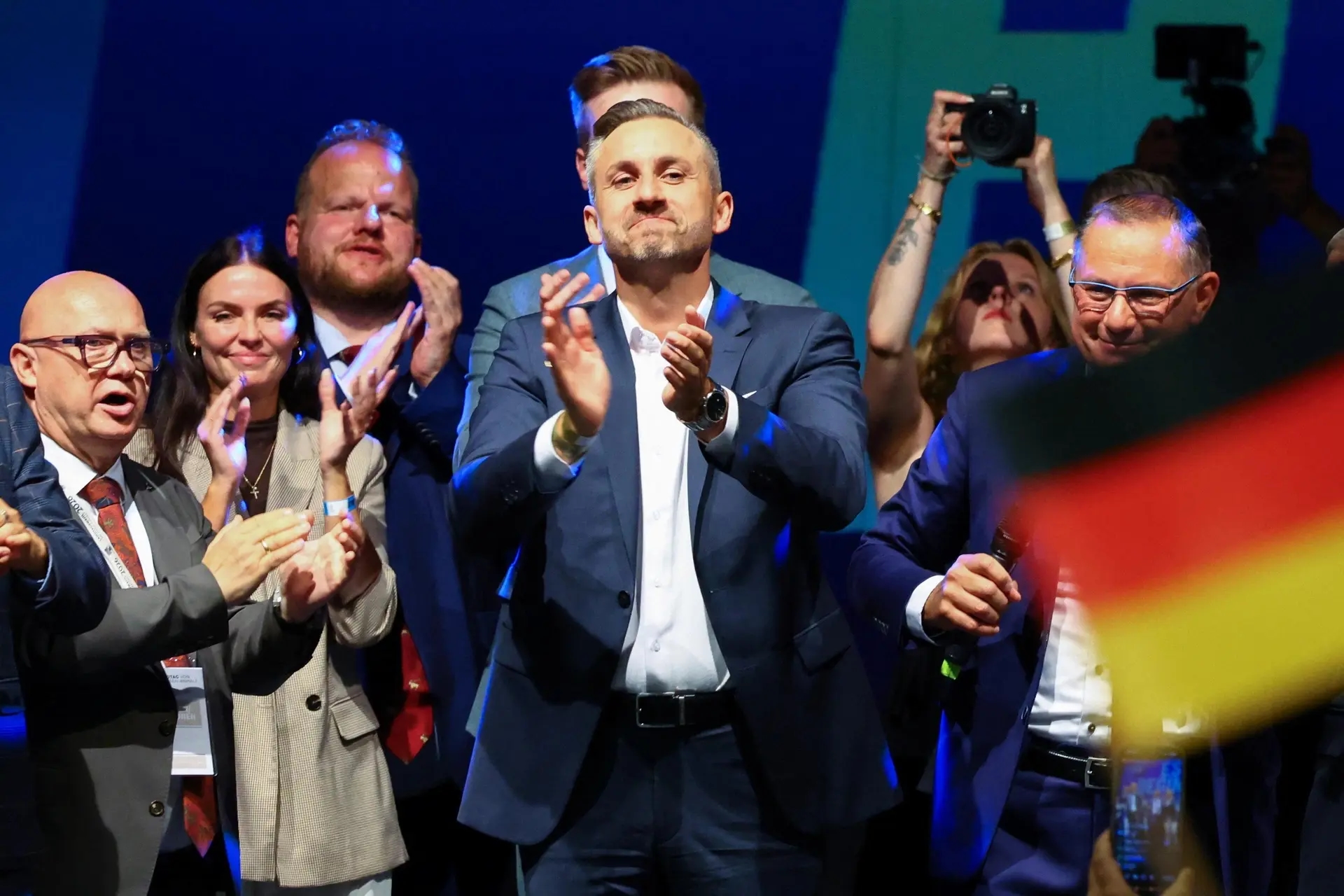
The far-right Alternative for Germany (AfD) won its first ever state-level election, taking 43.8% of the overall vote in Saxony-Anhalt on Sept. 6 — more than doubling its support from 2021, according to a report by Tagesschau. The party fell three seats short of being able to form a government on its own but still has a strong chance of taking control of the state government.
Dmitri Stratievski, chairman of the Eastern Europe Center in Berlin, told The Insider that the AfD branch in Saxony-Anhalt is one of the party’s most radical in Germany. Political analyst Alex Yusupov, director of the Russia program at the Friedrich Ebert Foundation, said the party succeeded in drawing protest voters from across the political spectrum.
According to official preliminary results, the AfD’s showing was 23 percentage points higher than its tally from the 2021 election. The Christian Democratic Union (CDU) came in second with 17.2%, down 19.9 points, while the Social Democratic Party (SPD) finished third with 9.3%, up 0.9 points. The Greens/Alliance 90 took 8.9%, up 3 points, and Die Linke (“The Left”) won 8.6%, down 2.4 points. The final party to clear the 5% threshold and enter the Landtag, or state parliament, was the Sahra Wagenknecht Alliance (BSW) with 5.3%.
Turnout was 77.8%, up from 60.3% in 2021 and the highest in the eastern state since the reunification of Germany.
The AfD will hold 39 of the Landtag’s 83 seats, while the CDU will get 15, and the SPD, Greens, and Left get eight each. BSW will have five seats.
The AfD is three seats short of a majority, while a potential coalition of the CDU, SPD, and Greens would have only 31 seats. Even with support from Die Linke, which the local CDU branch had previously refused to work with, the leading mainstream party would still be unable to form a government.
Germany’s other parties have maintained a “firewall” against the AfD, a political commitment not to cooperate with it to form a governing coalition. That leaves BSW in a pivotal position. Although it is on the left, it overlaps with the AfD on a range of issues connected to foreign policy — specifically relations with Russia and the war in Ukraine. Both parties are widely described as pro-Russian and have not ruled out cooperation with each other.
The newly elected parliament must convene no later than 30 days after the election, meaning by Oct. 6. MPs will then begin the process of electing a minister-president, the head of the state government.
A candidate needs at least 42 votes to win in the first round. If no one receives an absolute majority, a second round is held seven days later. If lawmakers again fail to elect a government leader, the Landtag must vote within 14 days on whether to dissolve itself. Such a decision also requires an absolute majority. If dissolution fails, a third round is held in which a candidate for minister-president needs only a simple majority of those voting, meaning abstentions no longer function as effective “no” votes.
In short, despite failing to achieve an absolute majority, the AfD still has a strong chance of forming a state-level government for the first time in its history. It would also mark the first time since the end of World War II that the far right has taken power in Germany — even at the regional level. As political analyst Stratievski told The Insider, the Saxony-Anhalt branch is not merely far right, but is one of the AfD’s most radical state organizations:
“The Saxony-Anhalt State Office for the Protection of the Constitution has classified the local AfD organization as ‘definitely right-wing extremist.’ AfD branches vary considerably from state to state. For a party that may appear to be a far-right monolith, internal conflicts are common. The Saxony-Anhalt branch belongs to the party’s radical wing, a far-right grouping led by Björn Höcke, the AfD leader in neighboring Thuringia. The grouping was formally dissolved by the party leadership because its level of extremism was deemed so high that, in the leadership’s view, it was damaging the AfD as a whole. Even so, representatives of that wing dominate in Saxony-Anhalt. Even by the party’s own standards, the branch there is hard-right.
At the same time, Ulrich Siegmund has put considerable effort into cultivating the image of a young, charismatic, and supposedly moderate leader. His campaign was, in many respects, smart and professionally run, if judged purely as a matter of political strategy.
If we consider the scenario in which the AfD actually comes to power, its greatest influence would be over state-level policy and education. Education, especially preschool and school education, falls under the authority of the federal states. Germany does not have rigidly prescribed curricula that every teacher must follow. But there are framework guidelines, and the AfD would undoubtedly rewrite them. In Saxony-Anhalt, one of the party’s stated goals has been to create a more positive image of German history and to educate young Germans in a spirit of patriotism and love of country. That would mean talking less about the darker chapters of history, including World War II.
The second major area is staffing. Unemployment in the state is very high, and in some districts it exceeds 10%. The state itself is a major employer, and not only of traditional civil servants. In Germany, teachers, for example, can also have civil servant status. The AfD would have the opportunity to reshape the state bureaucracy.
The third area is the police and local intelligence services, which are subordinate to the state government. The same Office for the Protection of the Constitution that classified the local AfD branch as right-wing extremist would likely face major changes.
Foreign policy, aid to Ukraine, purchases of Russian energy, and similar issues are the responsibility of the federal government. Saxony-Anhalt has only four of 69 votes in the Bundesrat — Germany’s federal legislative body representing the states — so the AfD would not have much influence over federal decisions, though its influence could not be ruled out entirely.
The larger issue is that, under Germany’s Basic Law, all federal states are required to cooperate closely. State premiers and ministers at various levels are linked through so-called conferences — standing meeting formats where information is actively exchanged and joint plans are developed. If an AfD government is formed, the party can no longer simply be ignored. That would be a serious shock to Germany’s entire political landscape.”
Political analyst Alex Yusupov, director of the Russia program at the Friedrich Ebert Foundation, told The Insider that the result in Saxony-Anhalt should not be projected onto Germany as a whole.
“The result is record-breaking and phenomenal. But an important caveat is that this is specific to this particular electoral region. The 1.9 million voters in Saxony-Anhalt account for just 3% of the German electorate. It is a very specific region — one of the most economically troubled and least populated parts of the former East Germany, with an especially long history of the AfD becoming firmly entrenched there with its radical rhetoric. On one hand, it is representative to some extent. But in terms of the drama of the victory, and how close it came to an absolute majority, this is a very specific case.
Furthermore, the AfD managed to mobilize a large number of people who had not participated in previous elections due to a lack of faith in the system or dissatisfaction with other parties. This time, they turned out, and the ‘Alternative’ managed to create a sense of momentum. There was little practical politics at their campaign events. Rather, there was a vibe of a cultural revolution — something historic, the beginning of change in Germany and Europe. That’s why a large number of people were drawn to the party — for emotional and psychological reasons rather than by carefully weighing its specific platform.
People for whom radical stances on migration, the EU, and Ukraine are of fundamental importance had long been mobilized by the party. Those who joined them — and who brought the result up to 43% — are people who were partly swept up by the energy of the moment, by the feeling that, after all, something could change fundamentally and radically. And people in general (as we can see from the fact that AfD drew in former voters from virtually all parties) are dissatisfied with the crisis situation and, first and foremost, with the leadership of other parties and the established political system. This is a very strong statement against the status quo, though not necessarily as radical in every nuance as that of the 15-20% who fully endorse the AfD’s agenda.”