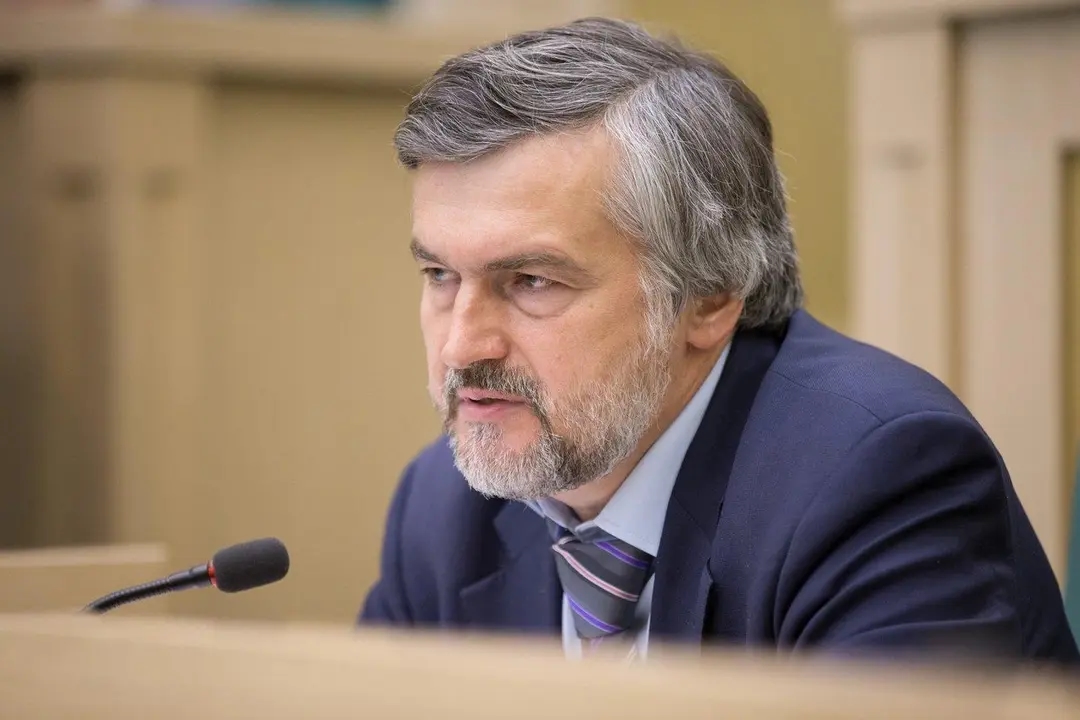
The Russian state corporation VEB.RF has fired its chief economist, Andrei Klepach, after media drew attention to a May speech in which he said Russia is losing the global economic and technological competition and that it cannot win a “war of attrition” with Ukraine, according to a report by independent outlet The Bell that cited two people who know Klepach personally.
According to The Bell, Klepach was fired Sunday, Aug. 16. One of the outlet’s sources said VEB head Igor Shuvalov made the decision “after a call from above” — a Russian expression typically meaning an order from senior officials. Another source confirmed that the dismissal was linked to the economist’s May remarks. VEB had not responded to The Bell’s request for comment by the time of publication.
Klepach worked as VEB’s chief economist for 12 years. Before that, he spent 10 years at Russia’s Economic Development Ministry. In 2004, while working under German Gref, he became head of the ministry’s macroeconomic forecasting department. From 2008 to 2014, he served as deputy minister under Elvira Nabiullina, Andrei Belousov, and Alexei Ulyukayev.
“The dismissal of Klepach, one of Russia’s best macroeconomists, is unlikely to delay the looming crisis he is talking about,” Alexandra Prokopenko, a senior fellow at the Carnegie Russia Eurasia Center in Berlin, told The Bell. “Only paid propagandists, not respected economists, can fail to see the problems in economic growth rates barely above zero, two-speed industry, declining investment, and rising unproductive defense spending.”
Prokopenko said Klepach had previously publicly defended his own assessments of the Russian economy, which were often more pessimistic than official forecasts.
“It is worth recalling his public disputes with Alexei Ulyukayev in 2011 and his departure from the Economic Development Ministry, where Klepach was responsible for macroeconomic forecasts, when Ulyukayev became minister,” Prokopenko said. “Klepach’s forecast as VEB’s chief economist was also based on assessments of reality, not on a desire to please anyone, and was often gloomier than the official figures.”
What Klepach said
Klepach delivered a report titled “Russia’s Economy and Geopolitical Challenges” on May 21 at a meeting of the Nikitsky Club, a nonprofit organization affiliated with the Moscow Exchange that holds discussions with Russian economists. The Moscow Times drew attention to his remarks.
Klepach said Russia’s economy had shown strong resilience to sanctions but that losses were gradually growing. After rapid growth in 2023 and 2024, the economy slowed sharply in 2025. In 2026, Klepach said, growth was lower than in the United States and Ukraine.
“After record growth rates in the Russian economy in 2023 and 2024, they fell in 2025 and, judging by expectations, are lower this year than growth rates in the United States and Ukraine, with which we are engaged in a military-political confrontation,” he said.
Klepach estimated that Russia’s GDP would grow by no more than 1.5% in 2027, and that growth would later lag behind the global average.
“If the special military operation continues, along with anti-Russian sanctions and fairly tight monetary policy — and, in the future, tight fiscal policy — the Russian economy is unlikely to achieve growth rates above 2% to 2.5% a year,” Klepach said.
Klepach also pointed to social problems, saying real disposable incomes rose by only 0.6% in 2026. Additionally, the decline in inequality had stopped, pensions were increasingly falling behind wages, and incomes for small- and medium-sized businesses were shrinking.
At the same time, Klepach said an immediate economic collapse is not on the horizon. He described the main threat as being Russia’s gradual fall further behind its competitors.
“Whatever we do with our economy, it will survive. In that sense, there is no critical point from an economic standpoint,” Klepach said. “The problem is rather that we are falling behind. We are losing both the technological and economic competition in the world. And we are losing it not only to China and the United States. In some ways we are losing it to Ukraine, however unpleasant that may be even for me. Ukraine’s economy, of course, has been partly destroyed, and there is a demographic catastrophe there. But Ukraine’s economy, despite everything, is surviving.”
Klepach added that Ukraine receives large-scale Western aid, without which its economy could not exist.
In the final part of his speech, Klepach said Russia could not win a prolonged war of attrition and warned of the risk of an unexpected social crisis:
“We won’t win this war of attrition. We’re under the illusion that everything over there will collapse. It hasn’t collapsed, and it won’t. Our costs are rising. According to public opinion polls, the quality of healthcare is deteriorating. In science and technology, our progress is very uneven. In some areas, we’ve achieved results and made breakthroughs, but overall, in my view, we’re falling behind the competition rather than pulling ahead. Inequality is becoming a growing problem.”
Overall, his message was one of prolonged depression, rather than of immediate collapse.
“The economy will hold up, but a social crisis may arise, and at a time when no one particularly expects it,” Klepach said. “But no one expected the February Revolution either, I would remind you. I believe Russia will not fall apart, but I am almost certain that we will arrive at a social crisis. Economically, we will not collapse, but our gap with the rest of the world will continue to widen, with all the consequences that entails.”