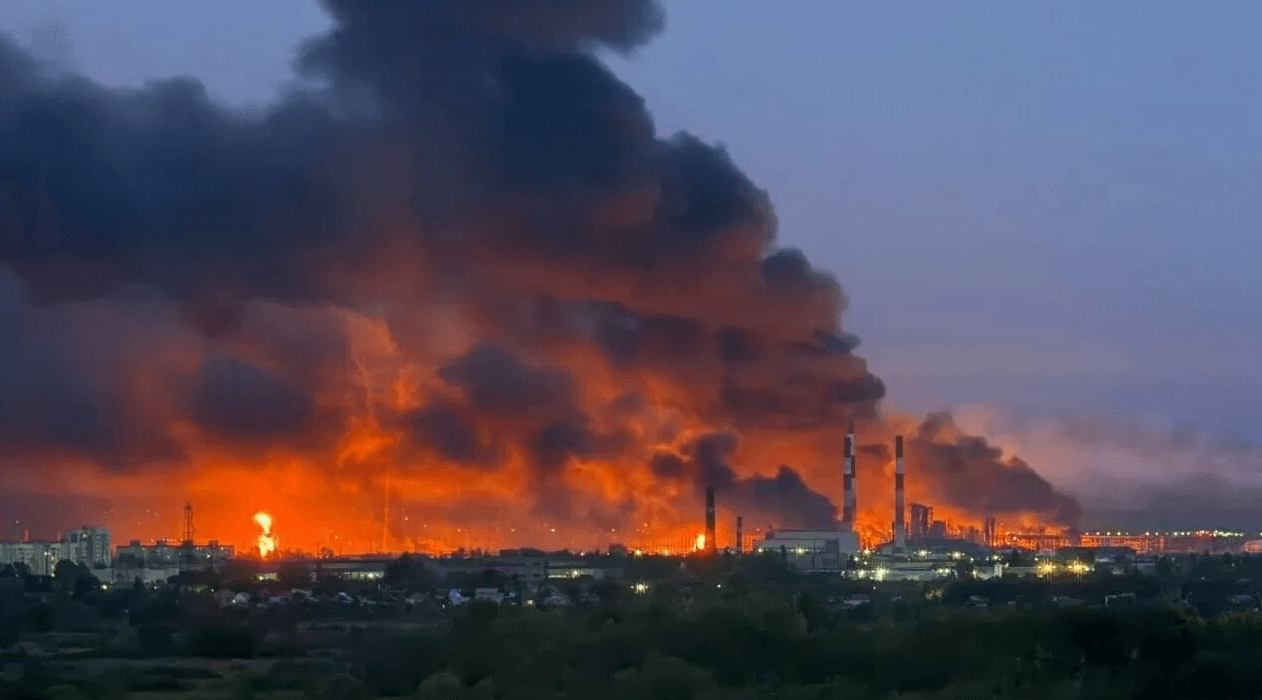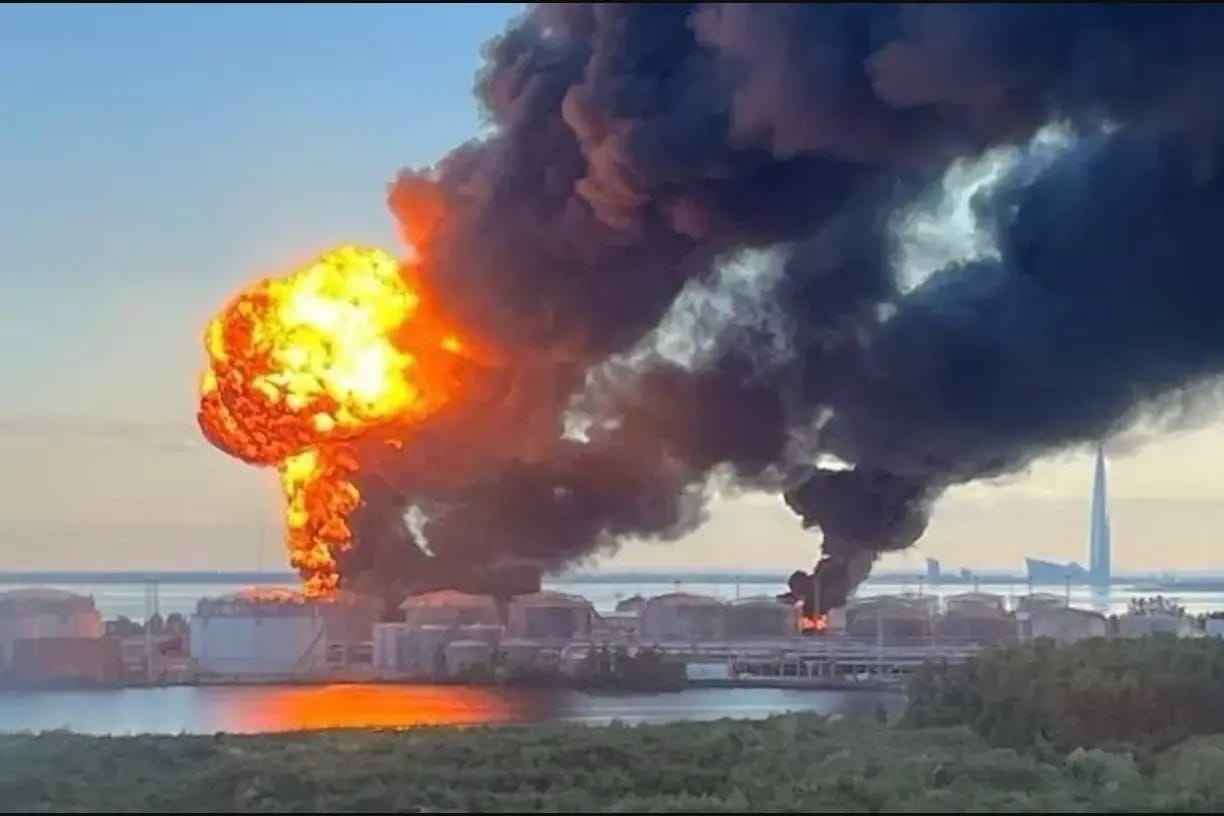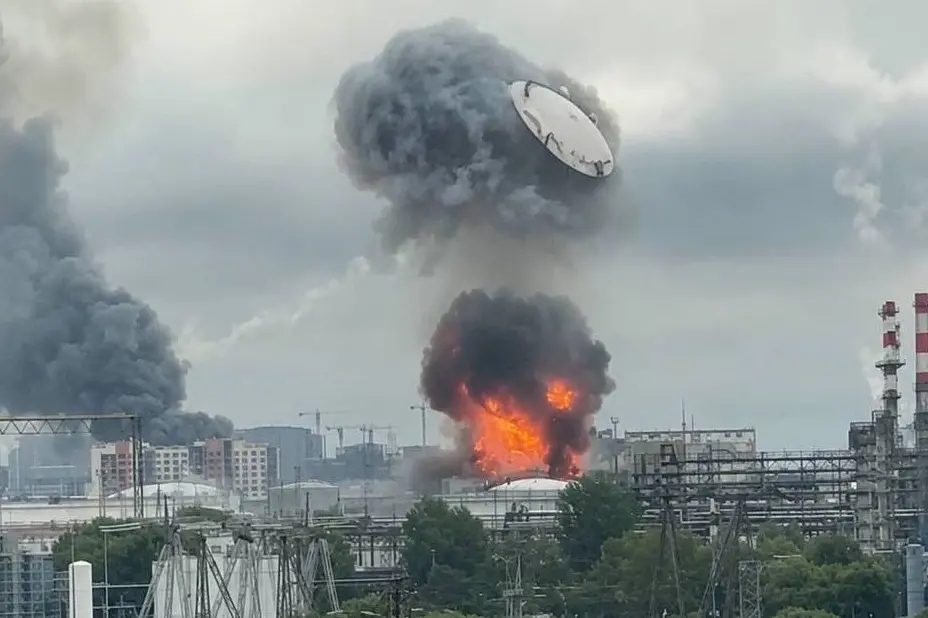
In the first 10 days of July, The Insider recorded six Ukrainian raids that caused significant damage to Russian refinery production capacity and/or tank farms — a record figure. Despite officials’ promises to protect such facilities with air defense systems, they are unlikely to be able to do so anytime soon: there are simply not enough systems, the plants are spread across too vast a territory, and even the most layered defenses can be penetrated by drones, as happened at the Moscow refinery. If the strikes continue, Russia’s fuel crisis will become structural. Prices are rising not only for gasoline but also for diesel, which could create problems both at the front and also across the entire country — negatively affecting agriculture, inflation, and even garbage collection.
In October 2025, The Insider predicted that Russian oil refining would face serious problems the following year, as a range of long-term repairs combined with sudden shocks from Ukrainian raids to gradually reduce production capacity, leading to inevitable fuel shortages. That forecast came true just eight months later. Although there are still no visible signs that Russia’s problems in the fuel and energy sector are significantly limiting the military’s capabilities, they have already led to the most serious and prolonged crisis in Russia’s rear since the start of the war. And because Russia has still not found a way to defend against such strikes, the situation will worsen.
The stages of Ukraine’s campaign against Russia’s oil refineries
Ukraine began carrying out its first strikes on Russian refineries in June 2022, but they were rare and caused little damage. In 2022-2024, Ukrainian drones carried out 31 raids on oil, gas processing, and petrochemical facilities in Russia, mostly in border regions and with limited damage to production complexes. The drones, which were not yet highly advanced, had three main limitations: they struggled to hit technologically vulnerable parts of refineries, carried relatively small warheads, and were severely limited in range.
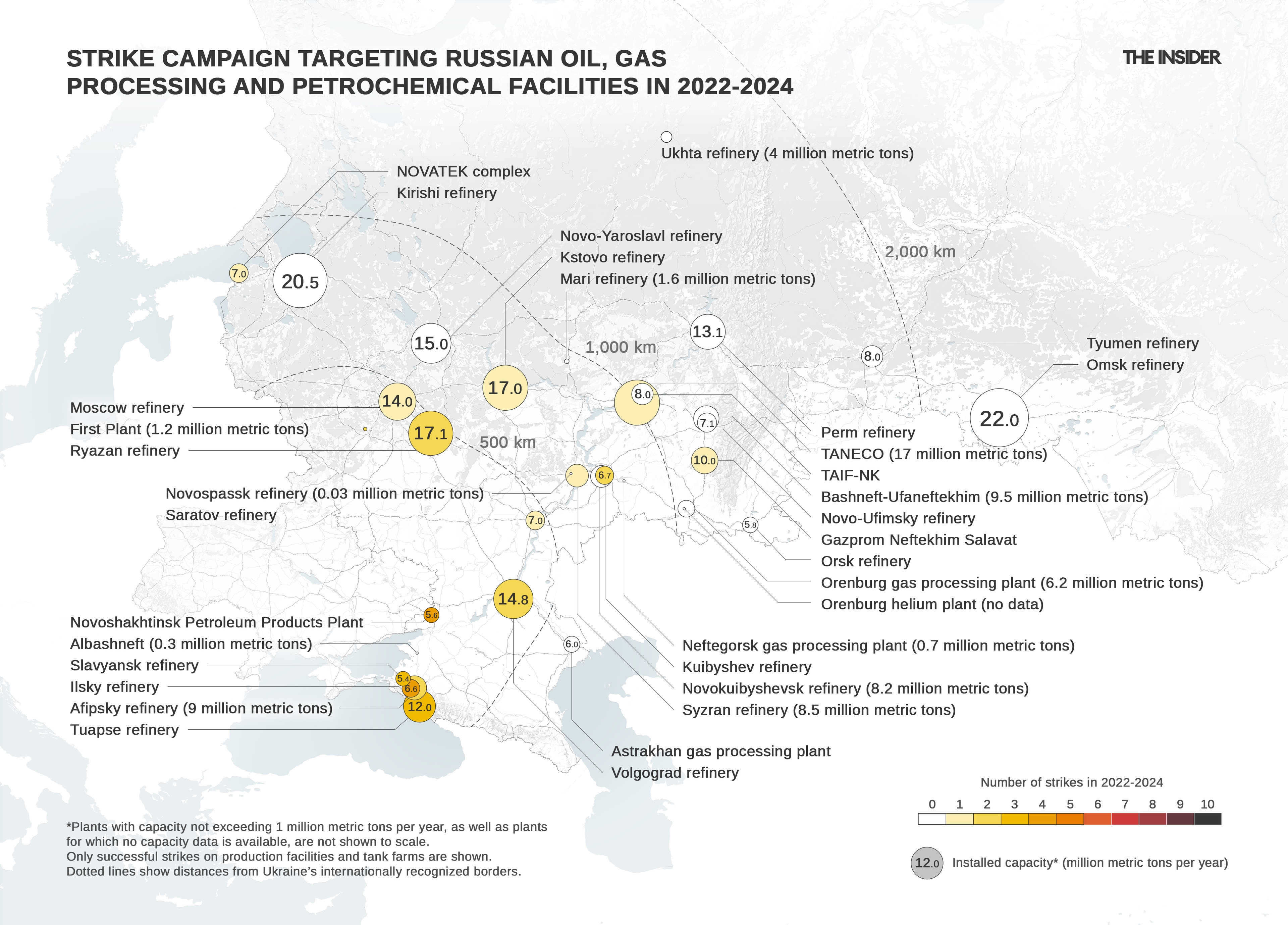
In 2025, the situation changed qualitatively. Ukraine’s Unmanned Systems Forces had finally taken shape as a separate branch of the military — and, as is now clear, a formidable one. It was one year ago that Ukraine’s strategy of deep strikes against targets in Russia’s distant rear began to work, and fuel and energy facilities were among its highest priorities. Ukrainian developers were able to significantly modernize the tactical and technical characteristics of Kyiv’s drones, making them far less visible to air defense radars and more resistant to electronic warfare. Their accuracy also improved.
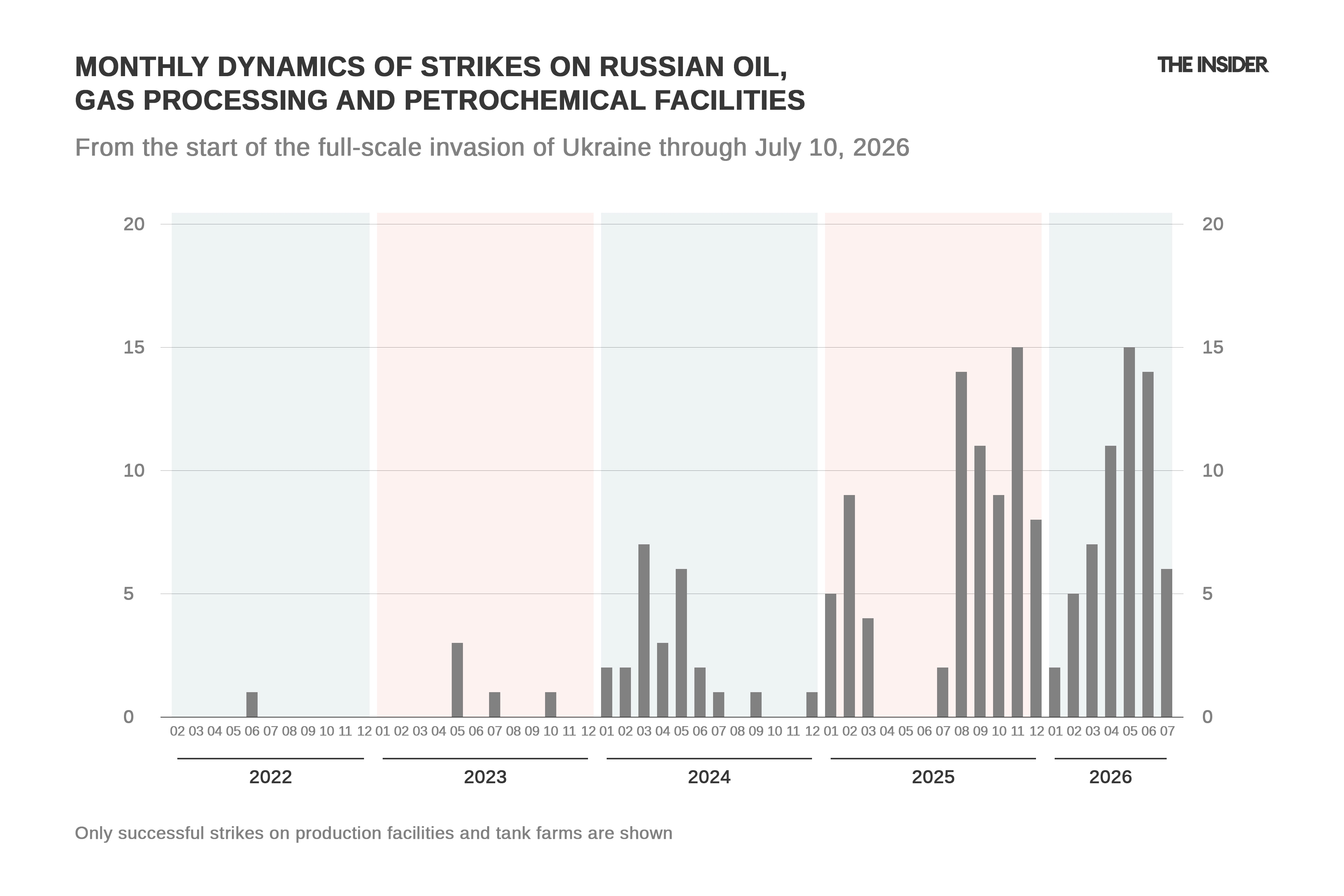
The attacks escalated. In 2025, there were 77 successful examples — and from August to October alone, there were more of them than in the previous three years combined (34 in three months, compared with 31 for all of 2022-2024). Ukrainian forces began operations against some enterprises on an almost weekly basis while continuing to focus on specific geographic clusters: the Ryazan refinery, along with those in Volgograd, Saratov, Syzran, Novokuibyshevsk, and Kuibyshev.
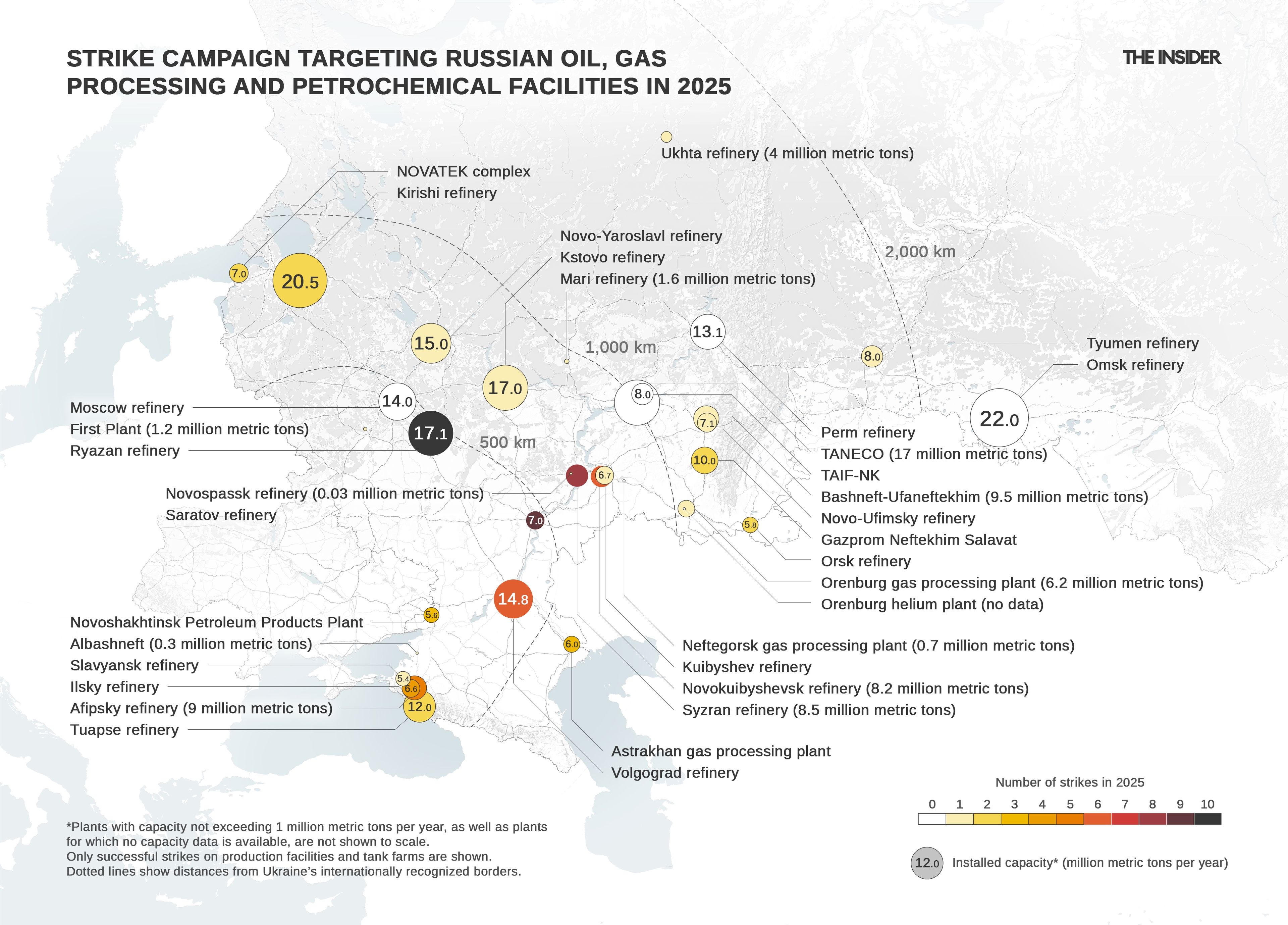
In 2026, Ukraine’s military managed not only to scale up its campaign against Russian oil refining across all of European Russia, but also to expand the strike zone to Siberia. Since April, it has maintained a steady level of more than 10 successful attacks per month on refinery production capacity and tank farms. The campaign affects not only oil and gas processing, but also petrochemical plants, oil and gas transport infrastructure, storage, distribution and export facilities for raw materials and finished products, and even extraction assets, including drilling rigs on the Caspian Sea shelf.
In July 2026 alone, five major oil refining facilities halted operations after Ukrainian attacks. The turning point was the attack on the Omsk refinery, Russia’s largest, located about 2,500 kilometers from the combat zone. After the strike on the plant in Omsk, Ukrainian President Volodymyr Zelensky said, with good reason, that the very concept of “strategic depth” as one of the Kremlin’s key advantages in the war no longer fully reflects reality, as almost all Russian refineries are now within range of Ukrainian long-range weapons. So far, however, there have been no examples of strikes on the most remote refineries in the Irkutsk Region or Khabarovsk Krai.
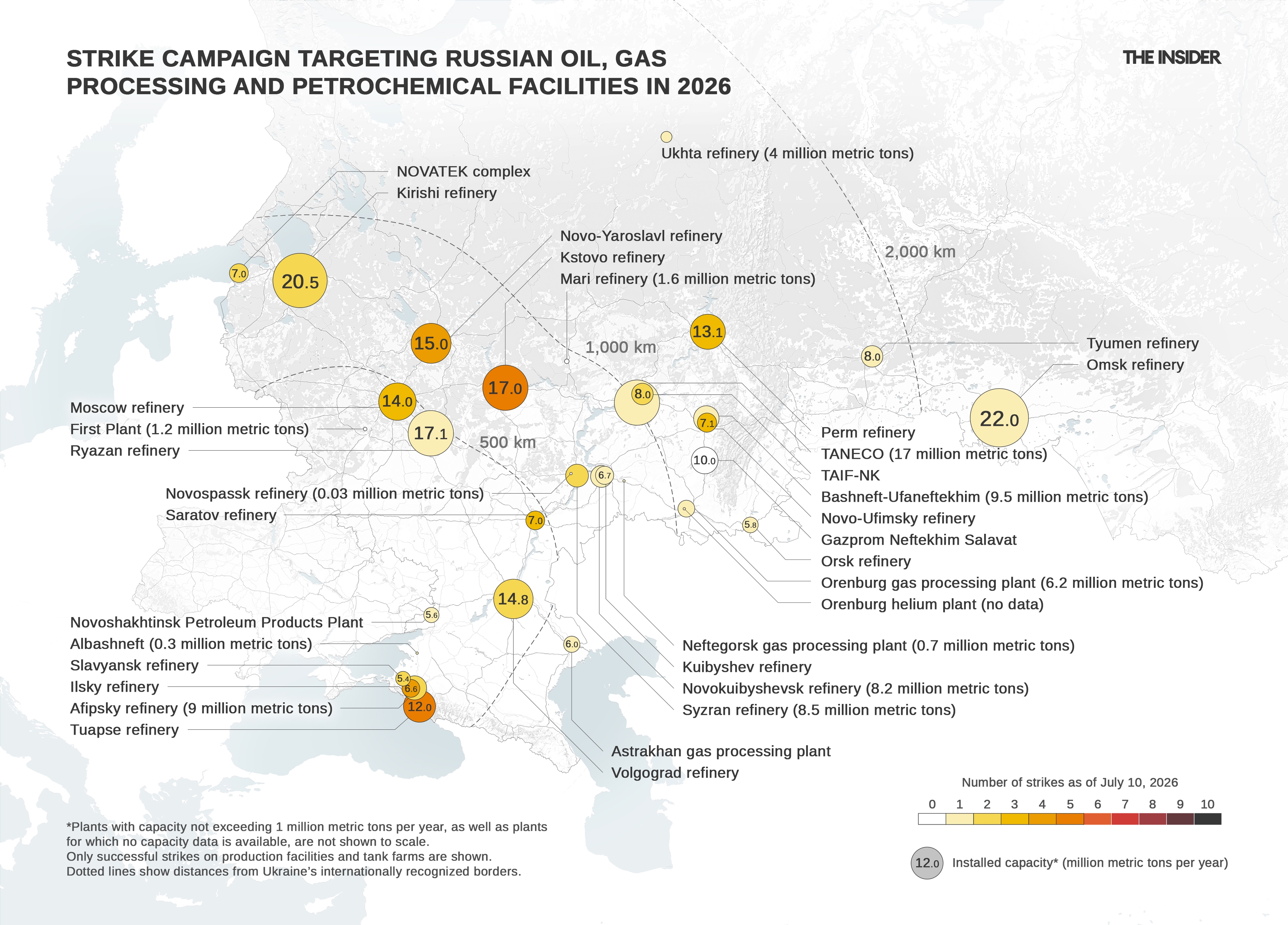
From January to July 2026, more than 50 raids on refineries were recorded, including six attacks in the first 10 days of July alone. Until now, Ukraine had not managed to carry out more than 15 such attacks in a month, a level reached in November 2025 and May 2026.
According to some sources, the Moscow refinery, attacked in mid-June, will not be able to restore production until 2027, though some oil and gas industry experts have predicted a shorter timeline. Under sanctions, already difficult and expensive repairs are further complicated by the need to source components and equipment from abroad.
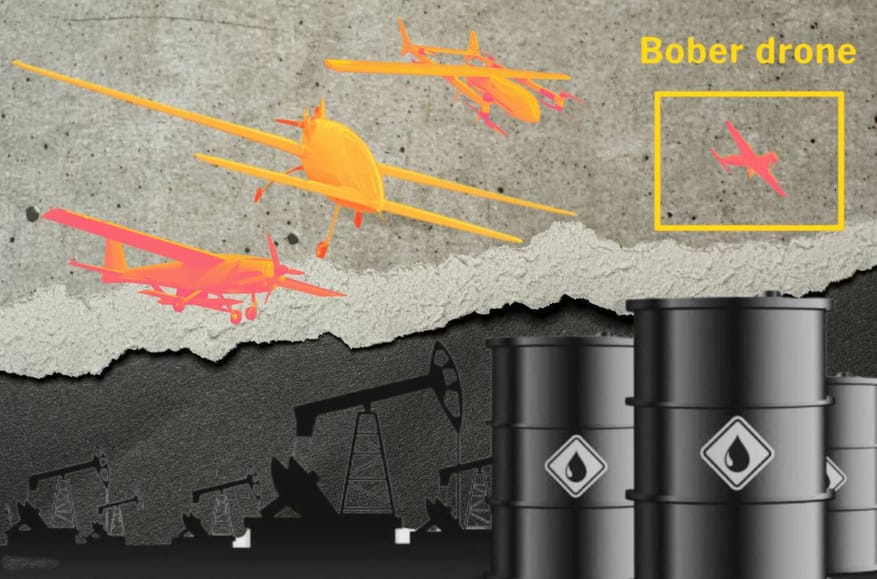
Meanwhile, Ukraine’s defense industry is building increasingly long-range drones. The FP-1 model that reached the Omsk refinery carried a 60-kilogram warhead and had built-in control modules with elements of artificial intelligence.
No countermeasure
As of mid-2026, all of Russia’s largest refineries other than those in Eastern Siberia are within range of Ukrainian strike systems and have experienced at least one successful attack on production capacity and/or tank farms. Some of these facilities have already been hit in more than 10 recorded raids, which appears to be creating a cumulative damage effect that has lengthened repair times.
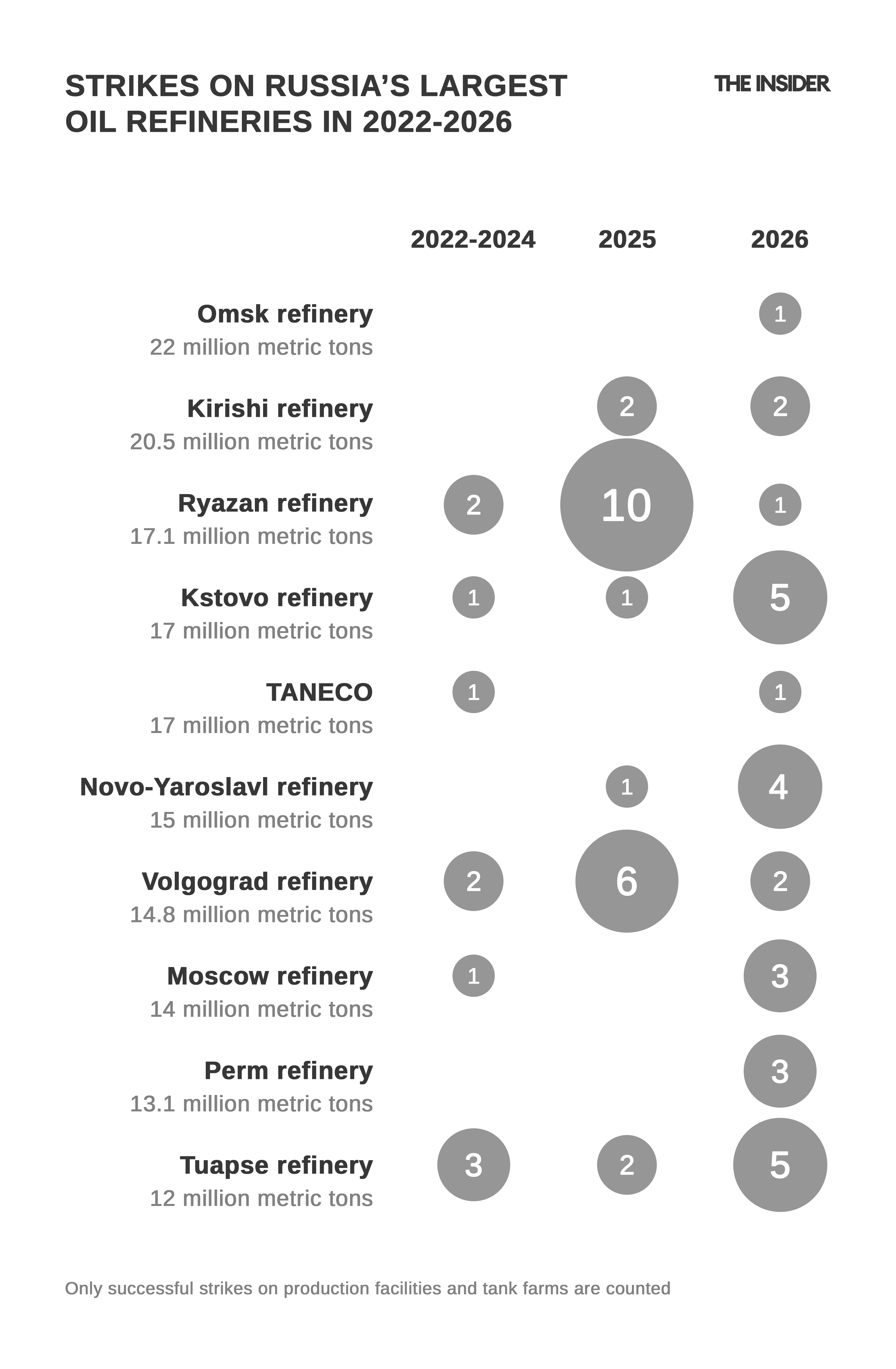
Although there is still no confirmation that the campaign against oil refining capacity is directly limiting the Russian armed forces’ battlefield capabilities, its importance to the broader course of the conflict is significant. For the first time since the start of the war, Russians across the country are facing costs that directly affect their daily lives.
The shock of the fuel crisis is not only feeding into public attitudes, but also undermining socioeconomic stability, generally raising the “price” the Kremlin pays to continue the war. Notably, the Trump administration considers strikes on oil refineries an “escalation” of the sort that could ultimately lead to peace.
Even more notable is that no clear solution to Ukrainian raids appears to be in sight. Vladimir Putin has so far put forward only two more or less concrete proposals: increasing air defense coverage for fuel and energy facilities, and developing a network of mini-refineries.
In a conversation with propagandist Pavel Zarubin published June 28, Putin said:
“The first task is to quickly and substantially increase production of the most in-demand air defense systems. To constantly improve them in line with the needs of conducting combat operations and protecting the relevant facilities, taking into account what the enemy is using — the issue is the speed of increasing their production and delivery to the troops, or for protecting critical infrastructure facilities... We need to come out of repairs faster, we need to arrange the necessary volume of imports and, as I have already said, reliably protect these facilities.”
The problem with this proposal is that air defense production cannot be increased quickly, given demand for other military products. More importantly, it is impossible to reliably protect dozens of large industrial complexes in different parts of the country with air defense systems. Even the Moscow refinery, located behind several rings of air defense, was hit during a massive aerial attack. Russia will not have the resources to create similar rings around other facilities in the foreseeable future.
It is impossible to reliably protect dozens of large industrial complexes in different parts of the country with air defense systems
Putin later backed the idea of developing mini-refineries, saying that “the wider the network, the harder it is to damage it.” That proposal looks even stranger given the fact that nothing prevents Ukrainian drones from attacking smaller facilities; in addition, developing a network with any meaningful refining capacity would cost hundreds of billions of rubles and require years of construction, regulatory approvals, and the creation of logistics and sales networks.
In the same conversation with Zarubin, Putin spoke about a rejected proposal for both sides to refrain from attacking targets deep in the rear, saying that “retaliatory strikes deep into Ukrainian territory are much more powerful, painful, and, frankly speaking, destructive, leading to truly serious consequences for the Kyiv regime.” He was unable to explain what those consequences were.
Consequences of the fuel crisis
Strikes on oil refineries have led to a gasoline shortage. By July, The Insider had recorded fuel disruptions, shortages or restrictions at gas stations in 88 of the 89 regions controlled by Russian authorities. Officials initially blamed logistical problems, but later even they acknowledged that there was less fuel than needed.
In June, Russia’s average daily oil refining fell by between 25% and 28%, according to estimates by Reuters analysts and Sergei Vakulenko, a senior fellow at the Berlin-based Carnegie Russia Eurasia Center — from 5.3 million barrels per day to 3.9 million barrels per day. Estimates are necessary due to the fact that Rosstat, Russia’s state statistics agency, has not published precise data on petroleum product output since 2024.
Those estimates are indirectly supported by other data. From June 16 to 22, retail gasoline prices rose by a record 3%, the largest increase since 2010. In July, both gasoline and diesel continued to rise in price — indirectly confirming that there is indeed a shortage, despite Kremlin spokesman Dmitry Peskov’s efforts to claim otherwise. Peskov called the situation a “buckwheat effect,” a Russian phrase referring to panic buying and a one-time price spike driven by media-fueled alarm rather than by a sudden drop in supply.
Retail gasoline prices rose by a record 3% from June 16 to 22, the largest increase since 2010
Industrial statistics also confirm the drop in refining. The separate line for gasoline has been removed from reports, but Rosstat continues to publish data on the production of “coke and petroleum products.” In May, that output fell 13% year-on-year.
Gasoline usually accounts for about 16% to 18% of total refining, Vakulenko noted. But according to the latest estimates, Russia is producing about 840,000 barrels of gasoline per day, only 15% less than in the first half of June 2025, when total refining stood at 5.3 million barrels per day.
By comparison, during the previous fuel crisis — in September 2025 amid a less destructive wave of Ukrainian strikes — gasoline production fell by only 6%, roughly in line with the seasonal increase in demand.
That means refining has now fallen more sharply than gasoline production. How can the shift in proportions be explained? “This suggests they have started using naphtha,” Vakulenko said. Only about 60% of the gasoline fraction previously went into gasoline production, while 40% remained straight-run gasoline, or naphtha. Before sanctions, naphtha was exported to Europe, which was more profitable than selling deeply refined gasoline. Now naphtha is the most obvious resource for increasing gasoline supply. Refineries whose operations have not been disrupted can significantly increase gasoline output by adding additives to naphtha.
Diesel is rising in price at roughly the same pace as gasoline, even though there should be no diesel shortage. Russia produces almost twice as much diesel as it consumes domestically, especially in summer (though the story of winter diesel is more complicated). The rest is typically exported. But now diesel exports have been banned since July 9, gasoline exports have been banned since April, and jet fuel exports since June. Even so, diesel supply disruptions were recorded in June in the Voronezh, Saratov, Omsk, Irkutsk, and Vladimir regions, as well as in parts of the North Caucasus. The problem appears to be logistics rather than production: fuel is physically not reaching the places where it is needed in time.
Who in Russia needs gasoline?
The crisis has hit not only motorists but also businesses that need industrial volumes of fuel and buy it from oil depots or by full tanker trucks of 20,000 to 30,000 liters. There, prices are rising by far more than a ruble a week. For many, again, the problem is not gasoline but diesel.
“On Friday, colleagues in the forestry sector were quoted 140 rubles per liter of diesel at an oil depot in the Leningrad Region. They suspended operations,” one participant said.
Rosstat’s official diesel price in the Leningrad Region is 83 rubles per liter.
The crisis has hit not only motorists but also businesses that need industrial volumes of fuel
In the Moscow Region and neighboring areas, market participants say prices have reached 200 rubles in the forestry sector, which uses about three liters of diesel to cut one cubic meter of timber.
It is not only about money. The Russian authorities have created some of the problems for businesses themselves by banning gas stations from filling large canisters with gasoline, allowing fuel only to be pumped into vehicle tanks. The ban did not stop gasoline resellers, as they drain gasoline into personal canisters, then return to fill up again. Online marketplaces, acting on a recommendation from the Federal Antimonopoly Service, are already blocking ads for fuel sales, meaning a gray market has already developed to the point that it was visible to regulators.
But tracked special equipment usually cannot drive to gas stations, making refueling by canister essential. Now owners are forced either to drain gasoline from private vehicles or increase the load on paved roads.
Limits of no more than 20 liters per purchase have affected taxi drivers, freight carriers, and garbage trucks. Taxi fleets are reporting driver losses of 5% to 20% because going out to work becomes unprofitable when drivers spend several hours a day waiting in line at gas stations instead of taking fares.
In the Vladimir Region, garbage trucks with 200-liter tanks are forced to sit in lines to fill up to the permitted 20 liters. Even Khartiya, the company responsible for waste collection in the region, has been unable to persuade local authorities to raise the limit — this despite the fact that the firm is owned by Igor Chaika, the younger son of Russia’s former prosecutor general.
The result is missed collection schedules. Nevertheless, regional governor Alexander Avdeyev said “nothing extraordinary is happening” and that the situation is “under control,” a description that does not match reports of problems on the ground.
Freight carriers have faced a double hit. Fuel companies cut discounts on fuel cards at the same time as prices rose. Some carriers are already reducing the geographic scope of their operations, refusing long-haul routes.
One group not facing gasoline problems is electric vehicle owners. For them, charging outside major cities and along highways is simply difficult on a regular basis.
“Against the backdrop of gasoline problems, sales of new electric vehicles have not grown. Dealers have almost none,” wrote Sergei Tselikov, co-founder and director of the Autostat agency. “In June, only 748 new passenger electric vehicles were registered in Russia. That is 22% less than in June of last year. In six months, 4,606 electric vehicles were sold, equal to 0.8% of the market. Despite increased demand, this year’s leading model, the Evolute I-Joy, is almost unavailable for sale. Since the start of the year, 1,350 have been sold, but in June, only 27.”
How is the Kremlin responding?
The government is stimulating gasoline production at small private units and oil depots using additives. It is also encouraging fuel imports. To do this, it expanded special subsidies under the so-called damper mechanism, meaning both importers and private producers will now be able to receive compensation from the budget.
Russian authorities also legalized a reduction in the environmental class of fuel, and some plants may produce Euro 3 gasoline until the end of the year. In the future, the class may be lowered further, possibly to Euro 2.
Trying to solve the shortage through imports carries its own risks. Fuel brought from far abroad, such as India, will be more expensive than Russian fuel. Some experts also cite long delivery times as a disadvantage, though with stable supplies this should not be a problem. But overseas fuel depends on a bottleneck even narrower than Russian refineries: Russian ports. If Ukraine’s armed forces wanted to leave Russia without a drop of gasoline, disrupting that logistical element would not be difficult. That is why imports are an unreliable solution.
If Ukraine’s armed forces wanted to leave Russia without a drop of gasoline, disrupting logistics would not be difficult
Belarus has already increased gasoline and diesel shipments to Russia by orders of magnitude, and talks have been underway on supplies from Kazakhstan, but such sources are not enough to fully cover the shortage.
Imports are also already happening without high-level agreements, through ordinary motorists. Chats in Chita and Zabaykalsk contain numerous offers to refuel cars in Manzhouli, China. Local entrepreneurs offer to drive a car into China, fill it at the nearest gas station, and return it.
What happens if the strikes do not stop
There is currently no reason to believe that Ukrainian strikes on Russian refineries will stop. If Russia’s military does not find a way to counter them, some plants will constantly be under repair, and the fuel crisis will only deepen. Refining will settle below prewar levels, and the shortage will shift from temporary to structural. In that case, a larger share of fuel than now will be distributed by government order.
The army would be the obvious priority. As The Insider has reported, it needs 2 million to 4 million metric tons of gasoline, diesel, and jet fuel a year. That amounts to 2% to 5% of domestic consumption of all three types of fuel. Separately, S&P has estimated that the Russian army in Ukraine consumes 6% of Russia’s total diesel output.
Next would come agriculture, public utilities, municipal public transport, and special transport such as ambulances and cash-in-transit vehicles. It is easy to assume that fuel supplies would also be arranged for delivery of a basic minimum of food. Everyone else, above all private businesses, would have to look for solutions on their own — abroad, by optimizing logistics, or by switching to other energy sources.