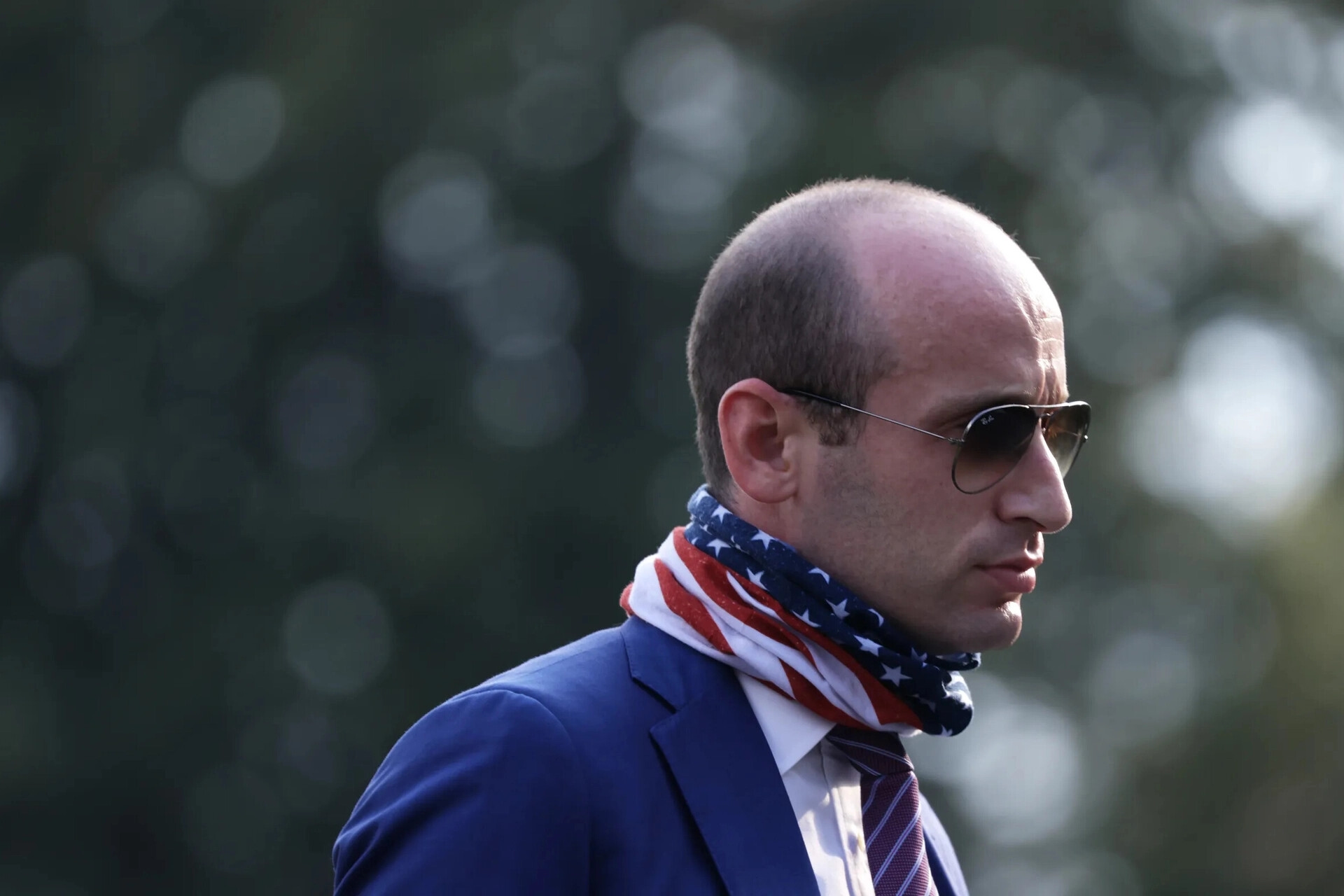
U.S. President Donald Trump has appointed trusted ally Stephen Miller to serve as White House chief of staff. Miller has been a key advocate of several controversial Trump initiatives, most prominently the policy of separating migrant children from their parents and of carrying out mass deportations. Although nearly half Trump's age, Miller has had an enormous influence on his development as a politician and was one of the key figures accompanying his rise to power. He is now set to take on even greater duties at a time when Trump faces a newly constituted U.S. Congress that is deeply hostile to him.
“He acted as if he wanted people to hate him,” recalled Stephen Miller's former classmate Justin Brownstone, telling journalists how the future Trump loyalist was remembered by those who knew him in high school.
Sadist or Reactionary?
Brownstone and many others who went to school with Miller in Santa Monica, California, describe him as a conservative and reactionary whose rhetoric not merely borderline racist, but often openly so.
Miller was born in 1985 and graduated from high school in 2003. Given Santa Monica High School's liberal image and Miller's own background (he was born into a prosperous Jewish family), his anti-immigrant rhetoric often seemed downright outrageous.
Miller was probably drawn into the Republican Party's right-wing camp by his classmate and closest high school friend, Christopher Moritz. Today, Moritz is known as an opponent of transgender rights and as the author of books portraying liberalism as the path to America's destruction. He served as a senior adviser at the U.S. Department of Commerce during Trump's first presidency.
Miller's parents also held reactionary views, but accounts differ as to how they came to support the Republicans. Some say Stephen's father had always leaned conservative, while others say his parents changed their political views under their son's influence. What is certain is that the elder Millers attended the 2016 Republican National Convention, where Donald Trump was nominated as the party's candidate for president. Their son was already working on the campaign.
In the relatively short time between his high school graduation and that fateful convention, Miller had already made his mark. He first attracted widespread attention while studying at Duke University, where he was among the first to defend members of the university's lacrosse team who had been accused of raping a Black female student.
Miller argued that the wealthy white athletes had been the victims of a “witch hunt” orchestrated by Democrats seeking political gain by portraying themselves as defenders of minorities, and his resulting television appearances brought him to the attention of Republican Party officials. He also acquired a reputation as a lucky charm: the rape case collapsed before reaching trial, and all charges were dropped.
It was hardly surprising, then, that after graduating, Miller joined the staff of Republican Congresswoman Michele Bachmann. He later worked for Alabama Senator Jeff Sessions, first as press secretary, then as communications director, and eventually as a senior adviser.
Sessions relied on on hard-line anti-immigration rhetoric, and he was close to political strategist and conspiracy theorist Steve Bannon. The Senator introduced his young aide to Bannon, who was then developing a new ideology aimed at uniting American conservatives, whose political standing had been badly weakened by the election (and re-election) of Barack Obama.
Bannon and Miller began working together in 2013, quickly agreeing that the Republicans should focus not on winning new voters but on mobilizing their existing base. They concluded that fear would be the most effective mobilizing force, with uncontrolled immigration serving as the ideal bogeyman.
This became the basis of a new Republican strategy: portraying Democrats as intent on flooding the United States with undocumented immigrants who would take Americans' jobs and government benefits. The strategy was in place even before the party found a candidate capable of serving as the face of the campaign.
The Republican Party's new strategy rested on the claim that Democrats wanted to flood the United States with undocumented immigrants
That candidate emerged in 2015 in the form of Donald Trump. Sessions personally asked Miller to join Trump's campaign, believing the young adviser could strengthen the team. Miller wrote speeches, crafted messaging, and spoke at campaign rallies, where he laid out Trump's planned immigration policy. After Trump's victory in 2016, he appointed Miller as a political adviser, and when he returned to the White House in 2025, Miller was named as deputy chief of staff and homeland security adviser.
The title translated into concrete policy. During Trump's first term, Miller helped devise the family separation policy under which adults who crossed the border without authorization were jailed, while their children were taken to separate facilities. Internal correspondence published by the watchdog group American Oversight shows that Miller discussed the policy with senior Justice Department officials and coordinated with the agency responsible for the children's custody.
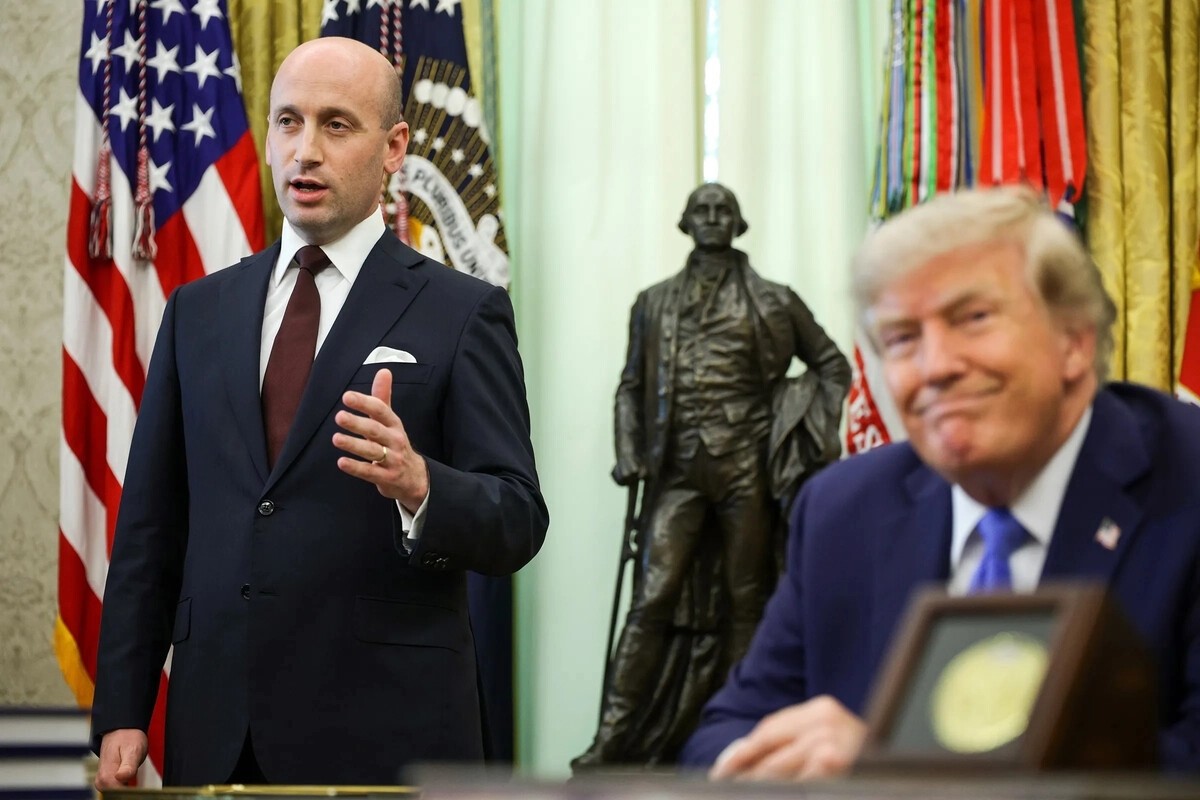
After returning to the White House in 2025, Miller demanded a sharp increase in migrant arrests. In late May of that year, he set a target for Immigration and Customs Enforcement (ICE) of at least 3,000 arrests a day. According to Reuters, he urged agents to detain anyone without legal status. To meet the target, raids spread well beyond border areas, with federal agents showing up at restaurants and workplaces and making arrests outside courthouses. Those targeted included people who had lived in the United States for decades and had no criminal records.
Students not welcome here
Another focus of Miller's work was education. According to CNN, he was one of the architects of the administration's pressure campaign against universities, ostensibly aimed at combating antisemitism. University representatives held private talks with May Mailman, a member of Miller's team, seeking to find out what concessions they would have to make to avoid losing federal funding.
The scale of the pressure is most evident from the case involving Harvard. In the spring of 2025, the administration demanded changes to the university's admissions and faculty hiring policies, the closure of its diversity and inclusion programs, and an external audit of “viewpoint diversity” on campus. Harvard refused, and the authorities in Washington responded by freezing $2.2 billion in grants and $60 million in contracts. In May, the Department of Homeland Security tried to strip the university of its right to enroll international students, but a court blocked the move.
Columbia University, by contrast, reached a deal with the White House. After its federal funding was suspended, it agreed to tighten disciplinary rules and change oversight of its Middle East studies programs.
In July 2025, Columbia agreed to pay the federal government $200 million over three years to settle investigations into alleged discrimination. In return, the authorities agreed to restore most of its grants. The agreement also stipulated, however, that the government could not dictate admissions or hiring policies or influence the content of academic speech.
Miller is now poised for another promotion — the biggest of his career. Following the Republicans' defeat in the midterm elections, his boss, Susie Wiles, lost her position (officially, Trump merely reassigned her to another post on his team). Miller has taken her place. White House insiders see the change as entirely predictable, describing Miller as a “wartime” adviser — an apt description given the challenges the Republican Party faces after its crushing defeat in the midterms.
White House insiders describe Miller as a “wartime” adviser
Officially, the White House chief of staff is an administrative rather than a political position. The job carries no authority to shape legislation, interfere with government agencies, or submit documents to Congress. Yet the chief of staff controls access to the president, decides which messages and news briefings reach his desk, and is often the last person America's commander-in-chief consults before making a decision.
In effect, Stephen Miller is becoming one of the most powerful figures in American politics, giving him who will a key hand in shaping the president's worldview. It is not hard to guess what that worldview will look like. A 2020 biography of Miller was aptly titled Hatemonger.