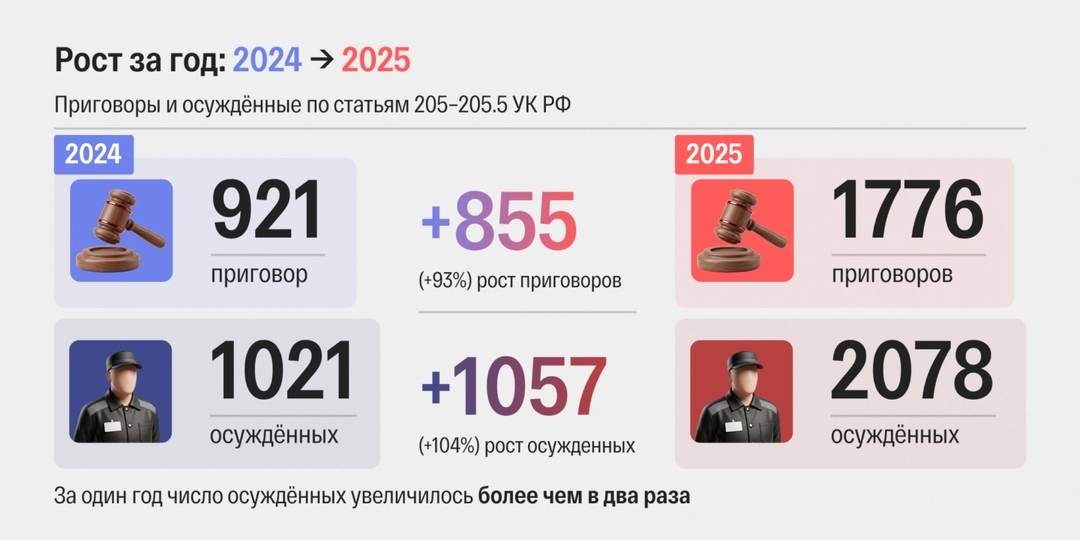
Russian courts handed down at least 1,776 verdicts on terrorism-related charges last year against 2,078 defendants, according to figures compiled by the Russian rights project Pervy Otdel (lit. “Department One”) and analysts from Parubets Analytics. The number of terrorism convictions more than doubled from 2024, when 1,021 defendants were found guilty.
The Judicial Department at Russia’s Supreme Court has not published official statistics for 2025; however, the researchers were able to gather the data independently from open sources.
Nearly half of those convicted — 889 people — were charged under Article 205.2, which criminalizes public calls for terrorism, justification of terrorism, or the spreading of terrorist propaganda. In 588 cases, Article 205.2 was the only charge, meaning defendants were being prosecuted solely over posts, comments, or other statements.
Rights researchers found signs of political persecution in the cases of at least 929 people, or 45% of the total. The report’s authors said that figure should be interpreted as the minimum number of politically motivated prosecutions, as hearings are often held behind closed doors and information about defendants is hidden. The names of 1,383 of the 2,078 people convicted do not appear in official databases.
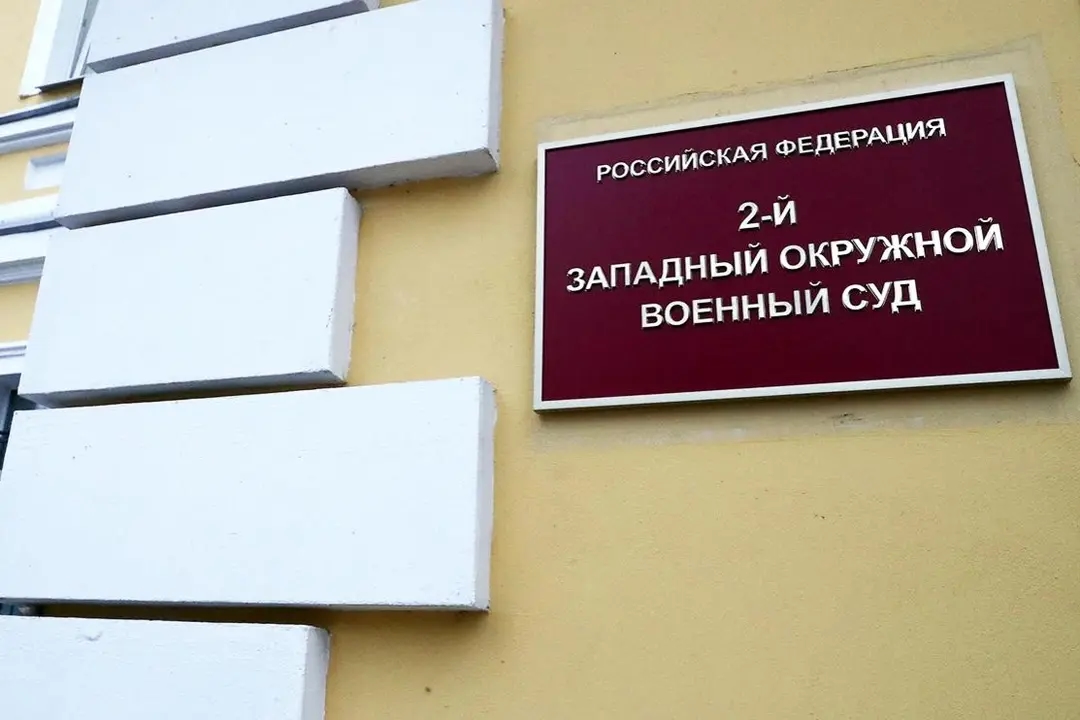
At least 630 of those sentenced were Ukrainian citizens, about 30% of the total. They included Ukrainian prisoners of war, residents of occupied territories, and civilians. The 2nd Western District Military Court alone sentenced at least 357 Ukrainian service members who had taken part in fighting in Russia’s Kursk region.
Most of the cases were concentrated in a few specific military courts. The 2nd Western District Military Court and the Southern District Military Court accounted for 1,079 verdicts, more than 60% of the total. Adding in cases from the Central District Military Court accounts for nearly three-quarters of all rulings on terrorism-related charges.
Specific sentences were established for 809 people. Fifteen defendants received life sentences, including eight people charged in the case over the October 2022 explosion on the Kerch Bridge. The median prison sentence was 15 years. Of the 794 people whose prison terms are known, 467 received sentences ranging from 15 years in a penal colony to life imprisonment.
Pervy Otdel head Dmitry Zair-Bek linked the rise in cases to the state’s use of software to search for comments on social media and track financial donations, as well as to the creation of fake websites and the use of bots and chats for the purpose of entrapment. He said terrorism cases are launched both over actual violent crimes and over anti-war statements or minor acts of sabotage.
Zair-Bek said he expects the repressive practices to keep expanding. Because district military courts are overloaded, he said, authorities may transfer some cases to regional courts, which would allow the number of trials to increase significantly.