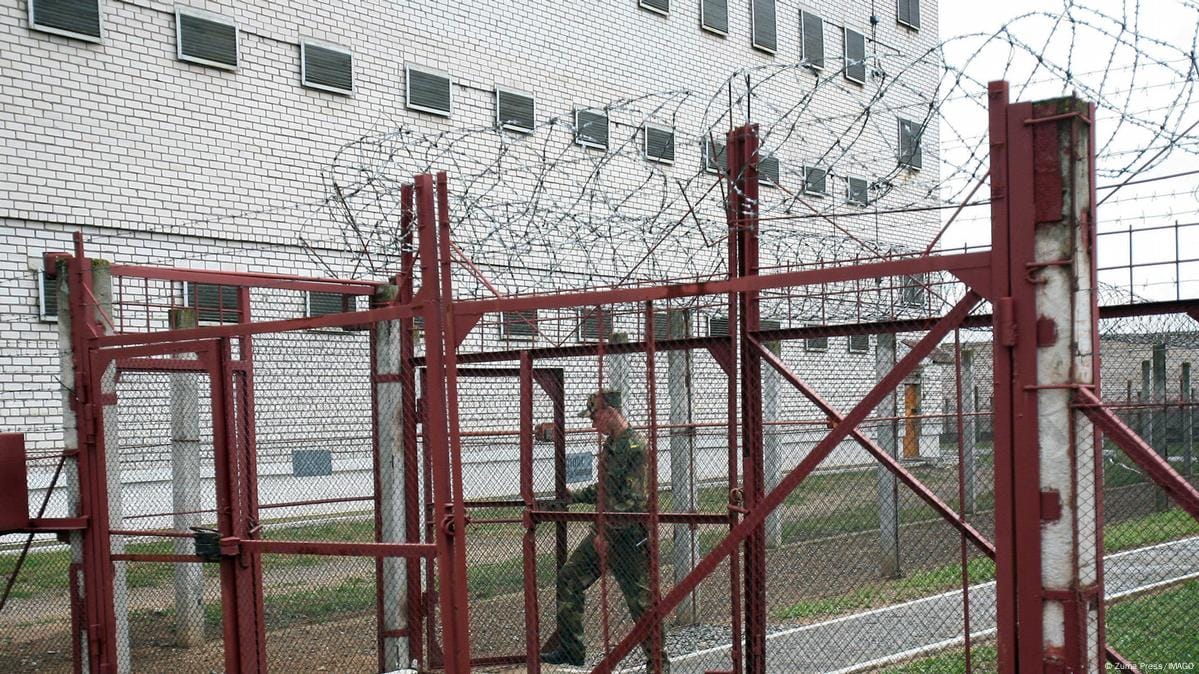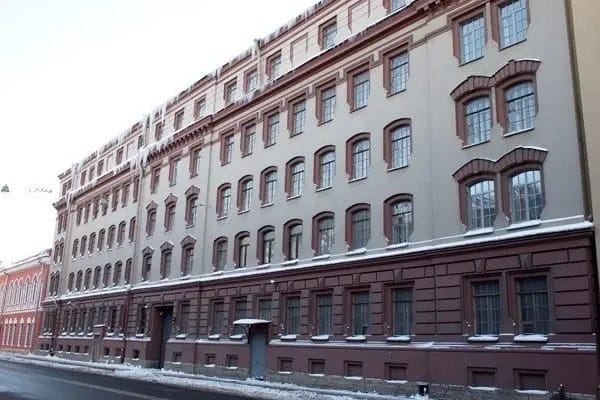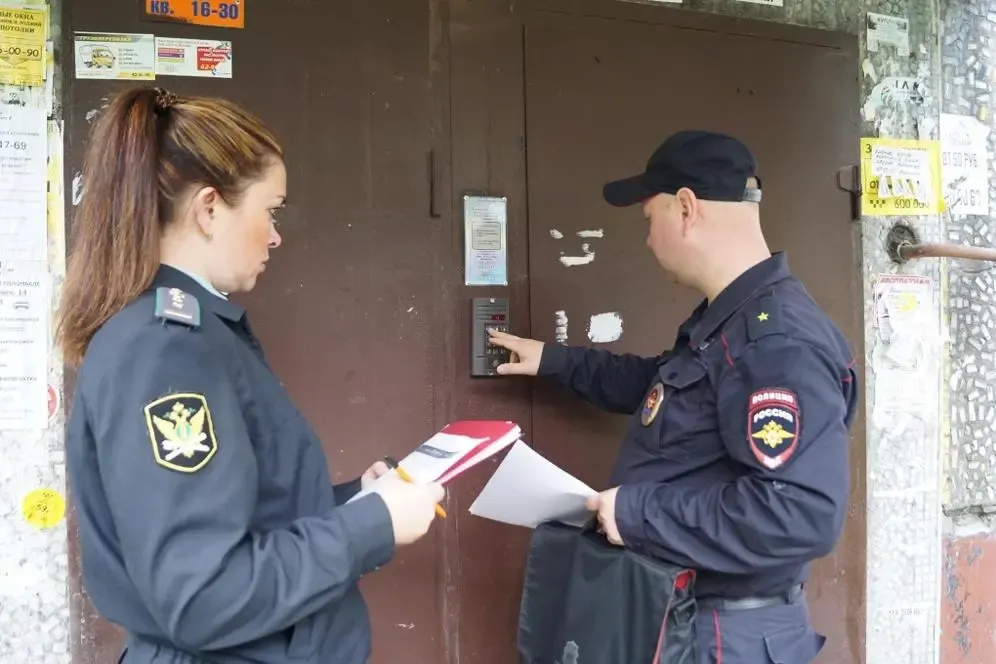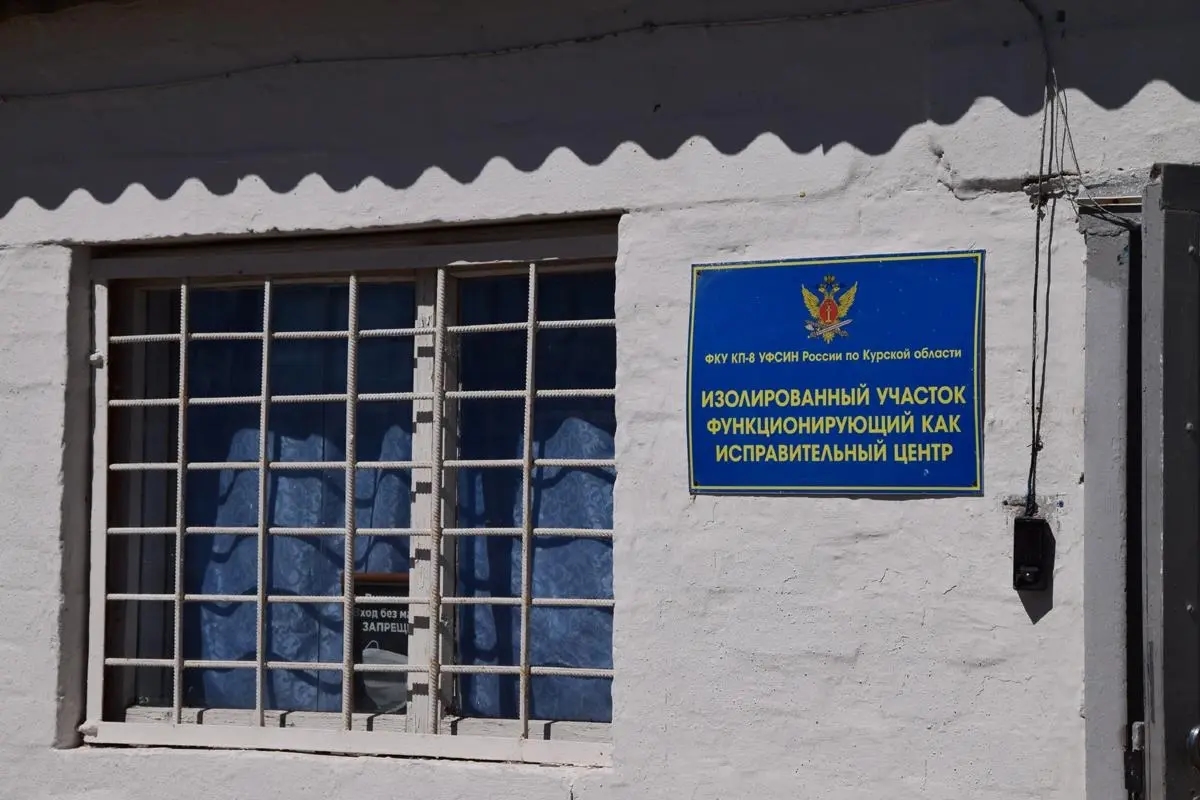
As the military recruitment of prisoners reduces the population of penal colonies across Russia, the country’s Federal Penitentiary Service (FSIN) is expanding another branch of its system: correctional centers for convicts sentenced to forced labor. By the end of 2025, Russia had created 400 of these centers, with space for up to 50,000 people. This past June, FSIN even unveiled a “quickly deployable” center that can be installed directly at businesses nationwide. The new system is more profitable than traditional penal colonies, providing FSIN with fresh revenue streams and companies with access to a workforce almost entirely devoid of rights.
- 1.You’re not prisoners, but you can’t leave
- 2.“A model correctional center with a sports ground and park”
- 3.30,000 workers with no rights
- 4.A “dormitory” behind a fence: What life is like in a correctional center
- 5.“Everyone was rounded up and told to work weekends”
- 6.There is pay, but people support themselves
- 7.What can lead to punishment in a correctional center
- 8.Who benefits from the new system
- 9.A Gulag without isolation
- 10.Not humanization, but a pragmatic move by FSIN
You’re not prisoners, but you can’t leave
Russian law does not classify forced labor as imprisonment, but a person sentenced to forced labor is nevertheless obligated to live in a closed FSIN facility. They must work wherever the administration sends them and cannot freely leave the correctional center.
“You can sit there and not go anywhere for a year,” Olga [name changed], a former convict who spent time in correctional centers from Perm to Volgograd, told The Insider. After a penal colony, Olga said, a correctional center can genuinely feel “almost like home.” People there can wear their own clothes, use a phone, read the news online, and communicate with relatives every day through messaging apps. But the relative improvement in quality of life that Olga experienced only applies to those who have previously spent time in a penal colony, where prisoners must wear standardized uniforms, communication with relatives usually happens by letter, and phones are banned.
For someone sent to a correctional center directly from life outside prison, the experience looks different: living by a schedule set by the FSIN, leaving the center only with permission, working forced overtime, and being subject to the administration’s will.
“People who were sent to a correctional center straight from home were somewhat shocked,” Olga recalled.
“A model correctional center with a sports ground and park”
According to Olga, life becomes especially hard when a correctional center is set up directly at a production site — with a dormitory next to the workshop and the employer working together with the administration to reduce inmates’ lives to moving between bed and the workplace. That is exactly the model FSIN now wants to replicate: fast-deployable correctional centers that can be built next to enterprises.
“At the St. Petersburg International Legal Forum, FSIN presented a model correctional center with a sports ground and a park. The project was sent to the regions as a recommendation,” TASS wrote in late June. In FSIN photographs, the model does not look like a prison but like a tidy workers’ dormitory: a long two-story modular building, lawns, bushes, streetlights, a separate sports ground, and a walking area with benches.
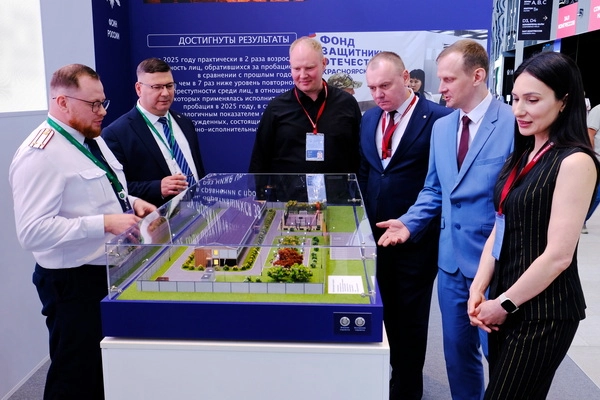
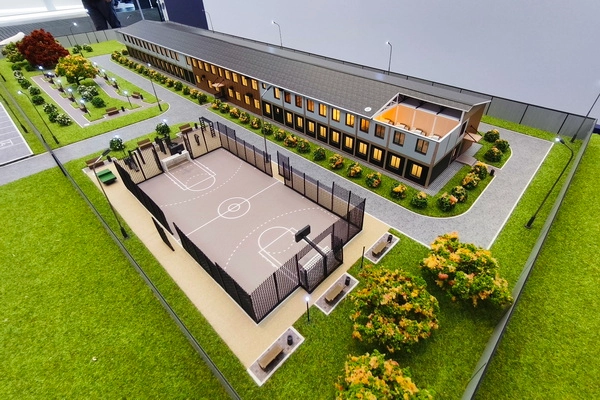
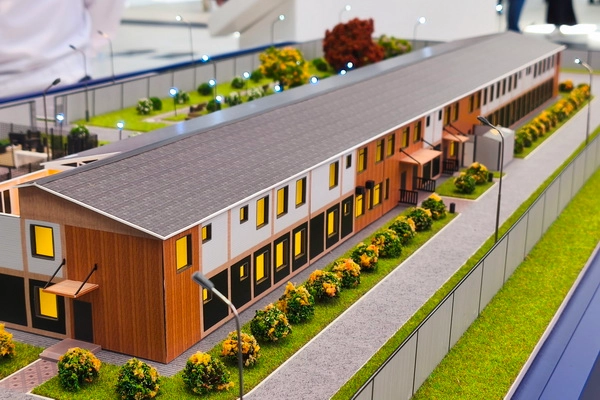
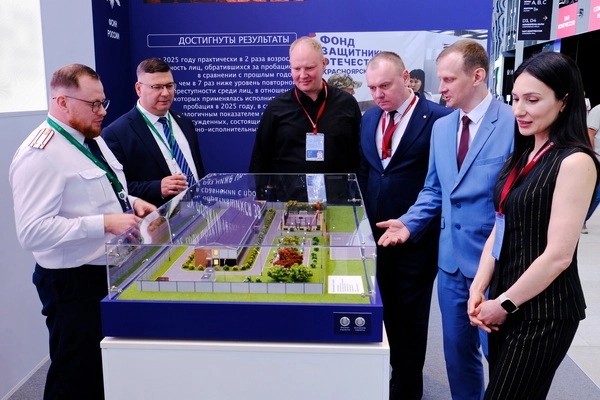
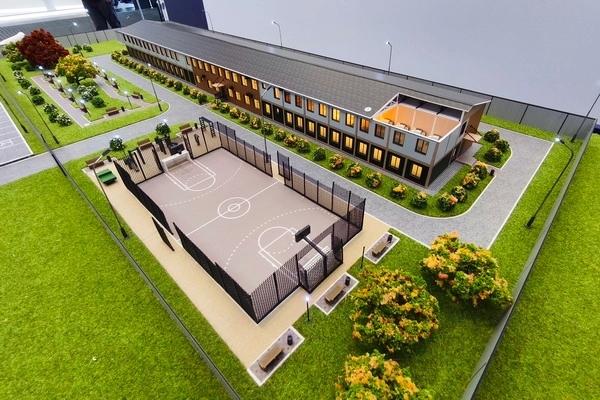
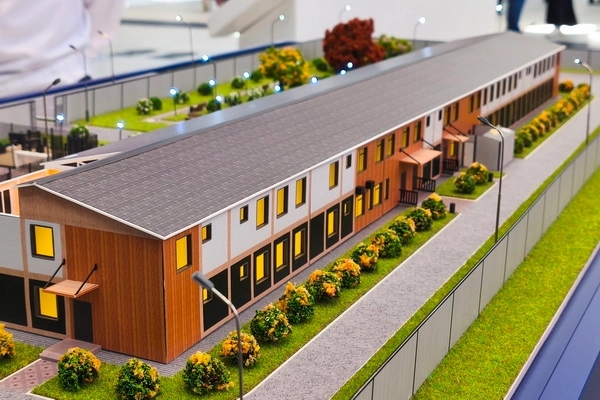
The TASS report also listed other elements of the project: a parking lot, a diesel power station, a transformer substation, and a separate yard where those who have violated prison rules can still get a chance to walk. But the presentation itself showed that the most attractive parts of the image — the park and sports ground — aren’t mandatory. A FSIN representative clarified that they are only “optional facilities.”
In other words, what was sent to the regions was not a plan for a center with a park but an easily replicable solution for quickly housing people sentenced to forced labor. The FSIN website describes it even more directly: the facilities can be built quickly “at any enterprise,” and the project can be used by representatives of large and medium-sized businesses interested in creating dormitories for convicts at their facilities.
That detail is crucial, Olga explained. She served her sentence both in a correctional center where she had to walk down the street to get to work and in a center where the dormitory was effectively on the production site.
“If it’s a closed-system correctional center, then the employer works in very close coordination with FSIN. No one’s getting away from them. FSIN plays the way the employer needs it to,” Olga said.
Employers work in very close coordination with FSIN in closed-system correctional centers
In that model, a person does not simply live near work — work becomes an extension of the prison regime.
“The conditions were always more lenient where the employer wasn’t in the same building as the dormitory. But where you live right in the workshop, right at the production site, that was where things were the hardest,” Olga recalled.
At one correctional center in the Moscow region, Olga said, the living quarters resembled a hangar or garage, with a workshop on the floor below. The facility had poor ventilation and was plagued by dirt, rats and cockroaches.
“It's legalized slavery,” she said. “They force people to work and use every tool of pressure and punishment available to make sure they keep working and don’t complain.”
30,000 workers with no rights
Forced labor as a new type of criminal punishment began to be used on Jan. 1, 2017, when FSIN opened its first four correctional centers and seven sections attached to its penal colonies, with a total capacity of fewer than 900 people. The first convicts arrived in March of that year. Now, a small network of facilities that was previously being tested as an alternative to colonies has turned into a separate and growing branch of the penal system.
By the end of 2025, according to FSIN Director Arkady Gostev, Russia had created 400 correctional centers and sections operating as correctional centers, with capacity for 50,000 people — and more than 30,000 convicts were actually being held there.
Given the overall decline in Russia’s prison population, those figures are especially notable. In May 2026, Gostev said that since the end of 2021 the number of people in places of detention had fallen from 465,000 to 282,000. About 85,000 of them were held in pretrial detention centers (SIZO) and PFRSI, a Russian abbreviation for facilities operating as pretrial detention centers, leaving about 197,000 in penal colonies and prisons.
The rise of correctional centers, whose inhabitants are not counted among the country’s prison statistics, do not explain that decline. Instead, the main reason for the drop in the population of penal colonies was the recruitment of prisoners for the war in Ukraine — first by the Wagner private military company, then by the Defense Ministry. In May, FSIN itself acknowledged for the first time that “efforts to recruit contract soldiers” for the armed forces was affecting the number of prisoners.
But at the same time, the agency is expanding the part of the system that is formally not considered imprisonment — exploiting the labor of convicts rather than simply isolating them away from society. The more than 30,000 people actually held in correctional centers already amount to about 15% of the current number of people under FSIN’s jurisdiction. The centers’ total capacity — 50,000 places — is comparable to about a quarter of that population.
The agency is expanding the part of the system focused not on isolation, but on exploiting convicts’ labor
At the same time, legal changes are making it easier to fill correctional centers. Since 2026, forced labor can be imposed as a standalone punishment, without a prior sentence involving imprisonment. The penalties under dozens of articles of the Criminal Code have also been expanded to include forced labor.
A “dormitory” behind a fence: What life is like in a correctional center
Russia’s Penal Enforcement Code describes correctional centers as special institutions for people sentenced to forced labor. They can exist separately, as sections attached to penal colonies, or directly at enterprises that use convict labor. Inside such centers, internal rules apply, and convicts are kept under supervision.
In correctional centers, people are allowed to have money, wear ordinary clothes, use a phone, access the internet, and keep personal belongings. At the same time, a convict must remain on the correctional center’s grounds, they may not leave without permission from the administration, they must carry an ID card at all times, they must follow internal rules, and they must take part in unpaid maintenance and improvement work for up to two hours a week. The person and the room where they live may be searched, and their belongings may be inspected. In effect, it is the same kind of closed institution as a penal colony, only with a softer internal regime.
The word “dormitory,” which is used to describe the living quarters in correctional centers, says little about the real conditions. Russia’s Penal Enforcement Code uses the same word for the places where convicts live in general-regime, strict-regime, and special-regime colonies. In practice, these are usually not separate rooms for a few people but buildings divided into large sections, each housing several dozen people. Even in the model FSIN showed at the St. Petersburg International Legal Forum, a large room with rows of beds can be seen inside the modular building. It looks more like a barracks-style sleeping hall than a regular dormitory.

Olga said conditions varied widely by region. In some places, the administration turned a blind eye to the rules, while in others, it used them as a tool of pressure. Still, the routine in forced labor facilities, she said, resembled the “Groundhog Day” rhythm of life in a penal colony:
“Wake-up, breakfast, go to work, a little lunch at work, and then at around 8 or 9 p.m. we come back from work, wash, have a bite to eat, and go to sleep. That’s basically every day.”
In some correctional centers, Olga said, people could go into town for a few hours on weekends. However, on others, people had to go months without leaving the grounds.
“If there are no problems, if the employer does not say they are working badly, then everything goes normally,” she said. “But if someone starts, for example, filing complaints against the employer, then the administration first of all restricts outings.”
Grigory Mumrikov, an artist who served a forced labor sentence in Zelenograd, just outside Moscow, after being convicted of participating in the organization of an anti-war protest, shared similar impressions. Compared with pretrial detention, the correctional center seemed to him like “great happiness,” even if he was still in captivity. From evening to morning, he was in the correctional center, and from morning to evening, he worked as a laborer at Aksakovo, a sanatorium run by FSIN. Mumrikov spent the couple of free hours he had after work walking around a lake.
“I could simply sit on a bench, just to avoid being on that territory,” he said, referring to the correctional center.
That was possible because the convicts worked outside the correctional center and traveled to and from Aksakovo on their own. But by 8 p.m., Mumrikov had to return to the center for the evening roll call.
“Everyone was rounded up and told to work weekends”
Under the law, people sentenced to forced labor must work wherever the correctional center’s administration sends them. Formally, their labor is supposed to be regulated by labor law. But convicts do not have the key right of a free worker: the right to refuse a particular job and leave for another employer.
Convicts do not have the key right of a free worker: the right to refuse a particular job and leave for another employer
In some correctional centers, Olga said, there was still some choice — the administration could offer two or three potential employers, and the person would choose where to work based on their skills and health. But that was not the case everywhere. In the correctional center in Leninsk, in the Volgograd region, where she was held in the winter of 2023-2024, there was only one employer: a canned goods factory.
“You cannot refuse to work, because that is considered a malicious violation,” Olga said.
According to her, people worked 10 to 12 hours a day, and weekends could be turned into workdays. However, if inspections began, the employer would show a normal schedule.
“The employers drew up a good schedule and pretended that no one had been forced to come in on weekends and that the working day was what it should be,” she said. “Accordingly, as soon as the inspectors leave, everything goes back to the way it was: longer working days and mandatory weekend work.”
The order to work on weekends, she said, usually came not directly from FSIN but from the production site. A foreman would gather the convicts, make sure no one had phones to record the conversation, and then announce the new schedule: “We work on weekends. We work until such-and-such time. And whoever complains will make things worse for themselves.”
That is what makes a convict’s position in a correctional center fundamentally different from that of an ordinary worker. In a correctional center, an employer’s demand almost automatically becomes an FSIN demand. The administration begins applying pressure, and complaints or refusal to work can result in disciplinary penalties.
“Inspectors work in coordination with the employer. They are one single system,” Olga said. If a person refuses to work for pennies or complains about conditions, she said, the administration can begin “catching them on small things” to find grounds for punishment. Accumulating such penalties creates the risk of transfer to a penal colony.
“Inspectors work in coordination with the employer. They are one single system”
Similar complaints have emerged in other regions. In Zelenograd, convicts in a correctional center said they worked without a proper schedule, faced overtime, and were threatened with tougher conditions if they reminded officials of their rights.
“We differ from undocumented migrants on a construction site only in that we are Russian,” forced laborers said.
Konstantin, a former prisoner who served his sentence in Kabardino-Balkaria in Russia’s north Caucasus, told the independent outlet Cherta that he was sent to sort household waste — eight hours in the heat at a rural dump that included hides of slaughtered cows and sheep, a terrible smell, large numbers of insects, and no ability to refuse the work.
Another person interviewed by the outlet, from the Voronezh Region in central Russia, worked at an agricultural complex growing mushrooms and said regular hired employees earned significantly more than convicts got from the correctional center.
These examples do not mean that people in every correctional center are forced to work overtime or are sent to the hardest jobs. Former convicts themselves also describe centers with decent working conditions and normal schedules. But all cases have one thing in common: a person cannot resign if they are unhappy with the conditions.
There is pay, but people support themselves
Officially, labor in correctional centers is paid. In any sentence, between 5% and 20% of a convict’s salary is withheld for the state, and the inmate is free to use the rest of the money. But unlike a penal colony, where prisoners have to be fed and issued uniforms, people in correctional centers are almost entirely self-supporting.
Convicts are given a bed and bedding, but they usually buy their food, clothes, shoes, hygiene products, medicine, and other everyday items while also reimbursing the correctional center each month for utilities and household services.
In Leninsk, in the Volgograd Region, Olga said, about 3,000 to 4,000 rubles ($35-$46) were withheld from her wages for utilities, and after all the deductions were made, convicts were typically left with about 9,000 to 10,000 rubles ($104-$116) a month to live on.
“And you have to take into account that this is not a colony: you need to dress yourself and eat something, because not all correctional centers provide food,” she said.
“This is not a colony: you need to dress yourself and eat something, because not all correctional centers have food”
Formally, if a convict has no money, the correctional center has to provide them with food, clothing, and shoes at the state’s expense. But in practice, Olga said, getting that support can be difficult.
“You go to the management and say: I have nothing to eat, you are supposed to provide me with food. And they say: ‘Well, where am I going to get it? You can see there is no kitchen,’” she said, describing life at a correctional center in the Moscow Region.
At the same time, Olga stressed that low pay is not an inevitable feature of correctional centers. In the Perm Region, where she worked at a private garment factory, the business was properly organized, and convicts’ wages could be comparable to ordinary wages outside the prison.
Olga earned about 40,000 to 50,000 rubles ($460-$580), while women who sewed well made up to 100,000 ($1,160), even after the deductions. “It was a fairly good place,” she said.
That contrast shows that the problem with correctional centers is not simply that they always pay poorly. With a decent employer, convicts can earn close to what they would outside prison. But if the employer is dishonest, the fact that a person is trapped means they are forced to survive on less than the national subsistence minimum.
What can lead to punishment in a correctional center
Under the Penal Enforcement Code, violations committed by people serving forced labor can lead to them being placed in an internal isolation cell inside the correctional center for up to 15 days. Olga said anyone sent there can only bring a minimum of belongings, and there is a ban on phones. “Not as frightening as in a colony, but the point is the same — to isolate you and show what they can do to you,” she explained.
The law separately defines “malicious violations,” which include refusal to work, disobeying the administration, participating in a strike or collective disobedience, possessing banned items, leaving the center without authorization, or returning more than 24 hours late. If a person is declared a malicious violator — for one “malicious” violation or for three ordinary violations within a year — the head of the correctional center submits a request to a court to transfer the person to a colony.
In practice, Olga said, these rules become a method of control. The administration may ignore minor violations for a long time, then use them against those who complain about an employer or refuse to work in poor conditions.
“They may treat you relatively well for a long time, but once you start demanding your rights, they begin finding fault with everything you do,” she said.
“Once you start demanding your rights, they begin finding fault with everything you do”
An everyday minor infraction can thus become part of a chain that ends in a person being packed off to a penal colony. “For those who came from a colony, that's the main fear,” Olga said. “They tell you: ‘if you don't want to work, you'll go back.’”
Who benefits from the new system
In public statements, FSIN describes correctional centers as a more humane alternative to colonies: a person is not completely isolated from society, and they can work, earn a salary, use a phone, and gradually return to normal life. In an explanatory note to the law expanding the use of forced labor, its authors wrote that such punishment allows convicts to maintain social ties, restore work skills, and compensate victims.
But this humanization also has an economic aspect. Under the Penal Enforcement Code, sections of correctional centers can be created directly at enterprises that use convict labor. The standard contract between a correctional center and a company describes the arrangement as a ready-made production scheme: the correctional center sends convicts, and the organization agrees to employ them at its site and report violations of labor discipline to the administration.
For businesses, this means access to workers whose minimal privileges depend on their successful fulfillment of assigned tasks. A convict cannot simply quit and leave for another employer, and as a FSIN representative told TASS, commercial entities are interested in creating such sections because people sentenced to forced labor are “fairly disciplined workers.”
“They are interested in doing their work well, because if they violate labor discipline or the procedure and conditions for serving their sentence, there is a risk that the punishment will be replaced with a harsher one — imprisonment,” the representative said.
The state additionally encourages businesses to take part in the scheme. Since 2026, organizations have been exempt from property tax on premises, territories, and other real estate they provide free of charge to house correctional centers.
The model is also convenient for FSIN. The agency does not need to build a traditional penal colony, as businesses provide part of the infrastructure while paying convicts enough that the state is not obliged to provide them with food, clothes, or medicine — 5% to 20% of their wages also go directly to the state.
In the end, businesses get workers whose discipline is backed by FSIN, while the agency gets infrastructure and a “contingent” — the official bureaucratic term used for prisoners and other people under state supervision — whose burden of support can largely be shifted onto the convicts themselves. At the same time, for FSIN and the state as a whole, this is a form of punishment that can be presented as humane resocialization.
A Gulag without isolation
The idea of correction through labor is not a new concept in the Russian penal system. In Soviet times, it was reflected even in the names of institutions, as camps and colonies were called “corrective labor institutions.” Soviet Russia’s Corrective Labor Code explicitly said that punishment should “correct and reeducate” convicts “in the spirit of an honest attitude toward labor.”
Under Stalin, this logic reached its extreme: the Gulag was not only a system of isolation and terror but also a vast economic mechanism. Prisoners built canals, railways, industrial facilities, and urban infrastructure. But direct comparisons between modern correctional centers and the Gulag would be misleading because the scale, conditions and level of violence are vastly different. Today, supervision is as light as possible, as it is the system itself that stimulates the efficiency of the inmates’ labor.
Correctional centers look like an updated version of the Soviet tradition of forced labor — without the barracks of the Gulag, but with the same basic idea that a convict must work for the benefit of the state — and now for Russia’s business sector
The state does not need to fully isolate a person in order to control them. It is enough to link their place of residence, their type of work, their salary, and the threat of transfer to a penal colony into a single system. As a result, correctional centers look like an updated version of the Soviet tradition of forced labor — without the barracks of the Gulag, but with the same basic idea that a convict must work for the benefit of the state — and now, also, for Russia’s business sector.
Not humanization, but a pragmatic move by FSIN
Correctional centers may offer better conditions than penal colonies, but they are still a form of deprivation of liberty, no matter what the paperwork says. In the end, they create even more opportunities to exploit prisoner labor than colonies do, and FSIN directly describes people sentenced to forced labor as a convenient labor resource.
Putin’s war in Ukraine is draining prisoners from Russia’s penal colonies, and dozens of institutions have closed down due to the lack of inmates. That could have led to FSIN losing bureaucratic influence (and with it, staff and funding from the state budget). Instead, the agency’s leadership appears to have found an effective way out: it can now report growth in the number of institutions providing a more humane form of punishment, and it can do so in a way that certainly pleases Russian businesses.