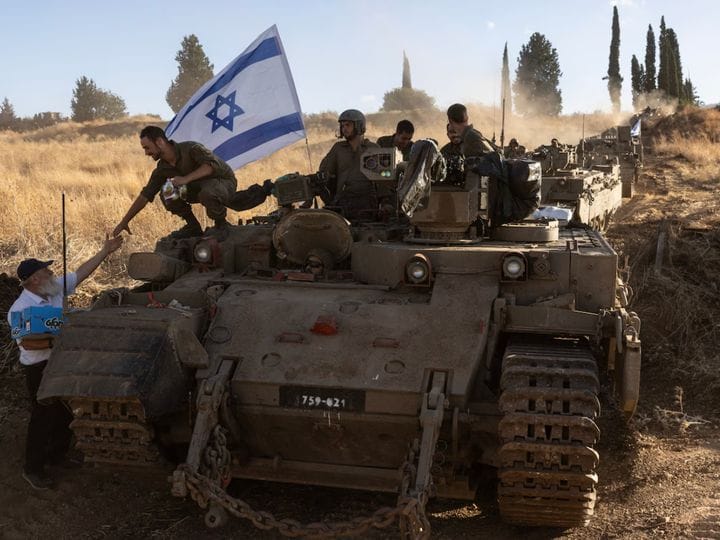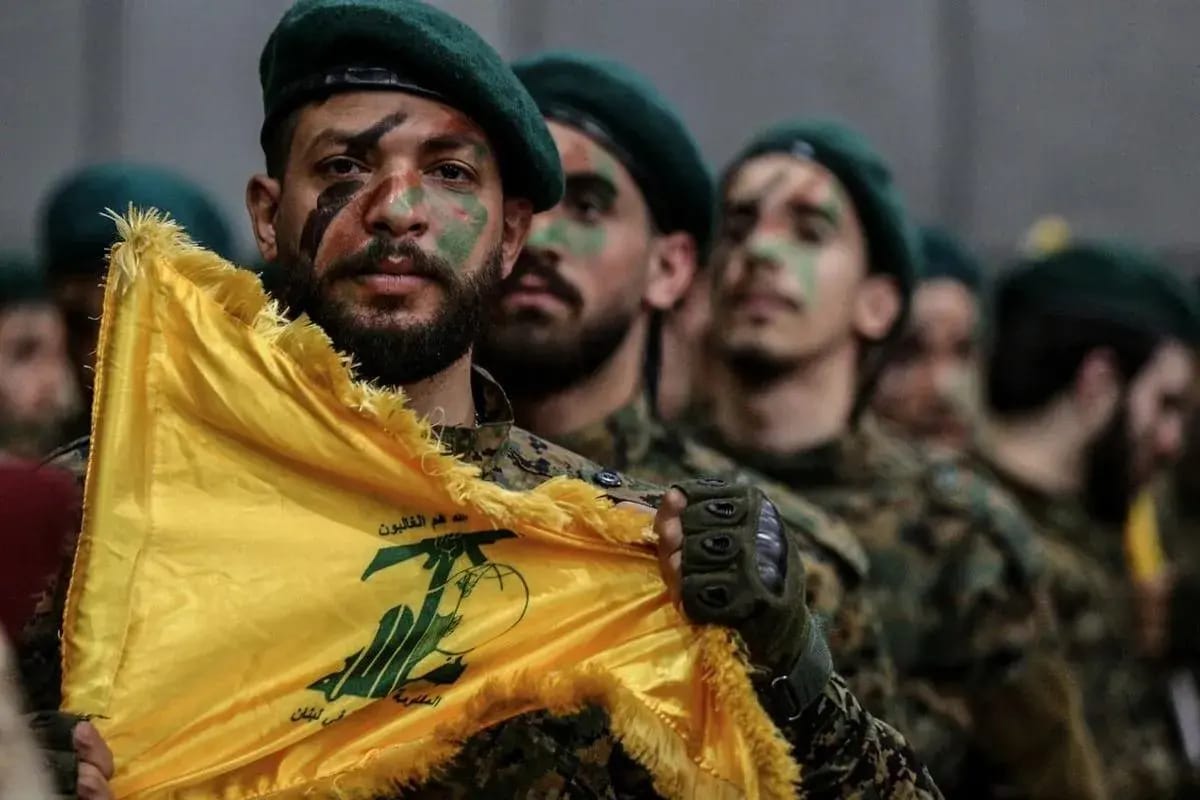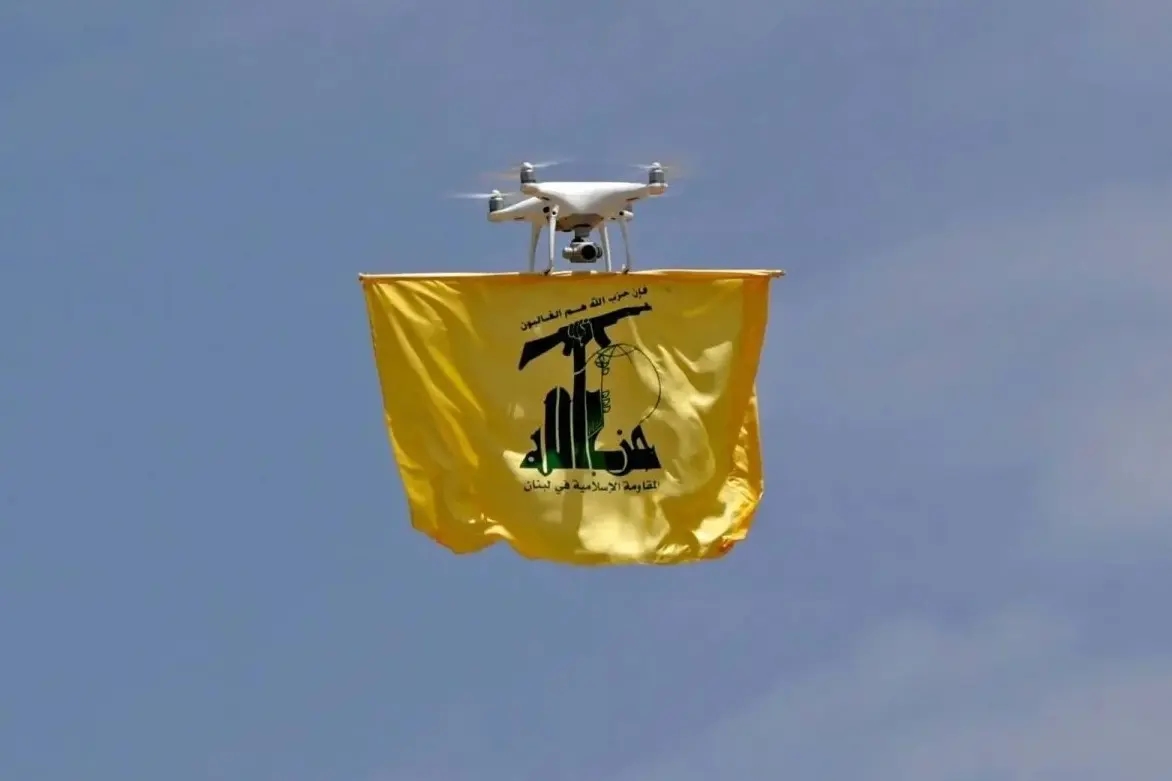
In late August, Israel resumed active strikes on positions held by the Shiite movement Hezbollah inside Lebanon — a response to FPV drone attacks against Israeli soldiers. Cycles of escalation keep repeating themselves in the region: despite ceasefire agreements between Israel and the Lebanese government, Hezbollah fighters continue to attack Israeli forces, and Jerusalem’s response results in civilian casualties, leading to further rounds of fighting. Importantly, Hezbollah’s countermeasures against the IDF now involve the use of fiber-optic-guided drones of the sort developed on the battlefield in Ukraine. The use of this relatively accessible, highly effective technology allowed Hezbollah to retain its ability to fight in the face of Israel’s undeniable military superiority.
What is happening in southern Lebanon
On Aug. 27, following an attempted drone attack on IDF troops near the Ali al-Taher ridge, Israeli aircraft carried out a series of strikes on facilities belonging to Hezbollah near Nabatieh. Military warehouses are reported to have been hit; a woman was killed, and other civilians were injured.
Two weeks earlier, three Israeli soldiers had been severely injured by a drone strike in the same area, and the airstrikes carried out in retaliation for that incident killed not only Hezbollah fighters and commanders, but also at least 11 civilians, including women and children (according to the Israeli side, some of them were relatives of the killed militants).
Similar “cycles of escalation” have accompanied the talks on conflict settlement in southern Lebanon in recent months — negotiations that are themselves part of the broader process of ending the conflict between the U.S.-Israeli coalition and Iran.
The Lebanese theater of operations is one of the key topics in the negotiations. Back in 2024, Israeli authorities announced their intention to “dismantle the terrorist infrastructure” and “liberate” Lebanon from the influence of Hezbollah, which remains Iran’s most valuable and dangerous asset on its “external perimeter.”
Israel’s stated goal in Lebanon is to free the country from Hezbollah’s influence
On Oct. 1, 2024, Israeli forces launched a ground operation into Lebanon aimed at limiting the Shiite movement’s combat capability — the third such war in recent decades (the first two being in 1982 and 2006). A ceasefire was reached at the end of November 2024.
Then, on March 2, 2026, Hezbollah resumed rocket fire on Israeli territory following the death of Iran’s supreme leader Ali Khamenei in a missile strike by the U.S.-Israeli coalition. In response, the IDF continued its ground operation in Lebanon.
A ceasefire was announced on April 16, but fighting continued yet again. With U.S. mediation, an agreement between the Israeli and Lebanese governments was signed on June 26, providing for a partial withdrawal of IDF units from several areas in the south of the country while maintaining an Israeli presence until Hezbollah is disarmed.
Hezbollah leader Naim Qassem refused to recognize the agreement and stated that armed resistance would continue. Notably, the particularities of the Lebanese political system make it impossible to implement any settlement agreement with Israel without the support of the Shiite community.
Drones vs. IDF
At the current stage of the war in southern Lebanon, fiber-optic-guided FPV (first-person view) drones have become Hezbollah’s main means of countering Israeli forces. As many as 33 incidents involving Israeli military deaths and injuries in southern Lebanon were recorded from March to July 2026, with FPV drones used in more than half of them. By some estimates, they have curtailed Israel’s offensive capabilities by up to 80%.
Observers note Hezbollah appears to be in the early stage of what is known as a reconnaissance-strike loop: drones first conduct aerial reconnaissance, followed by launches of fiber-optic FPV drones at identified targets. If the use of drones can be scaled up and incorporated into a strategy for countering Israeli forces, this would create a long-term threat with no clear solution.
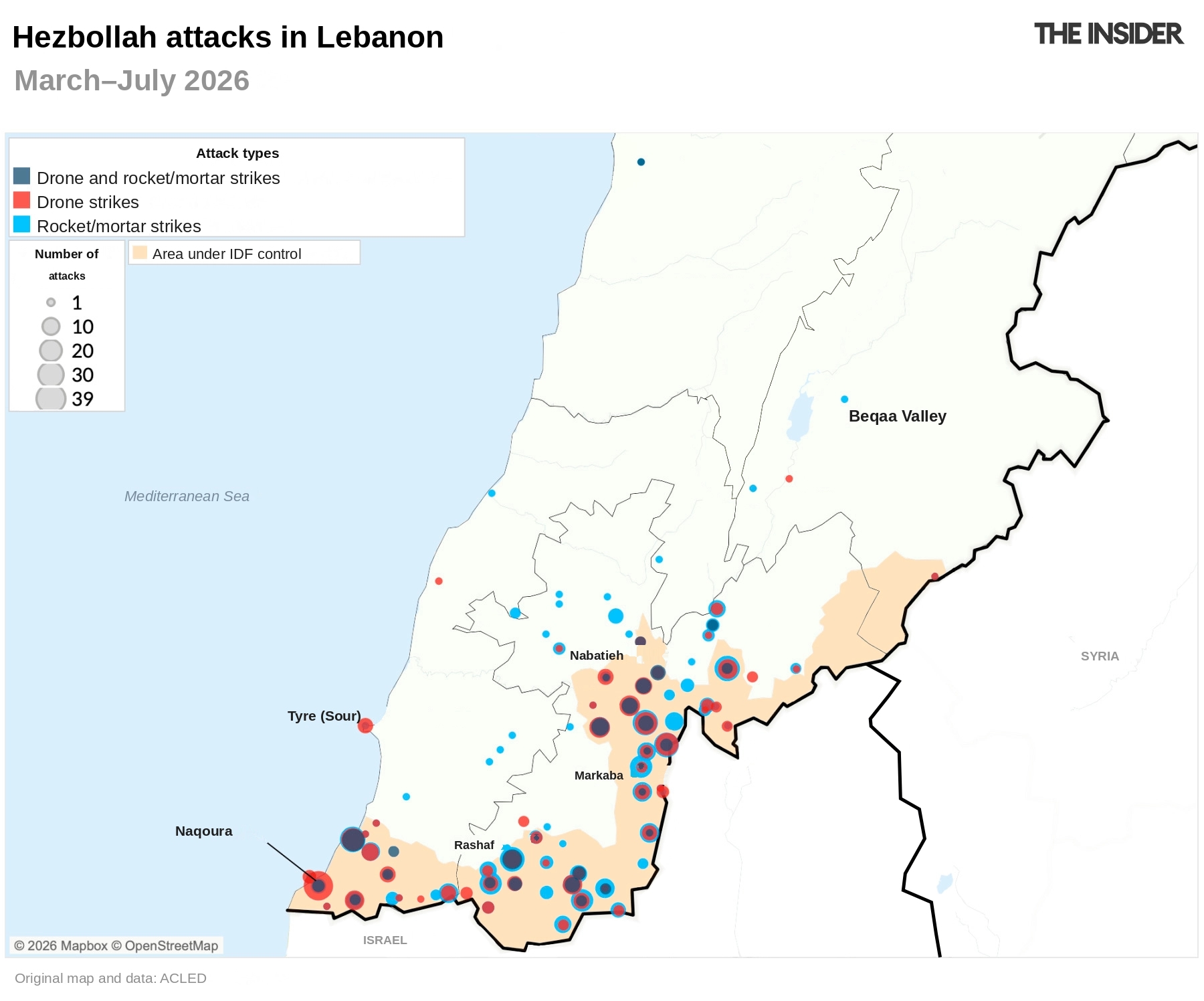
In a sense, Hezbollah has successfully exploited a gap in Israeli operational capability that stems less from technological asymmetry than from differing speeds of adapting doctrine to technological progress in warfare.
Hezbollah is successfully adapting to technological progress in warfare
Notably, before the April 16 ceasefire, videos of drone attacks showed hits on static objects or combat vehicles, and despite the agreement, on April 26 a Hezbollah FPV drone struck a tank, killing one Israeli soldier and wounding six others, and more drones came close to successfully attacking an Israeli helicopter that had arrived to pick up the wounded.
It appears that drones have become central to the attrition strategy Hezbollah has adopted against Israeli forces. Speaking with The Insider, Israeli military expert David Gendelman notes the similarities between the southern Lebanese theater of operations and the battlefield in Ukraine:
“FPV drones have proven to be an extremely cost-effective weapon on the Russian-Ukrainian front, which is why millions of them are now being used there, partially replacing the roles of artillery, anti-tank guided missiles, and air power. And this is happening in a symmetric war between two regular armies. Such weapons will be all the more effective in the asymmetric war that Hezbollah is waging against Israel’s regular army.
The Russian and Ukrainian armies are world champions at countering FPVs, with years of experience, and they still suffer several hundred casualties from them every day, because just as there is no wonder weapon, there is no counter-wonder-weapon either. There is a set of partial solutions, in both troop training and technical means, that reduces losses but does not bring them to zero.
The same is true of other types of weapons for which no ‘wonder shield’ has been found either. FPVs are no exception. Just as artillery, anti-tank guided missiles, small arms, and other battlefield tools remain with us, FPVs are here to stay too — this is now a new reality we have to live with.”
Hezbollah’s rocket and missile stockpiles — mostly short- and medium-range ones — have shrunk from roughly 100,000 to 25,000 since 2023, and drones have proven to be an extremely flexible and effective alternative, well-suited for use by small combat cells operating within a decentralized command structure.
Comparing the active periods of fighting in Lebanon from October to November 2024 and from March to July 2026, Hezbollah’s use of FPV drones for attacks on Lebanese territory rose from 0 to 214 cases (21% of all attacks), and the use of conventional suicide drones rose from 21 cases (6%) to 244 cases (24%).
In attacks on Israeli territory, the use of FPV drones rose from 0 to 16 cases (1% of all attacks), and suicide drones from 176 (14%) to 343 (31%). According to calculations by the Israeli research center Alma, from the announcement of the ceasefire on April 16 through June 21, 2026, Hezbollah carried out more than 1,163 attacks, with 637 involving the use of various drones.
Why the IDF was unprepared for drone warfare
The first serious incident involving Hezbollah drones occurred on Oct. 13, 2024, when a Sayad-107 suicide drone struck a dining hall at a Golani Brigade base in Binyamina. Four soldiers were killed, and more than 50 were injured. The drone approached the target from the Mediterranean Sea, evading detection by Israeli air defense systems. Still, Hezbollah’s systematic shift to FPV drones as a primary weapon is likely linked to the collapse of the Assad regime in Syria in December 2024, which disrupted the supply route of traditional missiles. So far, Israel has not found a reliable answer.
David Gendelman points out that the resulting asymmetry in drone use and countermeasures is explained primarily by organizational differences between the two sides:
“The experience of the Russian-Ukrainian war was studied by both Hezbollah and the Israel Defense Forces. The difference was that Hezbollah, as a relatively small, non-bureaucratic structure, adopts and masters innovations like FPVs quickly and doesn’t need a large quantity right away to start carrying out attacks.
For the IDF, the main issue wasn’t so much adopting FPVs themselves, which was also happening, but countering FPVs. And that is a far more labor-intensive process, because protective measures need to be introduced everywhere, tactics need to be changed everywhere, budgets and man-hours need to be allocated to everyone for this, and time and resources are limited. On top of that, the war has continued on multiple fronts since 2023, diverting resources to other urgent matters. Plus they had to deal with the traditional bureaucracy of regular armies and large organizations in general.
As a result, by the start of the latest war with Hezbollah, the Israeli army had spent several years studying Ukraine’s experience and writing recommendations on implementing the lessons learned, but they had adopted practically none of the tactics against FPVs — and only began doing so once the war had already started.
Hezbollah sporadically used FPVs, including fiber-optic ones, in 2024, and even in this current round of hostilities in 2026 the daily number never exceeded a few dozen — nothing comparable to the thousands per day in Ukraine. But due to poor preparedness, even such a small number led to undesirable losses… And we had to implement rapidly, on the fly, all those measures that the army had included in the guidelines years earlier based on Ukraine’s experience, adapting them to our own conditions given differences in terrain, the theater of operations, the forces and resources of the two sides, and so on.
Protective netting, shotguns, field training for troops, countermeasure tactics, acoustic, optical, and radar warning systems, electronic warfare, and various interception tools — all of this is already being put into practice, but there are limits to what we can speed up. Developing new tools, testing available ones, approval, procurement, distribution, training, deployment — once the decision is made, things move forward, but the decision itself came years too late.”
The FPV drone threat has already resulted in operational changes. Some IDF units have shifted to operating at night, although it is known that militants are trying to equip drones with thermal imaging cameras. No changes are yet apparent at the organizational level.
What’s next
Changes in Hezbollah’s tactics show just how quickly the processes of adoption and adaptation happen in wartime. Just a few years ago, the group relied mainly on unguided rockets, anti-tank guided missiles, and classic fixed-wing drones. Now, their mass use of commercial fiber-optic drones is rendering Israeli electronic warfare countermeasures useless. The cost of these new guided munitions starts at $300–400 per unit, and many components can be 3D-printed on site or sourced from civilian-grade parts.
The conflict in southern Lebanon shows how quickly innovations are adopted during wars
Improvised munitions and a guerrilla-style organization — with drone crews hiding in mountainous terrain or residential areas — pose a challenge to the foundation of Israeli military doctrine, which is built on unconditional technological superiority over neighboring state and non-state military-political actors.
Unlike in Ukraine, in southern Lebanon FPV drones serve as a cheap weapon in a low-intensity war, preventing Israel from establishing stable control over the “buffer zone” it created, and thereby serving as a tool of pressure on Israel both within Lebanon’s domestic context and regionally, in Iran’s interests. By some estimates, there are fewer than 100 trained drone operators in all of southern Lebanon, but even this quantity allows Hezbollah to sustain its activity.
Israel is working on interceptor drones and combined systems based on laser technology and electro-optical systems, along with so-called “smart sights” for firearms that significantly increase the chances of hitting a drone. The IDF, for its part, is procuring multi-pellet ammunition and special anti-drone shotguns as a last line of defense and adopting protective netting based on lessons learned from the war in Ukraine. Overall, according to Gendelman’s assessment, due to various constraints Hezbollah will not be able to scale up its use of FPV drones to Ukraine’s level and, as the IDF rolls out various countermeasures, the threat will largely be neutralized. But it will not be eliminated entirely.