The number of migrants worldwide has reached 300 million, and despite growing anti-immigration sentiment and the rise to power of leaders promising to halt the influx of newcomers, neither the United States nor Europe has managed to significantly reduce their numbers. Migration will continue to grow as aging economies face increasingly severe labor shortages. The main challenge for governments is not so much to stop the flow as to integrate migrants effectively, avoiding social conflicts while reaping the economic benefits immigration brings. International experience varies, but numerous studies show that migration policies have been more successful in countries where migrants have equal access to the labor market and can participate in public life. The higher the employment rate among migrants and the fewer bureaucratic barriers they face, the better results migrant communities show when it comes to questions of crime and social exclusion.
In recent decades, almost all developed countries have been experiencing a severe demographic crisis caused by population aging. Combined with globalization, this has led to a growing influx of migrants into these countries. According to the UN, the number of migrants worldwide stands at around 300 million, double what it was in 1990 (although its share of the global population grew much more modestly, from 2.9% to 3.7%).
This growth has fueled a global wave of anti-immigration sentiment. Yet even politicians who come to power on the back of such rhetoric usually fail to stop the influx of migrants. Donald Trump, for example, only slightly reduced the number of legal migrants entering the United States during his first term, largely by cutting the number of refugees admitted through the UN resettlement program. And during Giorgia Meloni's tenure as Italy's prime minister, the number of migrants arriving in the country has only increased — Italy has even remained the leading destination for people entering Europe illegally.
Brexit, which took place against a backdrop of British discontent over migration, led European citizens to leave the country, but they were replaced by far more migrants from non-European countries. Russian authorities, meanwhile, are fueling anti-immigration hysteria while trying to replace laborers from post-Soviet countries with different migrants from farther afield.
Migration, of course, has an objective driver: growing demand for labor. And as long as that demand persists, migration will continue to grow. According to forecasts by the International Organization for Migration, the number of migrants worldwide will exceed 400 million by 2050. It is therefore essential to understand how best to manage migration while integrating newcomers.
By 2050, the number of migrants worldwide will exceed 400 million
As with measures aimed at restricting entry, attempts to integrate migrants often produce outcomes that run counter to the aims of government efforts.
Sweden, for example, is the world's most migrant-friendly country and has the highest score on the Migrant Integration Policy Index (MIPEX). Yet migrants in Sweden are still more likely to commit crimes than the native-born population; they earn less, pay less in taxes, and their children perform worse at school.
In Spain, by contrast, migrants account for a similar share of the population — just over 20% — while both the MIPEX score and spending on integration programs are lower. Yet the gap between migrants and the native population is also smaller across all indicators. Moreover, migration has reduced unemployment and crime in the country and boosted GDP per capita.
In Russia, meanwhile, a country that is extremely unwelcoming to newcomers and has a very low MIPEX score, migrants commit crimes significantly less often than the native population while having the same employment rate.
Research shows that three factors matter more than either spending on integration or the strictness of migration policy itself: migrants' access to the labor market, the composition of migration flows, and the ability of institutions to prevent discrimination against newcomers.
Access to the labor market
Employment is the main factor determining an individual's propensity to commit crime across all population groups. Unemployed people are more likely to turn to crime to survive — subsistence crimes, which typically include theft, squatting, or even prostitution. They are also more likely to become involved in criminal networks, which essentially serve as alternative forms of employment.
Even among employed people, peaks in criminal activity occur during periods when they are not working — namely, on holidays, when the rate of violent crime tends to increase, largely because of alcohol. Among unemployed people, by contrast, holidays have a much smaller effect on crime.
Around 60% of migrants worldwide moved in search of work. Since labor migrants generally have lower crime rates than the local population as a whole, an influx of labor migrants can even reduce the overall per-capita crime rate.
Crime rates among labor migrants are generally lower than among the local population
This largely explains the paradoxically low crime rate among migrants in Russia. The country accepts virtually no refugees, and the overwhelming majority of newcomers are labor migrants. Since 2014, Ukrainian refugees — following Russia's occupation of Crimea and parts of Ukraine's Donetsk and Luhansk regions — have been granted preferential residency arrangements allowing them to work immediately, access government services, and remain in the country indefinitely. They were also eligible for a simplified path to citizenship (meaning they have barely registered in official crime statistics as migrants).
There is considerable evidence that allowing migrants to work legally also improves their integration. A revealing comparison of two waves of immigration to Britain illustrates the point. In the late 1990s and early 2000s, the country received asylum seekers who were mostly not allowed to work immediately, leading to an increase in property crime. By contrast, the wave of migration that followed the accession of 10 new countries to the EU consisted of people who immediately gained the right to work and, in turn, slightly reduced crime rates.
A similar situation emerged in Italy after Bulgaria and Romania joined the EU. Because citizens of those countries automatically acquired legal status, the incidence of “subsistence crimes” among them fell by half. The effect was particularly pronounced in the country's industrialized northern regions, while in the south, where migrants were often already working informally in agriculture, legalization had virtually no effect on crime rates.
The same pattern can be seen in the contrast between English-speaking countries — the UK, Canada, the U.S., Australia, Ireland, and New Zealand — and continental Europe. This is partly because the English-speaking countries are geographically distant from major conflict zones, making it more difficult for refugees to reach them unless they are resettled through the UN Refugee Agency's programs.
As a result, these people have already had their asylum claims approved and are granted the right to work immediately upon arrival. Consequently, in all these countries, the share of migrants among the prison population is lower than their share of the total population, while their children perform better on standardized tests than children of native-born residents.
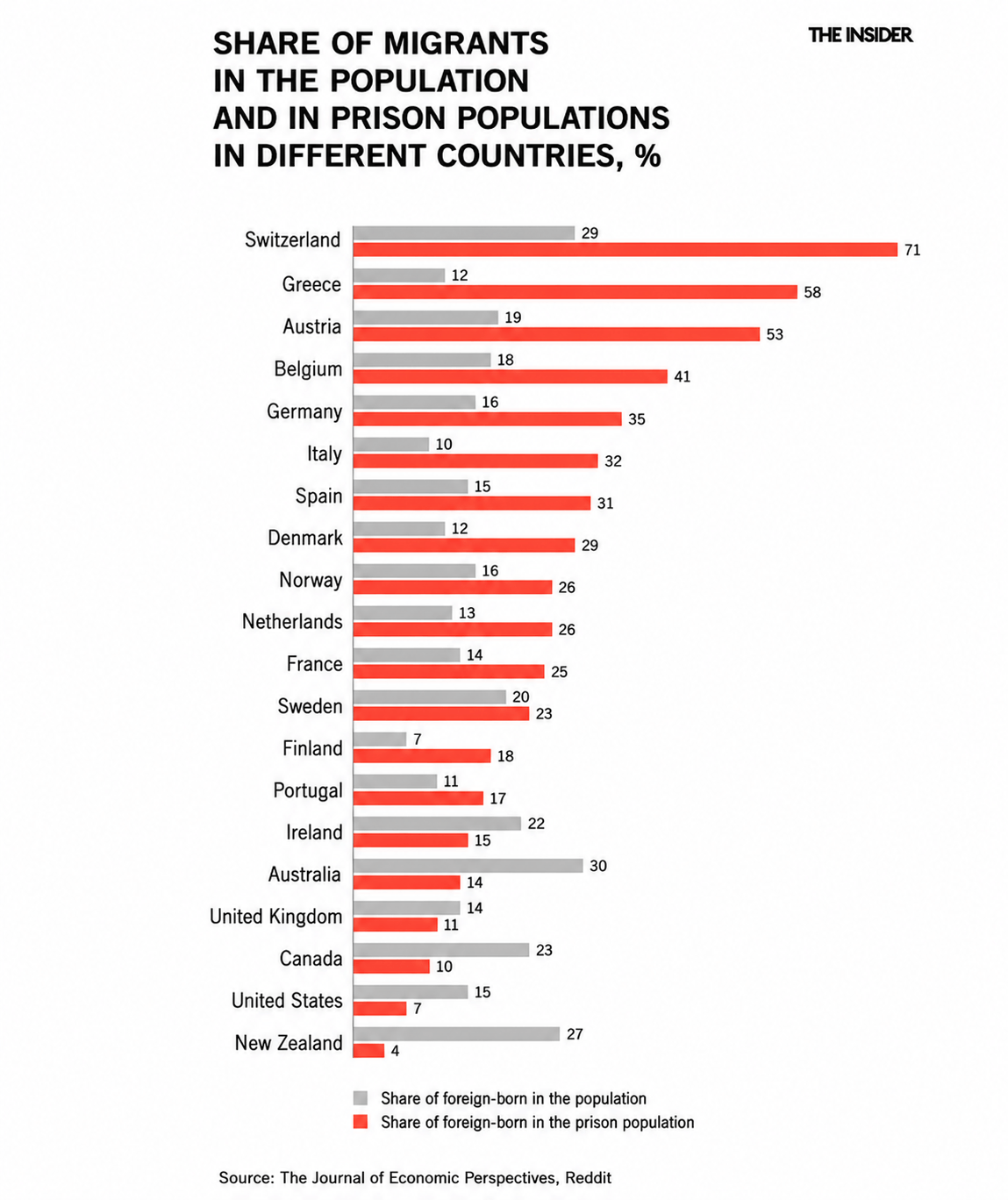
In continental Europe, by contrast, refugees arrive directly across land borders or by sea, meaning they do not immediately gain the right to work. A report by the European Council on Refugees and Exiles notes that, although numerous European directives recognize the right to work as a fundamental human right and call for asylum seekers to be granted access to the labor market as soon as possible, many countries still impose various barriers until their applications are processed.
In some countries, refugees are housed for long periods in camps located in areas with high unemployment or are frequently transferred between accommodation centers, making it difficult to secure permanent employment. Elsewhere, authorities delay the issuance of documents, while employers themselves may be unsure whether they are allowed to hire asylum seekers whose applications have not yet been approved.
In many EU countries, migrants are allowed to work only in a limited range of sectors, mostly in low-skilled jobs. At the same time, many higher-skilled positions require a relevant degree and a certain level of proficiency in the local language, and their professional qualifications obtained abroad may not be recognized. As a result, for example, low-skilled migrants in Italy have a higher employment rate than Italians with a similar level of qualifications (65.0% versus 53.2%), while highly skilled migrants have a lower employment rate (69.0% versus 85.7%).
In Hungary, temporary residence permits are issued for just three months, meaning refugees must repeatedly have their documents verified at their place of work, increasing employers' administrative costs. In Greece, only 3% of refugees have managed to open bank accounts into which they can receive their salaries. In the Netherlands, of the 26,520 people who applied for asylum in 2021, only 590 were granted the right to work.
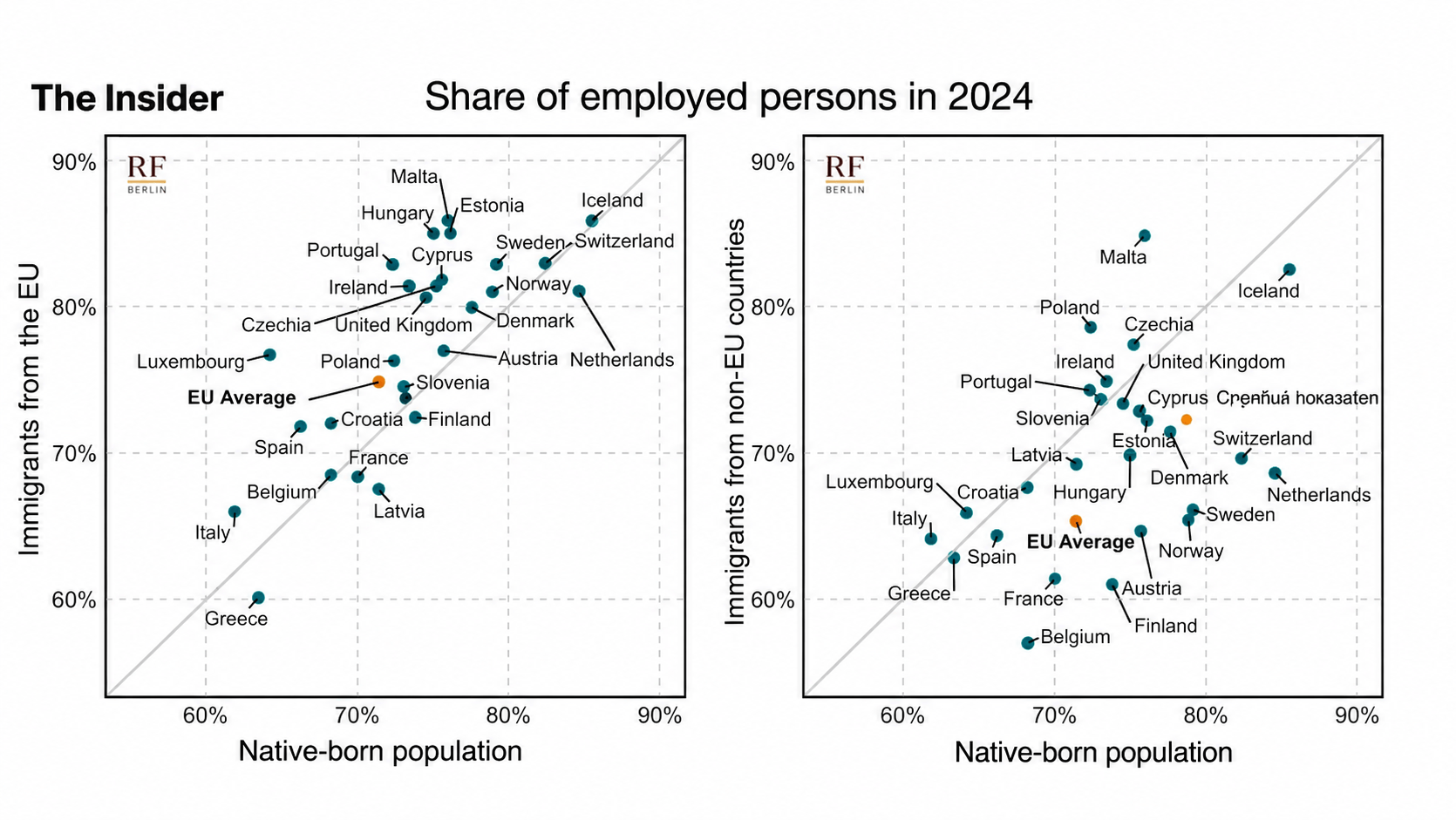
In eight EU countries, migrants from non-EU states have a higher employment rate than the native population: the Czech Republic, Ireland, Italy, Luxembourg Malta, Poland, Portugal, Slovenia. Among these, Poland and the Czech Republic receive large numbers of Ukrainians who benefit from simplified work-permit procedures, while Portugal has an analagous arrangement for people from its former colonies.
In the United States, migrants have traditionally had lower crime rates, better health outcomes, and higher levels of academic achievement than native-born Americans, while by the third generation they tended to converge with — or even surpass — them on economic indicators. Even refugees had employment rates comparable to those of labor migrants.
However, in the 2010s, a surge of asylum seekers began crossing the U.S. border from four primary countries: Honduras, El Salvador, Guatemala, and Venezuela. This influx was largely a legacy of U.S. intervention in these countries' politics during the Cold War, exacerbated by the flow of weapons into Latin America from the United States itself. Because these asylum seekers arrived in the U.S. directly rather than through the UN resettlement program, they were barred from working until their asylum claims were approved. Unsurprisingly, their integration outcomes were worse than for previous waves of newcomers, forcing the government to spend considerably more money to support them.
Restricting asylum seekers' right to work therefore has long-term negative economic effects. Until the restriction is lifted, refugees are forced to rely entirely on government support, thus becoming dependent on benefits. During this period, they remain disconnected from society because they are excluded from economic life, while their professional skills gradually deteriorate. As a result, their chances of finding employment after receiving work authorization fall by 15%.
Restricting asylum seekers' right to work has long-term negative economic effects
The phenomenon is not American in nature. In Germany, a court ruling reduced the length of time refugees had to wait for work authorization. This experience showed that people who had to wait an additional seven months for permission to work were 20 percentage points less likely to find employment than those who obtained the right earlier. The gap only disappeared ten years later, and researchers estimate that the EU lost €37.6 billion in GDP because refugees who arrived during the migration crisis triggered by the war in Syria faced restrictions on employment.
Which migrants arrive
In Sweden, refugees can work almost immediately after applying for asylum, although only in low-skilled jobs. Nevertheless, the country's integration outcomes are among the worst of any developed country.
A major factor is the composition of the migration flows arriving in Sweden. For decades, the country has accepted large numbers of refugees, most of them from the culturally distant Muslim world. The three main countries of origin for migrants in Sweden are Syria, Iraq, and Afghanistan. Sweden is now the European country with the highest number of refugees per capita.
Refugees, however, are the category of migrant that is hardest to integrate. Unlike economic migrants, who typically choose their destination in advance, prepare for the move, learn the language, and often already have useful contacts, in-demand skills, or a job offer, refugees are forced to leave their homes. They often lose their property, documents, professional networks, and the ability to make use of the human capital they have accumulated. They adapt much more slowly than labor migrants and people who move for family reunification, resulting in what researchers refer to as the “refugee gap.”
Refugees are the category of migrants that is hardest to integrate
While labor migrants move based on their skills and the needs of the labor market that attracts them, refugees go wherever they can find safety. Their integration is further complicated by the trauma they have experienced, prolonged uncertainty over their legal status, restrictions on access to the labor market while their applications are being processed, and administrative policies that place them in areas with limited economic opportunities and little or no diaspora support.
In Spain, the flow of humanitarian migrants today is comparable to that seen in Sweden at the peak of its refugee intake (although its relative size is significantly smaller given that Spain's population is five times as big). At the same time, 47% of migrants in Spain come from Latin America, with which Spain shares a language and similar culture. They can enter without a visa, are immediately allowed to work, and can apply for citizenship after just two years of residence. Another 27% come from other European countries, while only 18% come from Africa and 6% from Asia (including the Philippines, which was also once a Spanish colony). In short, historical, cultural, and linguistic ties make integration into Spanish society considerably easier for most migrants than the integration of Middle Eastern migrants in Sweden, despite the lower level of government spending.
Russia likewise has significant cultural and linguistic influence in Central Asia, as well as large diasporas from the region, making it easier for migrants from Central Asian countries to integrate into Russian society. Similarly, the U.S. has exerted influence across Latin America for centuries and is home to large Latin American diasporas. Poland and the Czech Republic have also achieved strong migrant integration outcomes because, historically, they have primarily received Ukrainians, who are culturally and linguistically similar and can take up employment immediately. Thus, even when a large influx of Ukrainian refugees arrived after the outbreak of the war, they were relatively easily integrated.
Cultural differences, however, do not account for the entire gap. The quality of the human capital that countries attract also matters. The U.S., for example, is geographically distant from most of the world's main migration routes, so reaching the country itself requires substantial resources. Its high wages consequently attract some of the most successful and highly educated migrants.
For example, Middle Eastern migrants in the U.S. are twice as likely as Americans overall to hold a bachelor's degree, and they earn slightly more. In Europe, by contrast, where many arrived as low-skilled guest workers, undocumented migrants, or refugees, they are among the most disadvantaged groups, with low incomes and high crime rates.
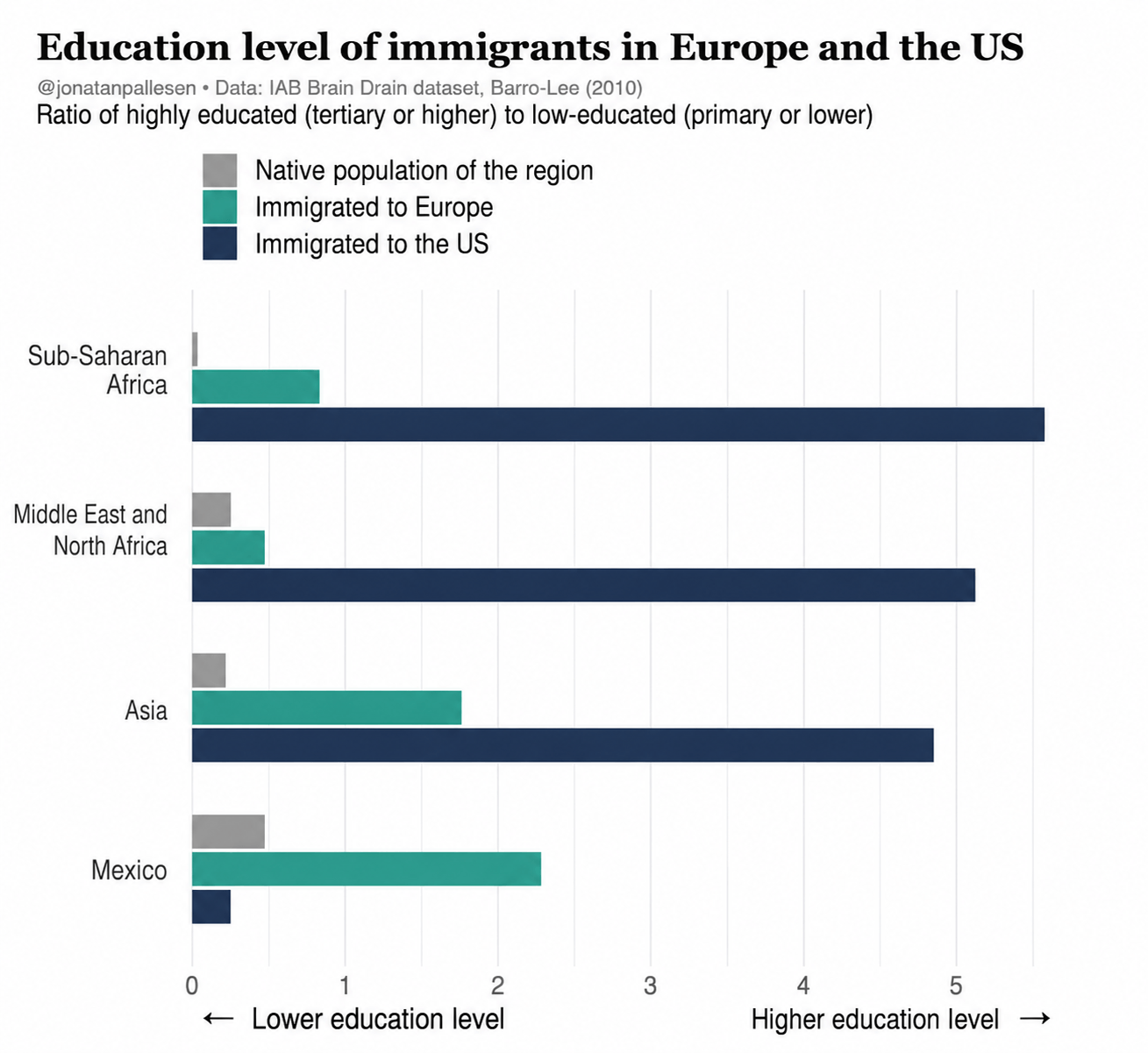
Similarly, Pakistani migrants in the U.S. have higher incomes and higher levels of education than the native-born population, while in Britain they have one of the lowest employment rates in the country. The colonial legacy plays a role: in the 1950s and 1960s, Britain itself brought in large numbers of workers from Pakistan to work in factories, and they later brought their families over.
A substantial part of the employment gap, however, is also explained by the fact that many Pakistani women, due to cultural traditions and discrimination, choose not to work and instead engage in unpaid domestic work, a common practice among diasporas from Muslim-majority countries across Europe.
The impact of discrimination
Finally, it also matters how prepared a country's institutions are to receive migrants. Even if a country attracts relatively well-off migrant groups and provides them with rapid access to the labor market, that alone is not enough. What matters is whether institutions allow migrants to compete with native-born residents on an equal footing.
The U.S., Canada, Australia, and New Zealand are countries built by migrants. They have accumulated experience with immigration and established diasporas that help newcomers integrate. European countries, by contrast, only became countries of immigration in the 20th century, having previously been countries of emigration. They are considerably more ethnically homogeneous and therefore have less experience and few longstanding institutions for integrating migrants.
A meta-analysis of 97 experiments examining hiring discrimination across nine developed countries — the U.S., Canada, France, Belgium, the UK, Germany, the Netherlands, Norway, and Sweden — found that the highest levels of discrimination in the initial screening of résumés were recorded in France and Sweden, while the lowest were found in Germany, Norway, and the U.S. In Sweden and France, the groups facing the highest levels of discrimination were also those that make up a significant share of the migrant population: Black people and people from the Middle East.
France and Sweden have the highest levels of discrimination in screening résumés from applicants with “migrant” names
The poor results of Sweden's integration policy can therefore also be attributed to informal practices, such as screening out candidates with foreign-sounding names at the résumé stage. Even when the state is highly willing to fund social programs, migrants can face serious barriers as early as the search for their first job. And this is only one form of discrimination. The study's authors note that Germany has managed to build a system that limits bias in hiring, while discrimination remains widespread in the housing market.
Promoting formal integration also has a positive effect on other aspects of integration. The experience of Switzerland, where naturalization applications in some municipalities were decided by referendum, showed that immigrants who won their vote and obtained citizenship earned an average of $5,000 more per year over the following 15 years than otherwise similar immigrants who failed to gain similar support. The effect was particularly strong among the most marginalized groups — people from Turkey and the former Yugoslavia, as well as low-wage workers.
Thus, institutions that not only give migrants access to the labor market but also recognize them as equal members of the political community can generate long-term economic benefits and improve the prospects for successful integration.