Mass migration involves a complex circulation of talent that cannot be reduced to mere “brain drain.” It can even bring unexpected benefits to the countries of origin. On the one hand, the departure of young, economically active citizens reduces the tax base, slows economic growth, leads to population ageing, and weakens institutions. On the other hand, based on multiple countries’ experience, emigrants form channels for the transfer of money, information, technology, and knowledge. That, in turn, often becomes the only tool for overcoming international isolation. Emigrants do not abandon their home countries; some even return with newly gained expertise and resources. Emigration may be a short-term weakness for the country of origin, but it leads to a long-term advantage, helping to lay the foundation for continuous development.
Negative consequences of emigration
The economic burden of population outflows lies primarily with the countries of origin. According to an IMF analysis, the departure of 20 million people from Eastern Europe (roughly 5.5% of the total population) between 1995 and 2013 led to an 8-percentage-point decline in population growth, a 6-percentage-point drop in labor productivity, and a slowdown in economic growth of 0.6–0.9 percentage points per year. Social spending consumed 6.2 percentage points more of the GDP than it would have if healthy, working-age citizens had remained in the country. A 1-percentage-point increase in emigration led to a 4.4% rise in the tax burden on those who remained.
India's experience demonstrates how the emigration of highly skilled workers can result in an estimated 2.5% annual loss in tax revenue. In the IT sector alone, these losses are estimated at $15–20 billion per year, while the country’s total losses from “brain drain” may reach $160 billion annually.
The outflow of talent from India reduces the country’s tax revenues by about 2.5% annually. In the IT sector alone, losses amount to $15–20 billion per year
More than 7% of India’s IT graduates move abroad. For the most prestigious colleges, this number is much higher. 31% from the Indian Institute of Technology’s Bombay branch, and nearly 50% from its Kharagpur campus.
The most educated and successful individuals are more likely to emigrate. While only 5.2% of Russia’s scientists are internationally mobile, they account for 28% of citations — a metric commonly used to measure research productivity. Until 2008, Russia’s emigration was composed primarily of these specialists. Although some returned after completing their studies abroad, the most productive scientists left permanently. Many specialists return home after encountering significant professional or social barriers to establishing themselves in the West; however, even they have a higher citation rate than those who never attempted to emigrate.
Highly educated migrants often experience 'brain waste,' filling roles that do not utilise their full professional capacity and generating less economic value for the destination country than they would have at home. According to 2021 data from the Organisation for Economic Co-operation and Development (OECD), this applies to about one-third of highly skilled migrants worldwide — roughly twice the rate among native-born populations. The highest levels of this mismatch are recorded in South Korea (73%), Canada (57%), and Costa Rica (56%).
Amid the global trend for population ageing, the outflow of skilled workers hits the healthcare sector hardest in poorer countries. According to the World Health Organisation, in 2021–2023, approximately 89,000 doctors and 257,000 nurses from countries already facing critical healthcare staff shortages were working in OECD countries.
Amid the global trend for population ageing, the outflow of skilled workers hits the healthcare sector hardest in poorer countries
From 2010 to 2020, the share of foreign medical professionals in eight OECD countries with an already high density of doctors per capita grew from 32% to 36%. Universal health coverage requires a minimum of 20.7 doctors per 10,000 people. While Europe has 43 doctors per 10,000 people, Africa only has two.
Official statistics from Nigeria’s Federal Ministry of Health show that over the past five years, the country has lost at least 16,000 medical professionals due to emigration. At the same time, Nigeria itself has only 55,000 licensed doctors for a population of more than 200 million — roughly one doctor per 4,000 patients.
In some African and Latin American countries, more than half the healthcare professionals have emigrated: 77% in Liberia and 54% in Guyana. In 2020, 12% of all nurses worldwide were working outside their countries of origin.
As a result, researchers estimate that developing countries collectively lose about $16 billion a year due to the migration of doctors to developed countries. Kenya, for one, loses roughly $500,000 per year for each emigrating doctor and $339,000 for each nurse.
Positive impact
Emigrants do not abandon the lives they led in their home countries after leaving. Roughly 30% of them return within 20 years, bringing back contacts, skills, knowledge, and money for investment. As such, emigrants from the former Yugoslavia who returned in the first half of the 2000s contributed about 6% to the growth of exports from their countries, thanks to connections and experience gained abroad. The rapid growth of India’s IT sector in the 1990s and 2000s was driven in part by members of the diaspora, who had founded major IT companies and venture capital funds and had the contacts and expertise to build these businesses and bring them to the global market.
Those living abroad transfer knowledge and technology, attract or make investments, and stimulate international trade. In India, the startup ecosystem continues to receive a significant share of funding from the diaspora abroad. Additionally, emigrants offer access to advanced technologies for their compatriots, helping accelerate the country’s development.
Emigrants transfer knowledge and technology to their home countries, attract or make investments themselves, and stimulate international trade
According to research, a 10% increase in immigration boosts trade volume between the destination country and the country of origin by 1–2%. In the case of the United States, a 1% increase in immigrants from a given country raises U.S. investment in that country by 0.35–0.42%. For highly educated immigrants, this rate can reach 0.41–0.52%.
Those who move abroad increase the visibility and productivity of their compatriots at home. Chinese scientists who emigrated made a major contribution to China’s rise as a global science leader between 2000 and 2015 by collaborating on research with colleagues who stayed in the country.
69% of all papers involving Chinese researchers included at least one member of the diaspora as a co-author, which doubled their citation rate. As a result of the increased citation rate, within a single generation, Chinese science moved away from the periphery and came closer to the level seen in the United States.
A similar situation is observed among European scientists in the United States. After moving to the global hub of science, they begin to file patents 42% more often than their counterparts in Europe. At the same time, if one co-author leaves, the productivity of those who remain increases by about 18%.
Overall, if the European Union tried to rein in emigration by lowering taxes for returnees, it would gain about 5% growth in the short term, but lose 6% after 25 years. By contrast, doubling the number of migrants from the EU to the United States would increase productivity in both economies by about 9%.
Doubling the number of migrants from the EU to the United States would increase productivity in both economies by about 9%
Some researchers argue that even authoritarian regimes could benefit from leaders who were educated in Western countries. Upon coming to power at home, such leaders could temporarily improve the country’s democracy index. Even North Korea’s Kim Jong Un, who studied in Switzerland, has promoted women to senior positions within the party apparatus. He is also rumored to be preparing his daughter as his potential successor.
Emigrants from Moldova send substantial remittances back home, accounting for about 12–16% of the country’s GDP (over the 30 years since the collapse of the USSR, 40% of the population has left the country). They also actively vote in elections, significantly contributing to the country’s pro-European orientation. Political emigration can directly support domestic opposition through resources and advocacy efforts.
At the same time, evidence is also emerging that migrants living in countries experiencing a rise in right-wing populism may contribute to democratic erosion in their home countries by voting for such politicians from abroad. Similar examples can be found among Latin American diasporas in the United States, as well as among migrants from Sweden and Romania, who tend to vote for right-wing populist candidates in their home countries more actively than their compatriots who remain there.
Money sent back home
Remittances — money transfers sent home by diaspora communities — remain the most important channel through which migrants influence their countries of origin. According to the World Bank, in 2023 these reached $740 billion, of which $656 billion were sent to developing countries — an amount that exceeded both foreign direct investment flowing into these countries and international aid, the latter by a factor of three.
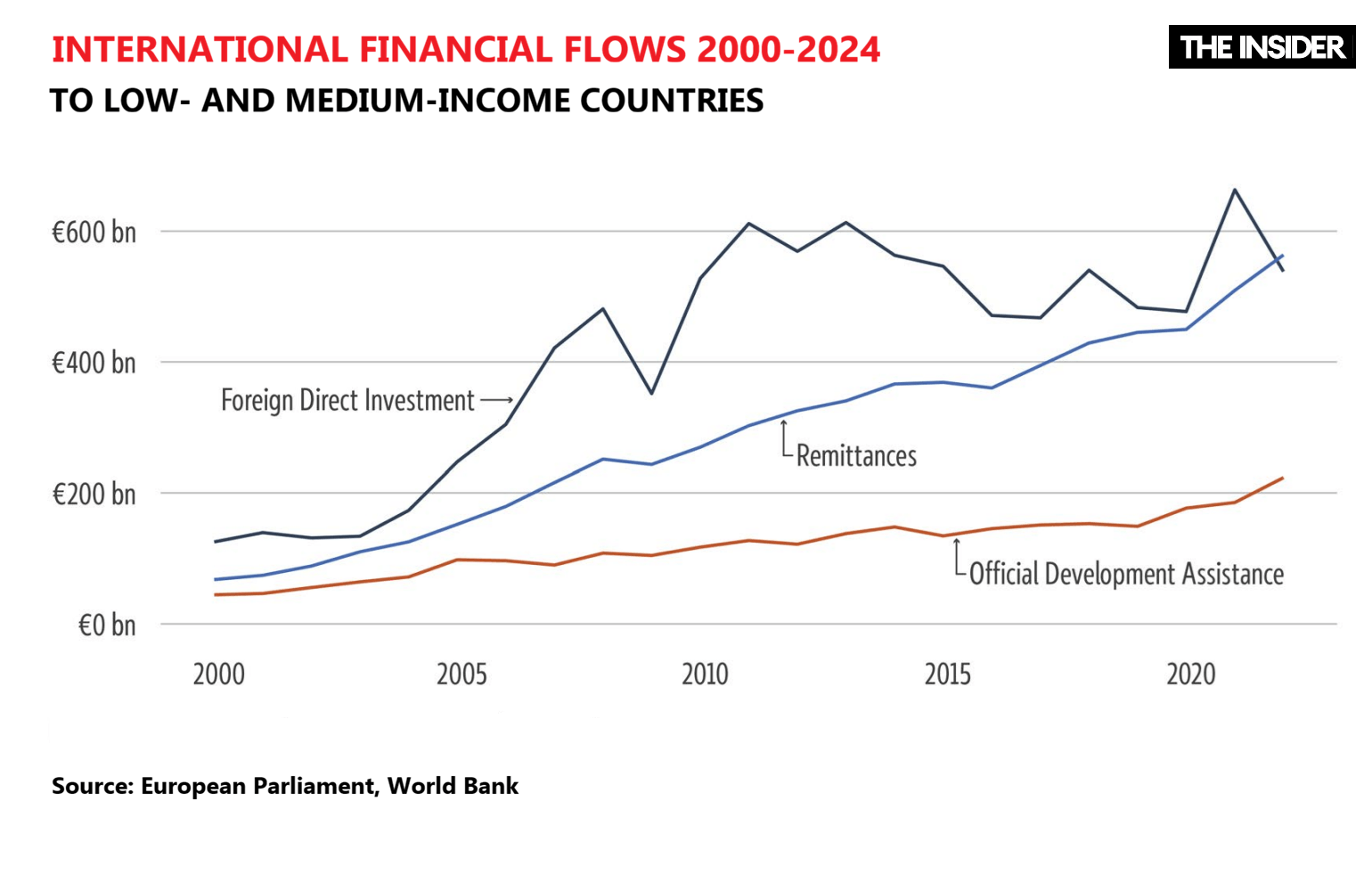
Migrants send 20–50% of their income back to their home countries, and remittances are received by around 800 million people. The most active senders are women, those who have family members in their home country, and those planning to return. Highly educated migrants tend to send remittances less frequently, and after about 10 years in the host country, the amount sent per person begins to decline.
India, which loses up to $160 billion a year due to the emigration of skilled workers, receives about $120 billion back in remittances — the largest flow of such transfers in the world. A similar situation exists in Latin America: the IMF estimates that a 1-percentage-point increase in emigration leads to a 0.29% decline in GDP, but remittances from the diaspora offset this by an amount equivalent to 0.19% of GDP.
However, the effect can vary by region, and some countries tend to lose more than they gain. In Bosnia and Herzegovina, a 1% increase in remittances leads to a 0.53% loss in GDP. Researchers suggest that the effect depends on whether a country’s financial institutions allow diaspora money to be channeled into investment and production, rather than being used solely for consumption.
India, which loses up to $160 billion a year due to the emigration of skilled workers, receives about $120 billion back in remittances — the largest flow of such transfers in the world
On average, roughly 75% of remittances are spent on consumption (food, clothing, and other immediate needs). The remaining funds are invested in education and health (that is, human capital), housing, and business. Remittances can even improve school attendance rates and reduce child mortality. Those who have emigrated also serve as role models, encouraging those who remain to work and study harder and for longer periods.
This effect primarily concerns close relatives. As data on families of Filipino migrants show, children whose fathers have emigrated are 24% more likely to go to college. In other words, migration indirectly improves the quality of human capital in countries of origin, since not all those who prepare for international employment actually emigrate.
Remittances can also be non-monetary. Migrants send back technologies, political culture, and social norms from their host countries to their native societies. A study in Burkina Faso found that returning migrants and members of the diaspora introduced new public health practices into rural communities (such as handwashing and waste management) and worked to improve housing conditions and local infrastructure.
The most notable outcome was the development of prenatal and postnatal care and malaria prevention. In Armenia, during the COVID-19 pandemic, families of migrants who had moved to the Czech Republic actively promoted Western sanitary practices at home and encouraged elderly relatives to follow safety measures, despite the government's policy of downplaying the threat. They demonstrated significantly greater caution than their neighbors who had no relatives abroad.
For many countries, diaspora remittances make up a significant share of national income. Tajikistan ranks second by the share of remittances as a percentage of GDP (39%), receiving $4.6 billion — an amount comparable to half of its state budget revenue. About a quarter of the country’s citizens work abroad, with 95–98% of them in Russia. However, Moscow’s anti-immigrant campaign could threaten regional stability given that frustrated, unemployed populations are an easy target for recruitment by terrorist organizations.
For many countries, diaspora remittances make up a significant share of national income
Ukraine is also a major recipient of remittances, ranking among the top 15 countries globally by total inflows. In 2023, it received about $15 billion from its diaspora, equivalent to 8.5% of the country’s GDP. In 2022, remittances reached $16.8 billion. For comparison, Russia received just over $10 billion in remittances in 2020, or about 0.7% of its GDP. More recent estimates for Russia are unavailable, as bank transfers from the European Union have been blocked and cash flows are difficult to track.
Some advanced economies, such as France and Germany, are also major recipients of remittances. A significant share of these funds likely comes from their citizens working in an even more developed country — Switzerland, for instance — while living and spending their income in their home countries.
Why people leave and why they return
Research suggests that migrants bring the greatest benefit to their home country when they maintain ties to it and return, or plan to return — they contribute more money, knowledge, and skills. But what influences one's decision to leave or to come back?
In the past decade, some Eastern European countries have welcomed back a significant share of citizens who left after the collapse of the socialist bloc. In particular, Poland and the Baltic states have experienced either increasing remigration or even a situation in which the number of people returning is more than those who left. In 2016, about 2.5 million Poles were living abroad, but by 2025, around one million had returned to their homeland.
Citizens of Eastern European countries largely emigrated due to poverty and a lack of jobs. Data from Lithuania show that the pace of emigration directly correlates with unemployment rates. At the same time, the departure of surplus labor eased pressure on the labor market, pushing wages upward. A 1-percentage-point increase in emigration led to a 0.67% rise in wages, with the effect being more pronounced in groups that accounted for the largest share of outflows — most notably young workers.
Some researchers believe that rising labor costs reduced the competitiveness of Eastern European economies. Nevertheless, improvements in economic conditions, lower unemployment, and rising wages have led people to return. This trend was also supported by Brexit, which triggered economic difficulties in the United Kingdom. The UK’s economic difficulties were also caused by the energy crisis at the start of Russia’s full-scale war in Ukraine, which, in turn, contributed to a recession in Germany.
Since emigration is often driven by unemployment caused by insufficient capital investment, some countries deliberately design their education systems with the expectation that “surplus” labor will work abroad and send back remittances that can be invested in development. The Philippines is often cited as an example: some 238,000 Filipino nurses work overseas — more than from India, Poland, and the United Kingdom combined, generating around $8 billion in remittances, which accounts for roughly 2% of the country’s GDP.
Some countries deliberately design their education systems with the expectation that “surplus” labor will work abroad and send back remittances that can be invested in development
China also trains more healthcare workers than it can employ domestically, partly due to underinvestment in its healthcare system. In some cases, the state assists these professionals in finding jobs abroad, taking a commission of about 10–15% of their salaries in return.
Faced with the departure of a significant share of the population, governments could become concerned with demographic decline, a shrinking tax base, and the need to improve domestic institutions in an effort to attract citizens back.
Researchers have concluded that this effect increases as emigration rises, up to the point where about 20% of the population has left. After that, it begins to decline, becoming negative as soon as 47.4% of residents have emigrated, at which point institutions tend to deteriorate. When too many people leave, the preferences of the median voter shift, politicians lose incentives to pursue reforms, and the influence of emigrants, as well as the government’s desire to attract them back, becomes insufficient to drive institutional improvement.
What Russia has lost and gained
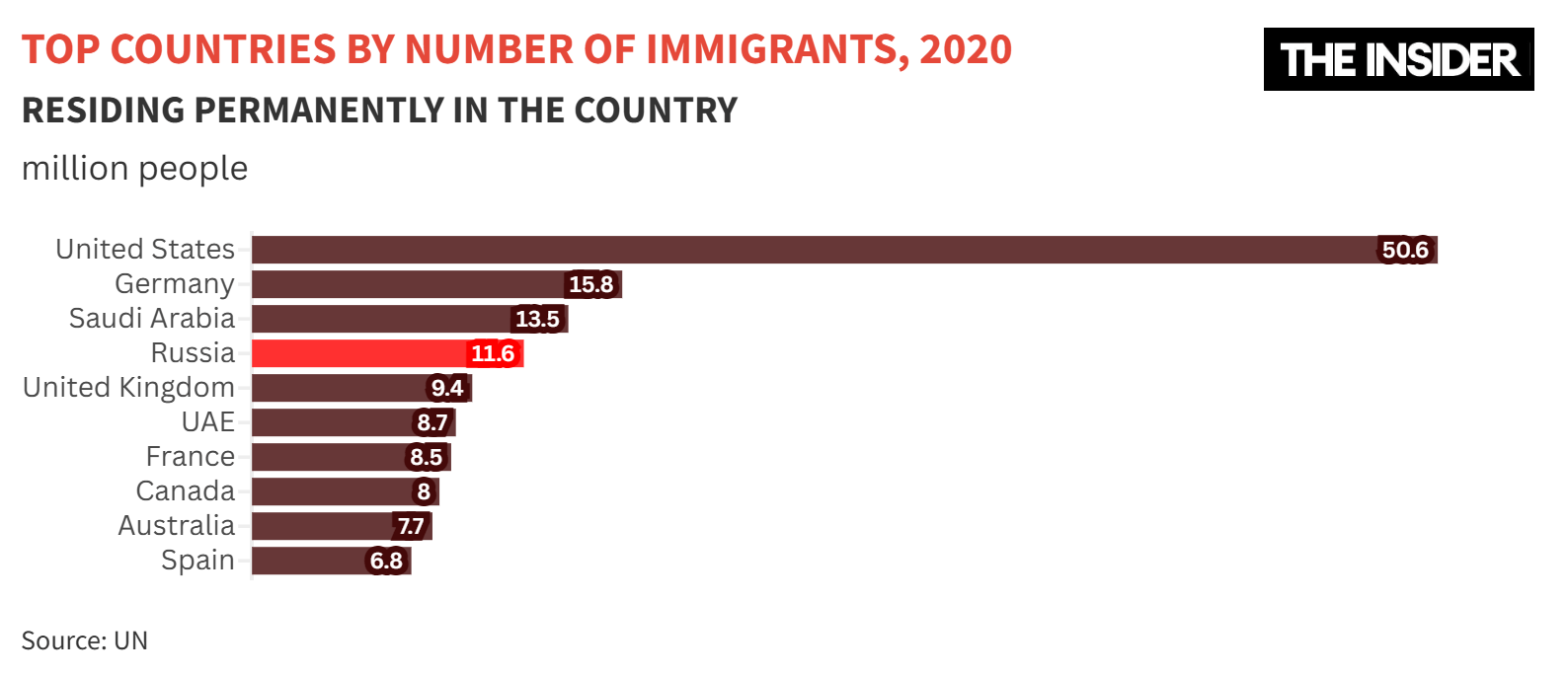
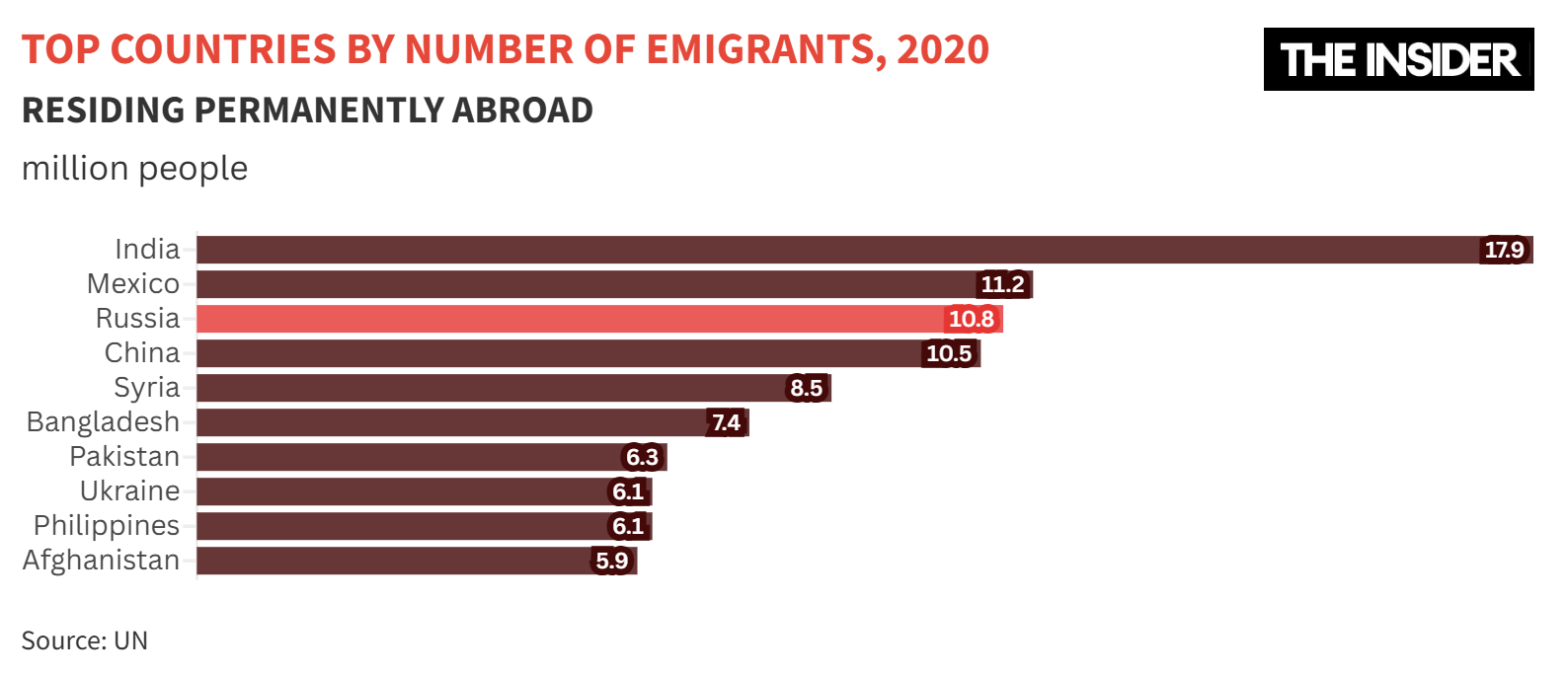
Throughout its history, Russia has experienced at least five major waves of emigration. For many years, it has been both among the leading host countries and countries of origin. According to UN estimates, 7.6 million immigrants were living in Russia in 2024 (compared with 11.2 million in 2020), while 11 million Russians were living abroad. However, data after 2020 lack precision since the latest censuses were conducted during the pandemic and later in wartime. The total number of Russian emigrants and their descendants may reach 25–30 million people. Most of them live in post-Soviet countries, the U. S., Israel, and Germany.
The migration wave that began after the full-scale invasion of Ukraine is often described as one of the largest in the country’s history. According to various estimates, between 500,000 and 1.3 million people left Russia in the first year of the war alone. However, this surge aligns with the peak of a broader wave that had begun in the first half of the 2010s amid election fraud, protests, and economic stagnation. In the decade preceding the full-scale war, more than 3 million people left Russia.
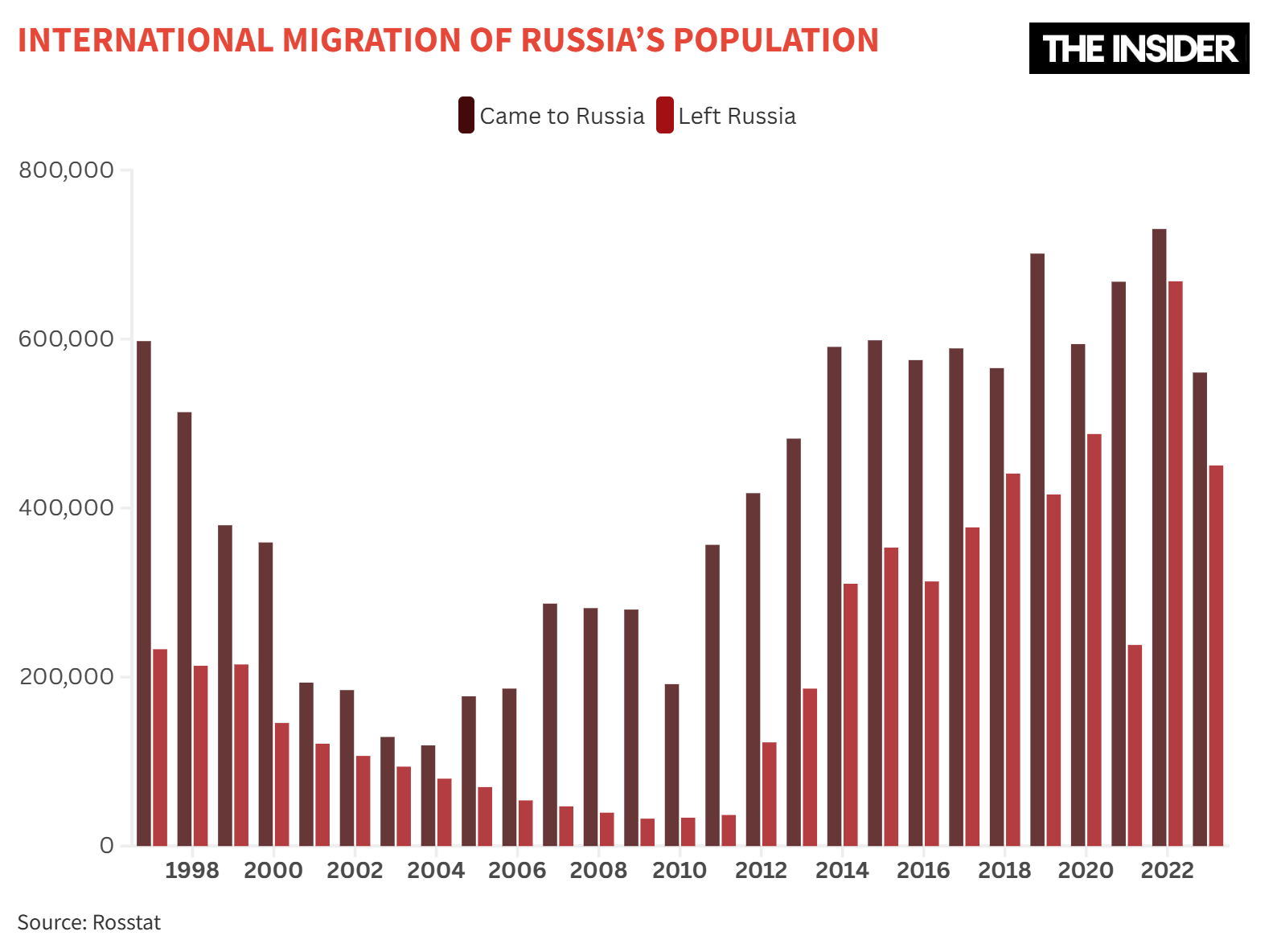
The country has been losing mostly young, educated, economically active people. According to OutRush, a project studying the current migration wave, Russians who left after the full-scale invasion have an average age of 33. Roughly 86% of emigrants are under 45, and nearly half are between 25 and 34. Around 80% of those who left have higher education, 43% work in IT, and another 21% in culture and science. For comparison, the median age in Russia is 40.5 years, and only 27% of the population has a degree.
Economists warned even before the war that emigration harms the already unbalanced demographics of a rapidly aging country, reduces the tax base, and slows technological progress due to “brain drain.” The IT sector alone lost about 10% of its employees in 2022.
At the same time, many of those who left after the start of the war continue to work for Russian companies and follow domestic news. Three-quarters of the recent emigrants are ready to consider returning if the war ends and the political situation improves.
Russian migrants could transfer money, experience, and technology back to their home country; however, Moscow’s isolationist policies and Western sanctions have largely limited these opportunities. At the same time, this has also slowed further losses of human capital in Russia.
The longer the conflict continues, the greater the gap between migrants and their homeland will become, and the likelihood of their return will become lower. However, an end to the war — and especially a change in the ruling regime — could play a significant role in restoring Russia’s international ties, rebuilding trade, and transferring knowledge and technology.