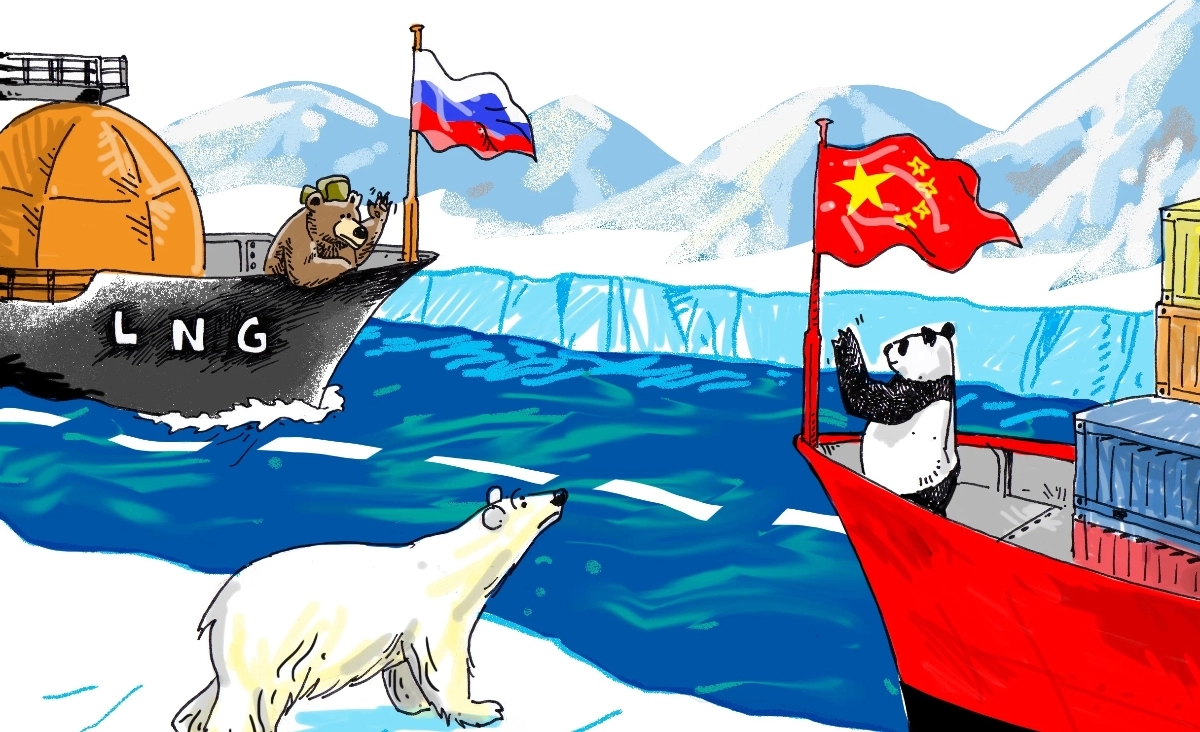
In January 2026, Trump refused to rule out the use of military force to annex Greenland, claiming that the surrounding waters were teeming with Russian and Chinese ships. On the surface, the evidence seems compelling: joint military exercises between Russia and China, Chinese deals to invest in Russian Arctic infrastructure, Russian projects exporting liquified natural gas (LNG) to the Chinese market along the Northern Sea Route (NSR). The multifaceted forms of cooperation between Moscow and Beijing are intended to project an image of strength. But how strong is this relationship really?
While Russia’s annexation of Crimea in 2014 made working with Western states in the North challenging, it remained possible inside the tacit zone of Arctic exceptionalism. However, since the start of the Kremlin’s full-scale invasion of Ukraine in 2022, both Sweden and Finland have joined NATO, meaning that every Arctic state other than Russia is now a member of the alliance. The Arctic Council, which served as the chief international platform for dialogue and cooperation on Arctic issues, has been largely put on ice.
For Russia, the Arctic is central to the country’s identity, economy, and policy direction — both foreign and domestic. The Arctic was outlined as a priority region in Russia’s 2023 Foreign Policy Concept, and economically, the region contributes 6% of Russia’s GDP and 10% of exports, according to official statistics.
While Moscow has long preferred to see the region function as an effective Arctic-states-only zone, ever since 2022 enforcing such an initiative is no longer a real option. Sweeping sanctions make any new form of cooperation in the North nearly impossible, and Russia’s economic troubles make it difficult to invest in the region independently. In February 2026, Russia and China ratified a protocol to cooperate on the Yamal LNG plant in Siberia, a move necessitated by the EU’s plan to phase out all Russian LNG imports by 2027. But while the visible trade and military cooperation between Russia and China project an image of partnership, the reality is far less clear.
The price of isolation
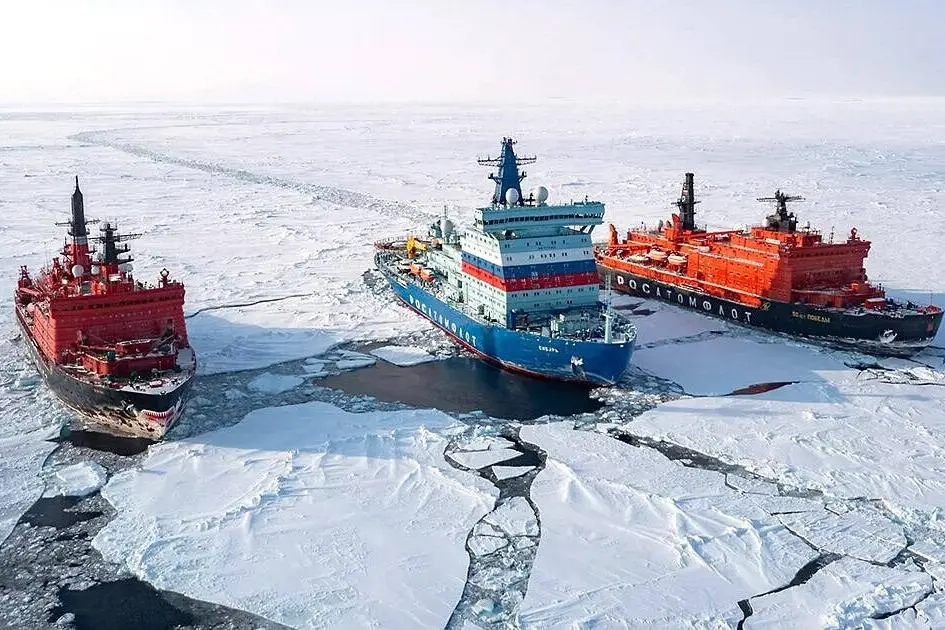
Russia's need to seek out alternative buyers for its Arctic energy reserves sheds light on Russia’s growing economic dependence on China. South Korean firm Samsung Heavy Industries, which was previously contracted to supply icebreaking LNG carriers to the project, has terminated its contracts with Russia’s Zvezda shipbuilding complex over sanctions concerns. Sanctions have also blocked the delivery of a floating dock, built in Turkey, that Russia needs if it is to service its nuclear-powered icebreakers.
The problem is not only external. Russian state-owned nuclear corporation Rosatom planned to develop and build modernized floating power units for the Baimsky Mining and Processing Plant in Saint Petersburg’s Baltic Shipyard. However, due to capacity constraints, three out of four hulls for the units were outsourced to Chinese company Wison (Nantong) Heavy Industry. “There's limits to what a heavily sanctioned Russia can do on its own from an infrastructure and commercial perspective. That leaves the Kremlin in a very hard place,” says Mathieu Boulègue, a non-resident senior fellow in the Transatlantic Defense and Security Program at CEPA.
What’s more, Ukraine's attacks on Russian oil terminals have taken roughly 40 percent of Russia's oil exports offline, meaning Russia cannot count on the commodity windfall that might otherwise offset its current constraints.
“They need investors and customers for Arctic resources,” explains Elizabeth Wishnick, a senior research scientist in China studies at CNA, a non-partisan analytic organization. “But they also don't want to depend too much on any one country, even their strategic partner, in a very sensitive region that's so important to the Russian economy.”
Russia needs investors and customers for Arctic resources, but it doesn't want to depend too much on any one country
Moscow remains clear-eyed about the risk inherent in its overdependence on China, looking to India and the United Arab Emirates as potential alternatives. “India is an important partner for Russia in the Arctic. Indian naval personnel are being trained in Vladivostok to work in Arctic waters,” adds Wishnick.
In order to help alleviate this dependency, Russia sells natural gas to these buyers at a heavily discounted price. But even so, this isn’t enough to ensure a sufficient diversity of customers. “The demands that China has, but also the funds that the Chinese state-owned companies can come with, are very difficult to replace with anything else,” explains Camilla T. N. Sørensen, an Associate Professor at the Royal Danish Defence College.
There is a strong need for investment in Russia’s Arctic infrastructure and resources, but as Sørensen notes: “There are Russian local leaders or business people who are somewhat frustrated by the lack of interest and lack of financing from Moscow, and they see opportunities also by engaging the Chinese.”
This frustration reflects a broader reality in the North. High rates of respiratory illnesses, food insecurity exacerbated by climate change, and lack of public services all contribute to a low standard of living in a region with a population of approximately 2.5 million. “They have to deal with the impact of climate change in the region and the precipitated consequences: mostly coastal erosion, unstable soil, and subsoil that is also endangering the infrastructure,” says CEPA’s Boulègue. “And the cost is rapidly rising for the Kremlin.”
The full-scale invasion of Ukraine has compounded these pressures. Wishnick points out that the region is now “facing outflows of population worsened by the need to enlist people in the military.”
A transactional relationship
China, meanwhile, is largely satisfied with its current role in the region. After years of Arctic institution-building — observer status at the Arctic Council, research stations in Svalbard, Sweden, and Iceland — Beijing grew increasingly assertive, declaring itself a “near Arctic state” and outlining plans for an “Ice Silk Road” in its 2018 Arctic Policy. “It was an exercise in Chinese soft power to try to be more visible in the Arctic. It failed very largely because it was seen as too aggressive by actual Arctic states,” explains Boulègue. China has since engaged in what Sørensen calls a “tactical retreat” from the region.
The real Arctic states saw China's attempt to become more visible in the Arctic as overly aggressive
Despite their economic cooperation, Russia and China hold fundamentally different views on Arctic sovereignty. China considers the Arctic a “global commons” open to multilateral use, while Russia insists that Arctic states alone should determine Northern policy.
The name “Ice Silk Road,” which was laid out in China’s Arctic Policy of 2018, didn’t help either. “That implies that Russia is a through space for China en route to Europe,” explains Wishnick. It was only after China agreed to accept the territorial rights of the Arctic states that Russia became amenable to China’s involvement.
Necessity, more than trust, has created a “transactional” relationship with an undercurrent of suspicion. According to a report by the New York Times, a Russian FSB document allegedly outlined Moscow’s fears about Chinese espionage in the Arctic conducted via mining firms and university research centers tasked with acquiring strategic data that could threaten its autonomy. This wasn’t an isolated concern. In 2020, a professor at Saint Petersburg's Arctic Academy of Sciences was arrested and charged with high treason for allegedly providing classified intelligence on submarine hydroacoustics to China.
“Right now there is simply a complementary interest,” Sørensen underscores. “When that's no longer the case, the Russians would find ways to try to work with states other than China or even turn again to the other Arctic states.”
It's not an abstract scenario. When Trump and Putin met in Alaska at the 2025 Russia-United States summit, Sørensen notes, it sparked a genuine moment of anxiety in Beijing.
Treading Arctic waters
For the moment, Russia remains China's gatekeeper to the Arctic, though one increasingly reliant on Chinese support. Russian capacity to sail through the eastern part of the Northern Sea Route (NSR) is constrained by the limits of its icebreaker fleet and the difficult conditions in the eastern Arctic. This is where China has stepped in, taking on the central foreign role on the route.
In 2024, Russia and China established the Russian-Chinese Subcommittee on Cooperation on the NSR, a joint body headed by Rosatom and China's Minister of Transport to coordinate navigation safety, cargo traffic, and logistics development. That same year, Rosatom and the Chinese company NewNew Shipping Line signed a deal permitting Russian and Chinese firms to access the route year-round. In 2025, NewNew Shipping Line signed another deal with the Murmansk regional government to develop container transport through the Port of Murmansk, a key point on the route. And at the moment, the vast majority of container traffic along the route runs between Russia and China.
As CEPA’s Boulègue explains, the NSR, while important, is not among Beijing’s top foreign policy priorities: “[The Arctic] is not a key strategic priority. It doesn't define the foreign policy of China. It is just an aspect of regional politics.”
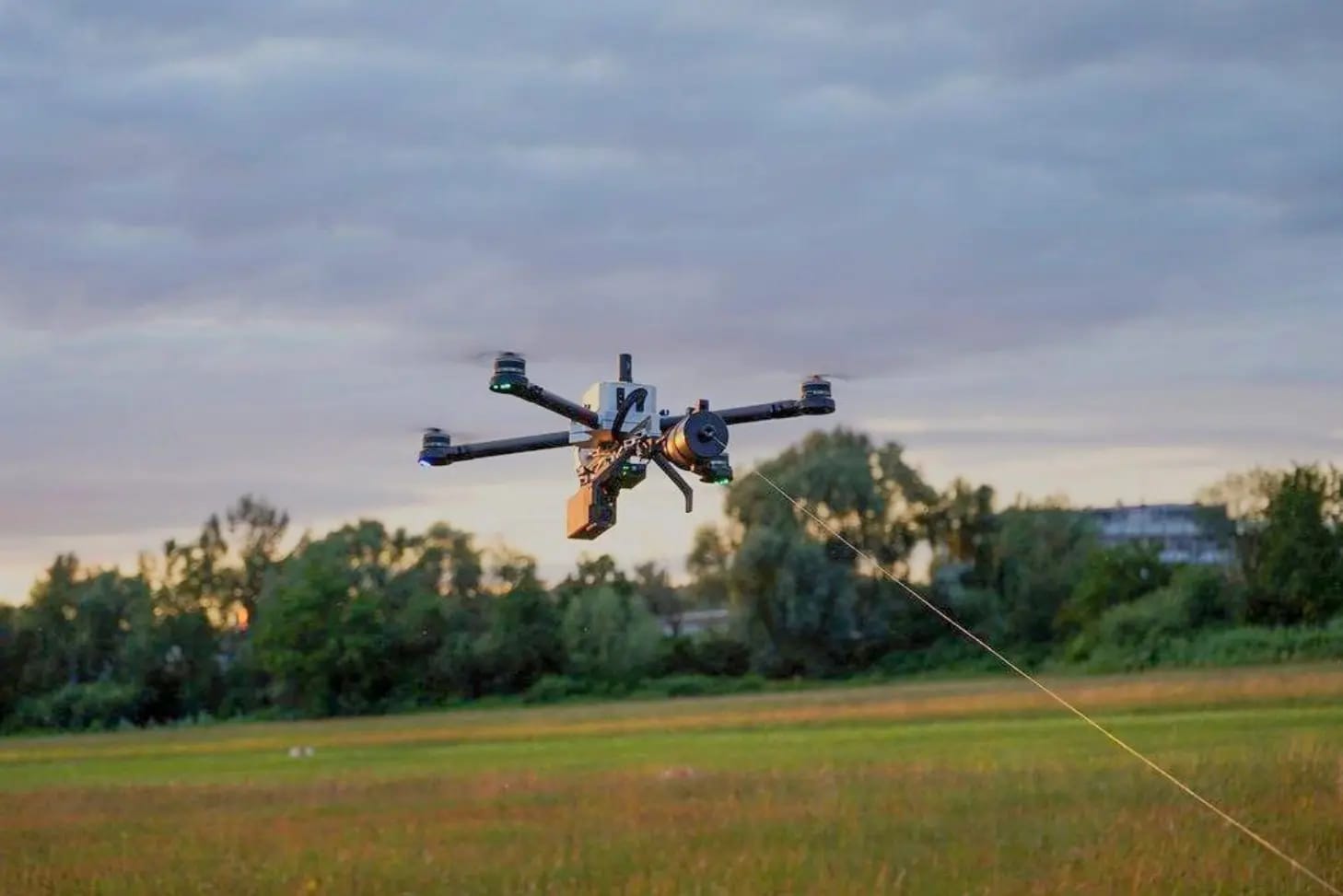
Instead, what’s most important for Beijing in the long-term is a China-friendly attitude in the Arctic providing for technological cooperation with regional states. Beijing sees the Arctic as a prime location to develop drones able to function underwater and in frigid Northern climates. Russia's expertise in navigating the region's environment, explains Sørensen, is particularly indispensable here.
But not all of the traffic along the NSR operates in the open. Russian shadow vessels have exported sanctioned LNG to Chinese ports via the route, cycling through names, flags, and registered owners. NewNew Shipping’s vessel NewNew Polar Bear was accused of cutting undersea cables in the Baltic Sea in 2024.
Yet the most significant security threat, according to Boulègue, is playing out far from the headlines about Greenland or the Baltic: “If you are looking for Russian and Chinese ships somewhere in the Arctic, they are around the Aleutian Islands and the Bering Sea, which is directly on the U.S. border, the exclusive economic zone, and the air defense identification zone.” It is here, along the Alaskan coast, that Russia and China have conducted joint bomber exercises and joint naval patrols and where Chinese Coast Guard vessels have entered the Arctic Ocean via the Bering Strait. The danger, Boulègue argues, is less about sustained provocation than the possibility of a single miscalculation followed by an unwanted escalation.
China, meanwhile, remains reluctant to be drawn into a direct confrontation with Washington, preferring to cast itself as a stabilizing presence in the Arctic rather than as an adversarial one. Beijing’s calculus is fundamentally about economics and norm-setting, not military gamesmanship. On Greenland specifically, “China has generally tried not to play up the whole crisis,” Sørensen observes, “because it's been coming at the same time as they've tried to improve relations with the U.S. themselves."
Complementary interests, mutual constraints
While Trump's comments about Russian and Chinese ships in Arctic waters are not necessarily unfounded, they tell only part of the story. As long as Russia’s war in Ukraine continues, Moscow will rely on Chinese investment in the Arctic. In turn, China will continue to depend on Russia as a gatekeeper for maintaining access to the region. “China's trying to get along with Russia, not to step on sensitive areas, but also to achieve its own goals, which may be different from Russia’s,” says Wishnick.
The limits of the partnership between Moscow and Beijing are written into its military dimension. Narrow in scope and concentrated in the Bering Sea, Russia-China defense cooperation is largely absent from the Baltic Sea and the waters around Greenland, the theatres that dominate Western headlines.
China's trying to get along with Russia, not to step on sensitive areas, but also to achieve its own goals
The Russia-China Arctic partnership projects an image of unity, and that projection is largely the point. Beneath the joint military exercises and energy deals lies a relationship built on mutual constraints rather than genuine alignment: Russia needs Chinese investment and export markets after Western sanctions left it isolated, while China is content to consolidate its existing foothold, pushing for a China-friendly policy.
“It's clearly driven by complementary interests. Russia needs to export and China needs to import,” explains Sørensen. Their cooperation is real but transactional, held together by overlapping interests — for now.