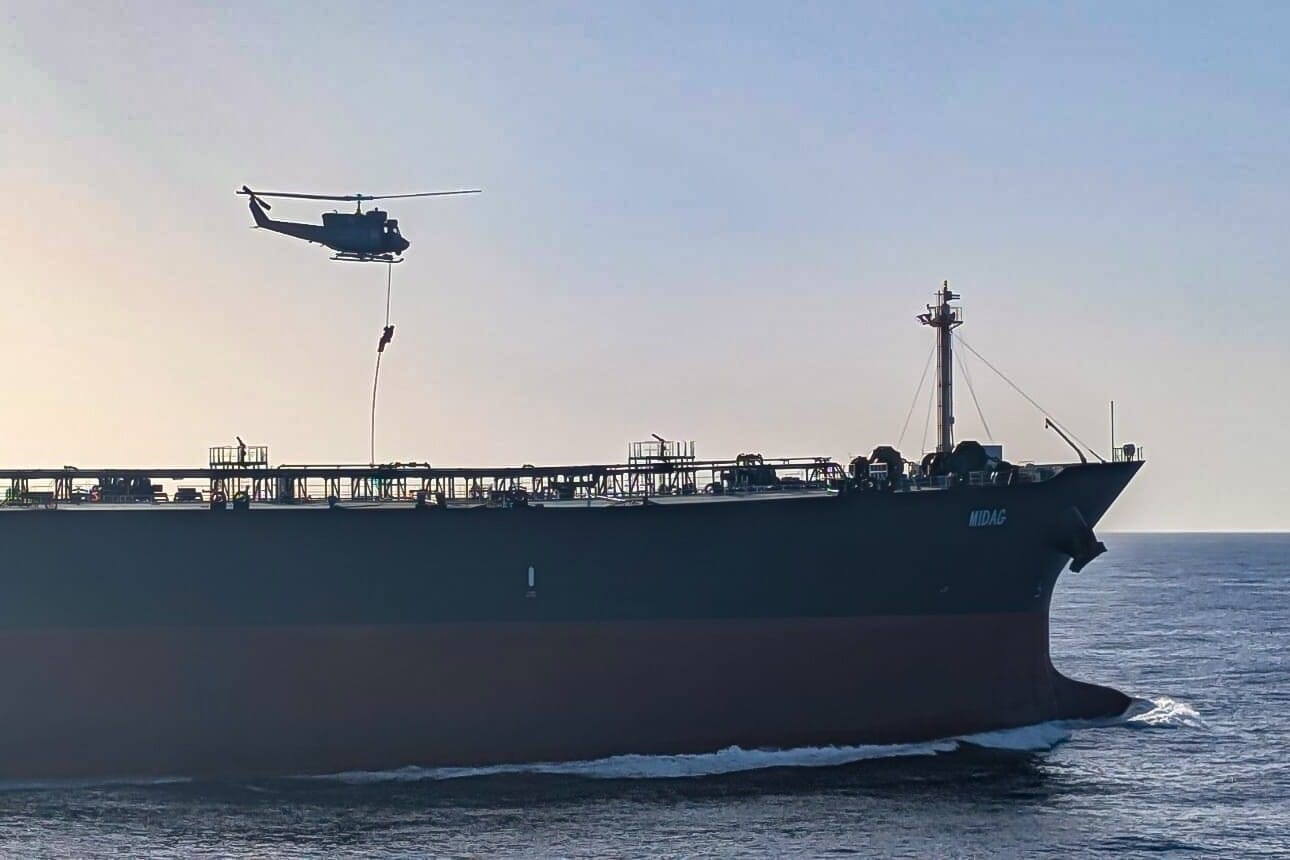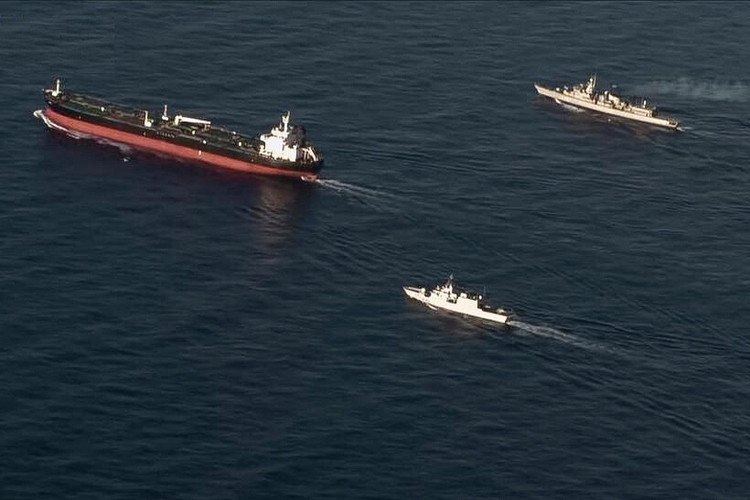
On Nov. 15, EU foreign policy chief Kaja Kallas announced that European military personnel had boarded the tanker Midag (IMO: 9266841) in the Mediterranean Sea and confirmed that it was sailing under a false flag. The vessel was not detained, however, and was instead allowed to continue its voyage. As The Insider found, the tanker had previously loaded Russian oil in Russia’s Primorsky Krai before being sanctioned by the United States for transporting Iranian crude.
One problem limiting the ability of the EU’s IRINI naval mission to detain such vessels is the absence of a designated port where they can be taken and subjected to further inspections, maritime security expert Gonzalo Saiz Erausquin told The Insider.
Erausquin, a research fellow at the Centre for Finance and Security at the UK think tank Royal United Services Institute (RUSI), said the mission depends on individual EU countries being willing to accept detained vessels and to bear the associated costs:
“The EU decision to expand IRINI's mandate to cover maritime domain awareness in the Mediterranean was a bold move to counter Russia's shadow fleet operations. IRINI has successfully boarded several tankers for flag verification but IRINI does not have a designated port where it can hold detained vessels and perform extensive inspections.
IRINI currently relies on coastal Member States making their own port to hold a detained asset. This makes IRINI dependent on inconsistent national appetites to face related costs and could be mitigated by the EU providing a designated port to IRINI to conduct its operations and carry out inspections that could further disrupt shadow fleet operations.
Most European detentions of shadow fleet vessels have been carried out under Article 110 of UNCLOS, that allows states to board vessels suspected of having no nationality — that is, falsely flagged tankers. The intervening state can then conduct the necessary inspections and if it identifies other technical deficiencies, it could decide to detain the ship until these are mitigated.
Most detentions have then allowed shadow fleet tankers to resume their voyage after a days or weeks, forcing Russia to incur greater delays and costs, but failing to cease their transits entirely.”
An internal document from the European External Action Service dated Feb. 23, 2026, and sent to the Council of the EU the following day also states that IRINI has no dedicated port or facility for holding detained vessels. The document’s authors said the lack of necessary infrastructure limited the mission’s effectiveness. As an example, they cited the July 2025 inspection of the vessel Aya 1 (IMO: 9293557) as part of IRINI’s efforts to enforce the arms embargo on Libya. A port to which the ship could be taken and a facility where it could be held would have to be designated before a full inspection and seizure of cargo could take place, the document said.
In the same document, European officials recommended expanding IRINI’s monitoring of Russia’s “shadow fleet” and allowing military personnel to board vessels suspected of using false flags, citing Article 110 of the UN Convention on the Law of the Sea (UNCLOS) as justification. According to the mission, 442 out of the nearly 600 Russian tankers then under EU sanctions passed through IRINI’s area of responsibility in 2025. Since it began carrying out maritime situational awareness tasks in 2025, IRINI has identified 72 vessels suspected of lacking nationality and confirmed 18 cases in which ships were sailing under false flags.
On Oct. 9, 2026, the Council of the EU extended IRINI’s mandate through the end of March 2029 and added countering Russia’s “shadow fleet” to its tasks. According to the mission’s Nov. 9 report, however, that work primarily involves monitoring vessels, gathering information, and verifying their nationality. By early November, IRINI personnel had carried out six vessel boardings to check flags.
The lack of a port is not the mission’s only limitation. Article 110 itself does not specify what should happen to a vessel once it has been confirmed to lack valid registration, Nele Matz-Lück, co-director of the Walther Schücking Institute for International Law and a professor of international law, told The Insider:
“Article 110 does not say anything about the consequences of the inspection. It is silent on the next steps, if the control results in confirmation that the vessel is stateless or was sailing under a (second) false flag.
States react differently: some ships that were boarded and considered stateless have been detained and fined, some have continued their journeys. While every ship must have a nationality, control rights do not automatically lead to confiscation. There is still private ownership of the vessel and its cargo.
The mere fact that a ship is listed on the EU list of ‘shadow fleet vessels’ is not sufficient for controls or detention on the high seas. On the high seas (including for that purpose the EEZ) only allegations of piracy or – as here – statelessness give rights to interception but, as above, not necessarily detention.”
As international maritime law experts previously explained to The Insider, even after a tanker is detained, authorities still face questions over the legality of continuing to hold it, who will maintain the vessel, and what should happen to its cargo and crew.