Since the start of Russia’s full-scale war against Ukraine, companies from Kazakhstan, Cyprus, India, Moldova, Georgia, and Ukraine itself have published at least 1,000 job ads recruiting sailors for vessels in Russia’s “shadow fleet,” The Insider has found. Crewing companies have largely avoided sanctions so far, even though they may be more vulnerable to designations than the ships themselves. The sanctioning of a vessel often does not create major problems for exporters. Crewing companies, however, work with hundreds of sailors who have no interest in losing their livelihoods — meaning these firms have a strong incentive to protect their reputations.
How the “shadow fleet” works
The so-called “shadow fleet” plays a key role in facilitating the continued export of Russian oil amid the Kremlin’s ongoing war against Ukraine. Estimates of the fleet’s size vary widely. In 2025, an investigation by Western journalists estimated it at 230 tankers, while the total number of suspected vessels can range from 1,000 to 1,800, depending on the source.
The term “shadow fleet” refers to vessels that evade international restrictions on Russian oil exports. That can include shipments to “friendly” countries that bypass price caps, ship-to-ship transfers on the high seas meant to disguise Russian oil as non-Russian, or exports by or to sanctioned companies.
The main destinations for shipments by the shadow fleet are India, China, Pakistan, and Turkey, though Georgia, Romania, and even Italy are sometimes added to the list.
The “shadow fleet” operates outside standard international cargo insurance systems, and many of its ships are in poor condition. They are typically aging, run-down vessels sailing under the flags of third countries — mostly African ones.
Companies that service “shadow fleet” vessels — as owners, charterers, managers, and crewing firms — are often registered in opaque jurisdictions that are difficult to monitor, making them harder to target with international sanctions. Aside from professional sailors, the ships themselves may carry GRU agents and former members of the Wagner Group, as highlighted in a recent investigation.
The Insider has previously identified several of these ships, along with the companies that utilize them.
Among the clear signs that a vessel belongs to the “shadow fleet” are the deactivation of its ship-tracking beacons, abnormally long periods at sea (as recorded in maritime traffic databases), changes in draft while on the high seas, and discrepancies between its declared and actual ports of departure and destination.
In this investigation, The Insider classifies vessels as being part of the “shadow fleet” if they are currently subject to sanctions by at least one country.
Why crewing companies matter
While sanctions against shipowners, operators, charterers, shippers, and consignees of “shadow fleet” vessels certainly make a positive difference in the struggle to deprive the Kremlin of oil export revenue, there is another category of company that also enables the seaborne trade in Russian energy: crewing companies. Sanctions authorities have largely overlooked them, but the firms that supply the sailors for vessels of the “shadow fleet” may be easier to pressure, as many of them operate in more accessible jurisdictions. Without access to the services of foreign crewing firms, Russia’s shadow fleet would face even more serious obstacles than it already does.
After all, vessels can be owned or chartered by opaque companies, and their counterparties may be equally murky oil sellers and buyers. Crewing firms, by contrast, often operate openly, posting job ads on maritime forums and Telegram channels. They depend on the capacity to operate openly, rendering them vulnerable to pressure from the coalition of countries seeking to enforce restrictions on the shipment of Russian oil.
Who recruits sailors for the “shadow fleet”
The Insider analyzed more than 20,000 posts from a number of popular Telegram channels where seafarer recruitment ads are posted, finding that over one thousand of them turned out to be seeking crew members for sanctioned “shadow fleet” ships. While most of these ads were posted before a given vessel was formally sanctioned, The Insider asserts that market participants are well aware which ships are engaged in which types of transport even before a ship is formally designated as a violator. A vessel’s name is also usually not specified in the ad, but its deadweight tonnage, year of construction, and flag are listed. This data is almost always sufficient to identify the precise vessel.
A significant proportion of the announcements seeking crews for vessels that are now under sanctions came from four companies:
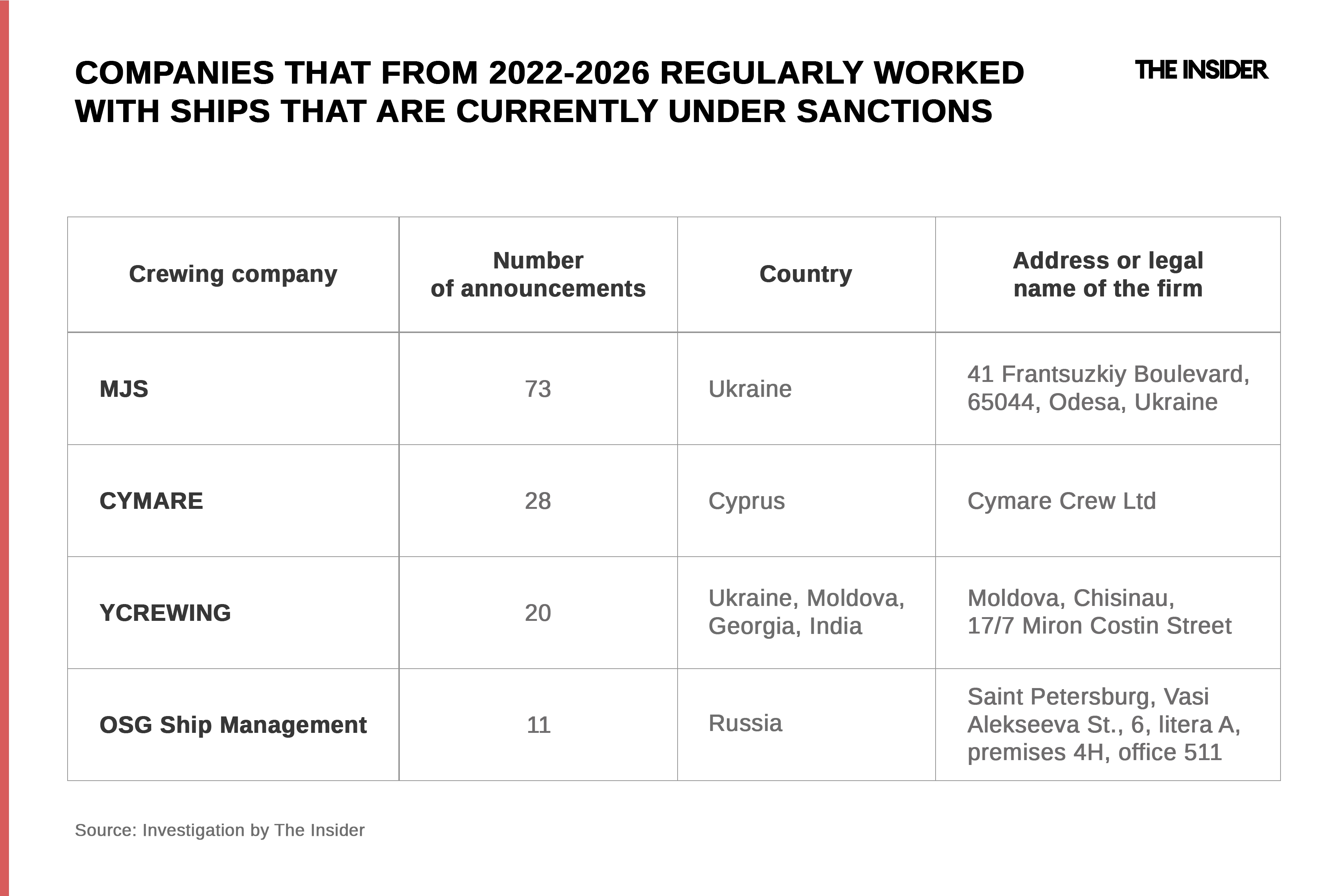
The Insider reached out to the aforementioned companies with inquiries but received only one response — from the Cypriot firm CYMARE. It did not provide any substantive clarification, but did criticize Ukraine’s classification of the vessels in question as being part of the “shadow fleet”:
“Ukraine does not use the G7/OFAC/EU compliance framework as its baseline. Instead, it applies a wartime economic logic. Under this logic, distinctions between ‘compliant’ and ‘non-compliant’ shipping are irrelevant. There is an intentional labelling, not a legal classification of factual and analytical evidence.
The content purposely holds false factual claims and skipping verification entirely, not bothering of any due diligence.
No need to say that intelligence agencies are, by definition, secretive and manipulative, often using the media to shape public opinion or serve strategic national interests, and advance their own narrative to others to become a tool for their agenda.”
The company stated that, at the present moment, it “is not recruiting a crew” for the tankers Grace Leon, Ocean Embrace, Asteri, Ursus Maritimus, and Cauveri. However, an analysis by The Insider showed that the deadweight, year of construction, and flag of the vessels listed in the Cypriot company’s crewing advertisements fully match the characteristics of these exact vessels.
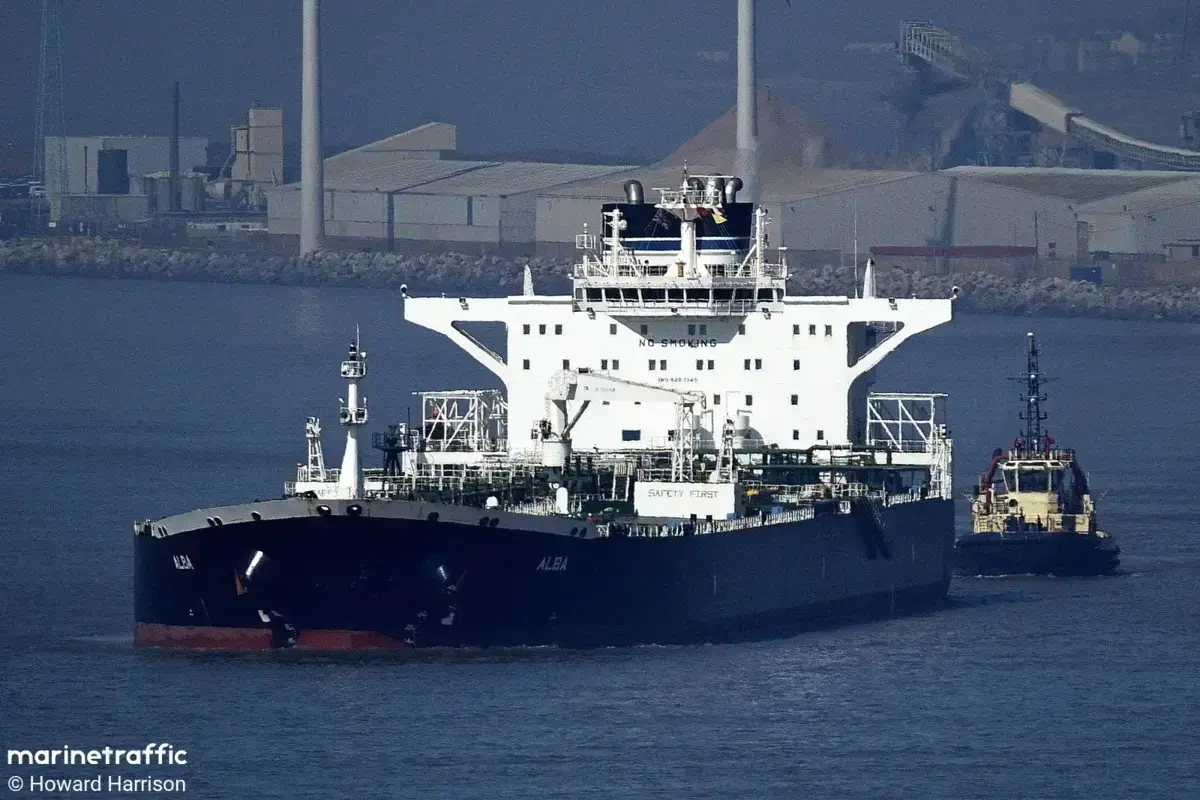
Most public job postings appeared before the vessels in question were designated. In some cases, however, recruitment continued even after the ships had been added to sanctions lists. For example, in 2025, the Odesa-based firm MJSML recruited seafarers for the vessel Hornet. The Kazakh firm LLP TS Agent Crew recruited seafarers for the tanker Dignity, while Euromarine Service recruited for the gas carrier Ziran, and YCrewing recruited for the LBS.
When The Insider called Euromarine Service, the representative on the other end hung up immediately after our journalist mentioned that the company had posted a job listing for the Ziran, a ship with a deadweight of 50,400 metric tons.