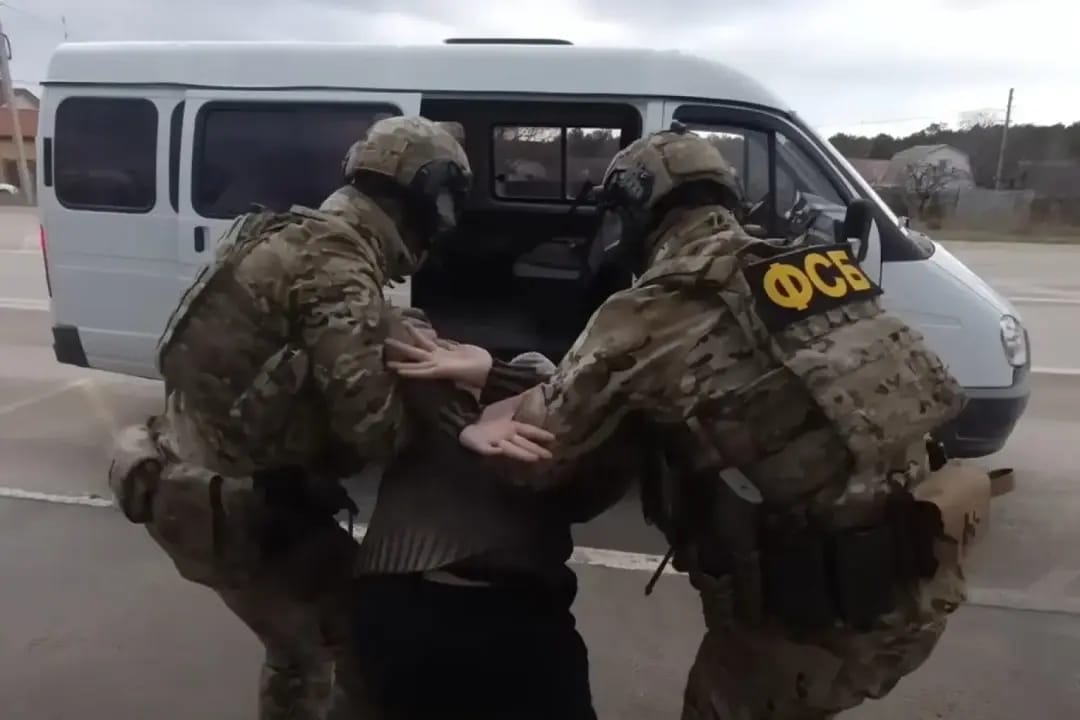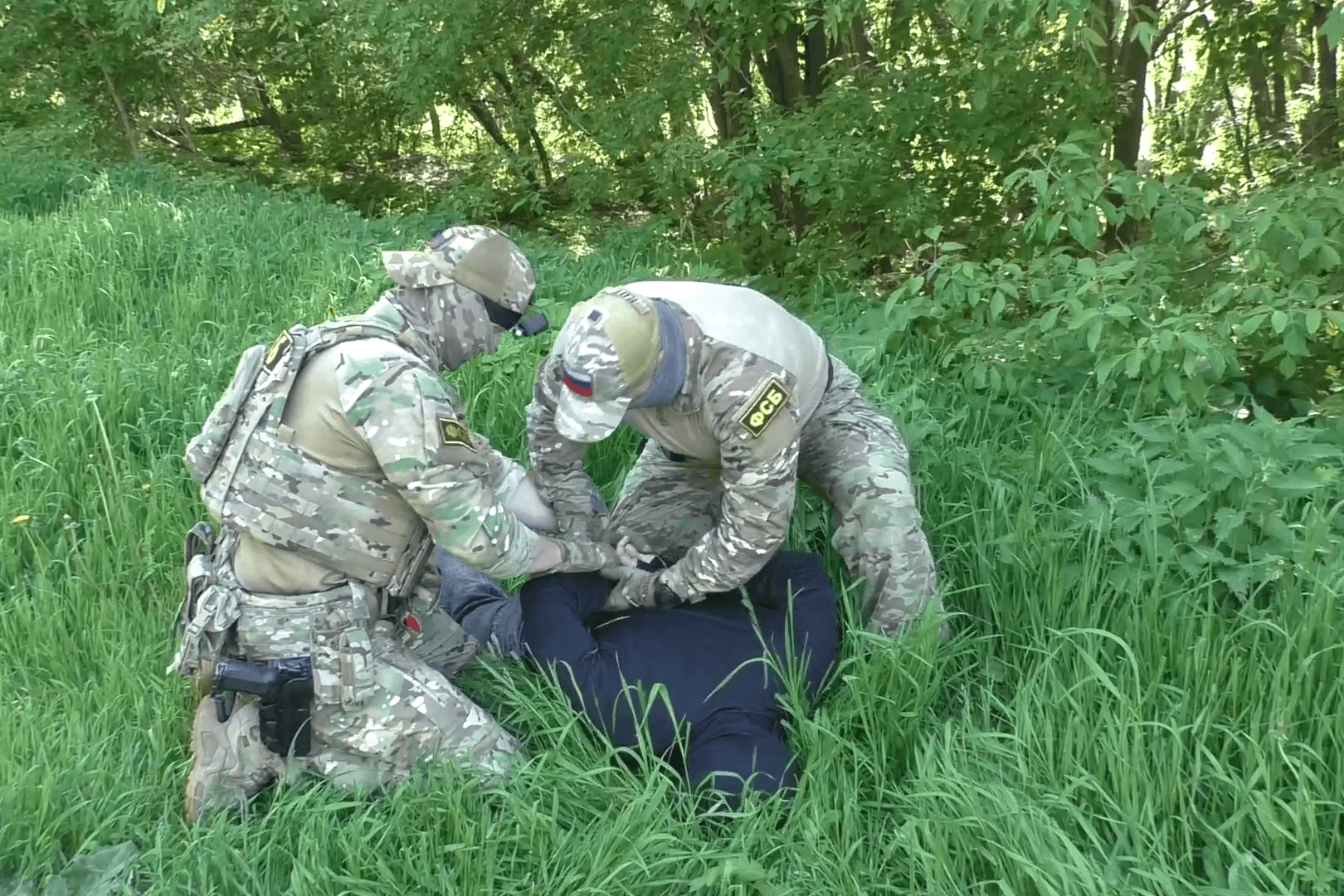
Russia’s Federal Security Service (FSB) often stages arrests for film crews and forces suspects to record confessions multiple times, including after torture, the Memorial human rights project concluded after studying materials from 70 politically motivated criminal cases opened after the start of Russia’s full-scale invasion of Ukraine. Human rights defenders found signs of staging in roughly a quarter of the examined arrest scenes, as they outline in the new report, “FSB Videos: Behind the scenes of dramatic arrests.”
According to Memorial, the FSB releases hundreds of short clips every year showing arrests, searches, and confessions. However, the real circumstances of criminal cases often differ substantially from what is shown. In some cases, detainees who are already in custody are taken outside for filming, forced to re-enact the events of their arrest, and read out confessions provided by the agency. The researchers believe the purpose of such videos is to demonstrate the FSB’s effectiveness, intimidate opponents of the Putin regime, and impose the investigators’ version on the public.
Human rights defenders also analyzed posts on the Telegram channels of the state-owned media agencies TASS and RIA Novosti. By their count, since the start of the full-scale war against Ukraine the percentage of posts mentioning the FSB has risen by a factor of between two and three. The share of FSB-related posts featuring video also doubled: from 23% in 2021 to 40% in the first half of 2026. In most cases, FSB video stories are now linked to Ukraine, primarily to accusations of terrorism and crimes against state security.
How the FSB stages arrests
One of the most vivid cases described in the study is that of Romanian national Adrian-David Kercho, who was detained in Abkhazia in November 2024 before being handed over to the FSB on Dec. 13. According to Memorial, after that Kercho was beaten, subjected to a series of back-to-back administrative arrests, and forced to confess to espionage. The security agency filmed a staged video of his arrest only on April 15, 2025, releasing it 10 days later. The date of filming was then declared the official date of Kercho’s arrest. He was subsequently sentenced to 15 years in prison.
Another example involves Yury Kayev, a defendant in the so-called “Kherson Nine” case. According to Kayev, after his actual arrest he was subjected to a week’s worth of brutal torture. Then, around a month later, security forces took him out onto a street in Kherson, handed him a bag with his personal belongings, and ordered him to walk along the pavement — warning that his arrest would be filmed. Kayev was told he should fall in such a way so as not to injure his face in front of the camera. According to Kayev, the scene was successfully shot on the first take.
The discrepancy between footage published by the FSB and the real circumstances of arrests was previously revealed by The Insider in the case of Ruslan Sidiki, who was convicted of carrying out a drone attack on the Dyagilevo military airfield and a railway bombing in Ryazan Region. The case materials studied by The Insider show that on Nov. 29, 2023, a police officer stopped Sidiki near his home in Ryazan. The officer compared the man’s face with a composite sketch and asked him to come to the police station for a conversation. Sidiki agreed. However, in the footage published by the FSB, Sidiki is shown being apprehended by armed security officers who drive up to him near a row of garages and jump out of their vehicles in order to make the arrest. Between the real arrest and the filming of the staged video, Sidiki was beaten and tortured with electric shocks. Upon admission to the pretrial detention center, numerous wounds, bruises, and hematomas were recorded.
The Insider found a similar discrepancy in July 2026, when the FSB published a video of the arrest of Anapa resident Maksim Ovchinnikov on treason charges. The Insider established his identity even though the agency had not named the detainee, and the clip itself turned out to be edited together from footage shot over the span of several months. According to an acquaintance of Ovchinnikov, the first shots date back to January 2026, when he was detained prior to his first administrative arrest. In the subsequent shots of the interrogation at the FSB directorate, green leaves are already visible on the trees, and people are wearing much lighter clothes. Ovchinnikov was first detained on Jan. 27, and on Feb. 27 FSB officers moved him from the detention facility to an unknown destination. For more than 70 days, his relatives did not know his whereabouts. In May, Ovchinnikov turned up in a pretrial detention center in Krasnodar. The FSB published the doctored arrest footage on July 4, presenting what was happening as the arrest of a man accused of treason.
Confessions after torture and in multiple takes
As the authors of the investigation note, confessions are present in almost two-thirds of the videos examined. The detainees often use official language that sounds unnatural in casual speech, reproducing the wording of specific articles from the criminal code and of investigators’ version of the events that led to their arrest. Some say that the texts of the confessions were dictated to them in advance and that the videos were redone when the result did not satisfy the FSB officers.
For example, Crimean artist Bogdan Ziza said that security forces recorded at least five versions of his apology following an anti-war demonstration. According to Ziza, the recordings were sent to superiors for approval, and the script was repeatedly changed. At one point, he was required to apologize to the Russian army, then to Vladimir Putin. When the security agents determined that he was repenting with insufficient sincerity, they beat him again. “I’m not a very good actor, and the script kept changing all the time,” Ziza said.
Denis Popovich, who was accused of plotting an assassination attempt on Metropolitan Tikhon (Shevkunov) — who is also known as Putin’s personal “confessor” — said that his confessions were recorded under torture. Speaking at Moscow’s Meshchansky District Court, Popovich said the confessions were obtained after torture with electric shocks, and that the video was recorded in several takes in order to obtain “precisely calibrated statements.”
Sometimes fragments that contradict the investigators’ version of events are removed from published recordings. For example, during a search of Nikita Ivankovich, another defendant in the case of the attempt against Metropolitan Tikhon, security forces agents found a phone and a spade. Ivankovich stated on camera that these items did not belong to him, and words made it into the original version of the clip, but some media outlets later replaced the video with an edited version that did not contain the detainee’s objections.
Videos used to pressure relatives
The researchers note that the FSB also films material not intended for public distribution. According to human rights defenders, such recordings are used to pressure detainees and their loved ones through humiliation and blackmail.
During a search, the mother of Irkutsk student Ilya Ukrainsky was shown a video of her son — beaten and crying at an unknown location. According to Memorial, security forces threatened the woman and forced her to sign documents without reading them. Ukrainsky later said that he was held for three months with no procedural status in a pretrial detention center in the Voronezh Region, where he was tortured — including by being shot in the leg during interrogations.
In another case, Chelyabinsk resident Aleksandr Novosad said in court that during a search security forces pulled his pants down, blindfolded him, wrapped him in Christmas lights, and photographed him, mocking his appearance.
The authors of the report concluded that the production of video clips has become part of the system of political repression. In their assessment, the purpose of such filming is not to document the circumstances of criminal cases but to create an atmosphere of total control, demonstrate the security forces’ power over detainees, and intimidate disloyal citizens. At the same time, the footage published by the FSB cannot be considered reliable evidence — neither of the circumstances of an arrest, nor of the timeline.