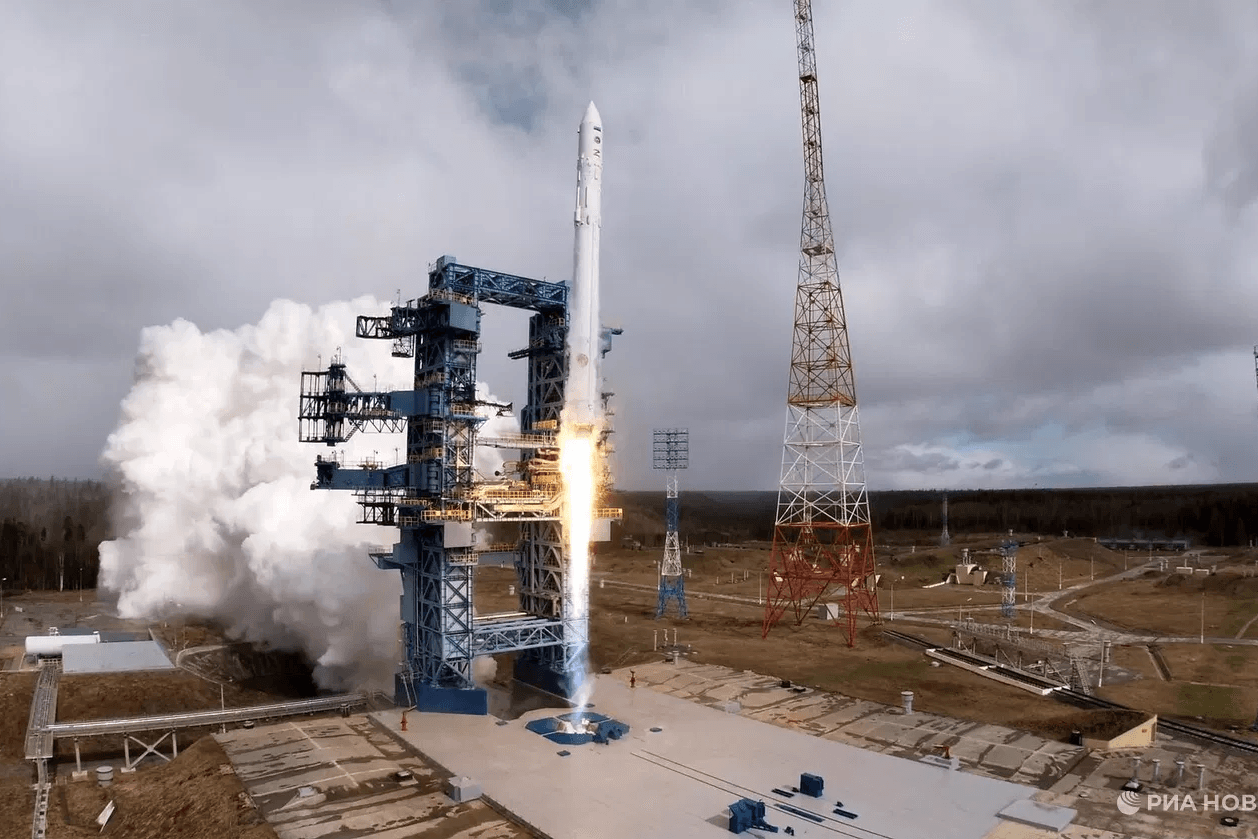
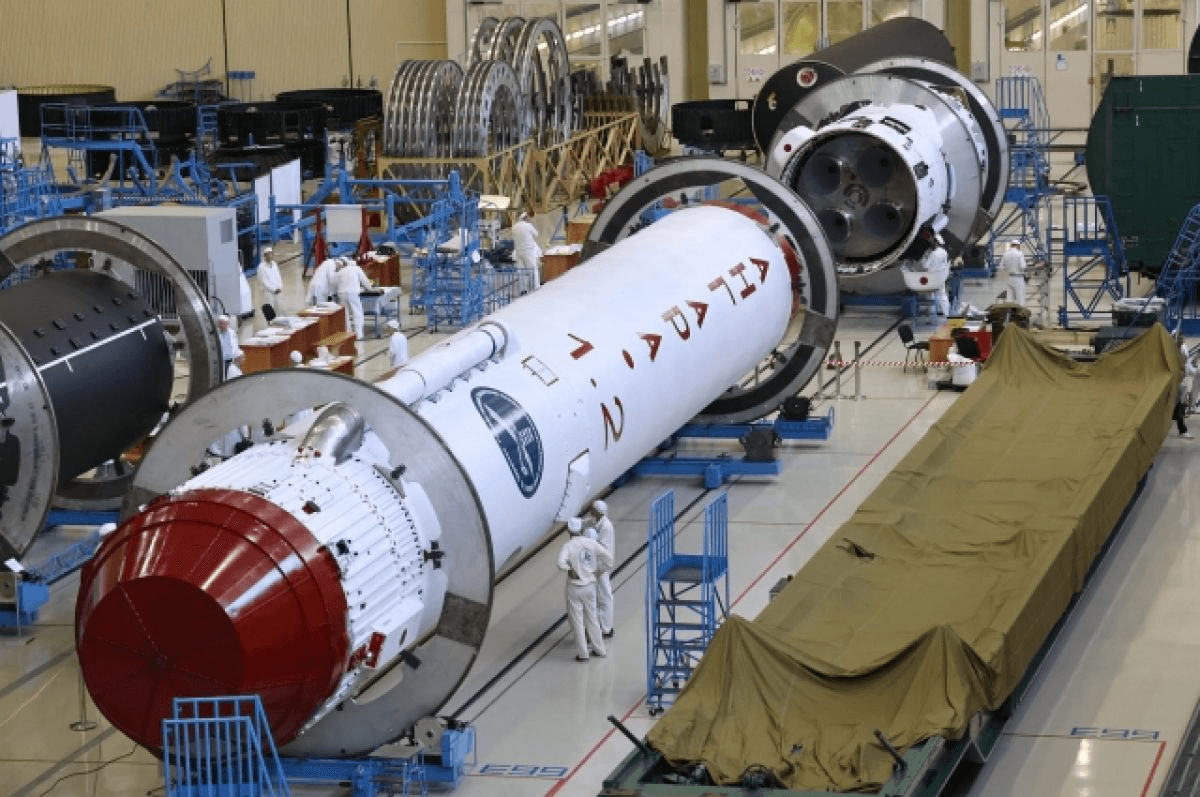
Russia’s Angara space launch vehicle program has turned out to be heavily dependent on China. According to Dallas Analytics, a Ukrainian firm that examined internal documents of the Khrunichev State Research and Production Space Center, a significant share of the Russian entity’s manufacturing equipment is supplied by Chinese companies. Russia’s Angara 1.2 launch vehicle is used exclusively for the needs of the country’s Ministry of Defense; meanwhile, the Chinese suppliers helping Russia militarize space are also active in the European and U.S. markets.
Angara-1.2 is a two-stage light-class launch vehicle. Since the rocket’s debut in 2014, it has been involved in eight launches — the most recent of which took place this past April.
Russian authorities are currently investing tens of billions of rubles in scaling up Angara production, according to internal documents reviewed by Dallas Analytics. Materials from the Khrunichev Center show that currently only one Angara 1.2 is produced per year, while plans call for increasing output to four per year. Additionally, there are plans to produce four heavy Angara-A5 rockets annually. To this end, production has begun to be relocated to a plant in Omsk at a cost totaling upwards of 17.5 billion rubles ($220.8 million). At the same time, the documents indicate that Angara production is currently unprofitable.
The relocation project to Omsk involves retrofitting five existing production lines and constructing five more from scratch. The plan to create new production capacity involves the procurement of 541 units of equipment valued at 3.62 billion rubles ($45.6 million). Of these, 477 are listed in the cost estimates as Russian-made, and only 57 are classified as Chinese. However, as Dallas Analytics emphasizes, this ratio can be misleading.
In the metalworking shop, for instance, Chinese suppliers are set to provide as much as 47% of the required equipment. In the composites and rubber products shop, the Chinese share drops to 15.9%. Notably, however, the only CNC (computer numerical control) machining center set to be installed in that shop is of Chinese origin.
Overall, China’s share of the total production equipment budget amounts to 24.3% (nearly 900 million rubles, or $11.3 million). However, within the technological core, 91.5% of equipment funds will go to Chinese suppliers.
According to the investigators, the largest Chinese supplier involved in the project is Anyang Forging Press Machine Industry Co., Ltd. (Anyang FPM), which operates in at least 80 countries, including in the markets of the United States, Germany, and Japan. Its website even has a Russian-language version. Anyang FPM is set to supply Russia with eight forging and pressing machines — products whose export to Russia is sanctioned by the EU and the U.S. In short, the company is earning money in countries that have supported Ukraine in its fight against Russia’s full-scale invasion while simultaneously selling equipment to upgrade Russia’s military-industrial base.
Dallas Analytics authors emphasize:
“The Angara launch vehicles to be produced with this equipment will place Russian Ministry of Defense satellites into orbit. Those satellites, in turn, may threaten European assets both in space and on the ground. The only factor likely to influence these Chinese manufacturers is the genuine risk of losing access to European markets. More broadly, doing business with Russia should carry the cost of losing access to the West.”
The investigators also note that the equipment Russia intends to procure from China is fairly standard, meaning that sanctioning a single company will not stop the deliveries, as identical machines can be sourced from other Chinese manufacturers. Furthermore, the examined documents suggest that China also engages in the practice of creating “short-lived brands,” specifically for sales to the Russian market.
As Dallas Analytics notes, the Angara 1.2 launch vehicles have never been used for civilian or commercial purposes. The sole customer for the rocket’s launches has been Russia’s Ministry of Defense, which uses them to put into orbit Kosmos satellites — the standard designation for Russian military spacecraft of various types.