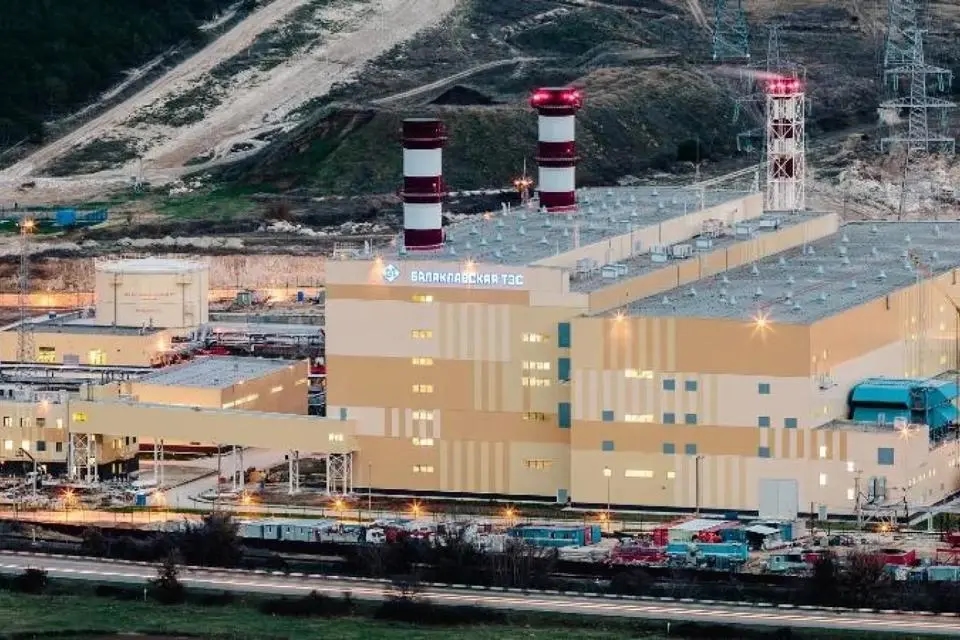
Part of Russian-occupied Sevastopol was left without electricity on July 14 after an overnight strike on the Balaklava thermal power plant, one of the two largest power stations on the Crimean Peninsula. The plant is equipped with Siemens turbines that were brought to Crimea in violation of sanctions imposed by the EU. The city’s Russia-installed authorities introduced a rolling blackout schedule of two hours with power followed by six hours without. Trolleybus service across Sevastopol was also brought to a halt.
The Telegram channel Krymsky Veter (lit. “Crimean Wind”), reported a “powerful strike” on the Balaklava plant on the morning of July 14, citing local residents. The channel’s subscribers said the strike hit the station building, causing damage to the facility that included large dents in structures, holes in walls, and blown out windows. There has been no independent confirmation of that report.
Mikhail Razvozhayev, the Russian-appointed head of Sevastopol, confirmed a “large-scale attack” on energy infrastructure but did not specify which facility was damaged.
“A special regime has been introduced at the sites, and specialists are assessing the scale of the damage. All emergency services are on full alert,” he wrote.
Razvozhayev said Sevastopol came under drone attack twice overnight into July 14. The first attack began around 2:18 a.m. local time. Russian authorities claimed five drones were destroyed in the Balaklava District. A second air alert was declared at around 4:19 a.m. No casualties were reported.
After the attack, part of the city was left without electricity. Because of the limited capacity of the power grid, Sevastopol temporarily introduced the aforementioned electricity rationing schedule of two hours on, six hours off. He urged residents to conserve mobile phone battery power, avoid using high-consumption electrical appliances unless necessary and reduce electricity use even during periods when power is available. Businesses were advised to temporarily limit the use of energy-intensive equipment. Trolleybus service was halted because of the power disruptions.
Sevastopolenergo, the city’s power utility, blamed the restrictions on a “technological disruption.” Razvozhayev said specialists were trying to reconfigure the system and use available reserves to shorten the outages by evening.
What is the Balaklava thermal power plant?
The Balaklava thermal power plant, along with the Tavricheskaya thermal power plant near Simferopol, was built by Russia following its 2014 annexation of Crimea in order to reduce the peninsula’s dependence on electricity supplies from mainland Ukraine. The project became especially important after an energy blackout in the fall of 2015, when power pylons in Ukraine’s Kherson Region were blown up by activists, leaving Crimea almost completely cut off from electricity.
The first generating unit at the Balaklava plant began continuous production in October 2018, and the second was connected to the grid in December of that year. The official commissioning ceremony took place in March 2019 with Vladimir Putin in attendance.
Four Siemens gas turbines were installed at the Balaklava and Tavricheskaya plants after being brought into annexed Crimea in violation of EU sanctions in 2017. The equipment was manufactured by a joint venture between Siemens and the Russian company Power Machines. Under the contract, the turbines were intended for a power plant in Taman, in southern Russia, but Russian entities later moved them to Crimea. Siemens said it had been misled and tried through a Russian court to secure the return of the equipment and to have the deals declared invalid. The court rejected the German company’s request.
After the turbine transfer became public, the EU imposed additional sanctions on three Russian companies and three individuals involved in the prohibited delivery. German prosecutors later brought charges against former Siemens executives in connection with the transfer.