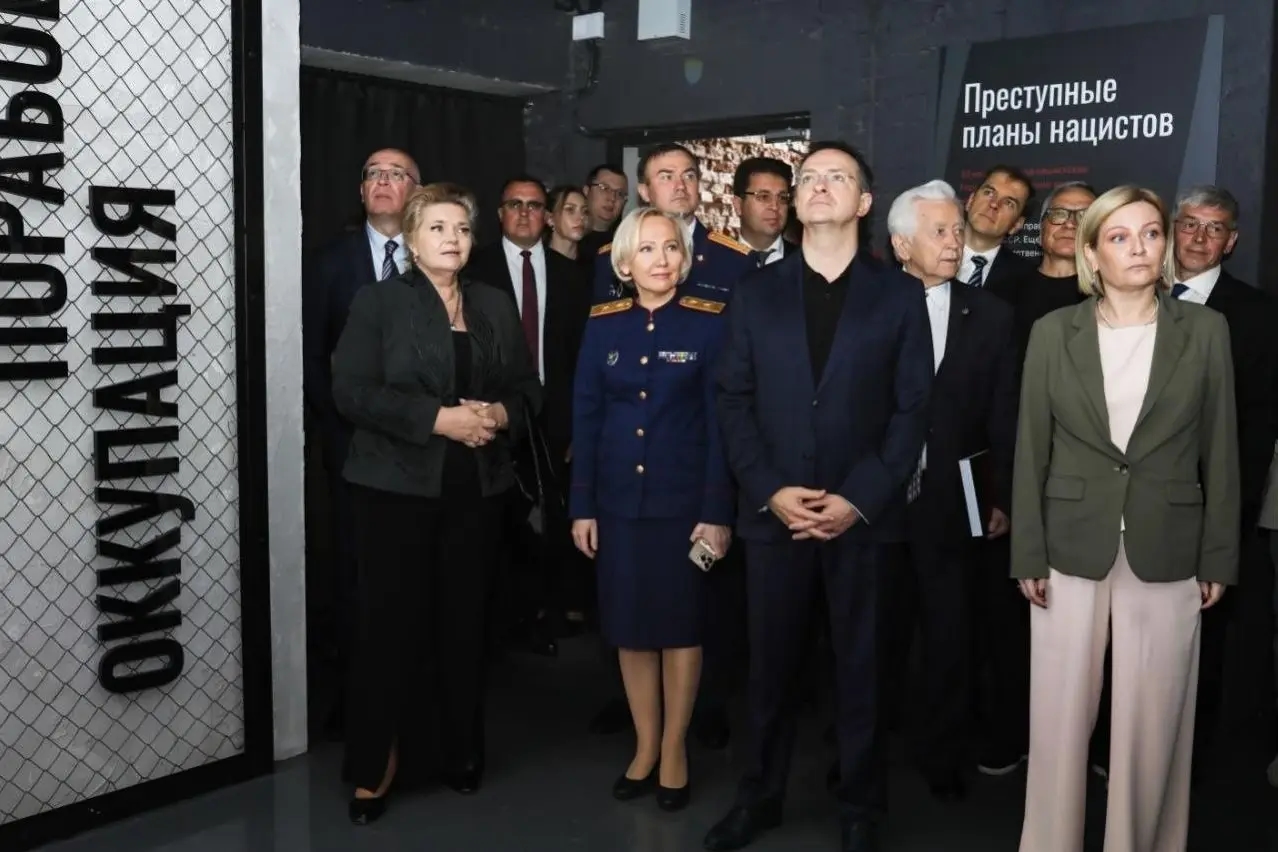
A “Museum of Memory of the Victims of the Genocide of the Soviet People” has opened in Moscow at the former site of the GULAG History Museum, which was closed by the Russian authorities in late 2024. The new project was launched at the initiative of Investigative Committee head Alexander Bastrykin, together with the FSB and Russia’s National Center for Historical Memory.
At the opening, Sergei Novikov, head of the presidential directorate for public projects, said the museum’s visitors would receive an “inoculation against neo-Nazism, because the parallels with today are obvious.”
The Kremlin has repeatedly used claims about fighting “neo-Nazism” to justify its war against Ukraine, portraying the invasion as a supposed continuation of the Soviet struggle against Nazi Germany. One of the goals of the full-scale invasion set out by Vladimir Putin has been the so-called “denazification” of Ukraine, a claim widely rejected by experts and historians, who have called it “disconnected from the history around the Nazi regime of the 1930s and 1940s.” Ukraine is notably led by a democratically elected president of Jewish heritage who lost relatives in the Holocaust.
The exhibition is housed in the building on 1st Samotechny Lane, where the Gulag History Museum operated until November 2024. The new museum focuses on Nazi crimes committed in occupied Soviet territories, including punitive operations, the siege of Leningrad, and the destruction of cultural heritage. The Investigative Committee said the exhibition is based in part on materials from its investigations into crimes committed by German forces and their accomplices.
Culture Minister Olga Lyubimova called the new museum a “point” where visitors would be told “extremely difficult information” in a modern museum language. Presidential aide Vladimir Medinsky — Russia’s former Minister of Culture (2012-2020) and the author of the country’s revisionist school history textbooks — said children should visit the museum starting in sixth or seventh grade.
The museum opened two and a half months after a law took effect in Russia introducing criminal liability for anyone denying or approving of the “genocide of the Soviet people.” The maximum penalty under the new provision is up to five years in prison in instances when such a statement is made through the media or online. The law also provides for up to five years in prison for those found guilty of damaging or desecrating graves and monuments to victims of the “genocide of the Soviet people.”
Historians have noted that the term “genocide of the Soviet people” is not generally accepted in international historiography. Russian historian Ilya Venyavkin has said Nazi documents contain no plans to destroy all residents of the Soviet Union specifically as a group called the “Soviet people.” Nazi authorities deliberately exterminated Jews and Roma as ethnic groups, while the mass killings of Soviet prisoners of war, guerilla fighters, and civilians may be classified as war crimes and crimes against humanity, but not necessarily as genocide under the definition in the 1948 U.N. Genocide Convention.
The GULAG History Museum suspended operations in November 2024, officially over fire safety violations. In February 2026, Moscow authorities said a Museum of Memory would open in its place. The outlet Verstka later reported that the previous exhibition had been dismantled and that the new management had told staff of plans to draw parallels in the museum between World War II and Russia’s ongoing war against Ukraine.