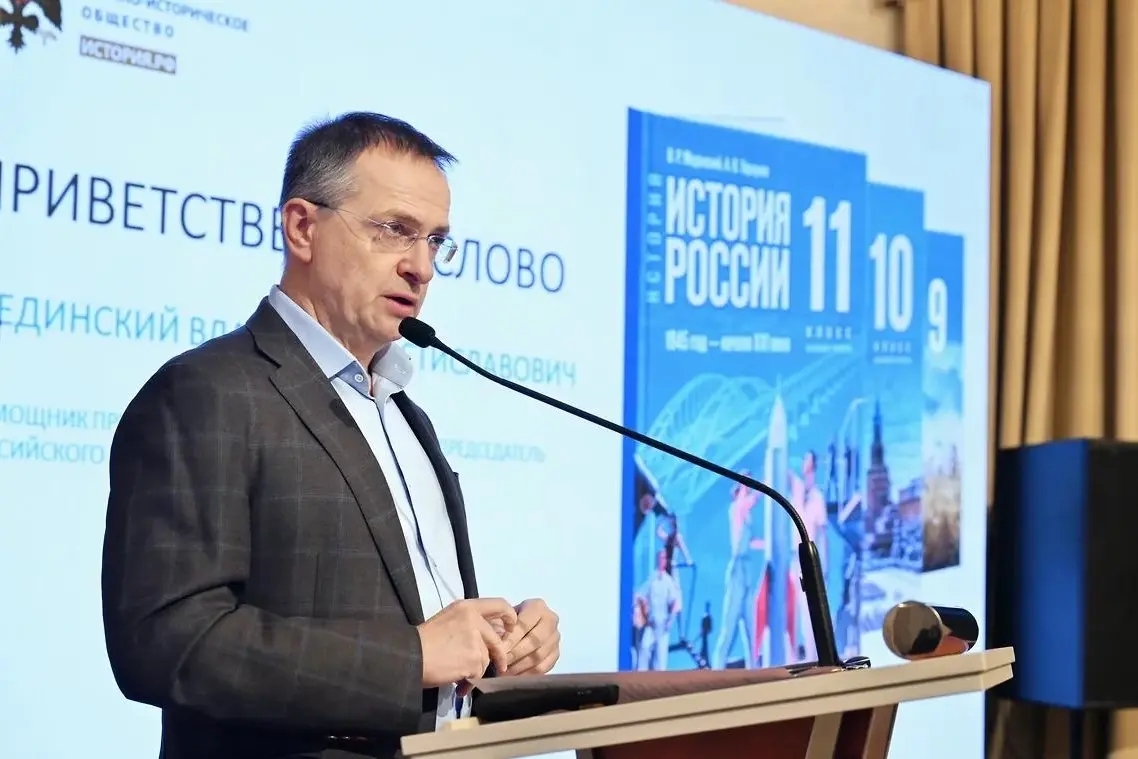
In Russia, a new edition of school history textbooks for 10th- and 11th-grade students is set to be published, authored by presidential aide Vladimir Medinsky and MGIMO rector Anatoly Torkunov. Previous editions under their editorship were criticized for factual errors — even by official educational institutions. Beyond inaccuracies, the texts were full of ideological manipulation and whataboutism, features that will evidently remain in the new versions. Unsurprisingly the textbooks present Soviet leaders in a positive light, even when it comes to events like the deportations of the peoples of the Caucasus and the suppression of the Hungarian uprising of 1956. Particular effort is devoted to justifying the foreign policy of the Soviet Union on the eve of World War II — most notably, this past episode clearly echoes the way the Kremlin now seeks to justify its full-scale invasion of Ukraine.
- 1.The only correct version of Russian history
- 2.Poland was preparing an attack on the USSR
- 3."If we had not gone in first, there would have been bases of the Third Reich there"
- 4."Referendums" and accession to the USSR
- 5.No mention of losses, but "serious shortcomings in the Red Army's training were revealed"
- 6.Textbooks are no place for debate
The only correct version of Russian history
The main reason why the new history textbook written by Vladimir Medinsky and Anatoly Torkunov is so notable is that it is the first which will be mandatory for all Russian high school students. Until September 2023, Russian schools independently selected textbooks from a Ministry of Education list that included different series offering multiple approaches and interpretations. By introducing the unified Medinsky–Torkunov tome, the state secured for itself a monopoly on accepted truth — at least when it comes to the version of Russian history that children are to be taught.
Of course, the Kremlin’s fight for history extends beyond the classroom. On a societal level, the subject of World War II — particularly its origins and the full role played by the Soviet Union — is so sensitive that the expression of alternative views can lead to criminal prosecution.
The subject of World War II is so sensitive that expressing alternative views can lead to criminal prosecution
The main provision is Article 354.1 of the Russian Criminal Code ("Rehabilitation of Nazism"). Under its current wording, punishable acts include: denying facts established by the Nuremberg Tribunal, approving Nazi crimes, and publicly disseminating knowingly false information, whether about the policies of the USSR during World War II or about the actions of its soldiers. Under the circumstances, fairly basic criticism of the Molotov–Ribbentrop Pact or of Stalin’s wartime repressions could easily be interpreted as a criminal act.
In addition to the criminal provision, there is a special administrative article – 13.48 of the Russian Code of Administrative Offenses. It directly punishes the public equating of the goals, decisions, and actions of the leadership, command, and servicemen of the USSR with the goals, decisions, and actions of Nazi Germany and the Axis countries, as well as denying the decisive role of the Soviet people in defeating Nazi Germany and the humanitarian mission of the USSR in liberating the countries of Europe. In other words, it makes any comparison of Hitler’s and Stalin’s various crimes an illegal act.
Unsurprisingly, the Russian state is using its instruments in the educational and legal spheres to promote the version of history most convenient for itself, while suppressing any alternative viewpoints or critical assessments regarding the darkest periods of Russian history.
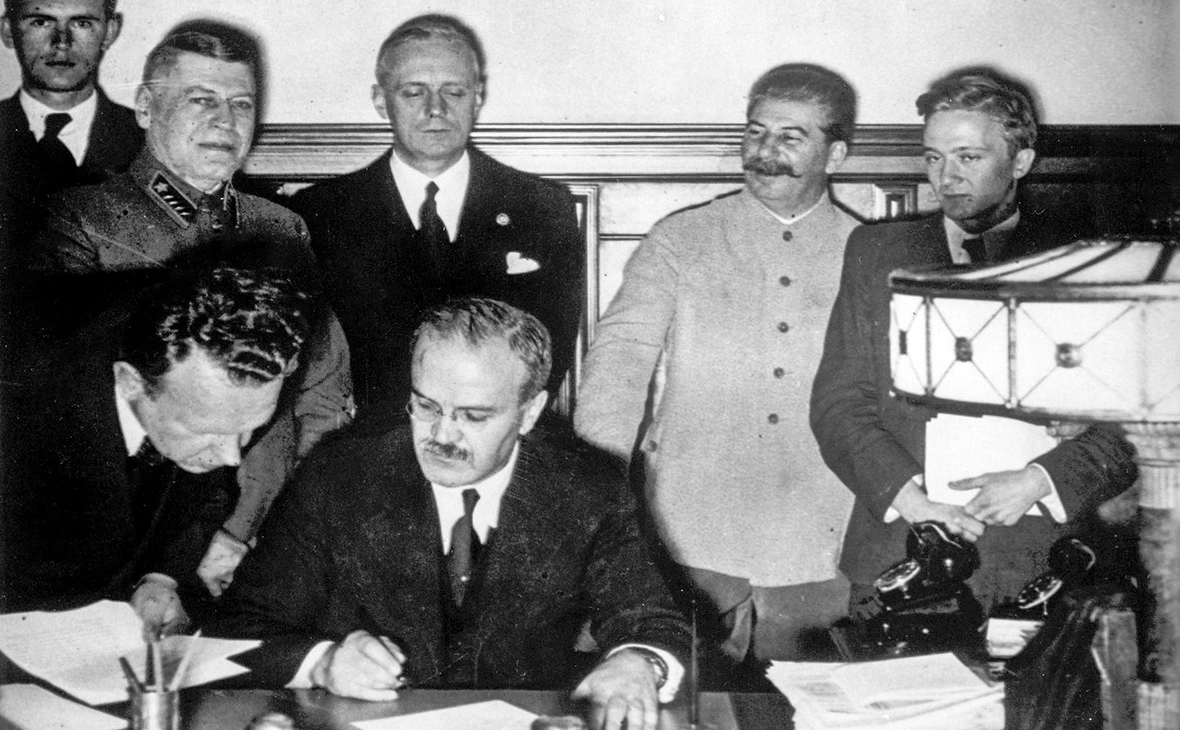
One such difficult and controversial episode is Stalin’s foreign policy in the year 1939, when the Soviet Union reached an agreement with the Third Reich on the division of Eastern Europe. After that, the USSR seized eastern Poland, annexed the Baltic states, and attacked Finland. The Russian authorities have consistently sought to portray these actions as justified and necessary, and to punish those who think and speak otherwise.
It is important to note that, before the unified history textbook, there were many others that described twentieth-century events — and Stalin’s foreign policy in particular — in completely different ways. One of the best examples is an 11th-grade textbook by Andrei Levandovsky, Yuri Shchetinov, and Sergei Mironenko, published in 2013 as part of Moscow State University’s “To School” series.
Poland was preparing an attack on the USSR
The 10th-grade history textbook by Medinsky and Torkunov promotes a consistently negative image of Poland while emphasizing that "the USSR was interested in peaceful development, expanding trade ties with Western European states and the United States," but "the threat of war forced the USSR to take measures to strengthen its security" (pp. 276–277). At the same time, it directly states that "until 1933, Poland was considered the main threat," as it was engaged in conspicuously unspecified "subversive activity against the USSR” (p. 276).
Again unsurprisingly, the Medinsky-Torkunov textbook remains perfectly silent on the fact that the Soviet Union itself engaged in subversive activity in Poland, spreading illegal propaganda, doing intelligence work, planting agents among the populations of the border regions, and coordinating Polish communist structures through the Comintern. And of course, Moscow’s capacity for carrying out such influence operations was in fact incomparably greater than Warsaw’s.
In places, the textbook describes Poland as nothing less than an ally of Germany, citing a certain "Hitler–Piłsudski Pact" (p. 276). In actual history, the document in question is known by its more prosaic name: the Polish–German Declaration on the Non-Use of Force. Signed on January 26, 1934, the agreement effectively normalized relations between the two states after a period fraught with border disputes arising from the Treaty of Versailles. In Russia, however, the document is referred to specifically as the "Hitler–Piłsudski Pact," a construction remarkably similar to that of the "Molotov–Ribbentrop Pact."
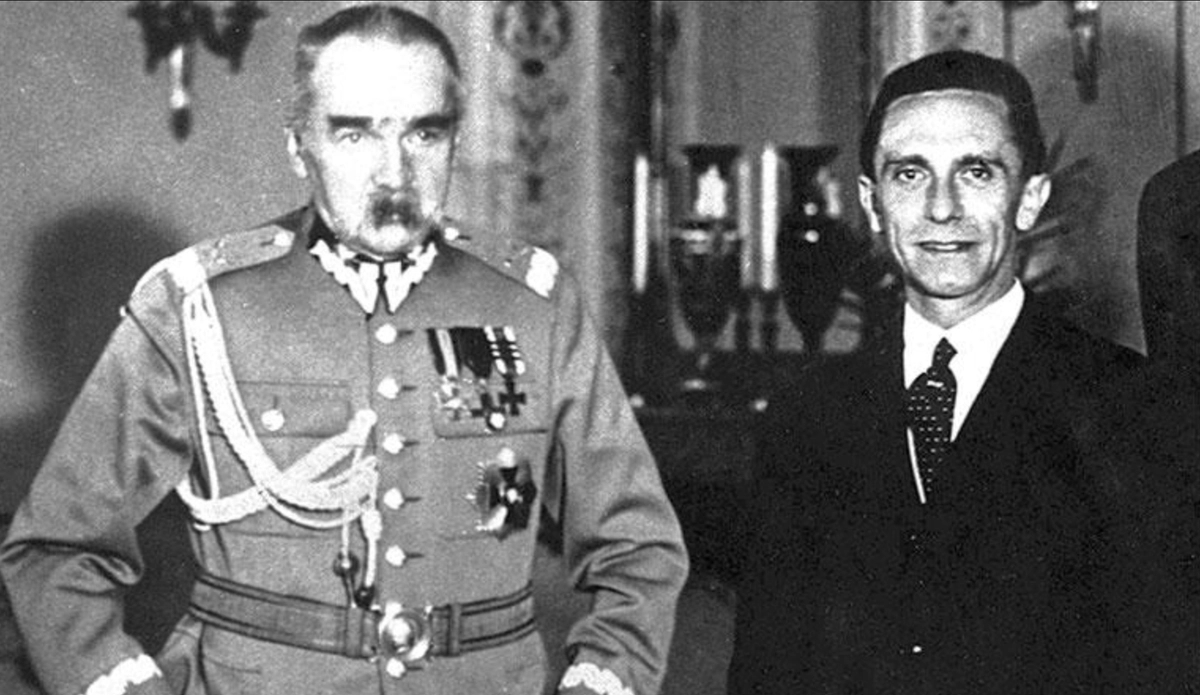
The Polish–German declaration stipulated the development of peaceful relations between the two countries and the renunciation of force in resolving any disputes between Poland and Germany. If examined on its merits, this document is more appropriately compared with the Soviet–Polish non-aggression treaty concluded in 1932.
Paradoxically, the text of the Soviet–Polish non-aggression treaty was far more specific and binding on both sides. In it, the USSR and Poland not only agreed not to use military force against one another, but also pledged not to assist a third power if it started a war against one of the treaty’s signatories. If these two agreements are compared, Poland could actually be seen as a loose ally of the USSR.
Skeptics may object that the public portion of the Molotov–Ribbentrop Pact also appeared peaceable, saving all of its notorious provisions for the secret protocol. The problem is, the secret protocols of the Molotov-Ribbentrop Pact have been verified and published, while nothing of the sort has been found in connection with the Polish-German Declaration.
Historians have certainly looked for evidence of a potential Nazi-Polish plot to wage war against the Soviet Union. For example, German military historian Rolf-Dieter Müller, in his work Enemy in the East: Hitler’s Secret Plans to Invade the Soviet Union, describes in detail how the Germans did indeed probe the Polish position regarding a possible alliance against the USSR, especially after the 1934 declaration was signed. The chief advocate of this initiative on the German side was Hermann Göring, who repeatedly visited Poland in 1935–1938. Germany made various proposals, ranging from benevolent neutrality to Polish participation in the Anti-Comintern Pact. The Polish side consistently rejected them precisely because it feared that Moscow might choose to interpret such actions as a violation of the 1932 non-aggression treaty between the USSR and Poland.
In short, the Medinsky-Torkunov textbook’s claim that Poland was Hitler’s ally is false and absurd. However, it serves its purpose: preparing students to accept the idea that Poland’s pre-war actions were so threatening that it was necessary for Stalin to agree to divide up the country with Hitler.
The claim that Poland was Hitler’s ally is false and absurd, but it plants the idea that the Poles deserved their fate
The next episode in the textbook leading up to the Molotov–Ribbentrop Pact is connected with the Munich Agreement of 1938, under which Poland did in fact issue an ultimatum to Czechoslovakia, obtaining the Teschen region. After quoting Churchill, who called Poland the "hyena of Europe," the textbook’s authors suddenly state that "in Moscow, it was well known that Poland harbored plans to seize Soviet territory and to act as Hitler’s ally" (p. 279).
This is a direct falsehood. As noted above, Polish politicians consistently rejected proposals from Nazi Germany to cooperate against the USSR, and the Czechoslovak crisis did not change that reality. The last German proposal for Poland to join the Anti-Comintern Pact was made in January 1939, and Poland rejected it.
As if contrasting the Soviet Union with Poland, the textbook’s authors emphasize that "among the major European powers, only the USSR had not concluded agreements with the Third Reich until the end of August 1939" (p. 279). Yet the USSR and Germany already had a non-aggression and neutrality treaty, signed in 1926, renewed in 1931, and remaining in force until the signing of the Molotov–Ribbentrop Pact in August 1939.
Both Stalin and Hitler had the option to renounce that treaty at any moment. However, that did not happen.
To repeat, Russian schoolchildren were not always subjected to such skewed versions of history. For example, the 2013 “To School” textbook described the events of August 1939 by writing:
"The main gain from the non-aggression pact, in J. V. Stalin’s view, was the strategic pause obtained by the USSR. From his perspective, Moscow’s withdrawal from active European politics gave the coming war a purely imperialist character. The class enemies of the Soviet state would mutually exhaust their strength, while the Soviet Union itself gained the opportunity to move its own borders westward (in accordance with the secret agreement with Germany on spheres of influence) and buy time to strengthen its military-economic potential."
Needless to say, there was no mention in that textbook of Poland as Germany’s ally, let alone of Polish plans to partition the USSR.
"If we had not gone in first, there would have been bases of the Third Reich there"
Interestingly, one of the most notable moments of the new textbook occurs in its account of Germany’s preparations in to invade Poland. The authors write that "the task of the USSR was, if not to prevent this war, then at least to delay its outbreak," adding that "the USSR knew Germany was preparing to invade Poland, and then the Baltic states" (p. 281).
However, instead of making efforts to aid Poland and the Baltic countries in their moment of need, Stalin entered negotiations with Hitler – and signed the secret protocol dividing up the Nazi and Soviet spheres of influence in Eastern Europe. As the textbook delicately phrases it, "through the formula accepted in diplomatic practice at the time ('sphere of interests'), the Soviet Union warned Hitler that it did not intend to allow Germany to occupy these territories" (p. 282). This passage looks even more absurd when one simply reads the following chapters of the tome and learns that the Soviet Union then occupied these territories itself.
The final flourish of the partition portion is the claim that "the treaty allowed the USSR to postpone a German attack for almost two years" (p. 283). Simply put, the figures contradict such a conclusion. The Wehrmacht force from which Stalin supposedly wanted to protect himself (and which invaded Poland on September 1, 1939), consisted of 1.5 million men, 2,800 tanks, and around 2,000 aircraft. The Polish army consisted of 1.3 million men, 870 tanks and tankettes, and more than 820 aircraft.
On September 17, 1939, the USSR sent into eastern Poland the forces of the Ukrainian and Belorussian Fronts, numbering 617,600 men, 4,736 tanks, and around 2,600 aircraft. In manpower they were smaller than the German forces, but they significantly surpassed them in tanks and aviation. And this was only part of the Red Army. Its total strength grew from 1.9 million men in February 1939 to 5.2 million by September 20 of that year.
In September 1939, the USSR possessed a significant military advantage over Germany. Therefore, the decision to divide spheres of influence and occupy eastern Poland cannot be explained solely by the idea of a threat from Hitler and the attendant need to postpone war as long as possible. On the contrary, Stalin consciously agreed to the partition of Poland while holding substantial leverage and securing major concessions from Hitler.
Stalin consciously agreed to the partition of Poland while holding substantial leverage and securing major concessions from Hitler
This argument about preventive occupation is once again "brilliantly" employed in the textbook in the context of the annexation of Lithuania, Latvia, and Estonia. The authors unabashedly write that "after France, the Baltic region could have become Hitler’s next direction of aggression,” adding that "the possible transfer of Lithuania, Latvia, and Estonia under German protectorate or the seizure of their territory by the Germans would have meant that Hitler’s invasion armies could be deployed in the immediate vicinity of Leningrad and Moscow" (p. 289).
The 2013 textbook, by contrast, directly links the USSR’s territorial claims against its neighbors to the Soviet–German agreement on the division of spheres of influence (p. 181), rather than to the oft-invoked German threat.
"Referendums" and accession to the USSR
Both in the case of the eastern Polish territories, which became "Western Belorussia" and "Western Ukraine" within the USSR, and in the case of the Baltic republics, the new textbook justifies the seizure by appealing to popular will of the people in the territories themselves, as if the citizens of eastern Poland and the Baltic states wanted to join the USSR and voted for it in a free and open referendum.
It is notable that the Medinsky–Torkunov textbook provides no evidence that, before the events of 1939–1940, the inhabitants of eastern Poland or the Baltic republics had expressed any desire to become Soviet citizens. Instead, the textbook’s authors simply write on page 286 that "in October 1939, the People’s Assemblies of Western Ukraine and Western Belorussia, formed as a result of nationwide elections, adopted declarations on reunification with the Ukrainian and Belorussian Soviet Socialist Republics."
The book once again unsurprisingly says nothing about the fact that the decision to create "People’s Assemblies" in the occupied territories of Poland was not made spontaneously by local residents themselves, but at a meeting of the Politburo of the Central Committee of the All-Union Communist Party in Moscow on October 1, 1939. Moreover, the range of tasks these "assemblies" were to address was determined in advance:
- approve the transfer of landlords’ lands to peasant committees;
- decide the nature of the new authority, that is, whether it should be Soviet or bourgeois;
- decide the question of accession to the USSR, that is, the incorporation of the Ukrainian regions into the Ukrainian SSR and the Belorussian regions into the Belorussian SSR;
- decide the question of nationalizing banks and large industry.
The elections to these "People’s Assemblies" were organized in such a way that, formally, the right to nominate candidates belonged to peasant committees and meetings of workers and intellectuals. In practice, however, all these structures acted under the full political control of the Soviet military-political administration. Each meeting nominated only a single candidate, and attempts to nominate alternative figures were suppressed. Criticism of official candidates was branded provocation and counterrevolutionary agitation. As a result, voters were not choosing among competing politicians, but merely approving appointees of the occupation administration.
To ensure that the electoral process was truly "free" and "nationwide," thousands of agitators from the Soviet Union were sent into the seized territories of Poland. In addition, all political parties, public organizations, and cultural-educational associations that had operated in independent Poland were immediately dissolved after the entry of Soviet troops. Under such "democratic" conditions, the "nationwide elected" assemblies brilliantly fulfilled their task, unanimously adopting documents on accession to the USSR on October 29, 1939.
In a similar way, "popular support" for the annexation of the Baltic republics was secured. The textbook’s authors state quite directly on page 289 that:
"The Soviet government presented the Baltic states with demands for a change of government, the holding of democratic parliamentary elections, and the deployment of additional Soviet troop contingents. These conditions were accepted. In the elections held in July 1940, pro-Soviet forces were victorious. Estonia, Latvia, and Lithuania were proclaimed Soviet republics and petitioned to be admitted into the Soviet Union, which was formalized by decrees of the Supreme Soviet of the USSR."
Yet again, the official textbook conveniently overlooks a few key details. Indeed, in the autumn of 1939, Estonia, Latvia, and Lithuania, under pressure from the USSR, signed mutual assistance treaties that provided for the deployment of Soviet military bases and troop contingents on their territory (up to 25,000 men in Estonia and Latvia, and around 20,000 in Lithuania). Already in October–December 1939, the de facto entry of Soviet troops into these countries began.
Then, in June 1940, the USSR presented ultimatums to all three Baltic countries, accusing them of violating the treaties and demanding the formation of new governments and the admission of additional Soviet troops. These demands were accepted, and on June 15-17, 1940, larger Red Army contingents entered Lithuania, Latvia, and Estonia, ensuring full military control over the countries. Pro-Soviet governments were formed with Soviet backing, and waves of deportees began flowing to Siberia.
Extraordinary "parliamentary elections" were held on July 14–15, 1940. Only the pro-communist "Working People’s Blocs" were allowed to participate, and the results were striking in their Bolshevik bluntness: in Estonia, 92.8 percent voted for the Union of Working People; in Lithuania, 99.19 percent; in Latvia, 97.8 percent. Later that month, "parliaments" elected on this basis proclaimed the creation of Soviet republics and joined the USSR.
The results were striking in their Bolshevik bluntness: in Estonia, 92.8 percent voted for the Union of Working People; in Lithuania, 99.19 percent; in Latvia, 97.8 percent
In the 2013 history textbook, the annexation of Poland’s eastern territories was described briefly and to the point, without the decorative façade of "People’s Assemblies": "On September 17, 1939, Soviet troops entered the eastern lands of Poland, which had suffered complete defeat at the hands of Germany. Western Ukraine and Western Belorussia were annexed to the USSR" (p. 181).
The USSR’s policy toward the Baltic states was also described fairly truthfully:
"In September–October 1939, the Stalinist leadership imposed 'mutual assistance treaties' on Estonia, Latvia, and Lithuania, under which they granted the USSR military bases on their territory. The following year, 'elections' were held to the Seimas of Lithuania and Latvia and to the State Council of Estonia. Candidates put forward by the communist parties and vetted by Soviet security services took part in them. Parliaments elected in this way petitioned for their countries to be admitted into the USSR. In August 1940, this request was granted, and the USSR gained three new 'socialist republics.'"
No mention of losses, but "serious shortcomings in the Red Army's training were revealed"
In describing Stalin’s foreign policy, the authors of the new textbook ran into a clear embarrassment over the history of the Soviet–Finnish (Winter) War of 1939–1940. Stalin’s original version, though false, was internally consistent in its own way: bourgeois Finland attacked a Soviet border post near the village of Mainila, after which the Soviet Union, as the victim of aggression, responded with all its might to the provocation of the White Finns.
With Medinsky and Torkunov, everything turned out far more muddled. On page 287, it is stated that "to thwart Hitler’s plans to turn Finland into a springboard for aggression against the USSR, Stalin repeatedly proposed that the Finnish government exchange part of the Karelian Isthmus, where the border lay only 32 kilometers from Leningrad, for Soviet Karelia territories twice as large in area."
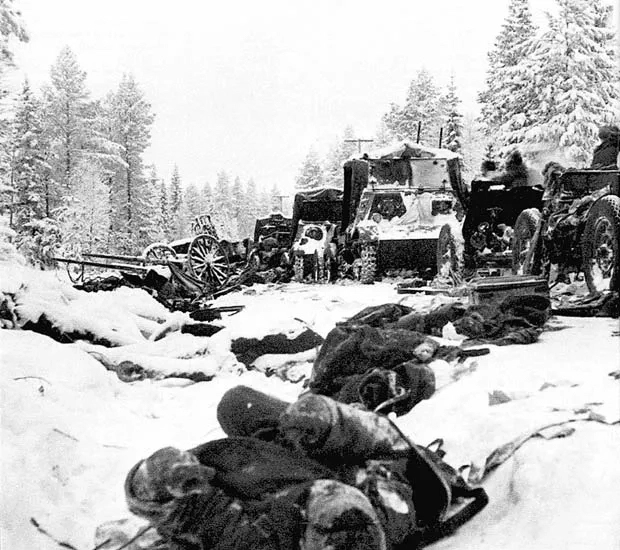
When it comes to the exchange of territories, the textbook’s authors naively forget to mention that the land Stalin lay claim to contained Finnish defensive fortifications. Moving the border northward would have meant leaving Finland defenseless before the Soviet Union, which had already partitioned Poland with Hitler, sent troops into the Baltic republics, and effectively established control over them. Finland, however, chose to resist such pressure – the country was prepared to defend its sovereignty with weapons in hand.
As if reinforcing the justification for the USSR’s war against Finland, the textbook’s authors note that Finland (much like Poland) had "long and actively cooperated with Germany" (p. 287). From the Soviet side, it is somewhat strange to level such an accusation against anyone, given that it was the USSR that by then had signed a pact with Germany to divide Eastern Europe, followed by the Treaty of Friendship and Border with Germany (September 28, 1939).
Under the secret protocol of the latter, Finland fell within the Soviet sphere of interest, and Germany had no intention of standing up for it. Moreover, it was Britain and France that were prepared to support Finland — as of 1939 Helsinki was oriented far more toward them than toward Germany.
Under the secret protocol, Finland fell within the Soviet sphere of interest, and Germany had no intention whatsoever of standing up for it
At the time, Finland was buying anti-aircraft guns from Germany and planes from Britain. What is especially notable is that as soon as the USSR attacked Finland, Germany immediately halted all arms deliveries to the Finns, notifying the Soviet side of this decision in December 1939. Simply put, the textbook authors’ attempt to portray the Finns of 1939 as Hitler’s allies is highly unconvincing.
The account of the start of military operations against Finland in November 1939 turned out to be extremely concise, with the authors briefly noting that "the command of the Red Army underestimated the strength of the Finnish fortifications" and that "the troops proved insufficient for a breakthrough" (p. 278). They do not mention the clear advantages in manpower and equipment that the Soviet side possessed, even when only taking into account assets on the Karelian Isthmus.
Page 288 of the textbook is devoted to the foreign-policy consequences of the Soviet attack on Finland. The authors write:
"As a consequence of the outbreak of hostilities, relations between the USSR and Britain and France deteriorated. The general staffs of these countries, while continuing to refrain from active military operations against Germany, developed plans for aerial bombardment of the Caucasus oil fields and for sending an expeditionary corps to assist the Finnish army. The Soviet Union was expelled from the League of Nations, which finally turned that organization into a fiction."
The League of Nations, created after World War I, did not merely expel the USSR – it called on member states to support Finland. In that sense, the military measures planned by Britain and France in support of Finland had not only strategic logic, but also a literal basis in international law.
It is worth recalling once again that at that time the USSR was supplying the Third Reich with raw materials (oil, iron ore, and manganese), cooperating with Hitler in the partition of Poland, and maintaining a friendship treaty with Nazi Germany. In light of these circumstances, the textbook authors’ attempt to portray Britain and France as the warmongers appears, to put it mildly, awkward.
The textbook then notes that by February 1940 "the Finnish army had exhausted its capacity for resistance" (p. 288). In March 1940, peace was signed between the USSR and Finland. The textbook does not explain why the USSR did not advance further given that the Finnish army supposedly no longer had the ability to fight.
Interestingly, the answer lies in the historical fact that it was precisely in February–March 1940 that the military leadership of Britain and France had decided to intervene in the war on Finland’s side and began preparing an expeditionary corps (Plan R3). Troops were being loaded onto ships at the very moment the peace treaty between Finland and the USSR was signed in Moscow.
In the textbook, incidentally, the initiative for peace negotiations is attributed to the Finnish side, whereas in reality the first probing on the matter was begun by Sweden in January 1940, acting at the Soviet Union’s behest. Helsinki did not agree to peace at that stage, and only in March — when Finland had indeed suffered substantial casualties and lost part of its fortifications, and at a moment when the USSR was facing the threat of Britain and France entering the war — were the sides able to compromise on peace.
During the 105 days of war, the USSR lost 131,476 men killed and missing, while Finland suffered 26,000 killed and 44,000 wounded. The textbook says not a word about this relative disbalance, merely noting (p. 288) that "serious shortcomings in the training and equipment of the Red Army were revealed."
The contrast with how the 2013 history textbook described the events of the Soviet–Finnish War is notable (p. 181):
"In November 1939, the Soviet leadership provoked a war with Finland and immediately formed a puppet government of 'people’s' Finland headed by Comintern figure O. V. Kuusinen. Military operations were accompanied by heavy losses for the Red Army (almost 127,000 killed and dead of wounds, against 48,000 on the Finnish side). In addition, the war caused serious foreign-policy complications for Moscow. In December 1939, the USSR was expelled from the League of Nations as an aggressor state. Britain, France, and the United States were preparing military aid for Finland. Under these circumstances, J. V. Stalin did not dare march on Helsinki. The Sovietization of Finland failed."
Textbooks are no place for debate
Modern instruments of Russian foreign policy — claiming to be the victim of aggression, justifying occupation as a preventive measure, and conducting controlled elections and referendums – are inherited from the traditions of Stalin’s foreign policy of the 1930s.
One might argue that the Russian Federation is not the Soviet Union, but instead of condemning Soviet crimes and learning from the repressive past, the Russian political elite of today embraced the role of legal successor to both the victories and the crimes of the USSR, adopting the worst Soviet traditions and retroactively justifying any and all actions taken by the Soviet leadership. This legacy is fully reflected in the unified history textbook, which not only feeds Russian teenagers historical falsehoods, but also leaves no room for self-criticism or scholarly debate.