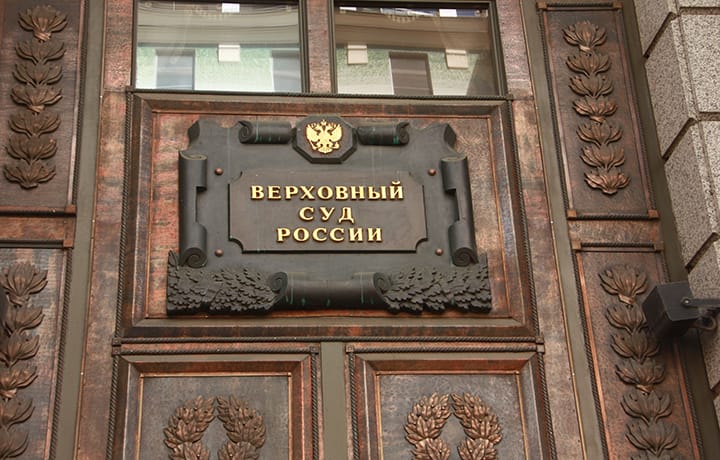
The Judicial Department of Russia’s Supreme Court has removed public access to judicial statistics on cases heard by courts of general jurisdiction, commercial courts, and justices of the peace. According to a notice on the department’s website, the information is now temporarily unavailable.
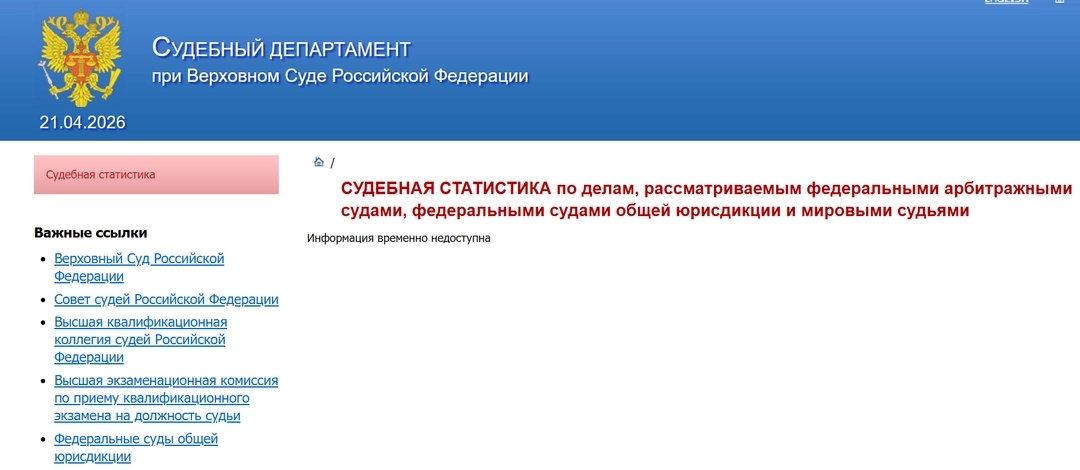
The department told the independent investigative outlet Important Stories that access to the statistics had been closed due to changes in legislation:
“The regulations governing publication are changing, so access to the statistics is now closed.”
The department’s representative did not specify what kind of changes were involved, when access to the statistics would be restored, to what extent it would be restored, or whether it would be restored at all.
Political scientist Mikhail Komin told The Insider that even if the Supreme Court ultimately stops publishing judicial statistics altogether, data for individual courts will still be available:
“It is possible that the new chairman of the Supreme Court [former Prosecutor General Igor Krasnov] wants to change some of the fields in the forms, for example by limiting the published statistics on military courts. Not publishing aggregated statistics would be too radical a step — and pointless from the standpoint of the political agenda — because it is general statistical information on law enforcement practice that does not cause any obvious harm to the political regime. Besides, in disaggregated form this information will still be available on the websites of the courts themselves, although it will become harder to collect.”
Ivan Pavlov, lawyer and founder of the human rights project Pervy Otdel (lit. “Department One”), told The Insider that manipulation of judicial statistics had been observed before:
“One wants to hope that the information has been removed temporarily, as the website says. But the negative trend is obvious. And the fact that the data for 2025 were not published on time is also bad. In our own field of cases — treason, espionage, confidential cooperation, extremism, terrorism — we noted that in these categories the statistics were distorted. In open sources we found information on a greater number of cases than was reflected in the judicial statistics for previous years (after 2022).”
As earlier noted by the Radio Liberty project Sever. Realii, the Supreme Court’s Judicial Department, contrary to its own regulations, had not published statistics for the second half of 2025 by its April 20 deadline.. The statistics for previous years have now also disappeared from the site.
The Supreme Court’s judicial statistics included data on the number and demographic makeup of people convicted on criminal charges, sentences imposed under various provisions of Russia’s Criminal Code, and figures for civil claims and administrative cases, including how many were reviewed, granted, or rejected, along with other information that could be used to assess broader trends.
Political scientist Ekaterina Schulmann told The Insider that these statistics were of particular interest to researchers amid ever-shrinking access to data in Russia:
“The statistics of the Supreme Court’s Judicial Department show data on court rulings. This information is significant in itself as it demonstrates how Russia’s judicial system works.
It makes it possible to see what judicial decisions courts are handing down. In this way, one can compile a ranking of the most frequently used articles of the Criminal Code under which our fellow citizens are tried. One can see how crime under particular articles changes from year to year.
In the trajectory of a criminal case, the court ruling is the final stage. A great deal falls away along that path, because not all crimes are reported, not every report leads to a criminal case, and not every case reaches court. That means that at each successive stage, more and more phenomena of social life are peeled away. But as all the other criminological data began to disappear, the information from the Judicial Department literally remained the last window into the world of Russia’s criminal reality.
In the past, sociologists were able to conduct what are known as victimization studies — studies of how often citizens become, or consider themselves, victims of crime. The Interior Ministry published its regular reports. We had data from the Federal Penitentiary Service on how many people it had in penal colonies, prisons and pretrial detention centers. By combining these numerous data sets, it was possible to obtain a more or less objective picture of how society in Russia behaves. But since 2023, the Interior Ministry has stopped publishing any regular crime data, and the Federal Penitentiary Service also stopped publishing any sufficiently detailed and diversified data on the prison population after inmates began disappearing from the system in large numbers by signing up for the war. And from the beginning of 2026, the Federal Penitentiary Service lost control over part of the pretrial detention system — those facilities were transferred to the FSB, which of course answers to no one.
Since 2022, more than 90 different databases that had previously been published by government agencies have disappeared from public access. Given that we have, for example, no demographic statistics at all, and that a significant share of economic indicators that were once available — for example oil and gas production or sector-by-sector wage data — have also ceased to be accessible, the Judicial Department of the Supreme Court was one of the last sources of objective data on Russian reality.”