The European Union’s latest sanctions package, adopted Oct. 12, bears signs of having been generated by a large language model. The document contains numerous errors — including references to companies that have long since closed, individuals listed without birthdates, and pseudonyms used in place of real names. The package also omits Chinese companies entirely, despite China’s growing role in helping Russia evade sanctions aimed at hindering the work of Moscow’s military-industrial complex amid the war in Ukraine.
The EU’s latest sanctions package is riddled with errors that are striking to the human eye: the mixing of Latin and Cyrillic characters (as in the phrase «Акcionерное общество», or “Joint-stock company”), names listed without birthdates, actors’ stage names used in place of real surnames, and references to companies that ceased operating long ago. While technical mistakes are inevitable in a document covering 1,500 individuals and legal entities, the latest package stands out for the apparent lack of care in its preparation. One of the clearest signs is what appears to be the use of large language models (LLMs) in drafting parts of the text.
“Workslop” and copy-pasting instead of meticulous bureaucracy
At first glance, the use of boilerplate language may not seem significant. Council Decision No. 2026/2279 relies on just two standard phrases to justify sanctions against 1,569 individuals and organizations. That marks a clear departure from previous sanctions packages, which generally included a specific explanation for why each newly designated person or entity had been targeted.
Additionally, for the first time, the EU writes the names of all legal entities as literal transliterations from Russian rather than as they appear in Russia’s official register of legal entities. When Russian organizations are registered, the database typically includes both their full and abbreviated Russian names as well as the English-language name chosen by the organization itself. Some companies use a transliteration in that field, while others provide an actual translation.
In the latest sanctions document, however, company names appear to have been transliterated mechanically and with little quality control. Capitalization was omitted throughout. While similar formatting errors had appeared occasionally in earlier EU sanctions lists, in the latest package nearly every legal entity contains the same type of error.
The transliteration itself is also inconsistent. Different systems appear to have been used for different entries. In most cases, the latest package appears to rely not on a standard transliteration system for Cyrillic but on output generated by the Python transliterate library, with apostrophes subsequently removed. Names of individuals, meanwhile, were generally rendered using the British-American BGN/PCGN system, though not consistently and sometimes with further modifications.
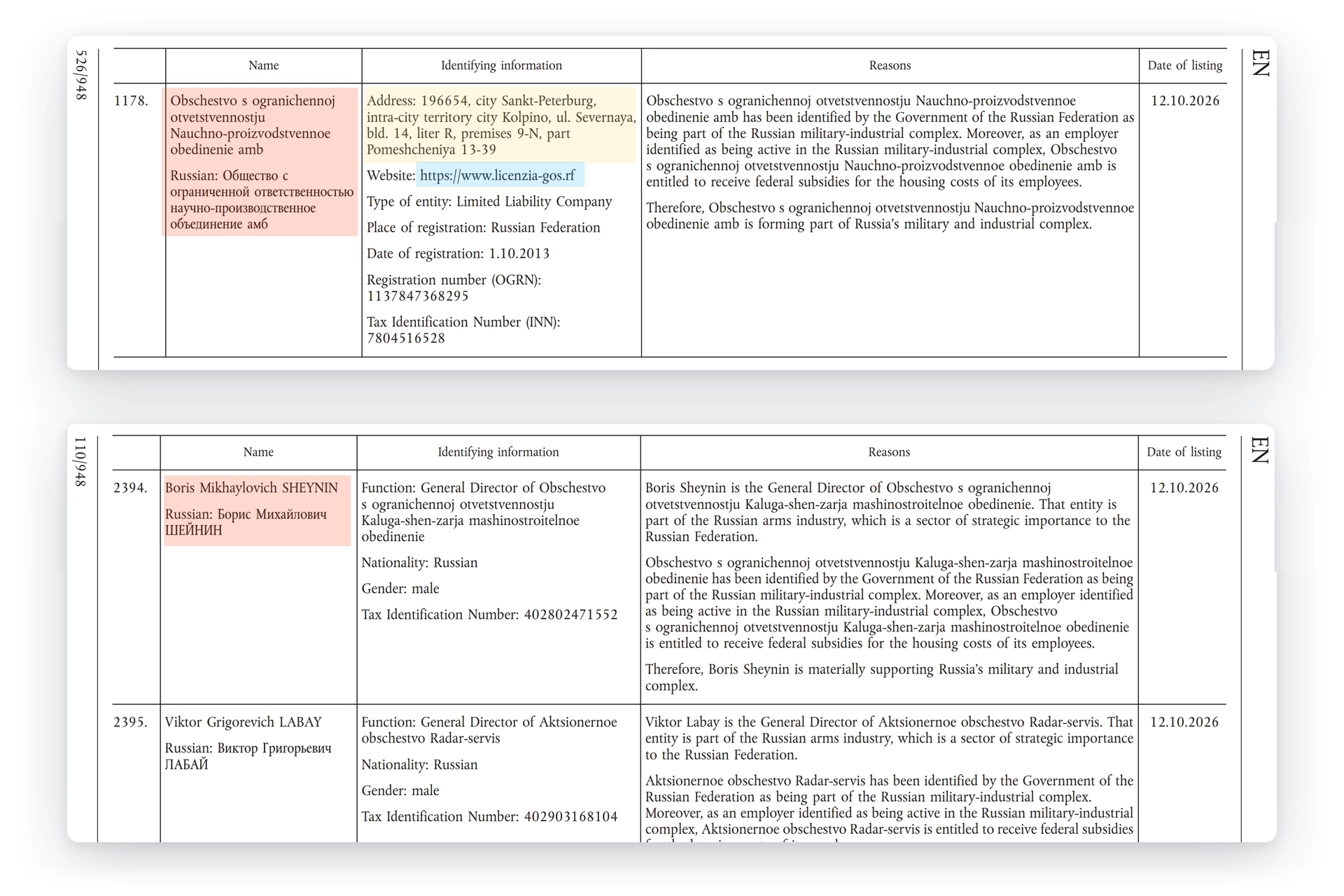
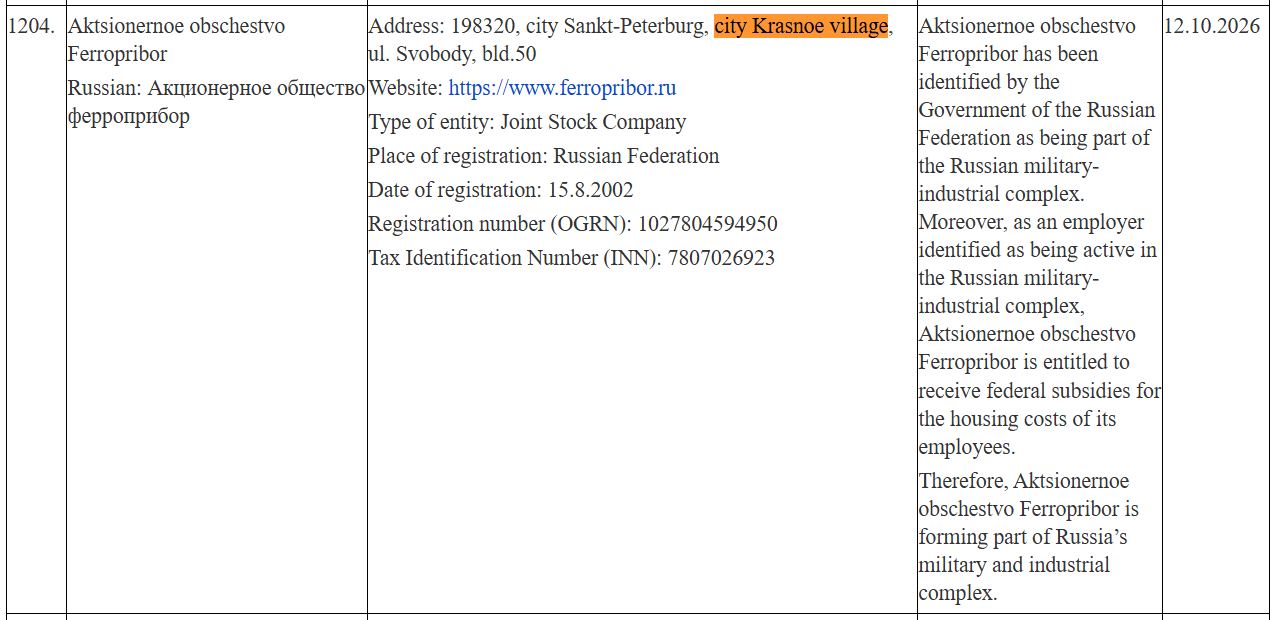
The document is also inconsistent in deciding when to translate Russian names, when to transliterate them, and when to do both at once. One example is the address of Neva-Ferrit LLC. The original address — “198320, St. Petersburg, Krasnoe Selo, Svobody St., 50” — was rendered as “98320, city Sankt-Peterburg, city Krasnoe village, ul. Svobody, bld.50.”
The result mixes translation and transliteration in a way that makes little sense. The place name “Krasnoe Selo,” which should normally remain a proper name, was partially translated into English as “Krasnoe village,” while the street name “Svobody” was left transliterated rather than rendered as “Freedom Street” or “Street of Freedom.”
One possible explanation is that large language models were used to generate parts of the document. That could also account for the apparent use of a Python transliteration library — when asked to automate a task of this kind, an AI system may generate a script, and such a script would likely rely on an existing software library.
If a Python library was in fact used to transliterate company names, that would explain some of the unusual spellings. It would not, however, explain instances in which Latin and Cyrillic characters appear within the same word, such as in the name of the Kalinovsky Chemical Plant: «Акcionерное общество калиновский химический завод».
Similar errors have appeared in earlier sanctions documents, but those usually involved letters that look identical in the Latin and Cyrillic alphabets — such as A, B, T and E. In those cases, the mistake was invisible to the eye but detectable by software and most likely resulted from a person typing without switching the keyboard layout.
The latest document is different. The mixing of alphabets within a single word is more consistent with errors that occur in text generated by neural networks, especially when a task requires several languages to be handled at once.
Another example is the English-language address given for CJSC Tehkrim: “Address: 426063, Udmurtskaya Republic of …” A human translator or conventional machine-translation system would be unlikely to produce that wording, as the standard English form is “Udmurt Republic.”
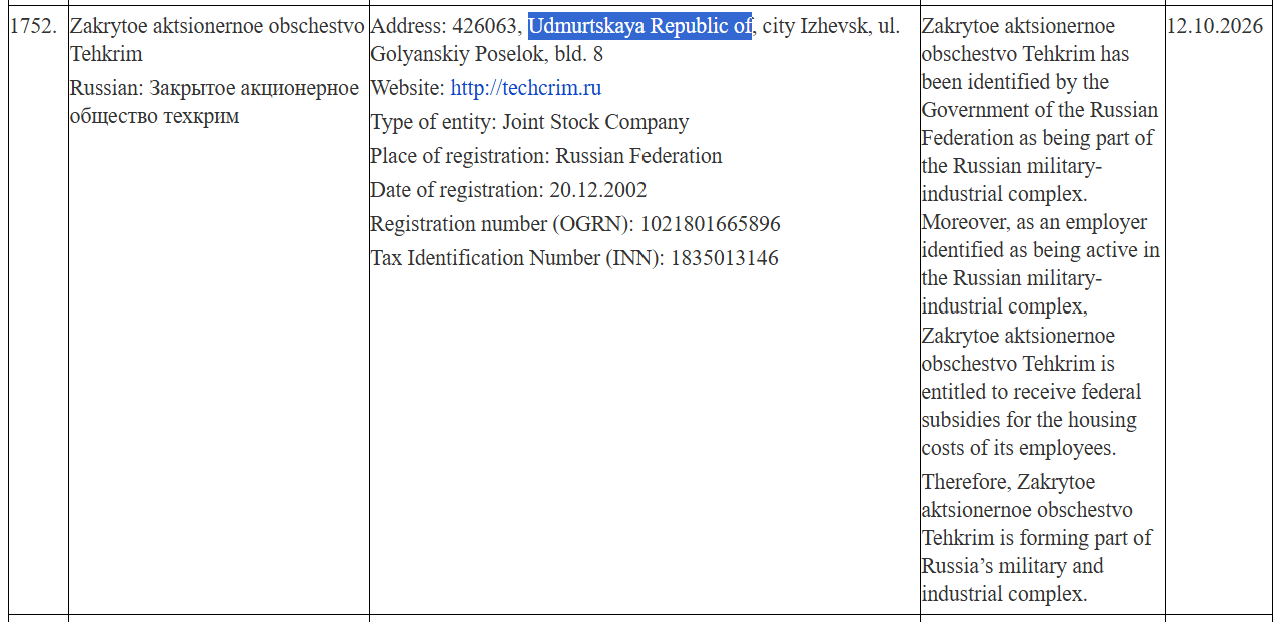
While a human translator would be unlikely to translate the phrase with such an awkward rendering, a large language model, which does not translate strictly word for word but predicts the most likely sequence of words, certainly could. Because many Russian regions are rendered in English using the construction “Republic of …,” a model could plausibly predict that “of” should follow the name of a Russian republic even where that order is incorrect.
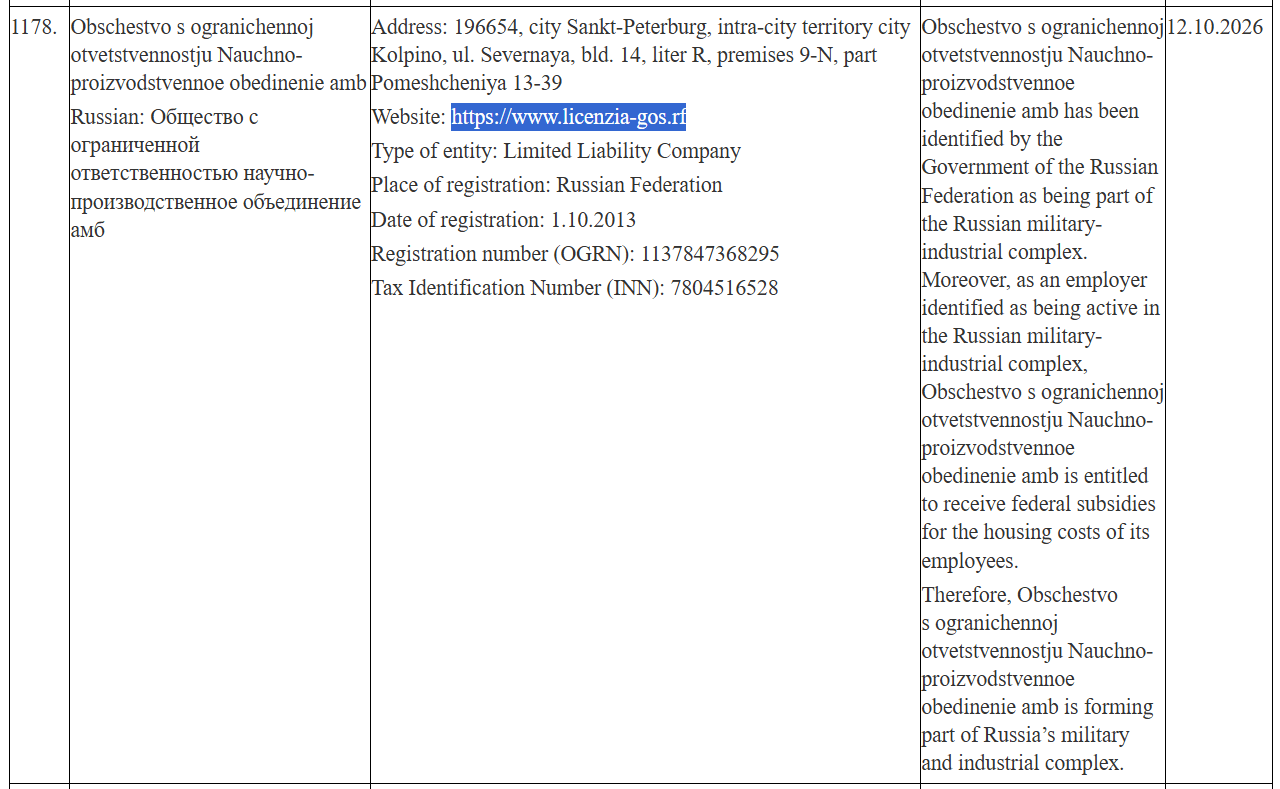
The careless transliteration appears to have affected website addresses as well. For example, the website listed for LLC NPO AMB — rendered by EU sanctions officials as “Obschestvo s ogranichennoj otvetstvennostju Nauchno-proizvodstvennoe obedinenie amb” — became https://www.licenzia-gos.rf. The problem is obvious: the top-level domain “.rf” does not exist. Nor does the listed website exist in that form, or even in the corresponding Cyrillic version, лицензия-гос.рф.
Factories of days gone by
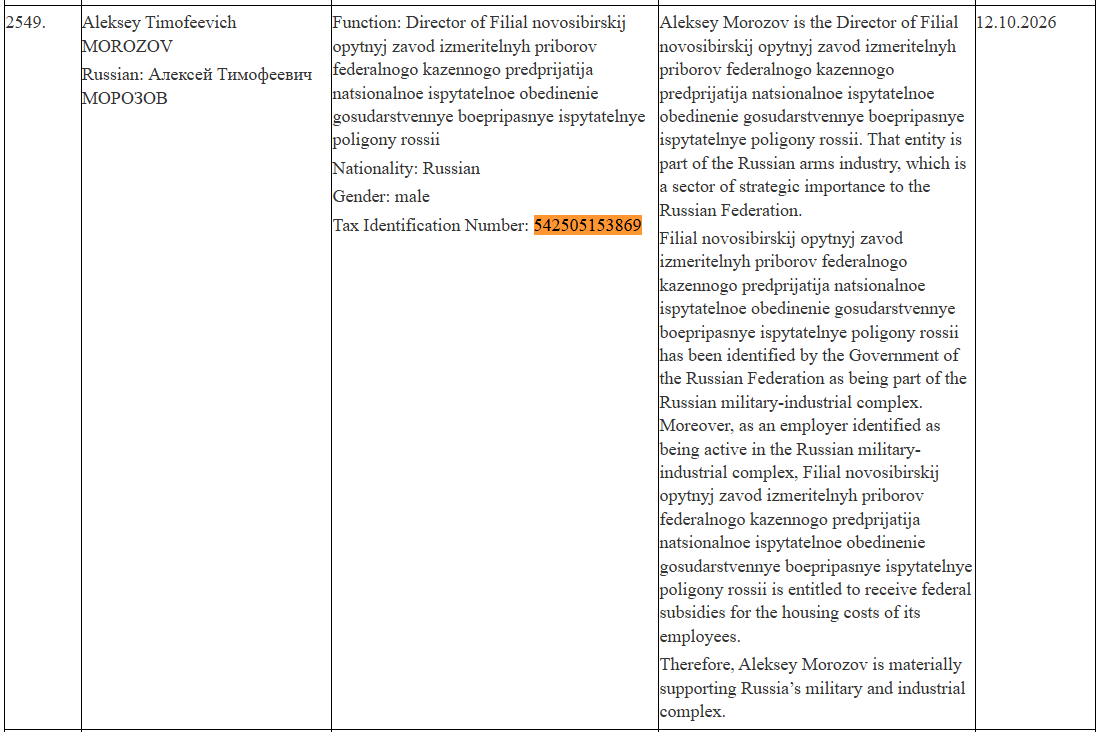
A telling example of an anachronism on the list involves the imposition of sanctions on the Federal State Unitary Enterprise “Novosibirsk Experimental Plant of Measuring Instruments” (TIN / INN 5425100089) and its director, Aleksey Timofeevich Morozov (designation no. 2549, TIN / INN 542505153869). However, this legal entity no longer exists, as it was reorganised in 2021 through a merger with the Federal State Unitary Enterprise “National Testing Association ‘State Ammunition Testing Ranges of Russia’” (TIN / INN 5023002050). That organisation was also subject to sanctions, but its CEO, Stanislav Gennadievich Yuzov, was not included on the EU sanctions list.
It is possible to see how such an error arose. Many companies appear to have been added to the list on the following basis:
“The entities concerned appear in a list recently established by the Government of the Russian Federation that identifies them as belonging to the Russian military-industrial complex, and they are therefore entitled to receive subsidies from the Government of the Russian Federation.”
That suggests an AI model or Python script may have been given a source list that, while broadly reflecting the composition of Russia’s military-industrial complex, was not fully up to date. The resulting entries appear not to have been adequately checked by experts.
More importantly, even an up-to-date list would have limited value as a sanctions tool. Companies in Russia’s defense sector generally do not make foreign purchases directly, meaning sanctions against them may have little practical effect on procurement. Instead, separate intermediary firms typically acquire goods on their behalf — a practice The Insider has documented repeatedly, as have other researchers who study Russian military-industrial procurement.
Even a cursory reading of the latest EU package reveals at least 25 discrepancies in the names and legal forms of the organizations on the list, and numerous errors occur when it comes to naming the positions held by individuals coming under restrictions. In some cases, parts of company names are missing, and in most cases, the legal form is incorrectly stated.
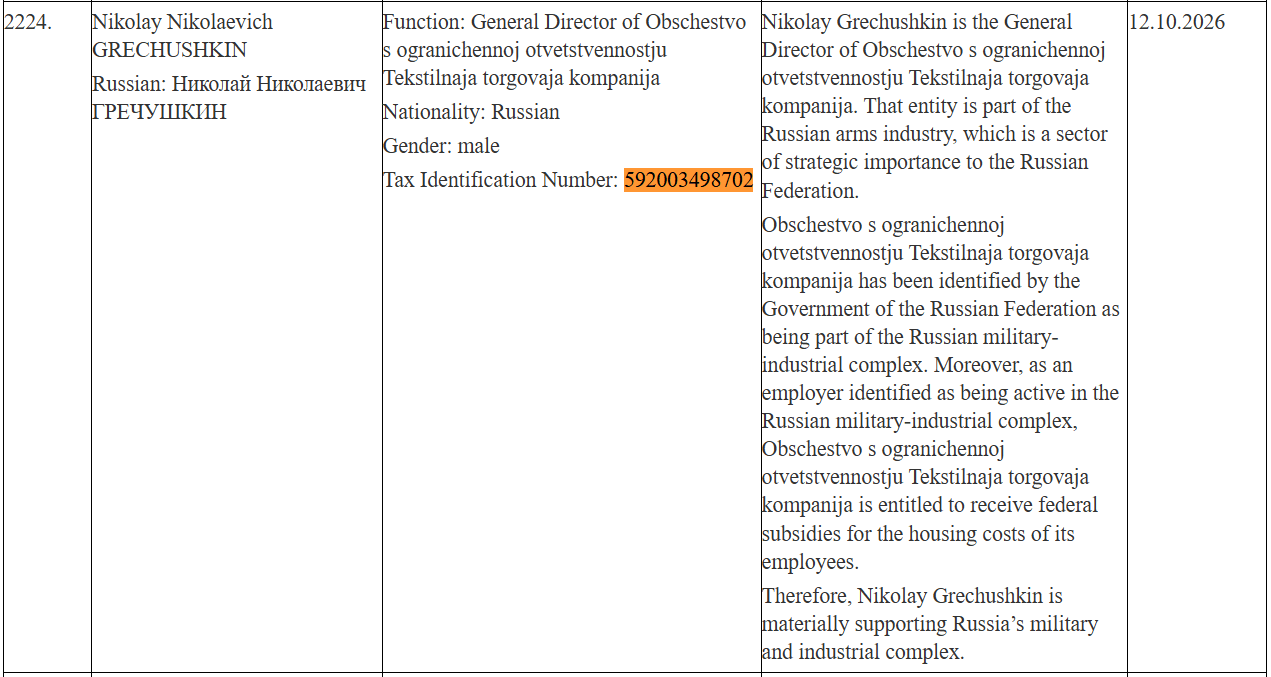
For example, Nikolay Nikolaevich Grechushkin (designation no. 2224) was sanctioned as the CEO of Textile Trading Company LLC (TIN / INN 9701054138). However, that position is actually held by Anatoly Mikhailovich Trubin. At the same time, the list correctly lists Trubin’s INN as 592003498702. Grechushkin, for his part, serves as deputy CEO of the company, and his TIN is 253303297804.
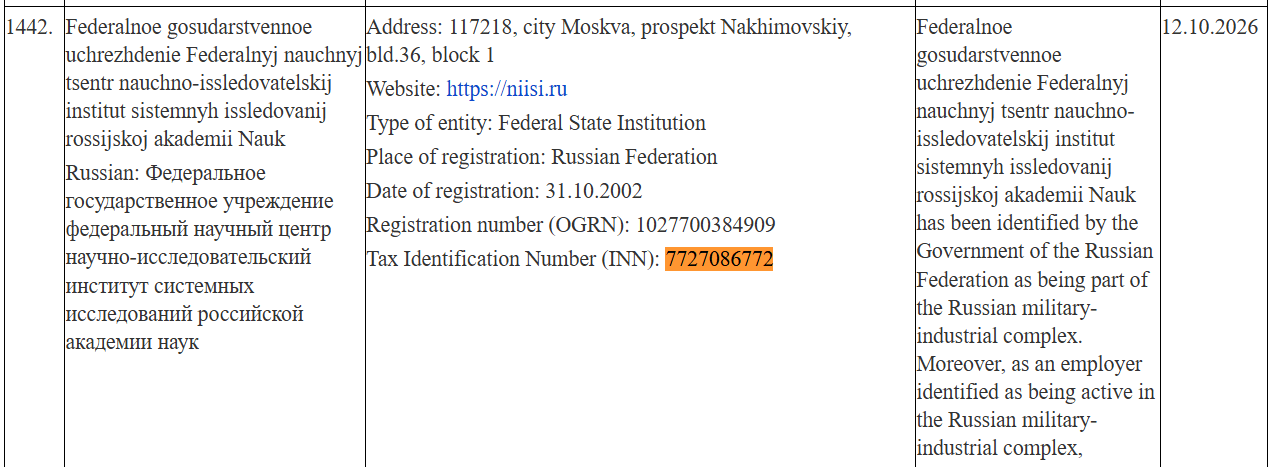
Evgeniya Vladimirovna Kovalenko (TIN / INN 525714947515), is listed as the director of JSC “Himreaktiv.” However, the CEO of this company is actually Vladimir Nikolaevich Lyamkin, who holds TIN 525702072428.
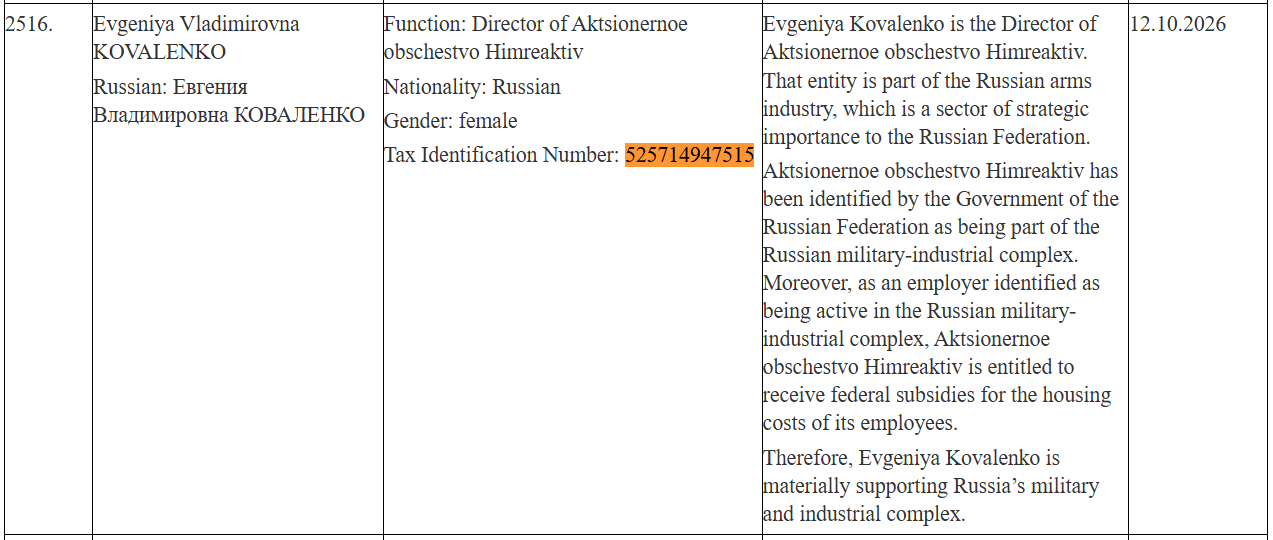
OJSC “Radiodetal,” with TIN 1308038496, also appears on the sanctions list. This organization has a different legal entity and a different name — PJSC “Zubovo-Polyansky Radio Component Plant” — which again indicates that the data used is outdated.
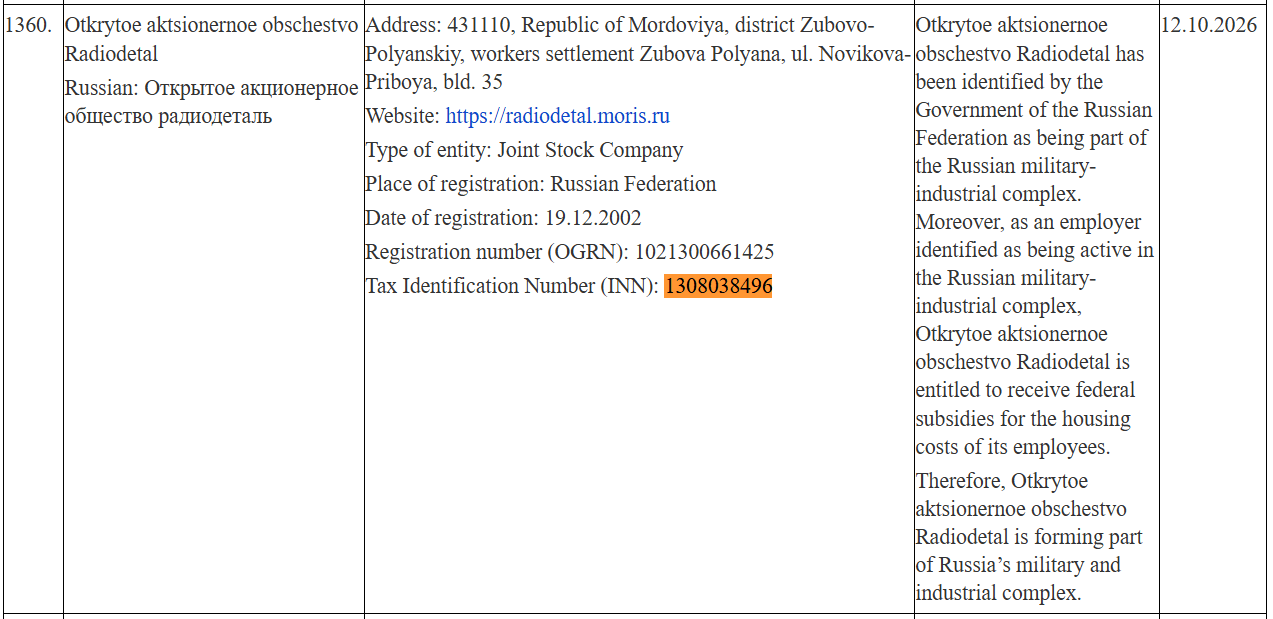
The list also includes the “Federal State Institution Federal Scientific Center Research Institute for Systems Studies of the Russian Academy of Sciences” (original spelling retained) with TIN 7727086772. This is also an anachronism. This institute was transferred from the jurisdiction of the Russian Academy of Sciences to the Kurchatov Institute Research Center on Feb. 7, 2023, by Decree No. 268-r of the Government of the Russian Federation. Its current name is “Federal State Autonomous Institution ‘Federal Scientific Center Research Institute for Systems Studies of the National Research Center “Kurchatov Institute”’.”
Sanctioning everyone with the same name — and missing the mark
As previously noted by investigative journalist Sergei Ezhov, EU officials failed to specify the patronymic, date of birth, or taxpayer identification number of Promsvyazbank CEO Mikhail Dorofeev when imposing sanctions against him, thereby creating risks for all people named “Mikhail Dorofeev” worldwide. When compiling the new list, the European Commission expanded this practice: in fact, in the case of the 743 individuals on the current sanctions list, none are supplemented with a date of birth or passport number. However, tax identification numbers (INNs) are listed — something that was previously rare on lists of sanctioned individuals.
The absence of birth dates and passport numbers significantly increases the risk of false matches or missed matches during automated sanctions screening. When processing a Schengen or other visa application, consular officials typically verify an applicant’s passport information and date of birth, but not a Russian taxpayer identification number. After all, if a person is not publicly linked to a Russian company as a founder or director, authorities may have no reliable way to match a TIN to that individual using open-source records, as such information is not generally public. (The same problem can arise in bank compliance checks, which typically rely on a person’s full name and transliterations, date of birth, passport details, address, job title and employer — but not a Russian TIN.)
The Insider has already seen the consequences of this approach: one of our employees was temporarily unable to receive their salary simply due to the fact that they share a surname with a person added to the latest sanctions list, prompting the bank to freeze the payment.
Previously, journalists had repeatedly pointed out factual errors made by European officials when compiling sanctions lists. For example, the EU imposed sanctions on comedian Mikhail Galustyan by using his stage name (the artist’s official name is Nshan). An error was also made regarding his date of birth: Galustyan was born in 1979, not in 1970, as stated in the EU Council’s implementing regulation. These errors have not been corrected a year and a half after the document’s publication.
These oversights may seem minor, but they can have serious legal consequences for EU authorities. In May 2025, for example, an EU court lifted sanctions against Andrei Kharkovsky, described as a “representative of the Cossack Union,” after Brussels failed to establish his connection to the organization. The sanctions listing did not include his date of birth or other identifying information sufficient to distinguish him unambiguously.
Documents such as the October package are examples of “Potemkin sanctions.” They create the appearance of intense activity, and the sheer scale of the lists might impress an outside observer. In reality, however, the latest package completely ignores the Chinese manufacturers and banks that continue to supply Putin’s war machine.
The elephant in the room: Brussels ignores China
Investigations by The Insider and other publications have repeatedly pointed to China’s leading role in the supply of critical goods to Russia. It is Chinese manufacturers and their affiliated Chinese banks — not intermediary exporters or importers — that represent the potential bottlenecks in Russian factories’ supply chains.
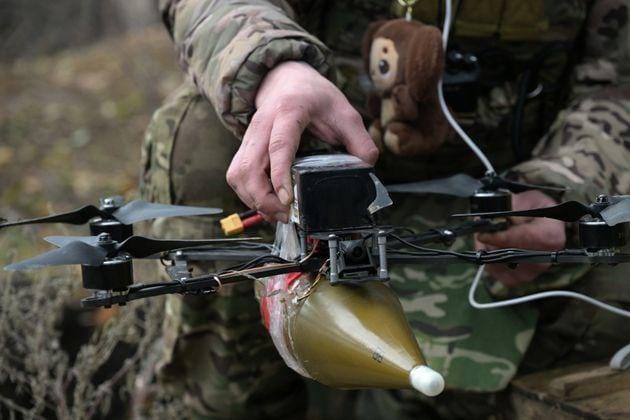
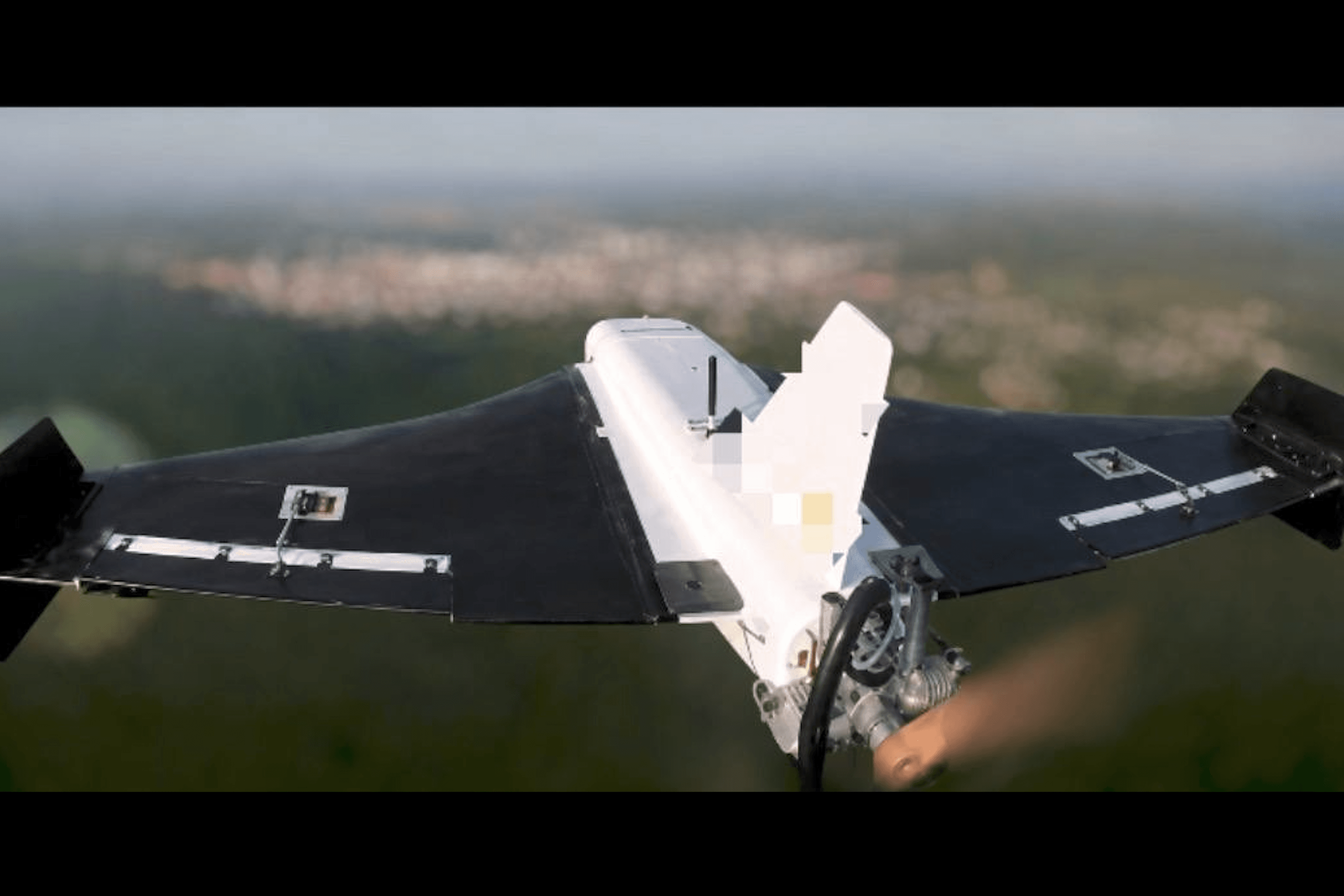
The Insider has identified several bottlenecks in a series of investigations related to long-range unmanned systems, such as the Geran attack drone and the Gerbera decoy drone, as well as the mass production of first-person-view (FPV) drones. Both are absolutely critical to the Russian war machine. About 70% of combat losses result from the use of FPV drones, while civilians and civilian infrastructure suffer the most from Geran drones.
Not a single Chinese company — neither manufacturers nor resellers — was included among the hundreds of companies listed in the latest round of EU sanctions. Given the documented role that Chinese products play in the Russian military-industrial complex, the absence of Chinese entities suggests that Brussels lacks the political will to address the driving force sustaining the Russian war machine: imports from Chinese suppliers.