Russia's 2027 draft budget, which the State Duma is set to approve, looks good on paper. After all, planned revenues and expenditures are expected to barely increase. This would be a miracle of fiscal restraint, except that in 2025 and 2026 the budget deficit exceeded its target by about 4 trillion rubles ($48.3 million). The same is likely to happen again this year, but either way, the budget makes the government’s priorities clear: this time, the Kremlin is not even trying to create the illusion of cutting military spending. Military outlays will rise by more than 40% compared with last year’s draft budget — at the expense of civilian spending, especially when it comes to social support and economic investment. Meanwhile, the burden of government debt is growing rapidly, nearly doubling since the start of the war.
The Russian government’s 2027 draft federal budget projects a year-on-year 5% increase in nominal revenues. Adjusted for inflation, however, revenues are expected to fall, while nominal spending is forecast to rise by a token 0.4% — meaning it will actually decline in real terms.
The deficit is projected at nearly 5.5 trillion rubles ($66.5 billion), or 2.2% of GDP, with inflation expected to run at 4%. Under the proposed budget, domestic government debt will remain below 48 trillion rubles, while external debt will not exceed $66.4 billion. Overall, government debt will rise to 22% of GDP.
The government also expects the ruble to depreciate by 10%, reaching 87.4 rubles to the dollar (compared with 79.5 this year). Oil prices are projected to fall to $53 per barrel, down from $61.2 in 2026 and $55.6 in 2025.
A rose-colored budget
The projected deficit and spending trends look broadly conservative, sensible, and cautious. For most countries at war, such a budget would represent a miracle of fiscal restraint.
Wars have never cost the Russian treasury so little as they do today. The Russo-Japanese War of 1904–1905, the Russo-Turkish War of 1877–1878, and the Crimean War of 1853–1856 all placed a heavy burden on the state treasury. In 1855, government spending was nearly double tax revenues, in 1878 it was 1.6 times higher, and in 1905 it was 1.5 times higher.
According to the draft budget, spending in 2027 will exceed revenues by just 13%. Even in peacetime, only the most frugal governments can resist the temptation to increase spending. Next year’s draft budget claims that it will do just that, promising to cut spending in real terms.
The chances of the budget being executed as projected, however, are slim. For several years now, the figures set out in the budget law have diverged from reality. In 2025, the deficit was nearly five times the planned amount. In 2026, according to the Russian Finance Ministry’s latest revision of its official forecast, it will be almost twice the planned level.
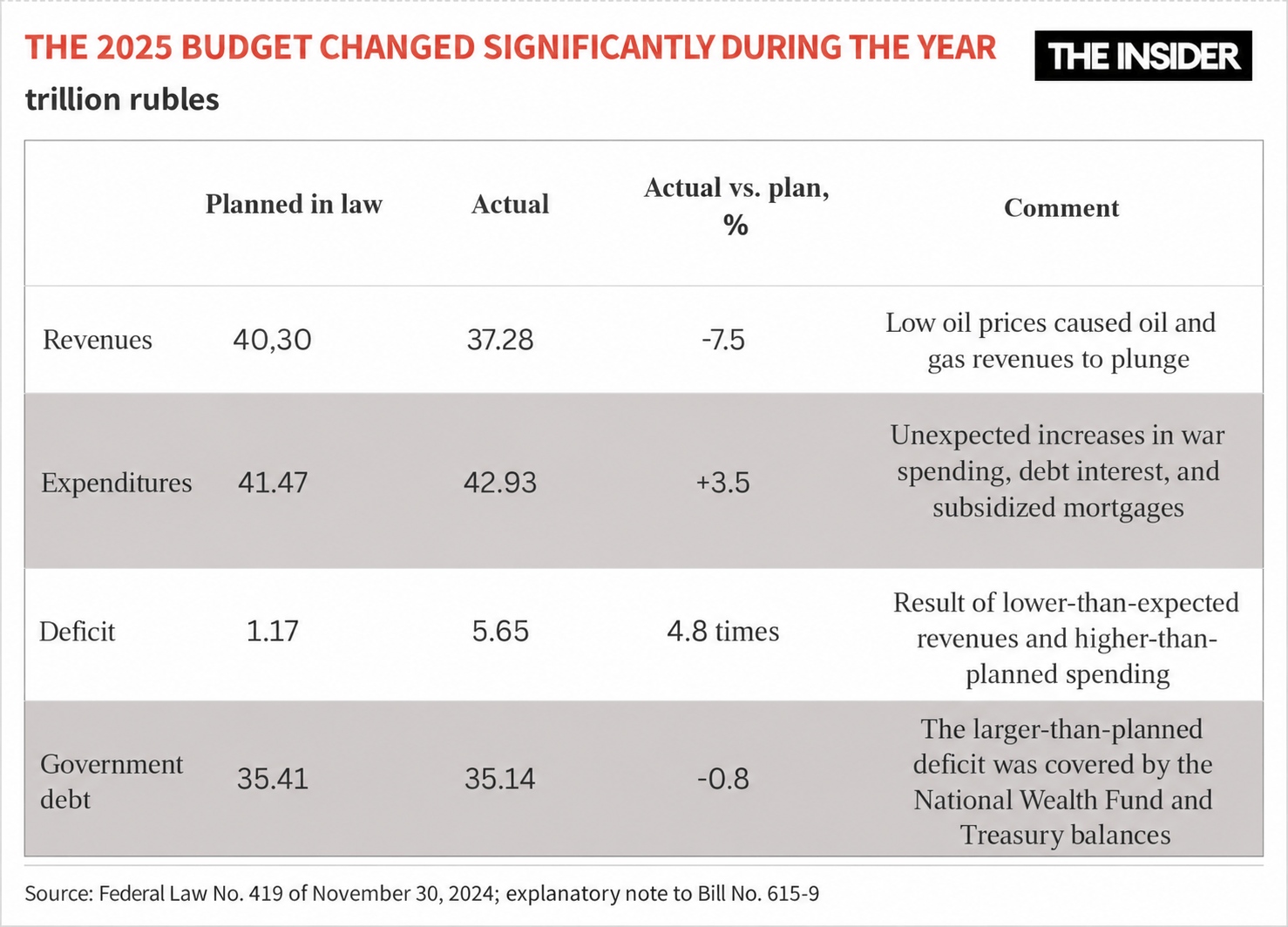
The deficit target went off the rails because revenues were misforecast. In 2025, revenues fell 3 trillion rubles ($36.3 billion) short of expectations, mainly because oil and gas revenues came in at 8.5 trillion rubles instead of the planned 11 trillion. Spending, too, proved difficult to forecast: in 2025, it exceeded projections by 1.5 trillion rubles ($18.2 billion).
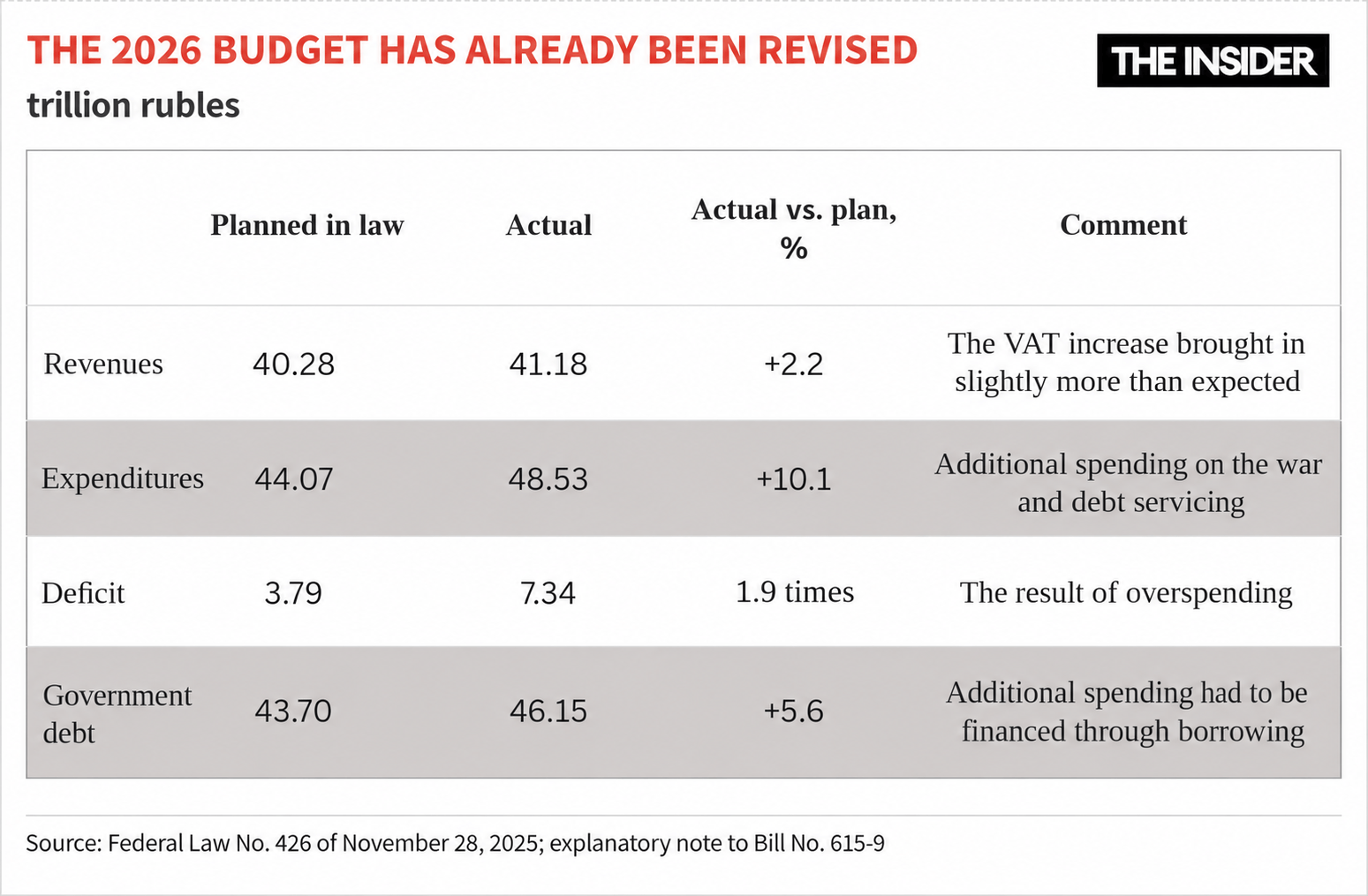
It is still too early to assess the final figures for 2026, but the budget has already been revised twice. The latest change came in late September, putting expected revenues nearly 1 trillion rubles ($12.1 billion) higher than last year's, with projected spending 4.5 trillion rubles ($54.3 billion) higher.
For 2025, actual budget execution at least came close to the projections made in the autumn, and the same is likely to happen in 2026. But the federal budget’s actual revenues and expenditures can not be known until the fall of the following year, and the figures published now will prove just as far removed from the actual accounting as the original projections for 2025 and 2026 were.
The figures published now will prove just as far removed from reality as the original projections for 2025 and 2026
Meanwhile, budget targets approved at the end of one year for the next have ceased to be reliable benchmarks. We can only speculate about why they are published in this form. Perhaps it is a ploy to reassure markets and the public. Perhaps it reflects self-deception among government leaders, or an irrational attempt to wish away financial reality by trying to influence it through a bureaucratic ritual.
The snowball of war
One thing the Finance Ministry can be believed on is its promise to increase spending on the war and interest payments on government debt. In the draft budget two years ago, open spending under the “National Defense” category was set at nearly 3 trillion rubles ($36.2 billion), but actual spending reached 4.34 trillion rubles ($52.4 billion) by year-end — a whopping 151% above the plan, the largest overshoot of any budget category. By contrast, debt servicing was budgeted at 3.18 trillion rubles ($38.4 billion), and 3.21 trillion rubles ($38.8 billion) was spent.
The largest spending category, “Social Policy,” received 97% of its planned allocation — just under 6.5 trillion rubles ($78.5 billion) instead of the promised 6.7 trillion rubles ($80.9 billion). The steepest cuts fell on “General Government Affairs,” which received 2 trillion rubles ($24.2 billion) instead of the planned 2.2 trillion rubles ($26.6 billion), or just 89% of the autumn target.
The publicly disclosed portion of federal spending in 2025 amounted to just 32 trillion rubles ($386.5 billion) out of total expenditure of 43 trillion rubles ($519.3 billion), with no official breakdown published for the remaining 11 trillion rubles ($132.9 billion). A simple calculation suggests that most of this money went toward military purposes: planned defense spending totaled 13.5 trillion rubles ($163.0 billion), of which 3 trillion rubles ($36.2 billion) was included in the publicly disclosed budget (as noted above).
According to an estimate by Janis Kluge of the German think tank SWP, 85% of classified federal budget spending goes toward military purposes. In 2025, total spending on the war in fact reached nearly 17 trillion rubles ($205.3 billion), or 39% of the entire budget, including spending outside the “National Defense” category, such as benefits for service members’ families.
In the 2026 budget, which was submitted to the State Duma in 2025, the government proposed an even lower 13 trillion rubles ($157.0 billion) for national defense, according to Interfax, and amount ultimately approved was just 12 trillion rubles ($144.9 billion). Slightly less than 3 trillion rubles ($36.2 billion) of that fell under publicly disclosed budget lines, leaving 9 trillion rubles ($108.7 billion) for classified military spending, out of 11.5 trillion rubles ($138.9 billion) in total classified expenditure.
By midyear, the Finance Ministry reported spending 16 trillion rubles ($193.2 billion) under publicly disclosed budget lines and 24 trillion rubles ($289.9 billion) in total. This means that 8.4 trillion rubles ($101.4 billion) had already been spent under classified budget lines in the first six months of 2026 — around 73% of the annual allocation. An estimated 7 trillion rubles ($84.5 billion) of that went to the military.
A conservative estimate assumes that military spending under both disclosed and classified budget lines in the second half of 2026 will be half of what it was in the first half of the year: 1.12 trillion rubles ($13.5 billion) and 3.55 trillion rubles ($42.9 billion), respectively. This would put spending in the second half at just under 5 trillion rubles (just under $60.4 billion) and the full-year total at 14 trillion rubles ($169.1 billion). This is a lower-bound estimate.
An upper-bound estimate assumes that military spending in the second half will match that of the first half. This would put the full-year total at 18.7 trillion rubles ($225.8 billion), though that would likely be an overestimate due to the fact that military funding is now front-loaded.
In any case, there is no sound basis for expecting actual military spending this year to stay within the 12–13 trillion rubles ($144.9–156.5 billion) allocated in the 2026 budget.
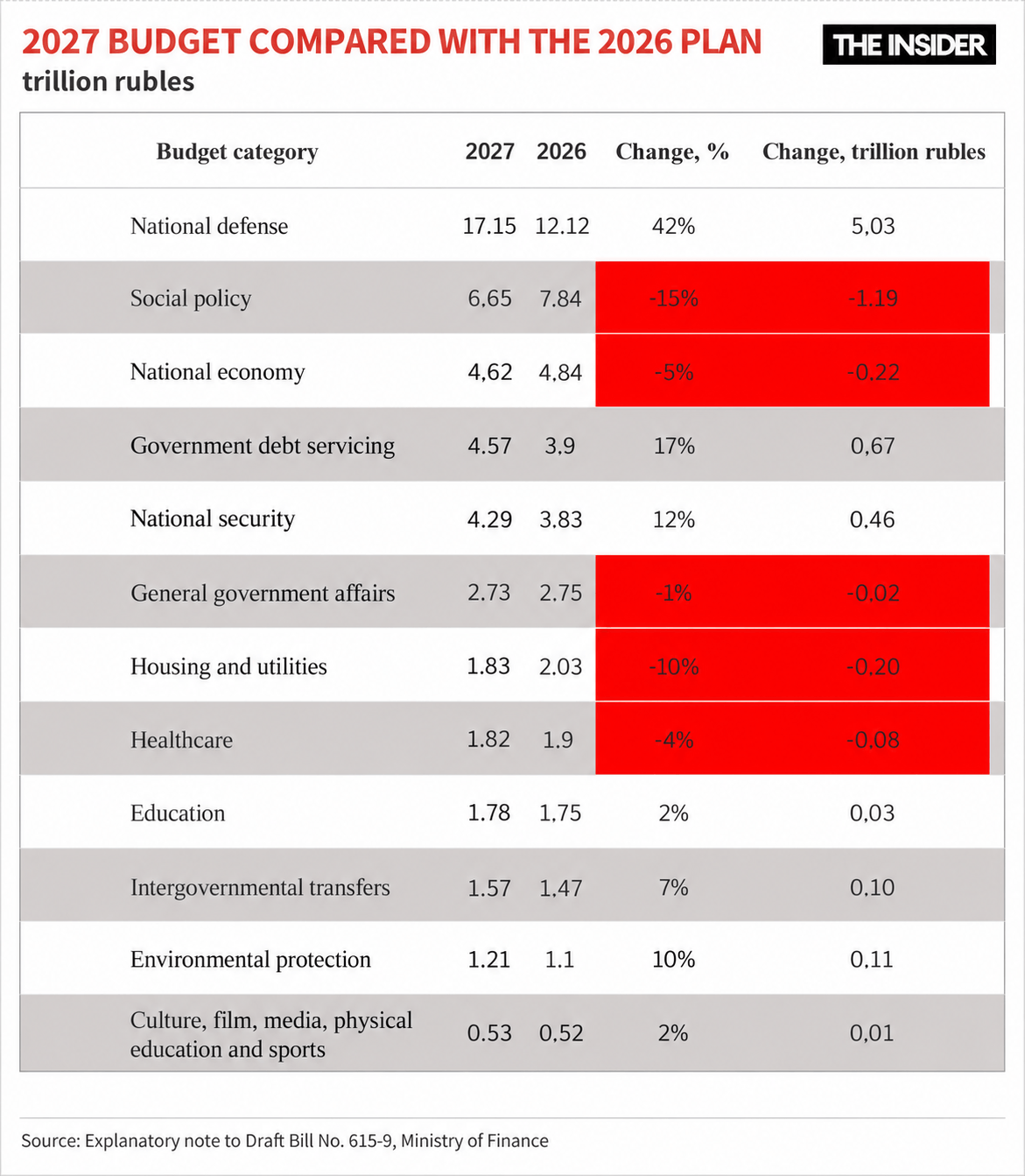
For 2027, the government has proposed more than 17 trillion rubles (more than $205.3 billion) in federal spending on national defense. That amounts to 35% of total expenditure, up from 29% last year. Based on the experience of recent years, actual spending on the war could exceed the planned amount by around 4 trillion rubles ($48.3 billion).
High interest on a small debt
For now, planned spending in 2027 can only be compared with the 2026 budget plan. Spending of 44 trillion rubles ($531.4 billion) was planned for the current year, while 49 trillion rubles ($591.8 billion) is earmarked for next year — an increase of 11%. Only three budget categories are set to see spending grow faster than the overall rate: national defense, up 42%; government debt servicing, up 17%; and national security and law enforcement, up 12%. These are the government’s stated policy priorities. Unlike last year’s budget, which announced a reduction in military spending, this time the planned buildup is explicit.
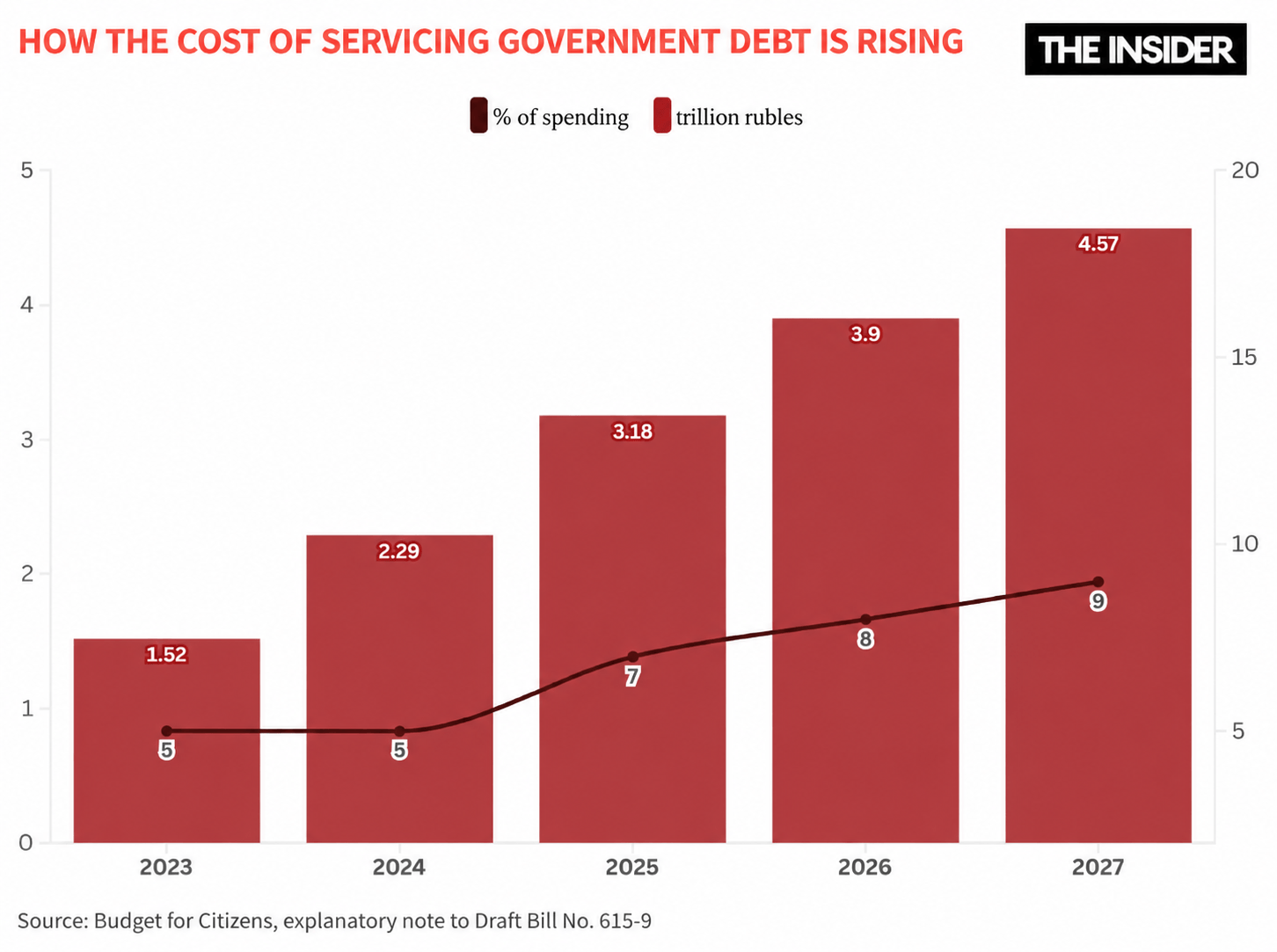
In 2023, government debt servicing accounted for 5.2% of total spending. Under the 2027 budget, it is expected to absorb 9.4%. As a result, debt-servicing costs will amount to 1.8% of GDP, compared with 1% in 2023.
Vladimir Putin has repeatedly pointed out that Russia has the lowest ratio of government debt to GDP among all G20 countries. Formally, this remains true. But if we look at annual interest payments on government debt as a share of GDP, rather than at the debt itself, the picture changes.
Several countries are in a clearly more favorable position than Russia: Canada, South Korea, Saudi Arabia, and even Japan (whose debt is enormous but whose interest rates are virtually zero). Depending on the methodology used, Australia, China, and Germany may also be considered to have a lower debt burden than Russia.
The high interest rates Russia must pay on its government debt reflect a risk premium. Investors consider the Russian government so unpredictable and unreliable that they demand annual yields of at least 15–16% — substantially higher than those required even for financially unstable states like Brazil, Mexico, Turkey, and South Africa.
A bigger hole, a higher price
When actual spending exceeds budget projections (sometimes compounded by a shortfall in revenues), the main problem becomes the deficit — in other words, where to find the money.
For now, the money is there: the budget gap has not led to missed payments even though, in the first nine months of 2026, the deficit exceeded 5 trillion rubles ($60.4 billion). The Finance Ministry has warned that it will reach 7.3 trillion rubles ($88.2 billion) by year-end, or more than 3% of GDP. The original forecast had put the shortfall at less than 4 trillion rubles (under $48.3 billion), or 1.6% of GDP.
Finance Minister Anton Siluanov has repeatedly insisted that he has the deficit under control, arguing that raising taxes is preferable to running a large budget deficit. In the end, however, Russians got both.
Siluanov argued that raising taxes was preferable to running a large budget deficit. In the end, Russians got both
How does the government plug the gap? First, it draws on the National Wealth Fund (NWF), whose liquid assets are the official source of deficit financing when oil prices are low. Second, it uses other reserves, like cash balances in government accounts at the Central Bank. Third, it borrows. This may seem like a vicious circle, but it allows the government to keep raising money almost indefinitely.
The first option is now barely being used. “The Finance Ministry financed half of this year’s deficit through domestic borrowing and half from cash balances. But of the amount raised through OFZ government bonds, about 1 trillion rubles ($12.1 billion) was financed through a scheme involving the Central Bank,” explains Sergei Aleksashenko, an expert at the NEST Center.
Under this scheme, banks use their short-term liquidity to buy 930 billion rubles ($11.2 billion) in government bonds from the Finance Ministry, then take the bonds to the Central Bank and pledge them as collateral in repo transactions.
“Yes, they incur some losses, but who asks them? The banks are state-owned, so they’re willing to take losses for the state,” Aleksashenko says. The same mechanism will probably be used to finance another trillion rubles ($12.1 billion) of the deficit by year-end. “Of the remaining nearly 2.5 trillion rubles (about $30.2 billion), the Central Bank still has to cough up another trillion,” he estimates.
This scheme is not new. “It would probably be an overstatement to say that it undermines the entire macroeconomic framework. Once is happenstance, twice is coincidence, three times is a pattern. We saw this in 2024 (1 trillion rubles, or $12.1 billion) and 2025 (900 billion rubles, or $10.9 billion). In 2026, another trillion rubles ($12.1 billion) has already been raised this way, and in my view, they will have to raise another trillion. This is becoming a system,” Aleksashenko notes.
The scheme fuels inflation. “The money the Central Bank pumps into the economy through the Finance Ministry adds about 0.5 percentage points to annual inflation,” Aleksashenko explains. But while this is a problem for the public, higher inflation is not necessarily a bad thing for the government and the Finance Ministry. As the economist concludes: “Spending in the 2027 budget is indexed to 4% inflation. If inflation reaches 6%, revenues will be higher.”