Russia's fuel shortage has returned. Ukrainian drones are now targeting the hardest-to-replace components, aiming to keep oil refineries idle for as long as possible. Repairs are failing to keep pace with fresh damage, and the industry’s dependence on sanctioned foreign components is only compounding the problem. Oil refining in the country has fallen to its lowest level in years, while queues and restrictions on fuel sales are once again popping up at gas stations. Under the circumstances, rationing remains a real possibility, and even in the best case scenario, Russian oil refining will remain at 10–15% below its 2020–2024 levels until the attacks stop altogether.
Fuel shortages in Russia are once again affecting filling stations across the country, with the GdeBenz mobile service showing fuel available at a record low number of locations and authorities in at least eight regions officially acknowledging the problem. Vladimir Putin, meanwhile, dismissed the situation as constituting merely “certain inconveniences.”
According to an assessment by S&P Global, drone strikes knocked at least 26 Russian oil refineries out of operation between January and July, seven of which have yet to resume operations. Four more refineries were hit in August, and in an attempt to keep the domestic market supplied, the Russian government extended its ban on gasoline exports for another six months (to Jan. 31, 2027), with the ban on diesel exports getting an extension only until the end of September.
The drone strikes twice
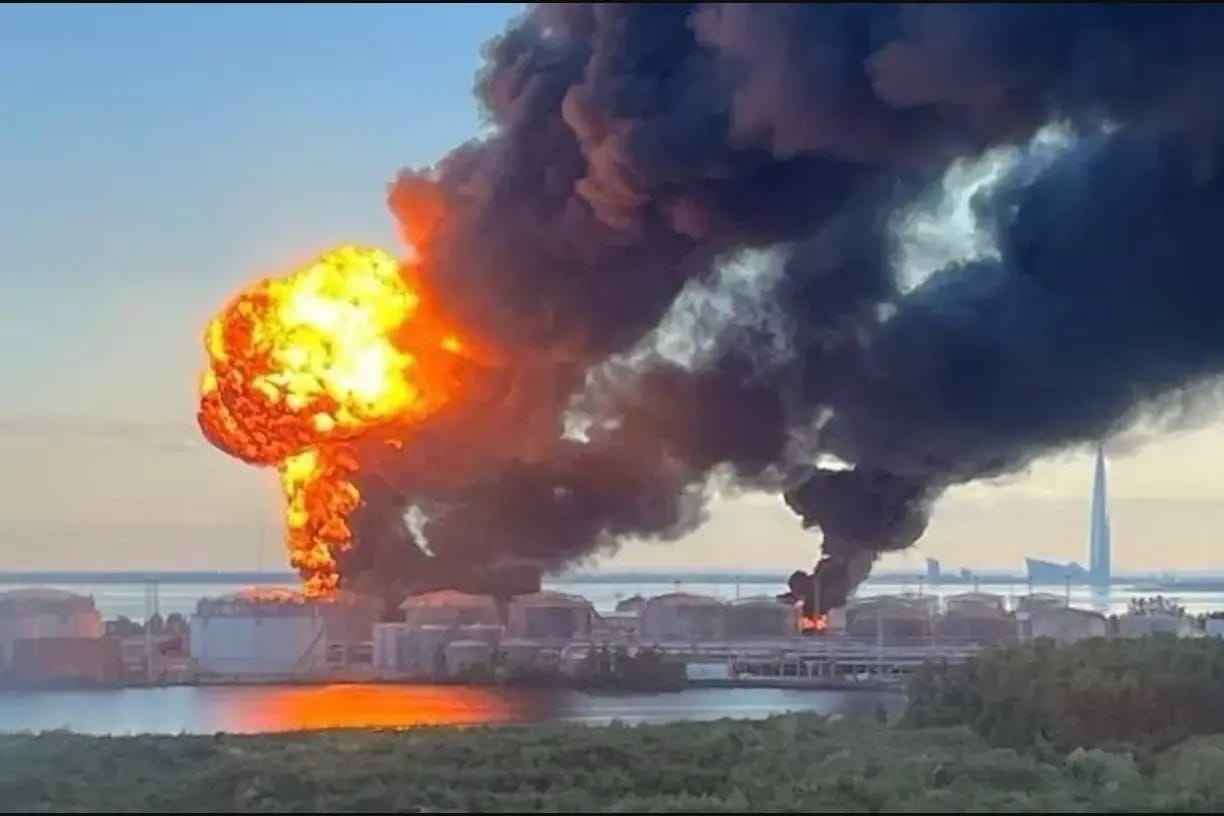
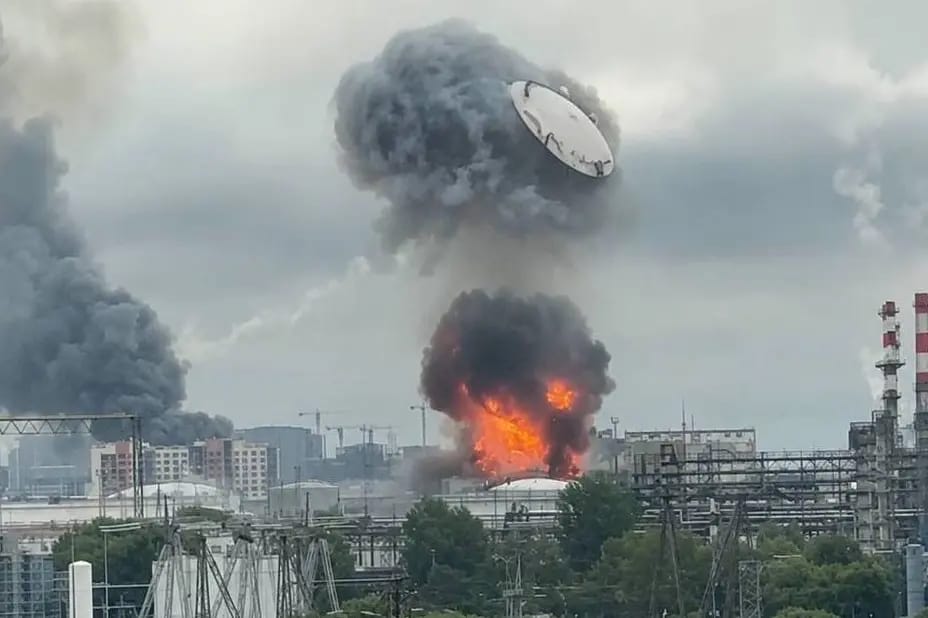
The collapse in supply is being driven by a record-large new wave of Ukrainian strikes on Russia's largest refineries. On July 25, a drone damaged the Tyumen refinery. On July 29, a drone hit Lukoil-Permnefteorgsintez, causing a fire at one of its processing units. On August 1, a refinery in Ufa was hit. According to the Financial Times, by that point Ukrainian attacks had already knocked out nearly a third of Russia’s refining capacity.
Lukoil-Permnefteorgsintez was subsequently attacked again. In addition, drone debris caused a fire in the tank farm of Slavneft-YANOS in Yaroslavl, a refinery that has been attacked six times since the beginning of the year. On Aug. 8, the Ilsky and Syzran refineries caught fire.
On Aug. 10, a strike on the Nizhnekamsk industrial zone, which reportedly affected Nizhnekamskneftekhim, left nearly 100 people dead or injured. That same day, the country’s largest complex for the fractionation and processing of liquefied petroleum gas (LPG) in Tobolsk shut down for an indefinite period.
On Aug. 13, drones set fire to the refinery in Salavat. Two days earlier, Orsknefteorgsintez in the Orenburg region had completely halted refining after a strike damaged critical equipment, apparently imported. Under the worst-case scenario, repairs there could take up to six months.
According to figures compiled by the DeepStrike project, at least 43 infrastructure facilities were hit across Russia in the first two weeks of August alone, a record since the start of the full-scale war. Some estimates put the number of Ukrainian long-range drones launched during this period at around 350 a day — more than 5,000 over the course of two weeks.
The shift in tactics was described in detail by the Financial Times. Ukrainian military planners and drone operators told the newspaper that Kyiv is now targeting the components that are hardest and most expensive to replace: primary refining units, catalyst units, and compressor equipment. The aim is to keep refineries out of operation for as long as possible and make each strike as costly as possible for Moscow.
The aim is to keep refineries offline for as long as possible and make every strike as costly for Moscow as possible
It was in this context that on July 10 Ukrainian President Volodymyr Zelensky announced the creation of a new Ukrainian Armed Forces unit to plan and carry out long-range strikes against targets in Russia. Then, on July 26, he put out an updated list of priority targets.
While attacks on Russia’s oil refining industry were sporadic last summer, by August 2026 Ukraine had shifted to a systematic campaign, designed to prevent targeted refineries from establishing a stable repair cycle by making each restored unit a repeat target before production has time to return to normal.
Repairs are falling behind
The pace at which Russia is bringing damaged capacity back online is increasingly lagging behind the rate of new strikes. According to a Kpler estimate, Russian refineries will process 4 million barrels of oil per day in August, down 5% from July and 2.5% from June, which was already the lowest level in years.
Industry sources do not rule out the possibility that actual refining volumes will be even lower, at 3.8–4.1 million barrels per day. Refining could rise to 4–4.3 million barrels per day in September, but the industry will no longer be able to return to Russia’s normal level of 5.3–5.5 million barrels per day for the foreseeable future.
The reason repairs are falling behind is not a lack of willingness or money on the part of oil companies, but the nature of the damage and their dependence on imported components. Minor damage of the sort caused at the Omsk refinery or Lukoil’s Permnefteorgsintez can be repaired within weeks. However, at facilities where primary refining units or catalyst units have been knocked out, repairs take months. At the Orsk refinery, for example, the equipment is imported, making repairs an even lengthier process, as under sanctions getting the necessary components into Russia is far from straightforward. Some parts are now being routed through China, but even then, much depends on logistics and compatibility.
The reason repairs are falling behind is the nature of the damage and dependence on imported components
Fuel availability on the domestic market reflects these swings. The acute phase of the shortage in late May and early July, when queues formed and sales limits were introduced across dozens of regions, began to ease by the end of the month. Kemerovo, Vologda, Omsk were among the regions to lift their restrictions.
But the crisis returned in early August, leading the Kaluga and Lipetsk regions to reintroduce odd-even fuel sales, while the Orenburg region introduced the system for the first time following the shutdown of the Orsk refinery. Sevastopol also reinstated QR codes for fuel purchases. According to Izvestia, by mid-August fuel was available at fewer than one-third of the country’s gas stations. Still, the situation with diesel is considerably less acute: production capacity is twice as high, while the gap between normal consumption and output is smaller.
The autumn season risks bringing another wave of problems. According to Kommersant, maintenance is scheduled for several major refineries, and some experts are already questioning earlier forecasts that the situation would stabilize by September or October. Now they point to the fact that the technological and logistical consequences of the strikes are more prolonged than appearances — such as queues disappearing — might suggest.
Three scenarios for the autumn
Estimates of the share of Russia’s refining capacity that is currently out of commission vary depending on the methodology used. In early July, the Ukrainian General Staff put the figure at 42.74%. At the end of July, the Financial Times estimated that 45% of capacity was nominally offline, while more than 30% was actually idle. Actual refining volumes, meanwhile, had fallen to about 25–30% below normal levels, and Russian Union of Industrialists and Entrepreneurs (RSPP) President Alexander Shokhin recently put the losses at 25–30%. Whether the share of knocked-out capacity reaches 50% or more will depend on which of the three scenarios outlined below develops between now and the end of the year.
Scenario one: escalation
Ukraine maintains or increases the current pace and effectiveness of targeted strikes on hard-to-replace components, while Russia continues to struggle with sanctions that restrict imports of equipment and catalysts. In this scenario, the nominal share of capacity knocked out could approach 50% — or even exceed it — as early as this autumn. Scheduled maintenance in September would only compound the problem by coinciding with the seasonal peak in demand.
In this scenario, the shortage would worsen, but its impact would be uneven. The hardest-hit regions would be those dependent on a single nearby refinery or a vulnerable supply route, such as the Orenburg and Volgograd regions. Meanwhile, larger cities with diversified supplies would suffer less, even if restrictions on fuel purchases at gas stations would become almost universal.
Formally, the military and security services would remain the priority for fuel supplies. On June 23, Vladimir Putin said that the strikes would not affect the situation at the front. A month later, however, volunteers reported shortages of several hundred liters of gasoline for some units. Further escalation could lead to more such cases.
The government is unlikely to allow fuel prices to be determined freely by the market. Based on the experience of 2018, a renewed informal agreement with oil companies to freeze retail prices in exchange for budget subsidies is far more likely. Those subsidies are already costing the treasury hundreds of billions of rubles a month.
The closest historical parallel is the 1973 oil crisis in the West. Authorities in several countries issued fuel rationing cards in anticipation of shortages, although actual rationing never materialized. The United States introduced an odd-even system, while the Netherlands banned private car travel on Sundays. The restrictions lasted about six months and ended after oil exporters reached a political decision to lift the embargo.
Because Russia’s current crisis is driven by war rather than market forces, resolving it quickly would require an end to the strikes themselves. For now, Putin’s public assertion that there have been no “critical consequences” — despite the loss of a third of the country’s refining capacity — suggests that he not preparing to make concessions when it comes to the war.
Scenario two: a plateau with partial adaptation
Under this scenario, the strikes continue at roughly their current level, but Russia gradually builds alternative supply chains for equipment through China and other Asian countries, increases toll refining at Kazakh refineries, and expands imports of finished fuel.
Nominally idled capacity would stabilize at 30–40%, with acute shortages occurring locally after each major strike, but without the panic seen previously.
Fuel imports and negotiations with Kazakhstan can be scaled up within weeks, whereas establishing reliable alternative supply chains for catalysts and equipment for primary refining units would take years. By the end of 2026 Russia could close only part of this gap at best. The “plateau,” therefore, would not mean recovery, but stabilization at a lower level.
Another question is why the refineries are not better protected in the first place. Effective air defense and electronic warfare systems remain scarce military resources, meaning Russia simply does not have the capacity to protect all such facilities simultaneously. Moreover, the oil refining industry, even at state-owned companies, is formally part of the commercial sector, which the government is not obliged to protect as heavily as its military infrastructure. The Moscow Refinery, for example, is located in the country’s most heavily defended air defense zone, yet it still suffered critical damage.
Economic fatigue is another issue that deserves attention. Repairing a single complex unit at a refinery the size of those in Ryazan or Tyumen could cost in the range of $50–100 million, while total payments to oil companies through the fuel-price damper mechanism and subsidies have already exceeded 1.2 trillion rubles ($14 billion) since the crisis began. Some refineries (like the one in Novoshakhtinsk) have also publicly complained about mounting debts to contractors and delayed wage payments following a series of Ukrainian strikes.
In other words, both the government and individual companies could run out of money before the Ukrainian campaign comes to an end.
Scenario three: de-escalation
If Ukraine reduces the intensity of its strikes on oil refineries for political or military reasons, or if it shifts its focus to other targets while damaged refineries are able to complete repairs, some Russian regions could return to pre-crisis conditions at gas stations by November. Even so, according to most estimates, overall refining volumes would remain 10–15% below 2020–2024 levels. This residual shortfall represents irreversible losses that are highly unlikely to be recovered by the end of the year, even if the strikes cease altogether.
The Moscow Refinery offers the clearest example. Both of its primary refining units were knocked out in June, and according to an estimate by Sinara Investment Bank, repairs could take up to a year and cost $1 billion. Reports circulated on social media that the refinery had resumed processing two weeks after the attack, b—ut the report appears to have been false — there has been no official confirmation, and there has been no corresponding improvement in the situation at Moscow gas stations. The refinery is not expected to resume operations before 2027.
Likely irreversible losses also include units dependent on sanctioned catalysts and other technologies licensed by Western companies. Efforts to replace them with Russian or Chinese alternatives by the end of the year is similarly unlikely, even if no further strikes are carried out against these facilities.
And so, even under the most favorable scenario for Moscow, refining will not return to the pre-crisis level of 5.3–5.5 million barrels per day. At best, the energy industry will settle at a new, lower level of refining that becomes its baseline for years to come. For now, the second scenario appears the most likely, but Ukraine’s focus on hard-to-replace components makes the even more pessemistic first scenario considerably more plausible than it would seemed just a month ago.
Has oil, imports gasoline
Foreign fuel shipments to Russia are already underway, but they are not yet large enough to make a decisive difference. The main supplier is Belarus, sendingh 141,000 metric tons of gasoline to Russia in June — a record high and 2.4 times the May volume. This was largely the result of redirecting some Belarusian exports that previously went to Central Asia to the Russian market instead. At the same time, transit shipments of Belarusian gasoline through Russia to third countries plunged from 166,000 metric tons in May to 24,000 metric tons in June. According to an estimate by experts at the Institute of Energy and Finance, the realistic ceiling for Belarusian supplies is no more than 200,000 metric tons a month — equivalent to just two days of summer gasoline consumption in Russia.
The ceiling for Belarusian supplies is no more than 200,000 metric tons a month — equivalent to no more than two days of summer gasoline consumption in Russia
India joined the effort later. The first shipment from the subcontinent, 42,000 metric tons, arrived on Aug. 5 from Nayara Energy, which is partly owned by Rosneft. Overall, India, Turkey, and to a lesser extent China, are expected to supply another 200,000 metric tons a month.
Since early August, Russia has also begun purchasing petroleum products at the South Korean port of Ulsan. Meanwhile, a shipment of gasoline loaded at Tangier, Morocco — reportedly supplied by Lukoil — has been sitting idle in Murmansk for a third week because of a dispute over the price.
Turkey joined the list in late August. The Wendrix, a tanker that is already on the EU and UK sanctions lists, left the Turkish port of Mersin carrying 200,000 barrels of gasoline. According to S&P Global CAS, it is bound for Primorsk. If so, this would represent the first confirmed shipment of Turkish-origin gasoline to Russia.
Kazakhstan is a separate avenue under discussion. Rather than direct gasoline exports, the proposal involves processing Russian crude at Kazakh refineries under a tolling arrangement, with some of the resulting fuel being sold in Kazakhstan and some returned to Russia.
At the same time, Kazakhstan’s crude oil exports through both Ust-Luga (down 16.9% year-on-year in July) and Novorossiysk (down 2%) declined, while exports via the Baku–Tbilisi–Ceyhan route — whicy bypasses Russia — rose from 138,000 to 155,000 metric tons. Kazakhstan’s efforts to diversify its logistics, along with the risk of direct strikes on Russian Black Sea ports and the tankers carrying oil from them, are both contributing to the shift. Meanwhile, on Aug. 10–11, Russia agreed with Mongolia on a one-off shipment of 25,000 metric tons of gasoline and 5,000 metric tons of jet fuel.
Gasoline imports cannot be described as cheap. According to calculations by Russia’s Federal Antimonopoly Service (FAS), based on June data the cost of an “import alternative” to gasoline, calculated using Indian prices and including freight to Baltic ports, is 112,600 rubles per metric ton. That is 1.6 times the average domestic selling price of gasoline.
At the same time, the subsidy paid to importers — more than 50,000 rubles per metric ton — is 3.6 times higher than the payments made to oil companies under the domestic fuel-price damper. The difference is covered by the federal budget through a special import damper introduced on June 1 — without it, the purchases would be economically unviable for traders. According to estimates published in Kommersant, total import requirements before the market stabilizes are estimated at 400,000–500,000 metric tons a month, potentially 15–25% more than Belarus, India, Turkey and China combined can actually supply.
Over the next four months, the trajectory of imports will depend directly on which of the scenarios described above unfolds with regard to the strikes and repairs. Under the escalation scenario, dependence on imports will only grow, along with the burden on the budget from the import damper and the risk of logistical disruptions like the standoff that has left the shipment in Murmansk idle. Under the de-escalation scenario, by contrast, the share of imports in the overall fuel balance will decline, serving as a mere safety net as Russia's domestic refining capacity is repaired.