New York’s statistics on sexual assault showed a 22% increase in 2025, prompting critics to accuse newly elected Mayor Zohran Mamdani of failing to take women’s safety seriously. But the statistics covering rape are particularly easy to manipulate, and right-wing politicians and propagandists have repeatedly done so. In New York, the increase reflected a change in the legal definition of rape rather than a sudden rise in the number of incidents. Similar revisions drove up FBI statistics in 2013 and Sweden’s figures over the past two decades. Donald Trump used the changing numbers to blame migrants for a nonexistent crime wave in Sweden, while British far-right politician Nigel Farage called Malmö the “rape capital” of Europe. Similar examples can be found across much of the Western world.
A fabricated rape epidemic
In July 2026, New York Mayor Zohran Mamdani again came under attack from conservative media and commentators. This time, they took the unusual tack of invoking feminism and women’s bodily autonomy.
During an interview, Mamdani was asked why the number of sexual offenses in the city had risen. He answered that the increase was caused by an expanded legal definition of “rape” adopted in 2025 and that crime was actually declining. That response brought further criticism, with opponents accusing him of downplaying the issue.
Right-wing bloggers and journalists seized on the opportunity to attack the left-wing politician from a new and electorally sensitive angle. Conservative activist and former athlete Riley Gaines asked how women could possibly have voted for him. Republican Rep. Chip Roy of Texas, who previously drew criticism for defending an apparent reference to lynching, also weighed in. “Rapes are up, rents are up,” he complained on X.
In fact, however, New York authorities had indeed broadened the legal definition of rape. In 2024, Governor Kathy Hochul signed a law expanding the definition to cover various forms of nonconsensual sexual contact, rather than only forcible vaginal penetration. The law now also treats forced oral or anal penetration, including same-sex assaults, as rape.
Police subsequently reported a substantially higher number of such crimes: 893 in 2025, up by 22%, or 163 cases, from 2024. A similar jump occurred after the FBI broadened its own statistical definition, but data sources, including state police and city statistics, use different definitions and collection methods. They show a modest decline in sexual violence in the city.
Figures from different agencies — such as the FBI, New York Police Department, and New York State Division of Criminal Justice Services — always differ somewhat because they are collected independently. Jeff Asher, an American criminologist, writer, analyst, and founder of AH Datalytics, reached the same conclusion as the mayor: that there is no rape epidemic. The new law is simply doing what it was intended to do — making it easier for survivors of sexual violence to seek justice.
How changes in the law change the statistics
The more complicated a subject is, and the less the general public understands it, the easier it is to manipulate. Statistics on sexual offenses are a particularly clear example.
“Rape” is a legal definition that differs from country to country — and, in the United States, from state to state. That makes international comparisons almost impossible. Conduct that New York now classifies as rape — for example, sexual assault within a same-sex couple — would be classified in Russia as a separate offense, namely “violent acts of a sexual nature.” It therefore does not appear in Russian rape statistics. Russian courts hear only about 2,000 rape cases annually, while cases involving other “offenses against sexual inviolability” arise roughly 8,000 times a year.
Definitions also change over time, sometimes gradually through transitional periods and sometimes virtually overnight. As soon as the definition changes, statistics based on that definition change with it, as happened in New York.
The United States offers one of the clearest examples. Until 2012, the FBI’s Uniform Crime Reports counted rape using a definition written in 1929: “the carnal knowledge of a female forcibly and against her will,” meaning only vaginal penetration. Russia still uses a similarly narrow legal definition of rape. Anal or oral assault was not counted as rape, and male victims — or female victims assaulted by other women — were absent from the FBI’s rape statistics, just as they are from Russia’s.
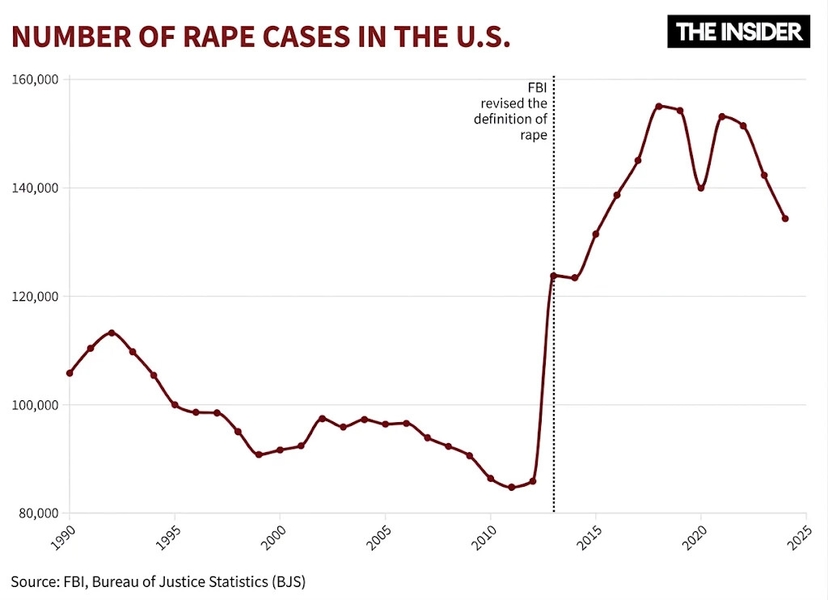
In 2013, under Attorney General Eric Holder, the FBI adopted a broader definition: penetration of the vagina or anus with any body part or object, or oral penetration, without consent. The agency estimated that the change alone could increase the national number of recorded rapes by more than 40%. That did not mean the United States suddenly had 40% more rapists or rape victims overnight —when crimes were counted under the old definition, the number remained essentially unchanged, even if the statistical graph suggested a rise.
Similar cases can be found elsewhere. In recent years Europe in particular has seen a wave of legal reforms aimed at making consent central to sexual-offense laws. Denmark, for example, rewrote its rape law so that it primarily rests on the absence of explicit consent rather than threats or physical coercion by the perpetrator. After the law changed, the number of reports in a single year jumped from 1,392 to 2,110, while the number of cases reaching prosecution rose from 1,079 to 1,695. Denmark’s director of public prosecutions concluded that the law was “working as intended.”
The Netherlands adopted a similar law in July 2024 and saw a 54% increase in reports to specialized support centers in just six months. In Amsterdam alone, complaints to police almost immediately tripled. Spain is another example. In October 2022, it adopted its “only yes means yes” law, which merged several categories of sexual violence and abuse into a single offense based on consent. Since then, the number of recorded rape cases nationwide has risen 33.9%.
“Look at what’s happening in Sweden!”
In February 2017, speaking to a crowd in Melbourne, Florida, Donald Trump declared: “You look at what’s happening last night in Sweden! ...Sweden, who would believe this? Sweden. They took in large numbers.They’re having problems like they never thought possible.”In reality, however, nothing particularly remarkable had “happened” in Sweden the previous night — at least by U.S. standards. Police arrested a drunken driver and authorities issued an avalanche warning. Former Swedish Foreign Minister Carl Bildt responded to Trump by asking: “What has he been smoking?”
It later emerged that Trump had watched a Fox News segment built around a short documentary titled Stockholm Syndrome. In it, filmmaker Ami Horowitz claimed that sexual assaults had surged in Sweden as a result of the actions of refugees from predominantly Muslim countries.
Several days later, right-wing British politician Nigel Farage picked up the argument, saying Sweden had accepted more young male migrants per capita than any other European country. According to Farage, this had produced a “dramatic rise in sexual crime” so severe that Malmö had become the “rape capital” of Europe. In fact, it had not.
Sweden is in some respects similar to New York. It broadened its rape law in 2005 and again in July 2018, adopting consent legislation and a new offense commonly translated as “negligent rape.” Sweden eliminated the previous requirement to prove violence, threats, coercive intent, or that the victim had been in a “particularly vulnerable situation.” Instead, the mere absence of active, affirmative consent became sufficient to qualify as rape. “Negligent rape” covers cases in which a person fails to take reasonable steps to establish whether the other person is participating voluntarily.
According to the Swedish National Council for Crime Prevention, known as Brå, adoption of the consent law increased rape convictions by 75% between 2017 and 2019. Brå’s latest study found that the increase in recorded rapes after 2018 was almost entirely attributable to the new law.
The adoption of Sweden’s consent law increased rape convictions by 75% between 2017 and 2019
Notable, Sweden also records each incident of rape separately. If a woman is raped by the same partner multiple times over the course of a year and reports all of them at once, Swedish statistics record multiple rapes, while in many other countries, the same report might be counted as a single crime.
In a 2000 article titled “Crime Statistics as Constructs,” a Swedish criminologist explained that comparisons of official crime statistics between countries are extremely risky. Reliable international comparisons, he argued, require standardized victimization surveys, which unfortunately do not exist on the necessary scale.
There is also no evidence that rape trends in Sweden are caused by migrants. A succession of criminological studies have failed to establish a correlation or causal link between migration and crime rates, sexual or otherwise. Nevertheless, researchers’ attempts to explain that to politicians have had little effect.
The Kremlin’s hand
Kremlin propaganda has also taken advantage of manipulated rape statistics — while sometimes simply inventing such stories. The Insider wrote about one such case 10 years ago: in 2016, a 13-year-old Russian-German girl in Berlin, publicly known only as Lisa F., disappeared for 30 hours. When she returned, she told her parents that she had been kidnapped and raped by men of “Middle Eastern” or “North African” origin. German police investigated the incident and found no evidence either of abduction or rape. Forensic examination of her phone showed that she had actually been hiding in the apartment of a 19-year-old acquaintance after getting into trouble at school. Russia’s state-run Pervy Kanal (lit. “Channel One”) presented the original allegation as fact, helping trigger protest marches by far-right activists and Russian-speaking residents in several German cities. Russian Foreign Minister Sergei Lavrov then accused the German government of concealing information about the apparently non-existent crime.
The accusation was serious enough that Germany’s Foreign Ministry summoned the Russian ambassador and publicly warned Moscow against using “political propaganda” amid an already heated debate over immigration and sexual violence. A German security-policy think tank later described the “Lisa case” as a fabricated story created by Russian propaganda, which is known to deliberately amplify European problems involving immigrants.
Russian propaganda deliberately amplifies European problems involving immigrants
Then on Oct. 26, 2016, Channel One aired a report about an incident in Austria, claiming that a migrant convicted of rape had been acquitted by the country’s highest court. The claim bore little resemblance to reality, but that did not stop Putin himself from referring to it in a speech. In fact, however, the defendant had not been acquitted and the case had not been closed; it was merely being prepared for a partial retrial.
That same winter, Russian-language websites began circulating posts about a campaign under the hashtag #sorry that claimed European women who had been raped by migrants were publicly apologizing to their attackers for wearing provocative clothing. The “news” appears to have originated with the satirical outlet Panorama, but it was quickly picked up and embellished — first by blogs and then by relatively mainstream outlets.
There are more recent examples. In a January 2025 article about a whistleblower complaint concerning Britain’s Operation Linden investigation, Russia Today cited the same sources as British media. However, RT changed the emphasis, turning a story about the failures of a particular police force into an indictment of the British state as a whole.
Nationalist parties are another beneficiary. One example is the Sweden Democrats, whose roots extend to the country’s 1980s-era neo-Nazi movement. During the 2010s, the party almost single-handedly pushed crime and immigration to the top of the national political agenda, significantly influencing the overall public debate.
Researchers examining Swedish public opinion found that concern about crime, which had remained consistently low for years, rose sharply after 2015. By 2022, a study published in the Nordic Journal of Criminology showed how Sweden’s mainstream parties across the political spectrum — not only the far right — had begun adopting the same rhetoric once the Sweden Democrats made it politically costly to ignore the issue.
But political parties are clearly not the whole story. Similar news stories 20 years ago did not trigger such intense debate, fuel culture wars, or regularly become political talking points. Sweden’s 2005 legal reform, for example, almost tripled its rape statistics relative to other European countries but provoked little international political controversy at the time. As Swedish Radio noted, foreign criticism focused mainly on the fact that the new law was unusually harsh toward perpetrators.
The collapse of media gatekeeping
Twenty years ago, a rumor about migrants committing an assault would generally have had to pass through a local reporter, an editor, and a publication’s editor-in-chief before reaching a national audience. Major news organizations tried to avoid earning reputations for sensationalism and generally steered clear of obvious fabrications. Today, that quality-control function has largely disappeared, in part because of social media.
Irish journalist Una Smith described a TikTok video that went viral in the country. It showed a half-dressed man running down a street and telling the person filming him that he had just been raped. The video ended there. Later, it was reposted on other platforms with entirely new details that had appeared from nowhere: the story was supposedly confirmed, and the attackers — now said to number five — were refugees.
In 2023, the Institute for Strategic Dialogue conducted an investigation analyzing TikTok, Twitter, and Telegram content in Ireland over the course of three months. Researchers found 877 separate unverified allegations of rape or sexual assault by migrants; they were shared or mentioned a total of roughly 21,000 times.
A separate fact-check that year found a viral video claiming that more than 20 migrants had been imprisoned for sexual offenses in Ireland in the previous six weeks alone. In reality, every case mentioned in the video had occurred between 2000 and 2017. The information had been repackaged and presented as current news by an account that regularly produces anti-immigration content.
Social media platforms profit from the spread of inflammatory material that provokes anger and hatred. Research into social networks and accounts dependent on platform advertising revenue has shown that a single controversial post can attract 100,000 clicks within 24 hours, while a genuine investigation produced over several months may struggle to reach 1,000 views. The situation becomes worse when the algorithms are controlled by unreliable actors such as Elon Musk. Under his ownership, Twitter (now X) became significantly more hostile, more prone to hateful content, and more saturated with false information, according to researchers.
At its core, these platforms exploit crowd psychology. A Facebook post about migrants or a Telegram video about a supposedly “confirmed” attack by a refugee gang uses roughly the same mechanism as lynch mobs did in the 19th century or witch hunters did in the 17th: the accusations are treated as true because everyone else in the crowd already believes them.
Posts about “refugee gangs” exploit the same crowd psychology as 19th-century lynch mobs or 17th-century witch hunts
A Pew Research Center study of Americans who primarily receive political news through social media found that they were substantially less informed and more likely to believe false claims than people who relied on other sources of news. Importantly, that segment of the population has grown significantly across Western countries over the past decade, with a recurring Oxford study covering 46 countries finding that trust in news declined most sharply in media environments that had shifted most strongly from television toward social platforms.
Twenty years ago, “the media” generally meant a relatively small number of outlets that were all bound, however imperfectly, by professional standards. Today it increasingly means individual content creators and anonymous accounts bearing little institutional or reputational responsibility while competing to be first and loudest, regardless of the quality or truthfulness of what they publish.
One striking recent example came in April 2025, when far-right commentator Milo Yiannopoulos reposted a fabricated article falsely presented as coming from The Atlantic. Its headline read: “The rise in migrant sexual assaults is the price worth paying to end racism.” The post received more than 1 million views on X because the fake headline’s message aligned almost perfectly with the fears and prejudices of Yiannopoulos’ audience.
Another example emerged in France in 2024, when a claim went viral that the overwhelming majority of rape suspects in Paris were foreign nationals. According to the French Interior Ministry’s own 2023 data, however, 86% of people accused of rape nationwide were French citizens. The viral figure ultimately traced back to a narrow, selectively chosen sample of solved cases from a single police district.
Even though the “86%” figure is effectively meaningless and does not exist as a valid national statistic, it continues to appear in election debates. In other words, influencing a country’s politics on this scale required little more than one account with a large following on Musk’s platform.