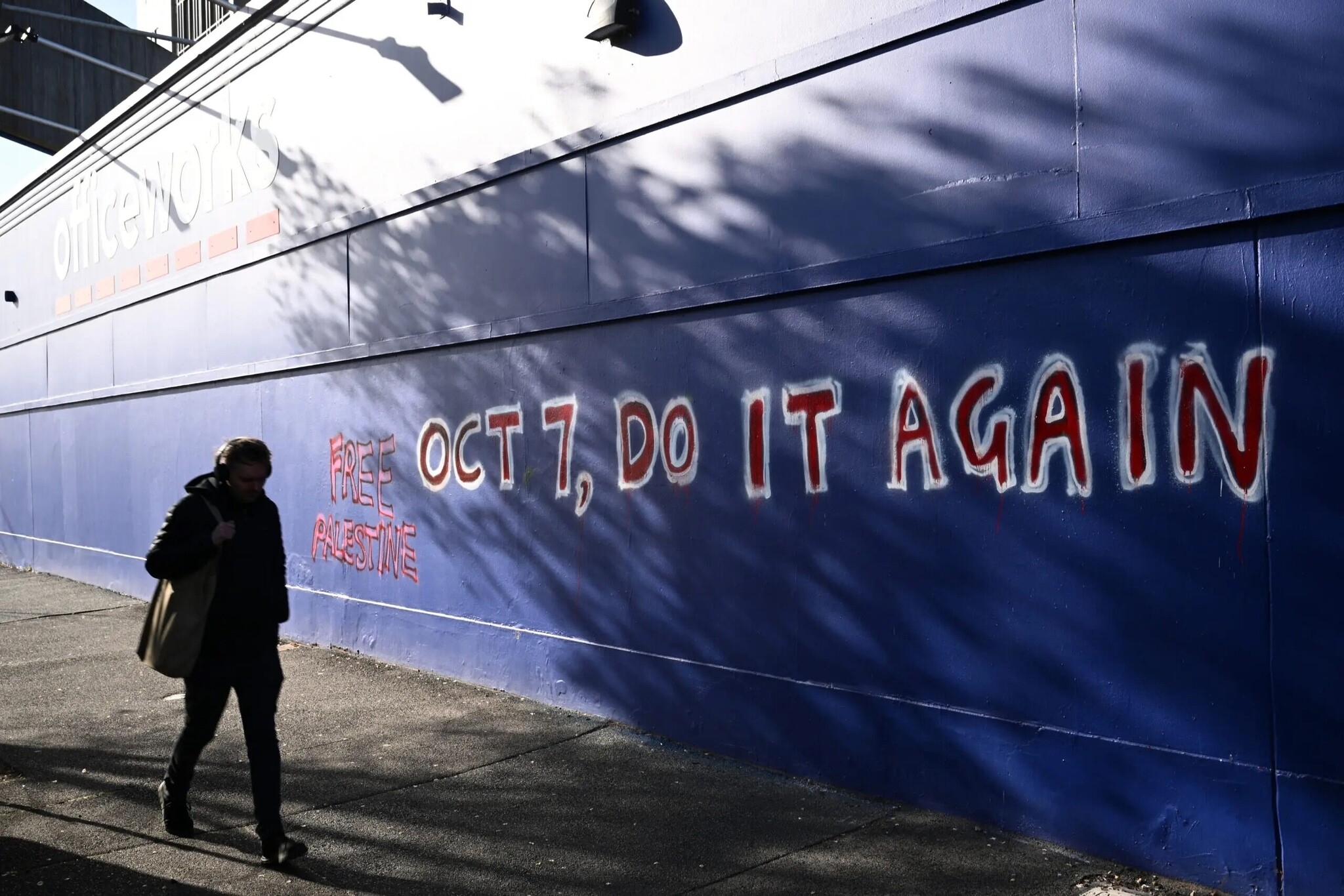
Over the past year, Israel’s Foreign Ministry received a record number of complaints from Israeli citizens who suffered physical violence, harassment, and discrimination while abroad. Three years after the October 7 massacre and the start of the devastating war in Gaza that followed, anti-Israeli sentiment around the world has not subsided. “Collective responsibility” for the government’s policy extends even to Jews from other countries as well. Public organizations, in response, speak ever more loudly about a return to “yellow stars” and a “hunt for Jews,” while Israeli developers create startups to help compatriots abroad.
In the second half of October, Hen and Adar Berti of Ashkelon, Israel, flew to Vienna for a vacation. They booked an Airbnb apartment in the Leopoldstadt district, next to a synagogue.
One evening there was a loud knock on the door. The Bertis were not expecting anyone and did not answer, but the stranger kept pounding and ringing furiously. When the couple decided to find out what he wanted, the man asked whether they were Zionists.
“I got nervous and pretended not to understand him, which made him even angrier,” Hen Berti said in an interview. The man outside the door shouted, calling the Israelis “Zionist occupiers,” and then went downstairs and loitered near the building for another hour or so.
The police officers who were called to the scene did not see fit to intervene given that the incident was “only” an issue of insults, not threats. Nor did they seem alarmed by the fact that the harasser knew in advance who was staying at the address. According to the victims, the police officers were not trying to hide their irritation.
Hen and Adar were afraid to stay in that apartment, and members of a local online community for Israelis helped the couple find alternative housing (and even provided them an escort).
“Unprecedented scale”
A 2025 report from Tel Aviv University’s Center for the Study of Contemporary European Jewry shows that, despite the end of large-scale hostilities in Gaza last October, the number of antisemitic incidents in the world is still well above prewar levels. In a number of countries — including Canada, the United Kingdom, and Italy — more incidents were recorded in 2025 than the year before.
The trend continues. In the first half of 2026, the British Community Security Trust counted 1,926 antisemitic incidents — 21% more than in the same period a year before. “This raises concerns that, rather than a backlash to a specific geopolitical crisis, high levels of antisemitism have become a normalized feature in societies with large Jewish minorities,” the Tel Aviv University report says.
At the same time, even in countries where the overall number of incidents is declining, cases of physical violence against Jews have become more frequent. France saw 106 physical attacks motivated by antisemitism in 2024, and 126 in 2025. In the U.S., according to data from the Anti-Defamation League, the number reached 203 — the highest figure since monitoring began in 1979.
Nearly half of the antisemitic acts recorded in the U.S. last year showed a motivation “related to Israel or Zionism,” Rachel Sass, of the Anti-Defamation League’s Center on Extremism, told The Insider. Attackers target Israelis and Jews abroad because of their national identity, seeking to hold them responsible for the actions of the Israeli authorities.
“Someone wearing a kippah, speaking Hebrew, or saying they're visiting from Israel can be enough to trigger antisemitic hate in public spaces. While criticizing Israeli policy or the government is legitimate, targeting individuals simply for being Israeli or Jewish is antisemitism,” Sass stresses.
Someone wearing a kippah, speaking Hebrew, or saying they're visiting from Israel can be enough to trigger antisemitic hate
Tourists from Israel have faced aggression before. In 2014, in Argentina’s Patagonia region, the “Committee of Solidarity with Palestine” launched a campaign against Israeli backpackers. Activists posted leaflets calling for an end to “Israeli military tourism” and for a boycott of businesses that supposedly serve it.
In January 2015, a group of locals staged a pogrom at a hostel popular with Israelis. The attackers threw stones, smashed windows, and shouted antisemitic insults, accusing Jews of “seizing Patagonia.” The hostel owner and several other people were injured.
Another high-profile incident occurred in Budapest on Sept. 7, 2023, one month before the Hamas terrorist attack. Two men who introduced themselves as ticket inspectors demanded that two Israeli women, a mother and daughter, pay a fine as they exited the subway. The women refused, after which one of them was punched and the other was knocked to the ground. According to the victims, the scammers also made a “long Jewish nose” gesture with their hands and told them to “get out to your Israel.” The tourists went to the police, who confirmed that the demand to pay a fine was illegal, as was the attack, but did not open a case.
The start of the war in the Gaza Strip saw antisemitic sentiment around the world reach an “unprecedented scale,” according to officials at Israel’s Foreign Ministry, which reported having received a record 45 appeals from travelers who needed help in connection with hostile treatment between July 2025 and 2026. Among the reported incidents are cases of physical violence, verbal threats and insults, and refusal of service or expulsion from hotels and restaurants.
At the same time, officials and experts alike stress that the statistics do not reflect the full picture, since far from all victims decide to report what happened.
“Underreporting is a well-known problem in documenting antisemitism and hate crimes,” explains Dr. Liram Koblentz-Stenzler, Senior Researcher and Head of the Extremism and Antisemitism Desk at the International Institute for Counter-Terrorism (ICT) at Reichman University. “There is also a wider circle that numbers like these do not capture: people who are already changing their behavior because they believe they could become targets.”
According to an ICT survey conducted in January 2026, more than 50% of Israelis take antisemitism into account when deciding on a trip abroad, and 86% of respondents are sure that the level of Jew-hatred in the world is rising. Almost half attribute this trend not only to hostility toward Jews as such but also to criticism of Israel’s policy. Among the countries considered to be “dangerous” for Israelis, respondents most often name France, the United Kingdom, and Spain.
Alla (name changed), who accompanies Russian-speaking Israelis on tours of Europe, told The Insider that many of her clients have changed their approach to planning trips. Some now prefer to fly to Eastern European countries, where there are fewer migrants and less anti-Israeli activity, while others try to keep a low profile:
“They avoid mentioning their place of residence, ask their children not to speak Hebrew in public, pay in cash, and sometimes even check into hotels using a different passport — a Russian one, for example. All this secrecy is unpleasant and humiliating, but it is even worse to run into rudeness and aggression. Paradoxically, for Russian speakers with a Russian passport, the chance of running into trouble is many times lower than for a tourist from Israel.”
“We are not calling on Israelis to give up traveling or to hide their identity wherever they go,” explains Eli Yifrah, the Israeli Foreign Ministry’s deputy director general for consular affairs. “But we strongly advise that before a trip you familiarize yourself with the recommendations for travelers that the ministry publishes and periodically updates, and use common sense.”
Yifrah warns against displaying Israeli symbols during mass events and “in troubled neighborhoods,” cautions tourists not to get into arguments with foreigners on political topics, and advises them to avoid posting information about their accommodation and itinerary on social media in real time.
“Even in a friendly country, an aggressive protest can take place, and even in a country with a significant Muslim population, most citizens may pose no danger at all,” he adds.
“Jews are not welcome”
Not every incident involving Israeli tourists has an antisemitic or “anti-Zionist” motive. Sometimes a conflict flares up because of their own inappropriate behavior. However, increasingly the trigger is merely their Israeli origin.
Thus, six Israelis traveling in motorhomes were attacked at a campground in Mongolia. Locals (of Kazakh origin, according to media reports), armed with knives and an ax, shouted antisemitic slogans and demanded that the Israelis leave. The tourists managed to fight back, but one of them suffered a serious facial injury.
On the Thai island of Phangan, a 62-year-old Israeli woman and her 23-year-old daughter were beaten up by a French citizen whom they had met on the way to a waterfall. Upon learning what country they were from, the man said that he “does not like what Israel is doing in Gaza.” Ynet cites the victim’s account:
“I told him we were on vacation and didn’t want to talk about that issue. He said, ‘I’m against violence,’ and the conversation ended. Suddenly, he called us from above, came down toward us, and then started beating me brutally. My daughter tried to protect me and was beaten as well. I never thought that something like this would happen to me here in Thailand, where people are so friendly toward Israelis. I’m always careful and don’t say that I’m from Israel. But here in Thailand, I thought it was safe. He had a French accent, but he didn’t look French. We could never have imagined he would do something like this...”
The tourists were hospitalized with severe head injuries, and both required surgery. The attacker fled the scene on a motorcycle and a few days later was detained in connection with another incident. It later surfaced that he had been released on bail.
Another case concerns a group of Israelis who suffered from harassment in the town of Plav, Montenegro. Upon hearing them speak Hebrew, locals began accusing the tourists of war crimes: “Baby killers, shame on you! Taking a break from genocide? So, how is the killing of civilians going?”
In a video that reached the media, the Israelis can be heard trying to defuse the conflict: “Keep walking, do not talk to us. I did not speak to you. I do not know you, you do not know me.” In response they hear remarks: “I know, you are all killers, killing children! Scumbags! You should not travel anywhere at all. Stay in your hole that you call Israel!”
Notably, Jews from other countries have been victims of similar aggression. In the summer of 2026, a group of tourists from France was subjected to harassment and pursuit after visiting a synagogue in Barcelona. As one of them recalls, it all began with a woman carrying pro-Palestinian symbols who saw that they were Jewish and began shouting slogans like, “Free Palestine!” Soon, other passers-by joined in, and dozens of people ended up pursuing the tourists for upwards of 40 minutes as they rushed to their hotel. The crowd spat on them along the way, insulting them and chanting “Jews are not welcome here,” “Baby killers!” and “Death to Israel!”
Dozens of people pursued the tourists for about forty minutes to their hotel, spitting at them and chanting “Jews are not welcome here” and “Death to Israel!”
Wide publicity was given to an incident at a supermarket near Avignon, France, where a Jewish married couple from Australia got into a conflict with an Irish citizen. An innocent conversation about association football grew into an argument about politics, during which the Irishman expressed regret that Hitler “didn’t finish the job.” When the Australian woman began filming the scene on her phone, the man threatened her: “You get away from me, before I put a f*cking bullet in your head.”
After the video from the supermarket went viral, French Commerce and Tourism Minister Serge Papin and Minister for Equality and Combating Discrimination Aurore Bergé issued a joint statement condemning what had happened:
“No antisemitic act, threat, or statement should go unanswered… No tourist should be subjected to threats or discrimination because of their identity or beliefs.”
Later, the Irishman was detained by French police and charged with justifying crimes against humanity and making hate-motivated death threats. At the end of October, a court sentenced him to six months in prison, suspended, and a fine of 1,600 euros.
Another incident occurred last summer at the Cypriot resort of Ayia Napa. Roman (name changed), a resident of Israel, took his wife on a five-hour boat trip:
“My wife took an Israeli flag with her to take photos with on the boat — we had planned such a photo shoot in advance. At some point she took out the flag, and I took several pictures on my phone. Then the boat stopped in a lagoon, and several people, including us, went swimming. When I came back, I discovered that my phone was missing.”
After searching everywhere, Roman reported the loss to the captain, who asked over the loudspeaker for the phone to be returned in the event that someone had taken it by mistake. About an hour later, one of the passengers told Roman that he had found someone’s phone in the men’s restroom:
“I immediately went down to the restroom, where I had not been before — and indeed, my wet phone was lying behind the toilet lid. Fortunately, it is waterproof and was not damaged at all. I had no doubts — it had been taken and then left in a conspicuous place.”
Before returning to the port, an elderly fellow passenger asked Roman what country he was from. He answered that he was from Israel. A young woman nearby remarked sarcastically: “Israel does not exist, it is Palestine,” and asked what had happened to his phone. After that, a verbal altercation broke out between them.
Roman does not know which of the passengers took his phone, but he is sure the reason behind its temporary disappearance was the photo shoot involving the Israeli flag.
“No entry for Zionists”
This past July, Italy’s La Repubblica reported on an anonymous Google form that circulated on social networks and messenger apps calling on users to report the whereabouts of Jews and Israelis — in hotels, rented housing, restaurants, and other establishments. Based on the information collected, it was supposedly intended to compile a map of “Zionist tourism” and “Zionist neocolonization” in Italy.
The description indicated that the data would be passed to the Global Sumud Movement (linked to the Freedom Flotilla to Gaza) and used to coordinate further actions. However, representatives of the movement denied involvement in the initiative.
News of the announced “hunt for Jews” provoked an immediate backlash from Jewish community figures and Italian politicians, and fairly quickly the form disappeared from the web.
A separate category of incidents recorded by Israel’s Foreign Ministry and researchers of antisemitism is indeed related to discrimination against tourists based on nationality. In such cases, the source of aggression is not ordinary passersby but those who provide services to visitors — from taxi drivers to hotel and airline staff.
In September 2025, a restaurant in the Bavarian city of Fürth put out a sign at the entrance, warning that Israelis were “not welcome” at the establishment. The text said that the staff “love all people” regardless of origin, but do not intend, “like the rest of the world, to stand aside” and simply watch what is happening in Gaza: “Our protest is not political and even less racist. Israeli citizens are not welcome here. Of course, they will be welcome here again as soon as they decide to open their eyes, ears, and hearts.”
A few hours later the notice was removed, but it managed to cause outrage among civic organizations. In a special statement, the Alliance Against Right-Wing Extremism called it a manifestation of “pure antisemitism,” reminiscent of the “darkest times in the history” of the country. The organization expressed solidarity with Israeli citizens and the Jewish community: “Since when is a citizen of a state responsible for the actions of its government? We repeat once more: ‘Never again is now!’”
Several complaints against the restaurant owners were filed with the prosecutor’s office. However, the investigation was soon closed given that no signs of incitement to hatred were found in the text. According to an assessment by lawyers, “the criticized statement — taking into account the right to freedom of expression — did not reach the threshold beyond which criminal liability begins.”
On some occasions, Israeli tourists have faced actual expulsion. This past August, a family with two small children was denied entry to a zoo on the Thai island of Koh Samui. Upon learning where they were from, an employee declared that Israelis were forbidden to enter. Then another employee joined in, allegedly cursing at the Israeli family and striking the father in the neck.
After the story gained traction, the zoo owner posted anti-Israeli messages on social media. In one of the posts, a “No Entry” sign was superimposed over the Israeli flag with a target next to it. As established by the anonymous X account SwordOfSalomon, which is devoted to monitoring antisemitism, the zoo is co-owned by a French national who had earlier called Jews a “dirty race” and his employees “team Khomeini,” Ynet writes.

A similar incident occurred in Athens in September when a pair of tourists were thrown out of a bar just for being Israeli. The manager shouted in front of other patrons: “Get out of here and do not even come near again!”
The victims shared the details of the incident in a travelers’ group, prompting their compatriots to begin leaving negative reviews of the establishment on Google. In response, a post appeared on the bar’s Facebook page with screenshots of reviews by “Zionists and their supporters” and an explanation that the establishment “does not accept those who commit genocide in Palestine or support it.” After some time the post was deleted.
Problems for Israeli tourists can also arise when checking into a hotel or rented apartment. A whole series of such episodes is linked to the popular service Booking.com. This past April, Margarita, a resident of Israel, reserved an apartment in Bologna, Italy:
“Literally right before check-in, when I was already on the bus, the owner called and told me to cancel the booking [to avoid triggering a platform penalty], and he would refund my money. Of course, I refused: finding other accommodation on such short notice was unrealistic. Then he canceled the booking himself, losing money, and even had the stupidity to leave me a message on Booking saying ‘F**k you, free Gaza’. I wonder if he'd have felt the same way had I been Arab or Druze.”
As compensation, Booking sent Margarita a voucher worth 22 euros. She left a negative review, but it was soon deleted, supposedly because of complaints from other users. “I called support repeatedly, but I was told to mind my own business — it's up to them which reviews to keep,” she says.
A similar case occurred in early October. Israeli national Simcha Goldstein booked an apartment in Naples through Booking.com, and after the order was confirmed, he received a message from the owner asking him to cancel it, with the explanation: “I do not accept citizens from countries guilty of genocide.”
On Goldstein’s behalf, a request was sent to the platform to remove this property over discrimination against a customer on the basis of nationality. However, no sanctions followed. Instead, the company issued a warning to the owner and promised to consider further measures if something similar happened again.
Noa Sabar Dvoskin, who immigrated from the U.S. after the October 7 terrorist attack, also failed to hold the offender to account. This past August, she was returning to Israel from Seattle with her children. The family flew with Alaska Airlines to Los Angeles, and there transferred to a flight to Tel Aviv. While unpacking a suitcase after arriving, the woman found inside a handwritten note saying “F**k Israel.”
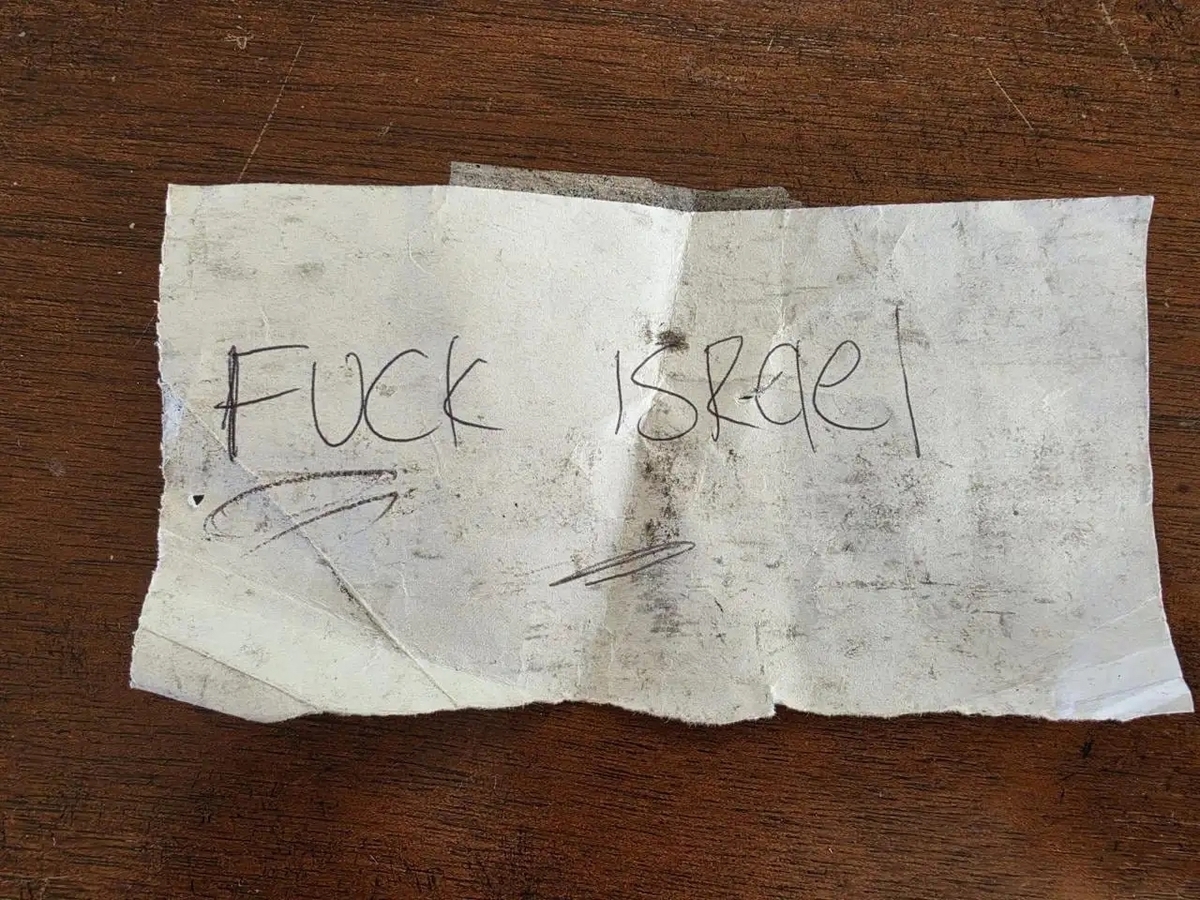
Noa filed complaints not only with the airline but also with the Seattle and Los Angeles airports and the U.S. Transportation Security Administration (TSA). As Sabar-Dvoskin told The Insider, Alaska Airlines informed her that it had carried out a check, interviewed employees who worked that day, and reviewed surveillance camera footage — and found nothing suspicious.
The appeal to TSA also did not help establish who put the note in the luggage or when. No one apologized to the passenger, who explained: “It could become indirect evidence that everything happened through the fault of someone among the airline’s or airport’s employees, and that is fraught with serious problems.”
God helps those who help themselves
While officials limit themselves to issuing recommendations and warnings for tourists, Israeli IT specialists are designing digital services to help their compatriots plan a comfortable and safe trip abroad.
Last year saw the launch of SafeforJews.org, a platform that uses AI tools to assess tourist destinations based on the level of threat to Jews. The service analyzes information from multiple sources — news about antisemitic incidents, protests and government measures, official recommendations of Israel’s National Security Council, and user reports — and ranks cities and countries by level of safety.
There are five safety levels. Most countries are currently in the “Caution” category. The “Warning” category includes Russia, Canada, the United Kingdom, France, Germany, and Italy, among others. At the time of writing, countries listed as “Safe” included the Baltic states, the Czech Republic, Hungary, Albania, South Korea, and Singapore.
Most countries of the world are placed in the “Caution” category when it comes to the safety of Israeli tourists
The startup’s founder, Shai Yaish, explained the project to The Insider:
“Ideally, I would like to create something like Google Maps for Jewish and Israeli users so they can quickly find Jewish communities and consulates and figure out whether it is safe for them to be in a particular area and which places they should avoid. As our community grows, members will be able to find each other in different locations, meet up, and spend time together — for example, to organize shared Sabbath meals. That is how I imagine the platform’s development after the situation with antisemitism in the world calms down.”
The startup OneBayit (from the Hebrew “bayit,” meaning “home”) is also designed to connect Israelis with local communities. The essence of the project is reflected in its slogan: “Where strangers become family.” Registered users leave their contact details and indicate how they can be useful to travelers (options range from “give recommendations” to “invite to Shabbat dinner” or “offer a place to stay”).
According to the service’s founder — Joshua Buchalter, an immigrant to Israel from South Africa — the need for a safe space for Israelis and Jews abroad has grown noticeably over the past three years:
“This is especially important now, when many tourists are reluctant to speak openly about their connection to Israel for fear of other people’s reactions. At the same time, there are quite a few Jews in the world who love Israel and are ready to support Israelis. Our platform helps find such people and connect with them.”
The Insider’s interviewees have no illusions about the idea that anti-Israeli sentiment in the world will subside any time soon.
“Of course, I do not like that the number of our users is growing in parallel with antisemitism. I would like the situation we found ourselves in October 2023 to end,” says Shai Yaish. “But I have no particular expectations; I do not count on sudden change. I just hope that I can feel safe traveling the world, even if it has to be with the help of my own service.”
It is obvious that after October 7, “the threshold for justifying hostility, and in some cases violence, toward Israelis and Jews has become lower,” notes Liram Koblentz-Stenzler of the International Institute for Counter-Terrorism. The key question is what behavior people driven by this hostility consider acceptable for themselves. When refusing service to an Israeli is presented as a legitimate political act, and the use of violence is justified as a response to Israel’s policy, the boundaries of the permissible begin to shift. People have been repeatedly exposed to the idea that Israelis and Jews can be held collectively responsible, and in some cases, behavior targeting them has already been given political or moral justification. The next crisis in the Middle East will not start from zero. It can reactivate and intensify patterns that have already become more normalized,” Koblentz-Stenzler warns.
Whether this becomes a “new normal” will also depend on the larger response to such behaviors. When denial of service, harassment, or violence against someone on the basis of their Israeli citizenship or Jewish identity is met with clear condemnation and real consequences, it sends a clear message that political anger does not justify targeting someone based on their passport or their religion.