
At the most recent St. Petersburg International Economic Forum in early June, Vladimir Putin claimed that Russia’s third Oreshnik missile strike of the invasion of Ukraine was carried out for testing purposes and hit what he described as a “shed.” Judging by Putin’s public statements, in just a year and a half Oreshnik has been transformed from a “wonder weapon” capable of deterring Western support for Ukraine into a “terror of sheds” that is not ready for full combat use. Available data from its three “test” strikes suggests the missile system still has technological flaws that prevent its effective use with nonnuclear payloads, while demonstration strikes in their current form are losing their “psychological effect” even among domestic audiences.
A “wonder weapon” against a “shed”
At the St. Petersburg International Economic Forum in early June, Putin said the launch of an Oreshnik missile at Ukraine during a massive aerial attack on May 24, 2026 had been a test that resulted in a hit on a “shed.” He said two missiles were launched: one at the city of Bila Tserkva and another at what he called the “perimeter of the main fortified area” of the Donetsk “People’s Republic” (DPR).
“In fact, there has not been a single combat use of Oreshnik on Ukrainian territory in the full sense of the word. And the latest one was, to be honest — I will reveal a great military state secret to you — we simply struck where it was convenient to look at the results. This applies to Bila Tserkva, and even more so to the DPR area, along the perimeter of the main fortified area. Our drones later flew there, to that shed we hit, and simply looked at how the separating blocks had landed and measured everything down to the millimeter. This is important for us so we can make future decisions on the full-scale use of Oreshnik against targets, including in urban areas,” Putin said.
The Oreshnik strike on Bila Tserkva, a town located about 80 kilometers from Kyiv, did cause debate among experts regarding the target, as there are no significant military facilities there apart from a transport aviation airfield.
The visible aftermath of the attack on Bila Tserkva was indeed seen in an area filled with storage garages. Ukraine’s State Emergency Service said a fire engulfed three of them. According to prosecutors in the Kyiv region, a building belonging to an unidentified enterprise was also damaged. It was likely one of the objects Putin referred to as a “shed.”
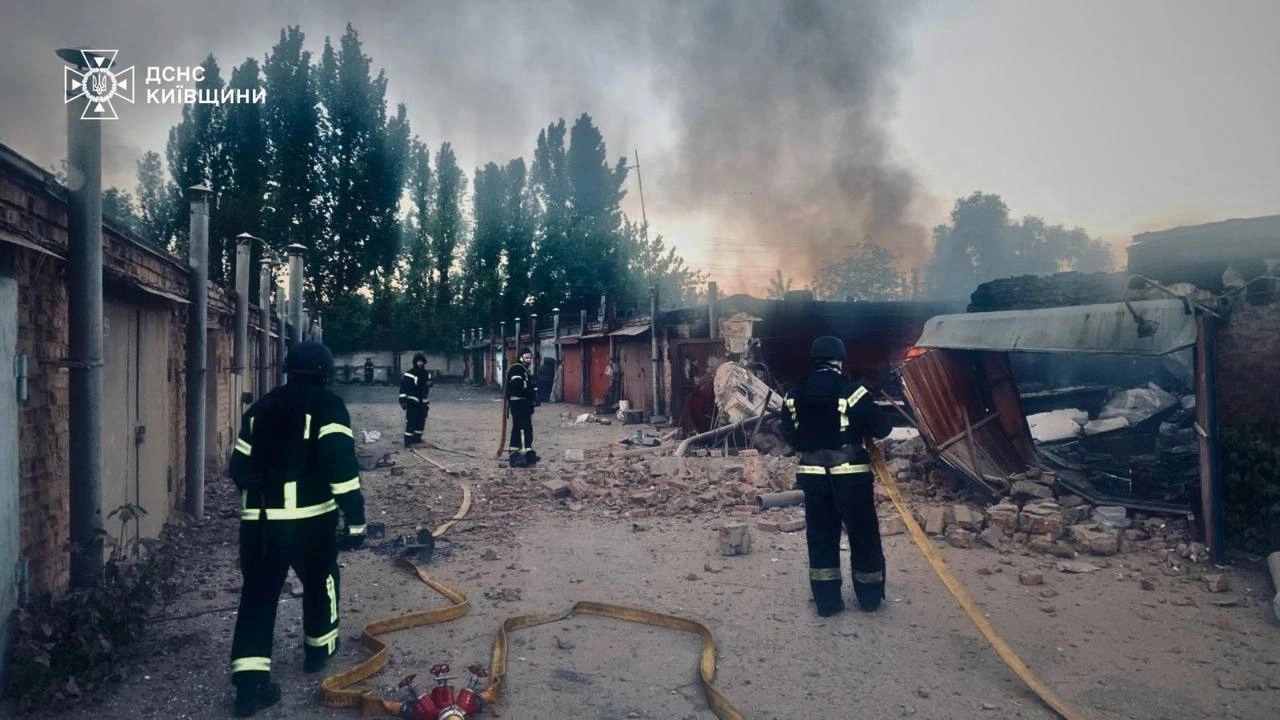
As for the “fortified area in the DPR,” video appeared online of Oreshnik warheads falling somewhere on the northern outskirts of Donetsk. There are still no publicly available satellite images or ground-level photos showing the aftermath of the missile impact — this despite Putin’s characterization of the system as a “wonder weapon” with a destructive force comparable to the Tunguska meteorite.
What military effect did the Oreshnik have?
Until recently, both Putin and Russia’s Defense Ministry spoke of Oreshnik’s outstanding characteristics, saying all military objectives set for the missile launches had been achieved. After its first use against a facility in the Ukrainian city of Dnipro, Putin said “kinetic strike elements” had been heated to “the temperature of the surface of the sun.”
“The destruction is very serious. Everything at the center turns to ash, breaks down into its component elements, and targets located three or four floors down, perhaps even deeper, are hit. And these are not just floors, but fortified structures. The force of the strike is colossal,” he claimed.
Putin said the results of using Oreshnik were the same “as using nuclear weapons” — but without radioactive contamination. In June 2025, he claimed the Oreshnik had “proved itself very well in combat conditions.” In August 2025, the Russian leader said the first serially produced system had been delivered to the troops, meaning mass production began before all testing had been completed, which contradicts standard defense industry practice.
Putin claimed the Oreshnik had “proved itself very well in combat conditions”
In May 2026, Putin said Oreshnik had been placed on combat duty in 2025. At an expanded meeting of the Russian Defense Ministry board on Dec. 17, he promised to put the system on combat duty “before the end of the year,” referring specifically to a road-mobile missile system. Russia says Oreshnik has been on combat duty in Belarus since December.
Russia’s Defense Ministry, for its part, said the “objectives of the strikes were achieved” and that “all assigned targets were hit” in all three known uses of Oreshnik: against Dnipro on Nov. 21, 2024, against Lviv on Jan. 8, 2026, and against and Bila Tserkva (1, 2, 3) on May 24, 2026. Notably, in all three cases, Russia reported its Oreshnik launches had been made in response to Ukrainian actions the Kremlin considered “escalatory.”
Each of Russia’s Oreshnik launches has been justified by the enemy’s “escalatory” actions
The strike on Pivdenmash in Dnipro came, Putin said, “in response to the use of American and British long-range weapons.” At the time, Ukrainian forces had been using ATACMS and Storm Shadow missiles to hit command posts and ammunition depots in the Kursk and Bryansk regions.
The attack on an aircraft repair plant in Lviv followed what Russia called “a response to a terrorist attack” on the Russian president’s residence in the Novgorod Region in late 2025. The attack itself has not been conclusively independently confirmed.
The latest strike on Bila Tserkva, meanwhile, was presented as “retaliation” for a strike that killed more than 20 civilians at a college in Starobilsk.
The Insider has previously explained in detail why Oreshnik’s stated characteristics do not match reality and why its use with nonnuclear payloads makes little military sense due to its high cost and low accuracy. In none of the cases listed above is there evidence of substantial damage caused by a weapon of “colossal force.”
According to Ukrainian estimates, the kinetic effect of Oreshnik’s inert blocks — mass-dimensional mock-ups or heavy decoys — is equivalent to between 52 and 95 kilograms of TNT, comparable to a Shahed drone warhead. The strike elements found after the attack on Bila Tserkva turned out to be “ordinary billets,” made not from steel or tungsten, which could theoretically provide high penetrating power, but from cast iron.
The kinetic effect of an Oreshnik block is comparable to the impact of a Shahed drone
There is no particular reason to test a weapon of Oreshnik’s class on enemy territory. It is far more convenient to do so at domestic test ranges, especially if the goal is to measure the effects of impacts and collect all necessary telemetry.
Another possible explanation — testing the weapon under enemy air defense conditions — does not fit either, since Ukraine does not have systems capable of intercepting this type of munition. At best, Russia could observe the work of Europe’s missile attack early warning system. But as far as can be judged, Oreshnik launches comply with the 1988 agreement on ballistic missile launches, meaning the United States receives advance notification and then passes the relevant information to Ukraine. That means Russia cannot even achieve surprise.
The Insider has previously noted that the strike on a “shed” — an obviously civilian object — directly contradicts repeated statements by Russian officials that only military targets are attacked.
It is also difficult to understand why Russia would conduct tests on enemy territory, handing the enemy missile parts that make it possible to study the weapon’s design. Together with accumulated remnants from missiles used against Lviv and Dnipro, experts have gained a comprehensive picture of Oreshnik’s component base and design principles (1, 2):
- a layout rooted in the Cold War era;
- Russian- and Belarusian-made components;
- parts and devices manufactured no later than 2018.
In other words, the missile is not a new development, but a legacy from the period when work on the RS-26 Rubezh project had officially been halted. This likely makes it indirectly possible to assess the design of missiles used in the Topol and Yars systems.
Notably, none of the strikes used the principle of a MIRV system — multiple independently targetable reentry vehicles, which allow for targets up to 100 kilometers apart to be hit.
Moreover, Dallas Analytics published internal correspondence between Russian defense industry enterprises indicating that Oreshnik is equipped with the Soviet-era GU-503 gyroscope and that current contractors cannot calibrate the device before final assembly. For that reason, the warheads’ deviation from the target could reach tens of kilometers. Some experts, however, have questioned this conclusion.
What political effect did the Oreshnik have?
Launching a missile designed to deliver nuclear weapons with inert warheads — in other words, dummy payloads — makes sense only as a signal of readiness to escalate. It serves asa warning that demonstrates the weapon’s capabilities without crossing the political line that would be crossed if it were used with a full combat payload.
But it can only be used that way once — for the simple reason that a repeated warning without further action inevitably results in a loss of credibility. The same applies to demonstrative steps to create infrastructure for the Oreshnik in Belarus, along with military exercises involving its use. The next step on the escalation ladder declared by the Kremlin after launching missiles with inert warheads would be the use of tactical nuclear charges, and so far there are no signs of any readiness to take that step.
A repeated warning without further action inevitably costs credibility
In any case, the warning clearly did not work. Deliveries of Western long-range weapons are continuing, Ukrainian drone raids on Russian territory have reached a qualitatively new scale, and massive Ukrainian airstrikes have hit Moscow for the first time.
Ukrainian forces have also reported strikes on Kapustin Yar (apparently unsuccessful), where known ground infrastructure for servicing Oreshnik is located, and on the Votkinsk plant (visibly successful), where the missile is produced. Moreover, Ukraine’s Flamingo missile caused significantly more damage to the Votkinsk plant, as confirmed by satellite images, than Oreshnik has caused in all its known uses.
Why the Oreshnik does not affect the course of the war
The Oreshnik intermediate-range ballistic missile is considered a development of the RS-26 Rubezh project. Support vehicles for the system shown by Russia’s Defense Ministry are identical to those used in the Yars road-mobile missile system, while some components match those of the Topol missile system.
In the current war in Ukraine, there are no suitable targets for this system using nonnuclear warheads, and political restrictions remain on using a nuclear warhead. Militarily, investment in drones and counter-drone measures could have an incomparably greater effect than occasional Oreshnik strikes.
Some experts note that in its current form, Oreshnik serves as a “psychological weapon” without real operational value when measured by cost, combat power, and accuracy. The repeated nominal use of the “wonder weapon,” with its focus shifting from an external audience to a domestic one, reflects not readiness to raise the stakes in an escalation game, but rather a deadlock in the war and a degree of “inflation” in Putin’s traditional “trading in threats.”
In its current form, Oreshnik serves as a “psychological weapon.” However, pro-war Russian Telegram channels have also noted (1, 2, 3) Oreshnik’s diminishing psychological effect, along with a steady decline in the significance of the chosen targets: from a strategic missile enterprise and an aircraft repair plant to a “shed” in a garage cooperative.
During the St. Petersburg forum, it also emerged that a ride called “Oreshnik” had opened at Divo Ostrov, a local amusement park. Visitors are lifted on a platform and then suddenly dropped down. The observed function of the real Oreshnik is not very different from that attraction: a thrill that results in no real harm to anyone.