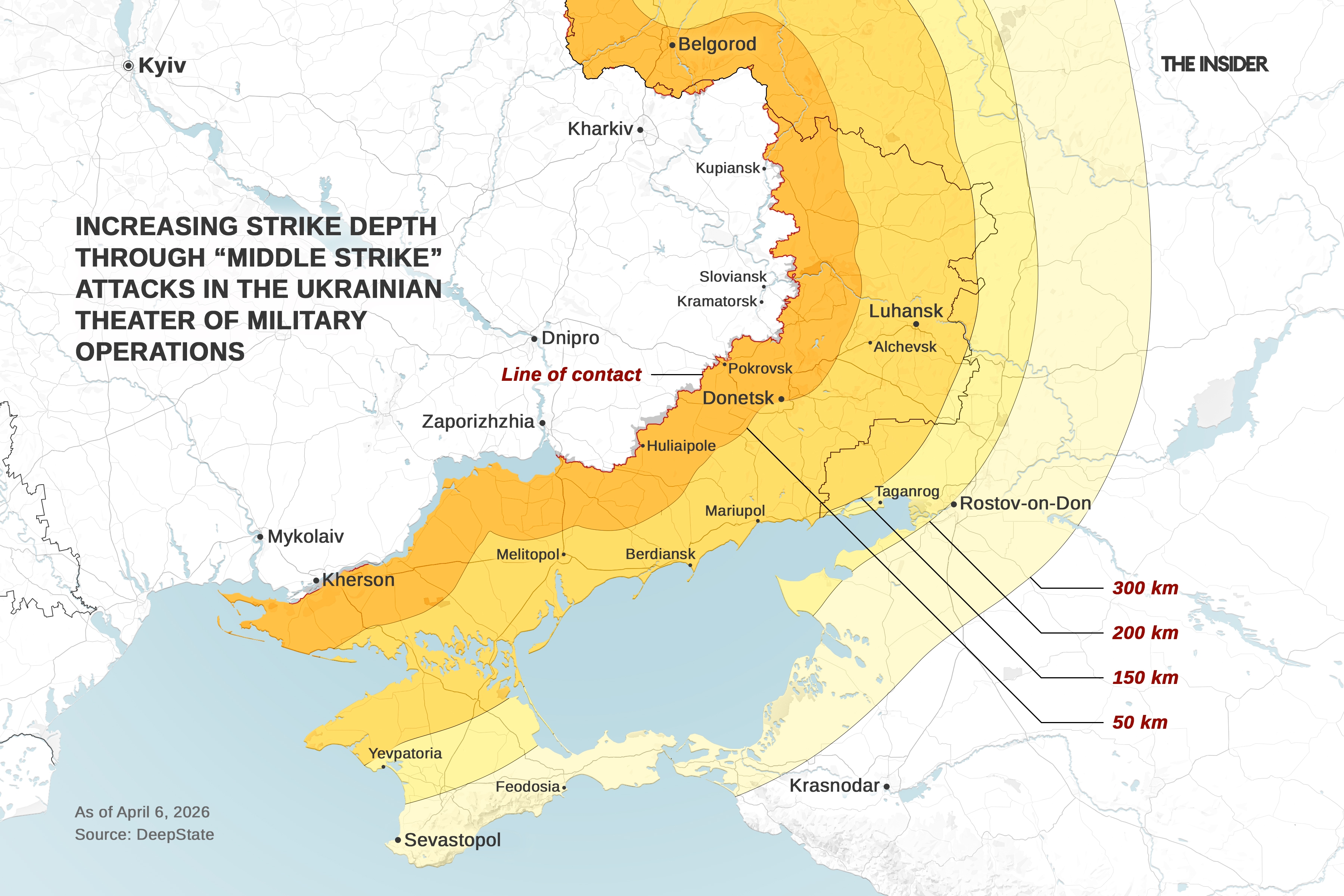
Since February 2026, Ukraine’s defense forces have begun increasing the number of drone strikes at distances of 30 to 300 kilometers from the front line, the result of efforts to expand production of “middle strike” drones, create specialized units, and build what are known as reconnaissance-strike networks. All of this has allowed the Ukrainian military to move closer to parity with Russian forces in strikes on logistics. It has also helped Kyiv gain an advantage in destroying air defense systems. This, in turn, creates conditions for deeper and more effective attacks on the entire support system of Russian troops, complicating the impact of "meat grinder assaults" — a tactic heavily favored by the Russian command.
Russia’s full-scale war against Ukraine rapidly evolved from a “classical” maneuver conflict centered on artillery into positional warfare before shifting yet again into a war in which drone operators and digital command platforms play the decisive role. Facing a manpower shortage, Ukraine’s Defense Forces (UDF) became one of the first in the world to systematically integrate drones at every level of combat and to partially replace soldiers with unmanned systems in the performance of a range of combat and logistical tasks.
In March 2025, the UDF launched a new defensive project called the “Drone Line.” Its goal was to create a drone-saturated “kill zone” in which the enemy could neither conduct active offensive operations nor advance toward Ukrainian infantry positions. To achieve this, specialized unmanned systems units were reinforced, becoming a “second line” capable of covering vulnerable sectors of the front and containing enemy assaults.
However, excessive focus on eliminating Russian manpower often led to other critically important tasks being neglected. Moreover, creating an unbroken “wall of drones” capable of stopping all Russian infantry in any weather and at any time of day is physically impossible. Without sufficient infantry of its own to control terrain and hold positions, even the infliction of heavy enemy losses do not guarantee a stable defense. New solutions were needed – ones that would not only protect the front line itself, but also allow operations deep inside enemy territory — from several dozen to several hundred kilometers, the space that military terminology calls the operational-tactical level. Expensive and scarce systems such as HIMARS and ATACMS did not solve this problem.
Problems of striking targets at operational depth
By the end of 2025, Ukrainian UAV operators and specialists in unmanned aviation had become increasingly aware of systemic miscalculations. Despite retaining high effectiveness in strikes against Russian infantry, Russian assault troops continued to advance by infiltrating through thinly held Ukrainian positions and entrenching themselves at tactical depth. Ukrainian forces were bringing Russia’s tally of irreversible losses close to the pace of Russian Armed Forces replenishment, creating pre-sighted “kill zones” along the front — but it was not enough. Russian infantry still dispersed across the frontline zone, where they targeted Ukrainian drone operators, mortar crews, and logistics networks, forcing the UDF to withdraw.
Even before that, analysts had begun arguing that the Russian Armed Forces had reduced — if not overcome — their battlefield deficit in drone technologies. Innovative drone use, an advantage long held by the UDF and an important factor allowing Kyiv’s forces to compensate for shortages of manpower and equipment, began to gradually erode in 2025.
In November 2025, Serhii “Flash” Beskrestnov wrote about the need to develop and deploy cheap loitering munitions with a range of 50–100 km as a more economical alternative to expensive systems such as HIMARS. Such range is critically important because it covers the zone where key frontline targets, relocated deeper into the rear by Russian forces, are concentrated. “Flash” noted that such drones would require different solutions in communications, navigation, and design.
American volunteer Ryan O’Leary, who left service in the Ukrainian military in the summer of 2025, wrote a thread in January 2026 (now deleted) in which he raised problems facing Ukraine’s Defense Forces. In his view, Ukraine, while not losing the drone war at the tactical level, was losing it operationally and strategically because it had “failed to define control of depth as the objective.”
His main argument was as follows: wars are won not in the trenches, but in the zone 10–40 km behind the line of contact. If the enemy can freely move equipment, fuel, ammunition, and drone operators, then it controls the sector, even if it loses more soldiers in the trenches. That was precisely how the Russian Armed Forces operated in 2025 — particularly the Rubicon center, which was rapidly expanding the use of drones such as the Molniya, an inexpensive Russian fixed-wing FPV drone that is used for reconnaissance, as a kamikaze drone, and as a carrier for other FPV drones.
In a post on March 9, 2026, “Flash” noted that Molniya drones are extremely difficult to suppress with electronic warfare. The problem, he said, is that it is unclear on what frequency control is taking place, as the drone only receives the controller’s signal without transmitting any telemetry in return.
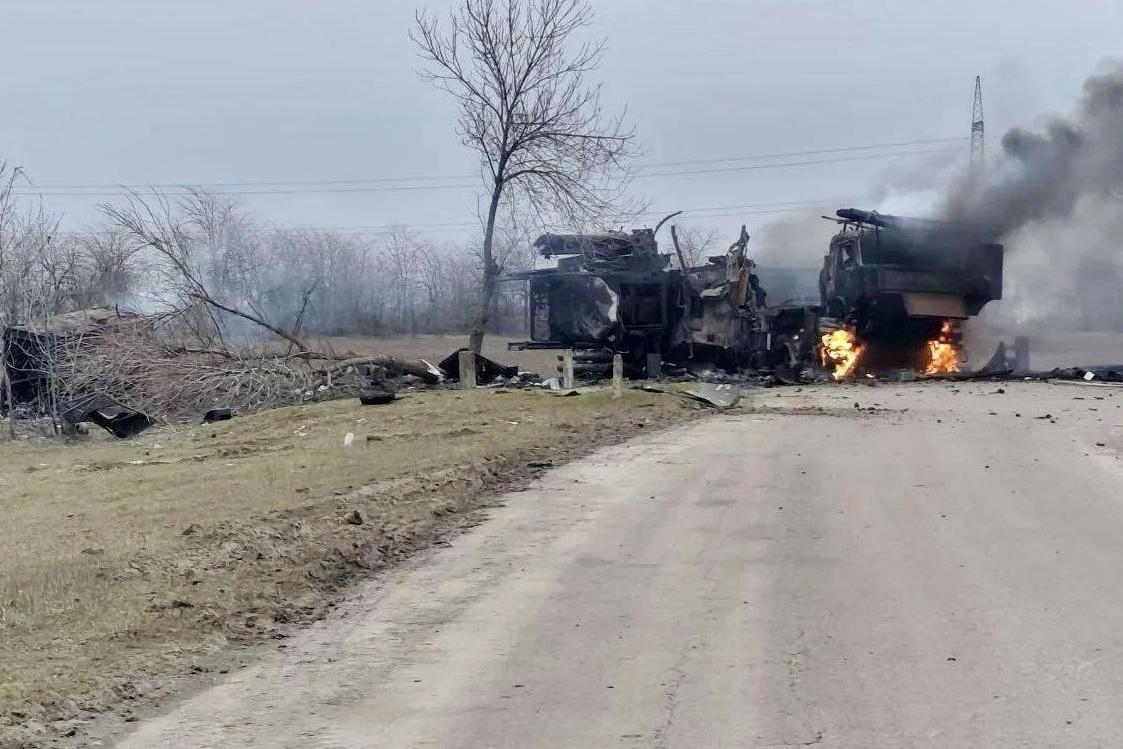
Speaking to The Insider, analysts from the Conflict Intelligence Team (CIT) confirmed that the Russian Armed Forces began concentrating their efforts on strikes against the operational rear of Ukraine’s Defense Forces earlier and achieved certain results. This was particularly evident during the battle for Pokrovsk in 2025. However, in their view, the key difference between the two sides lies in the quality of reconnaissance: in this component, Russia lags significantly behind. Russian forces’ practice of “counting” strikes against non-military targets as successes that they get passed up the chain of command further slows what is already uneven progress in this area. For this reason, Russian strikes in the area of the operational rear are regularly seen against targets such as farm buildings that really turn out to be genuine agricultural facilities containing livestock or grain, rather than, for example, equipment hangars, as they are likely described in Russian reports.
Military expert Kirill Mikhailov also believes that the effectiveness of Russia’s “middle strike” has been negatively affected by “the shutdown of illegal Starlink terminals, since this limits drone control at great depth and forces reliance on still imperfect machine-vision systems, which, among other things, do not distinguish military targets from civilian ones.”
The effectiveness of Russia’s “middle strike” was negatively affected by “the shutdown of illegal Starlink terminals”
At the same time, because of Russia’s greater overall capabilities, even the comparatively low effectiveness of its strikes still mean significant damage behind Ukrainian lines.
But Kyiv is developing the capacity to answer in kind. Ukraine’s new defense minister, Mykhailo Fedorov, appointed to the post in January 2026, separately highlighted the problem of striking targets at operational depth. In a speech before the Verkhovna Rada ahead of his appointment, he identified the technological transformation of the army as a key priority.
“We urgently need to introduce new capabilities, including drones, that will allow us to increase the depth at which we can strike the enemy. We already made this decision at the previous Stavka meeting and are now implementing it. In other words, Ukrainian equivalents of the Russian Molniya must appear. We have a large number of manufacturers working on this,” Fedorov said.
“Middle strike” tech
In the same speech, Fedorov emphasized the importance of working with foreign partners. Beginning in early March this year, reports began to appear (1, 2, 3) that Ukrainian operators were using HX-2 drones made by the German company Helsing. With an X-shaped wing, a speed of up to 220 km/h, a weight of 12 kilograms, a range of up to 100 kilometers, and terminal guidance using machine vision, the HX-2 can operate under electronic warfare conditions and coordinate in swarms.
They approach the target without the need to communicate with the operator or to shut off the engine during the final phase of flight, making detection more difficult. The HX-2 is positioned as a high-tech analogue of the Russian Lancet and is intended to strike armored vehicles, artillery, and other military targets including engineering fortifications. Notably, it had previously been reported that the Ukrainian side refused to place orders for these drones because of defects it had identifies (1, 2). Apparently, the manufacturer managed to eliminate them.
At the same time, Ukraine was developing its own domestic production of fixed-wing “middle strike” drones. In September 2025, the Ukrainian company Fire Point unveiled a system of this class designed to strike frontline targets with a 105-kilogram warhead: the FP-2 drone, which generally replicates the design of the long-range FP-1 unmanned aircraft while adding operator control and the ability to fly a complex route to a target at distances of up to 200 km. Its main feature is control via Starlink, which makes the drone virtually immune to Russian electronic warfare systems.
Now that UAV capabilities of the FP type are available, costly ballistic missiles like ATACMS have become relatively less important than they were two years ago, notes the Ukrainian serviceman who runs the Telegram channel “Ofitser.” It is also reported that over the past five months FP-2 drones have carried out more strikes than long-range Rubaka systems.
Since last year, Ukraine’s RAM-2X drone has also been used for strikes on the “middle rear.” The drone is an analogue of the Russian Lancet, with an X-shaped design that, thanks to a relay system, can hit targets at ranges of more than 100 kilometers. Ukraine’s Defense Forces also use the Bulava loitering munition, which has an operational range exceeding 100 kilometers and a guaranteed flight time of 75 minutes.
In the 412th Brigade of the Unmanned Systems Forces, the Nemesis unit uses drones of the same name from the family of heavy Ukrainian “Baba Yaga” unmanned aircraft, capable of striking targets at ranges of up to 60 kilometers. They are launched primarily at night. Targets of the Nemesis UAV include armored vehicles, air defense systems, and ammunition depots. The system is constantly upgraded depending on mission requirements, and an integrated Starlink terminal allows the drone to be controlled from any location.
Another element of the technological transformation was the mass return of control frequencies, a change that caused alarm among pro-Russian military correspondents. According to one of them, Ukrainian drones began operating on non-standard frequencies in the 9–10 GHz range and “hammering logistics at 50–60 km.”
Most electronic warfare systems are not designed to counter these drones, and developing new defensive measures in such cases can take up to a year, writes a Russian mobilized serviceman who runs the channel “Vault 8. Shelter No. 8.” In turn, the pro-war channel “ZIMOVSKY,” in a post dated March 13, 2026, describes a growing technological crisis for Russian forces in the “small sky.” Its essence, according to the post, is the sharp decline in electronic warfare effectiveness due to the shift of Ukrainian UAVs to new frequencies, the introduction of autonomous guidance using machine vision, and the emergence of interceptor drones systematically destroying Russian reconnaissance UAVs.
Ukrainian troops have managed to transform their approach not only to defense, but also to offense, resulting in the emergence of a high-threat zone in which logistics and vehicle movement are severely constrained for a distance of up to 15 kilometers from the front line. In this area, overall advantage is increasingly determined not by the number of drones but by the quality of technology and the speed of adaptation. Russian serviceman Sviatoslav Golikov cites reports from several of his colleagues saying that because of the “extreme level of activity” of Ukrainian tactical drones, “logistics has died” within 15 kilometers of the front, even for movement on foot.
Pro-war channels are noting a growing technological crisis for Russian forces in the “small sky”
In early March (1, 2), Golikov noted efforts by Ukraine’s Defense Forces aimed at rapidly increasing the drone-strike capabilities of combined-arms formations in order to create “air-strike fists” capable of operational maneuver and concentrated employment of unmanned aerial strike assets. He is echoed by the author of the Telegram channel “Belarusian Silovik 🇧🇾,” who writes that Ukrainian forces have learned to compensate for the lack of aviation by using drones.
He describes preparations for Ukrainian counteroffensive actions at the junction of Dnipropetrovsk and Zaporizhzhia regions as follows: by launching a swarm of 300–400 drones simultaneously over a narrow sector to a depth of around 20 kilometers, an “air-strike fist” was created — in other words, a massed air strike was delivered. This mode of fire preparation was conducted, after which mobile groups and consolidation units moved in. Behind them advanced teams of drone operators, and the cycle was repeated again.
Ukrainian military observer Bohdan Miroshnykov notes that although the counteroffensive actions failed to create a threat to Russian forces in Uspenivka or to supply routes to Huliaipole, Ukraine’s Defense Forces succeeded in pushing Russian troops back, slowing their tempo of advance and thereby gaining breathing room to organize defenses that prevented Russian forces from gaining space for operational maneuver toward Zaporizhzhia.
It is worth noting separately that one aim of Ukrainian offensive actions is to buy time to build more fortifications before Russian forces begin advancing again. Over the course of 10 days in mid-March, Ukrainian troops dug 22 new trench systems and nearly 186 kilometers of ditches while also laying 100 kilometers of barbed wire, researcher Playfra found using satellite imagery. All of these obstacles are intended to slow Russian infantry, making them easier targets for drones.
How the “middle strike” stops infiltration tactics
Judging by current developments, the technological transformation has already begun to produce results. Because of Ukraine’s new tactics, the Russian army has been unable to increase its already extremely low rate of advance and is facing serious difficulties moving personnel and supplies to the front line. In this regard, the experience of the Ukrainian 412th Brigade of the Unmanned Systems Forces, known as Nemesis, is illustrative. In late March, Nemesis conducted an operation to disrupt Russian logistics in the Huliaipole area. Fighters from the brigade’s Asgard Battalion identified key supply routes and temporary resupply “windows,” after which they carried out concentrated strikes while constantly changing their tactics. As a result, Russian vehicles failed to reach the front, troop rotations and ammunition deliveries were disrupted, and any Russian advance in that sector became substantially more difficult. Then, when an attempted armored-column assault from the northern outskirts of Huliaipole was recorded on the South Donetsk axis in the third week of March, Ukrainian forces detected it as it was leaving the town and struck it.
Conflict Intelligence Team (CIT) founder Ruslan Leviev suggests that with improving weather conditions, Russian forces will resume offensive operations using the proven tactic of “infiltration,” employing assault infantry supported by Rubicon drones to isolate Ukrainian logistics. Military analysts Michael Kofman, Rob Lee, Konrad Muzyka, and Franz-Stefan Gady identified Russian infiltration tactics as a new feature of this war after visiting the front in the summer of 2025. Ukraine’s new tactics are designed to counter this method by preventing enemy infantry from slipping through thinly held defensive positions by destroying them before they reach the front line.
Ukrainian forces are trying to “break” Russian infiltration tactics through “middle strike” attacks
Pro-war Russian military correspondent Yury Kotenok has acknowledged the success of Ukraine’s Defense Forces in this effort. “Any movement/approach of reserves to the line of contact and any attempt to concentrate them for offensive actions connected with breaking through enemy defenses become…problematic, and in most cases impossible,” he wrote as part of a lengthy March 25 post.
On the Lyman axis in particular, Ukrainian forces recorded local successes in March resulting from a deliberate change in tactics. According to a statement by a planning officer of the Mara UAV battalion of the 66th OMBri, Ukrainian units changed their approach several months ago, shifting their focus from destroying enemy infantry to systematically striking Russian drone operators and UAV infrastructure, artillery positions, logistics routes, and concentration areas.
This approach has produced tangible results: the number of assault actions has declined, and resupply and rotation capabilities have worsened, thus making it possible to gradually retake previously lost positions. As the officer emphasizes, in conditions where the enemy is prepared to sustain heavy personnel losses, strikes on equipment and logistics are what deliver results.
In Kirill Mikhailov’s view, “recent Ukrainian successes are explained more by organizational than technological factors. The same FP-2 systems were introduced half a year ago, but only in recent months have they begun to be used on a truly mass scale to strike targets in the ‘middle rear.’”
The CIT team believes the successes of Ukraine’s Defense Forces are the result of a combination of factors:
- Reconnaissance. Ukraine’s Defense Forces are effectively identifying a significant number of targets in the operational rear of Russian forces. This capability had been noted earlier as well — both by military personnel themselves and by analysts like Michael Kofman during visits to the front. At the same time, however, there was a shortage of means to strike targets at such ranges. Recently, that situation has begun to change.
- Strike capabilities. For a long time, Ukraine concentrated either on tactical targets in the frontline zone (small UAV-based munition-drop systems, FPV drones) or on strikes deep in the strategic rear (long-range drones hitting targets inside Russia). There were effectively no suitable systems for striking the operational-tactical rear (other than GMLRS rockets, which are limited both in quantity and range). Now, however, production capacity for UAVs with ranges from 50 km to several hundred kilometers is visibly increasing, and it is these systems that appear to be forming the foundation of “middle strike.”
- Organizational structure. This refers to creating an effective reconnaissance-strike network (as it is termed in the Russian Armed Forces) — a system that ensures targets are identified and rapidly passed to units carrying out strikes directly. Such units must be structured from the outset for these missions rather than handling them as a secondary task. Until recently, this element was either entirely absent or insufficiently developed.
Destruction of Russian air defense systems
If the two sides have reached a kind of parity in destroying enemy logistics, then in strikes against air defense systems Ukraine’s Defense Forces clearly pulled ahead in March 2026, Mikhailov believes. “Russian superiority in ‘middle strike’ was noted by O’Leary as well. It was visible during the isolation of Ukrainian logistics in the Kursk Region and continued during the capture of the Pokrovsk-Myrnohrad agglomeration. Now Ukraine’s Defense Forces have at least reached parity in this respect, and in some aspects, such as the destruction and suppression of air defenses, have even surpassed the Russians,” the analyst says.
For several months already, Ukraine’s Defense Forces have been conducting a systematic campaign to disable Russian air defense systems. According to calculations by the author of the monitoring project Dnipro Osint ⟨ Harbuz ⟩, from March 2025 through March 2026 there were at least 365 recorded strikes on targets in the “middle rear,” with more than one-third of them occurring in the last three months alone. Beginning in November 2025, units of Ukrainian military intelligence (HUR), Special Operations Forces, the Unmanned Systems Forces, and the Security Service of Ukraine (SBU) joined the operations, while the geography of strikes expanded across the entire front and operational rear. Nearly half of all strikes targeted Russian radar stations, launchers, and other elements of the air defense network at operational depth.
According to information from the General Staff of the Armed Forces of Ukraine (AFU), 55 Russian air defense systems were hit over the three months of winter. Robert “Madyar” Brovdi, commander of the AFU Unmanned Systems Forces, reported that as part of the “spring air-defense genocide” campaign, Ukrainian drone operators struck another 27 enemy air defense units in half of March alone. A monthly increase is also being recorded in the number of damaged and destroyed SAM and gun-missile air defense systems. “The enemy has found a way to knock out FPV air defense assets (comprehensively, all at once) …what can we use to oppose this? Nothing,” Russian blogger Andrey Filatov laments. Similarly, the author of the Z channel “Military Informant” writes that: “There is a feeling that if nothing is devised to counter mass Ukrainian drones using Starlink, then within a year, at a minimum in Crimea, the air defense system will either simply cease functioning or begin pulling more and more SAM systems and radars from other regions, exposing them instead.”
According to CIT analysts, the claim that Ukrainian drones equipped with Starlink terminals were used in Crimea is likely based on UAV interface data visible in strike footage — namely, a green crosshair in the center of the screen, as they write. The video signal was clearly stable, as the footage does not cut out. Starlink does not operate in Crimea, so it is fully possible that Starshield terminals were used instead, developed by SpaceX for military and secure communications needs and not subject to the same restrictions as civilian terminals. The AFU received Starshield in 2024.
The Z channel “Informant,” analyzing recent attacks on Russian territory, suggests that Ukrainian drones may have used Starlink satellite communications beyond previously established coverage zones. As supporting arguments, it cites strikes on targets dozens and hundreds of kilometers from the border, as well as sightings of drones carrying equipment resembling satellite communication terminals. On this basis, it concludes that the de facto Starlink operating zone has expanded to cover several Russian border areas: the Belgorod, Kursk, Oryol, and Bryansk regions, along with Krasnodar Krai.
In mid-March, Clément Molin mapped strikes on targets in Crimea over the previous two and a half months. These included ammunition depots, watercraft, missile launchers, air defense systems, and radar stations. Altogether, over the last three months the analyst counted more than 300 successful Ukrainian “middle strike” attacks on Russian rear areas.
At the same time, a researcher using the name Daniele from the Tochnyi open source intelligence (OSINT) team published an infographic listing 553 targets attacked by Ukrainian “middle strike” operations over the previous nine months. An OSINT researcher using the name Vitaly also marked confirmed strikes on Russian SAM systems and radar stations at operational depth. In total, he counted 72 such strikes over the last three months, including 41 in March 2026 alone.
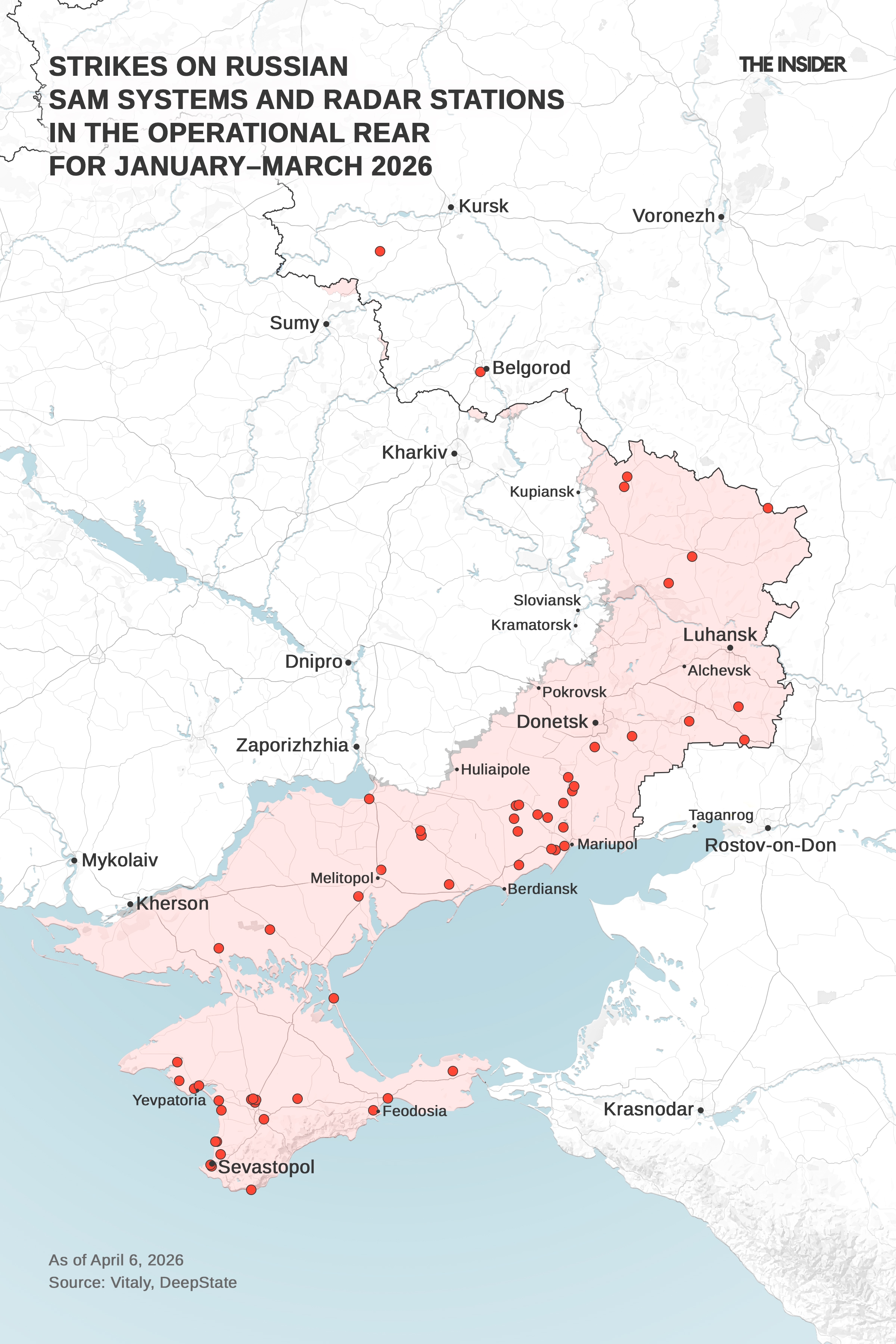
Throughout February and March, the command of Ukraine’s Defense Forces regularly reported strikes on such SAM systems as the S-300VM (near Mariupol), the S-400 Triumf (in Crimea), and the S-300V (in the Luhansk Region). Other systems that were hit included the Osa SAM system (in the Zaporizhzhia Region), the Tor SAM system (1, 2, 3, 4), the Buk SAM system (1, 2, 3, 4), and the Pantsir-S1 gun-missile air defense system (1, 2, 3).
In particular, according to a statement by fighters of the 429th Brigade “Akhilles,” five Pantsir-S1 systems were hit in February 2026 on the “Belgorod axis” alone. According to information from the Security Service of Ukraine, Russia’s defense industry produces up to 30 such systems per year. According to statistics kept by the Unmanned Systems Forces, the number of destroyed SAM systems/gun-missile air defense systems rose noticeably in March.
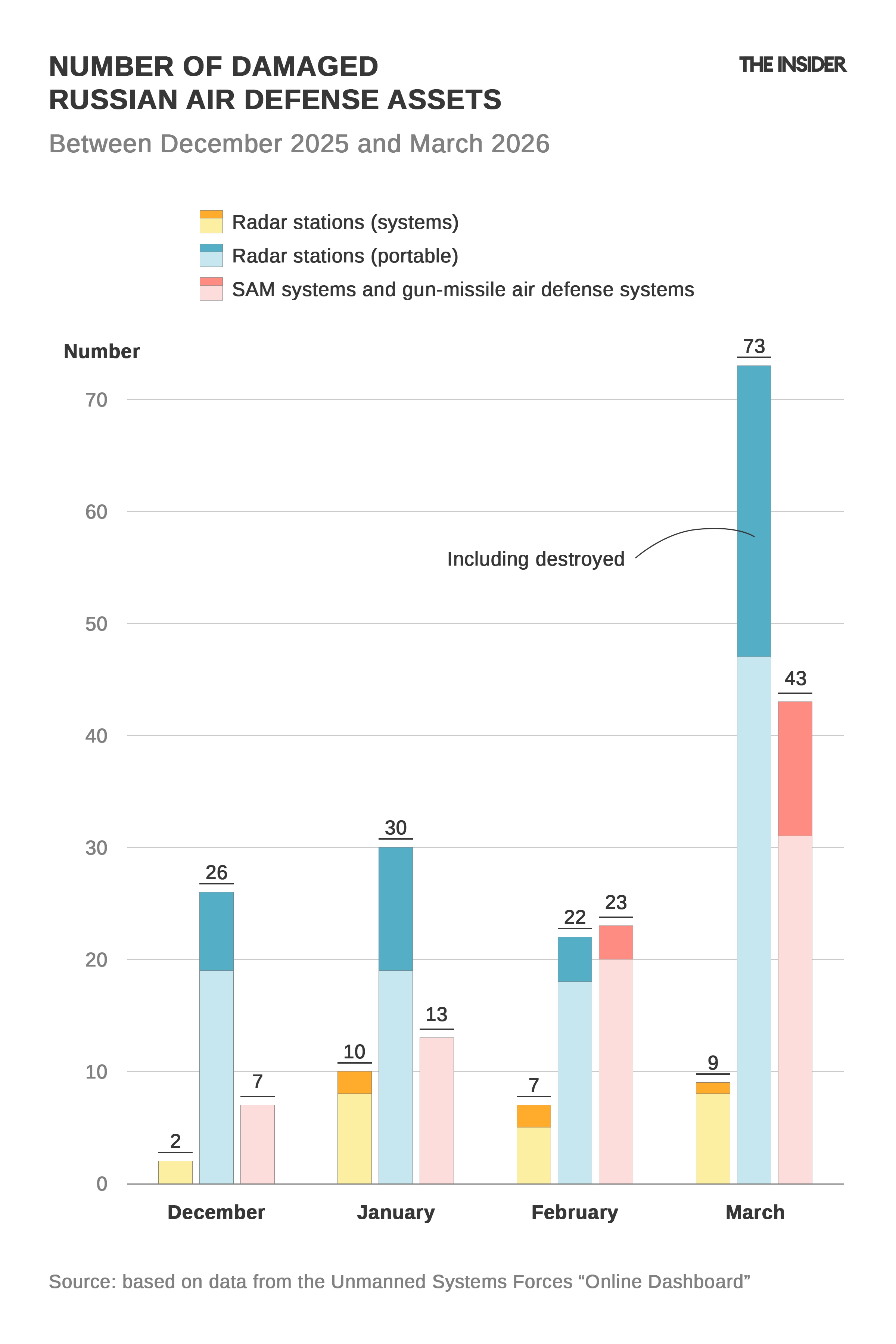
The Ukrainian OSINT project “Eye of Horus + News and Analysis” published an infographic of “middle strike” attacks on occupied Ukrainian territories for March 2026. According to these data, in March units of the Unmanned Systems Forces, the Security Service of Ukraine, Special Operations Forces, military intelligence, and the Navy struck at least 28 air defense systems and 14 radar units. The Unmanned Systems Forces’ online dashboard shows that the number of damaged and destroyed portable radar stations rose noticeably in March. By the end of the month, 55 radar stations had been reported hit, 47 of them portable. The overwhelming majority were in Crimea.
It should also be noted that strikes were carried out against expensive Russian missile systems such as the Iskander tactical ballistic missile system, including in Crimea. During February and March 2026, drones of Ukraine’s Defense Forces hit three launcher positions of these systems and three Bastion coastal missile system positions. “Middle strike” attacks have also targeted bases of the Russian Rubicon unit in occupied territories (1, 2).
Overall, during March 2026 Ukrainian UAVs struck a large list of Russian radar systems that included the Podlet-K1, Sopka-2, Nebo-U, Yastreb-AV, Nadgrobie, Protivnik, Imbir, and Kasta, among others. As a result of these actions, Russian forces were likely compelled to redeploy some Kasta-2E2 and Podlet low-altitude radar systems to Ukraine from the border with Finland, OSINT analyst Athene Noctua noted.
It is clear that the Ukrainian command is seeking to create a “corridor” in Russia’s radar coverage through which long-range AFU missiles and drones can penetrate deep into Russian or occupied Ukrainian territory. It is no surprise that Crimea and southern Ukraine have been chosen for this task. In this region, Russian military logistics have long faced difficulties. Using the Crimean Bridge is unsafe (the Russian army stopped transporting fuel and explosives across it after the 2022 and 2023 attacks), and the ferries (1, 2) and railway lines (1, 2) offering an alternative supply route have also come under attack.
For Russian forces, all of this creates objective difficulties when it comes to replacing and repairing air defense systems, including on site. A Ukrainian strike on Sevastopol on the night of March 19 hit the building of the Russian defense concern Almaz-Antey, damaging a center for servicing and repairing Russian air defense systems.
Moving away from a war of attrition
Russia’s redeployment of radar stations and air defense systems from other areas makes it easier for Ukrainian long-range drones and missiles to strike major targets (1, 2). The use of “middle strike” capabilities also allows Ukraine’s Defense Forces to hinder the Russian Armed Forces’ movement of personnel and equipment intended to support offensive operations. Given the pace of development and the scaling up of production, a further increase in strikes on operational rear areas can be expected.
For now, it is difficult to assess definitively how much these attacks have already affected the operational-tactical situation at the front. However, it is clear that in 2026 competition in strikes against operational rear areas will intensify as both sides place increasing emphasis on “middle strike,” according to a CIT expert who requested anonymity. At present, in his assessment, Ukraine’s Defense Forces are operating more effectively, though the situation continues to evolve and the balance shifts almost monthly.
“In 2026, we can indeed expect further development of ‘middle strike’ as part of the transition from the tactical use of drones to operational-tactical employment. This is important because both sides are seeking to return to maneuver warfare instead of a politically disadvantageous war of attrition. The Ukrainians have already demonstrated drone-enabled offensive actions at the operational level at the junction of Dnipropetrovsk and Zaporizhzhia regions. It can be expected that the Russian Armed Forces will in one form or another try to replicate these successes, for example in an offensive toward Zaporizhzhia or the Sloviansk-Kostiantynivka agglomeration,” Mikhailov believes.