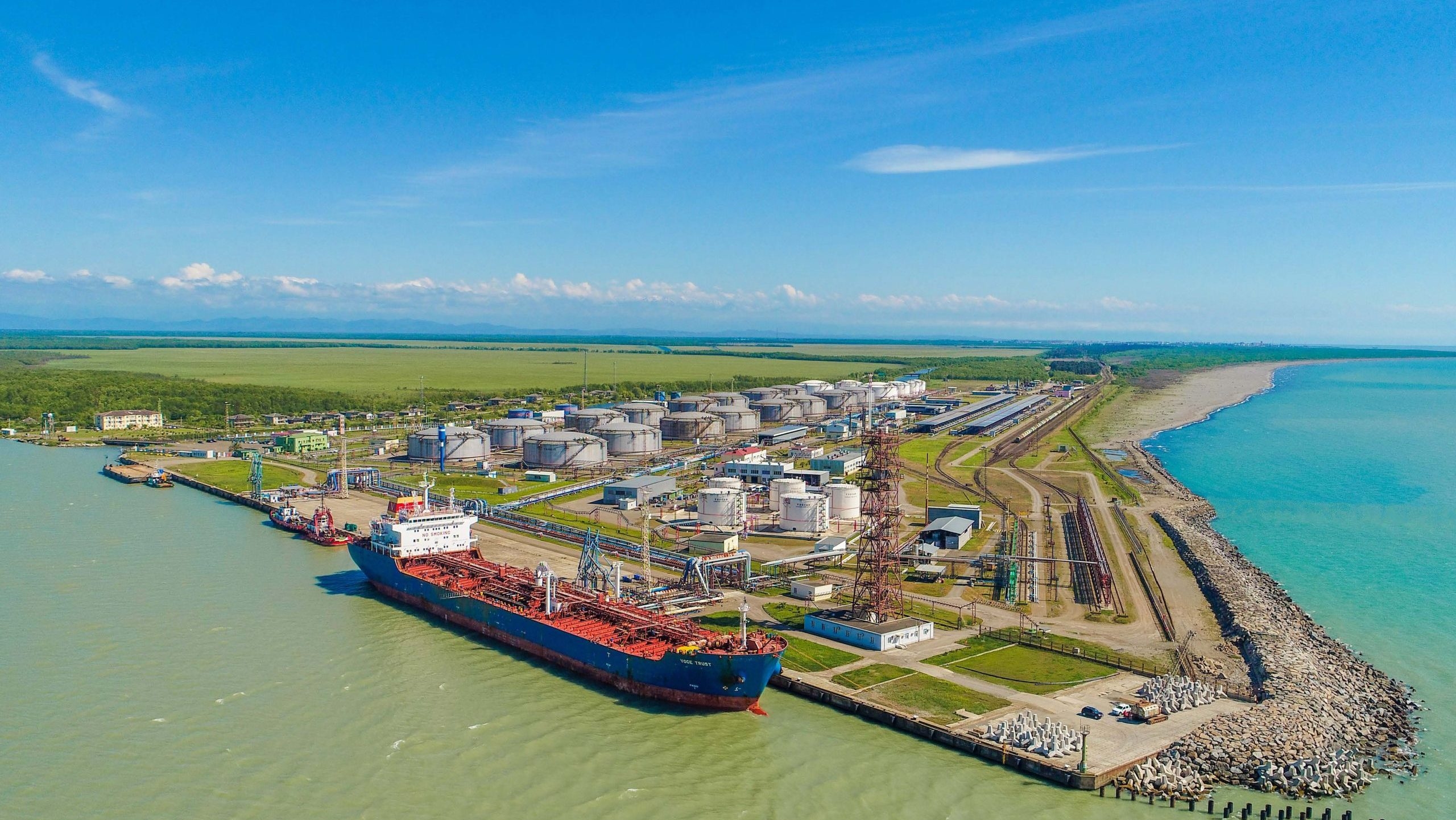
In January 2026, Georgia exported $56 million worth of petroleum products that it claimed were domestically produced, a 3,300% increase from the same period the previous year. The unprecedented surge is being linked to the opening of a new refinery in Kulevi, which received its first oil tanker in October 2025. The family that owns the refinery has ties to Russia, and “shadow fleet” vessels have delivered crude to the facility. More notably, however, there is no publicly available evidence that oil processing at the Kulevi refinery has actually begun. Experts suggest the facility is selling Russian petroleum products as if they were Georgian, which has put the port at risk of EU sanctions.
An ex-model with an oil plant
Speaking at the presentation of the Kulevi oil refinery project on the Black Sea coast in October 2024, Georgian Prime Minister Irakli Kobakhidze promised that the new refinery would increase Georgia’s export potential, improve the country’s foreign trade balance, and stabilize the national currency.
Sitting in the front row with Kobakhidze was Black Sea Petroleum owner Maka Asatiani, whose company had taken on construction of the plant. Asatiani is often described as a designer, but there is virtually no information in the media about her doing any design work since the early 2000s. A former model, the daughter of well-known Georgian footballer Kakha Asatiani, and the ex-wife of Georgian footballer Merab Jordania, Maka was for many years a figure in society pages rather than business news.
After divorcing Jordania, Asatiani married Kote Gogeliya, a Russian businessman of Georgian origin. For a time, the couple and their three children (Asatiani’s two sons from her first marriage and one child from her marriage to Gogeliya) lived in Switzerland and Spain. In 2009, after coming back to Georgia, Asatiani said she lived as a homemaker and grew cucumbers in her garden.

Asatiani rarely appeared in public following her marriage to Gogeliya, but she did not become a homemaker. Instead, she went into business. Her Mercedes dealer in Georgia — AKA — was listed as a family firm, though her husband showed more interest in a stake in the Maestro TV channel. In 2019, the “most beautiful woman in Georgia,” as tabloids often called her, opened the Darial concept store in Barcelona with designer Jaba Diasamidze. But in March 2022, the store announced it was closing due to “challenging circumstances in the world.” Six months later, Asatiani founded Black Sea Petroleum to build the plant in Kulevi (which, in turn, belongs to Azerbaijan’s state oil company, SOCAR).
At the project presentation in 2024, prime minister Kobakhidze sat in the front row along with Asatiani, her elder son Kakha Jordania, and her husband Gogeliya. The latter is considered to be the de facto owner of Black Sea Petroleum, having previously founded the companies Neftresurs and Arctic Bunker in Russia.
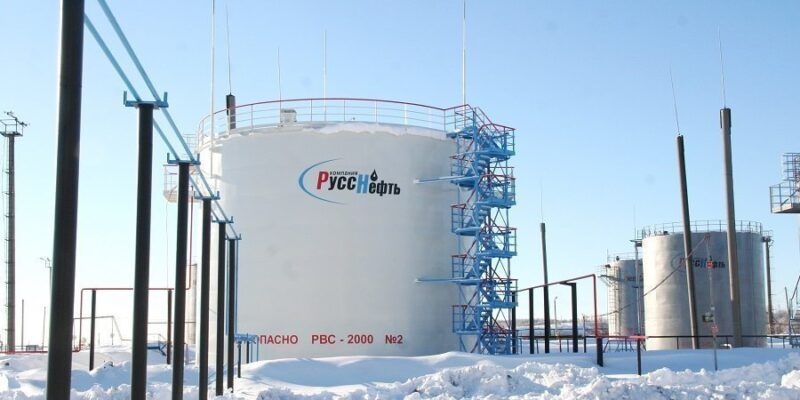
Kakha Jordania is also linked to Russia’s oil business. According to a report by the independent Russian outlet Agentstvo, from 2016 to 2023 Kakha owned the Russian oil trader Oil Energy Group, and since 2018 he has held a 25% stake in SDO-Logistik. Sergey Alexeyev, the son of Russian Lt. Gen. Vladimir Alexeyev, holds 51% of SDO-Logistik. (The elder Alekseyev is the same GRU first deputy chief who recently survived an assassination attempt in Moscow.) Sergey worked at Russneft before launching his own company. Russneft, founded in 2002 by businessman Mikhail Gutseriev, was the first company to supply oil to Kulevi in October 2025.
An achievement backed by the government
Corruption researcher Besik Donadze told The Insider that Black Sea Petroleum appears to be more of a Russian business than a Georgian one. “[The owners] did not make their money in Georgia. They made it in Russia, brought it to Georgia, and started a business,” he said. Donadze also noted that the refinery project, which had remained on the drawing board for about 10 years, moved forward rapidly once it became a priority. “Obtaining licenses and construction permits, it all went very quickly,” he added.
At the presentation of the refinery project, Asatiani herself acknowledged that, “This achievement would have been impossible without effective work and significant support from the government, as well as the participation of state and local institutions.”
Anti-corruption researchers in Georgia also note that the construction of the Black Sea Petroleum refinery is clearly in the interests of Georgia’s ruling elite. The level of investment needed for the first stage of construction was estimated at $110 million, while the overall project budget was put at $700 million. Financing involved the Georgia Development Fund and several commercial banks, including Cartu Bank, which previously belonged to Georgian Dream party founder Ivanishvili.
“The Georgia Development Fund is a private fund controlled by the government. It invests in sectors that the government believes need stimulation. That means the prime minister signed the decision to invest in Kulevi. In other words, the government cannot say this is an exclusively private initiative,” said Sandro Kevkhishvili, a program manager at Transparency International Georgia.
Commenting on Cartu Bank’s participation in the project, Kevkhishvili noted that after U.S. sanctions were imposed on Ivanishvili in 2024, the bank’s shares were redistributed. Formally, the billionaire’s son, Uta Ivanishvili, remained the owner of 35% of the shares, while the other shareholders were not disclosed. But in the expert’s view, “control over the brand remains,” and “given his de facto control over the ruling party, it can be said that Ivanishvili has a personal interest in the project’s success.”
Donadze also pointed out that Georgian Economy and Sustainable Development Minister Levan Davitashvili, who took part in approving the refinery project, resigned in 2025. Soon after, he became chairman of Black Sea Petroleum’s supervisory board.
Donadze said he is certain that building the refinery in Kulevi primarily serves Russia’s interests, but that carrying out such operations in Georgia would have been impossible “if there were no interest from Ivanishvili’s team.”
“Georgian” oil before Kulevi
Georgia began ramping up imports of oil and petroleum products from Russia after Putin’s full-scale invasion of Ukraine began in 2022. Tbilisi did not join the international sanctions regime targeting Moscow, and for Georgian importers, buying Russian oil was profitable amid rising global prices.
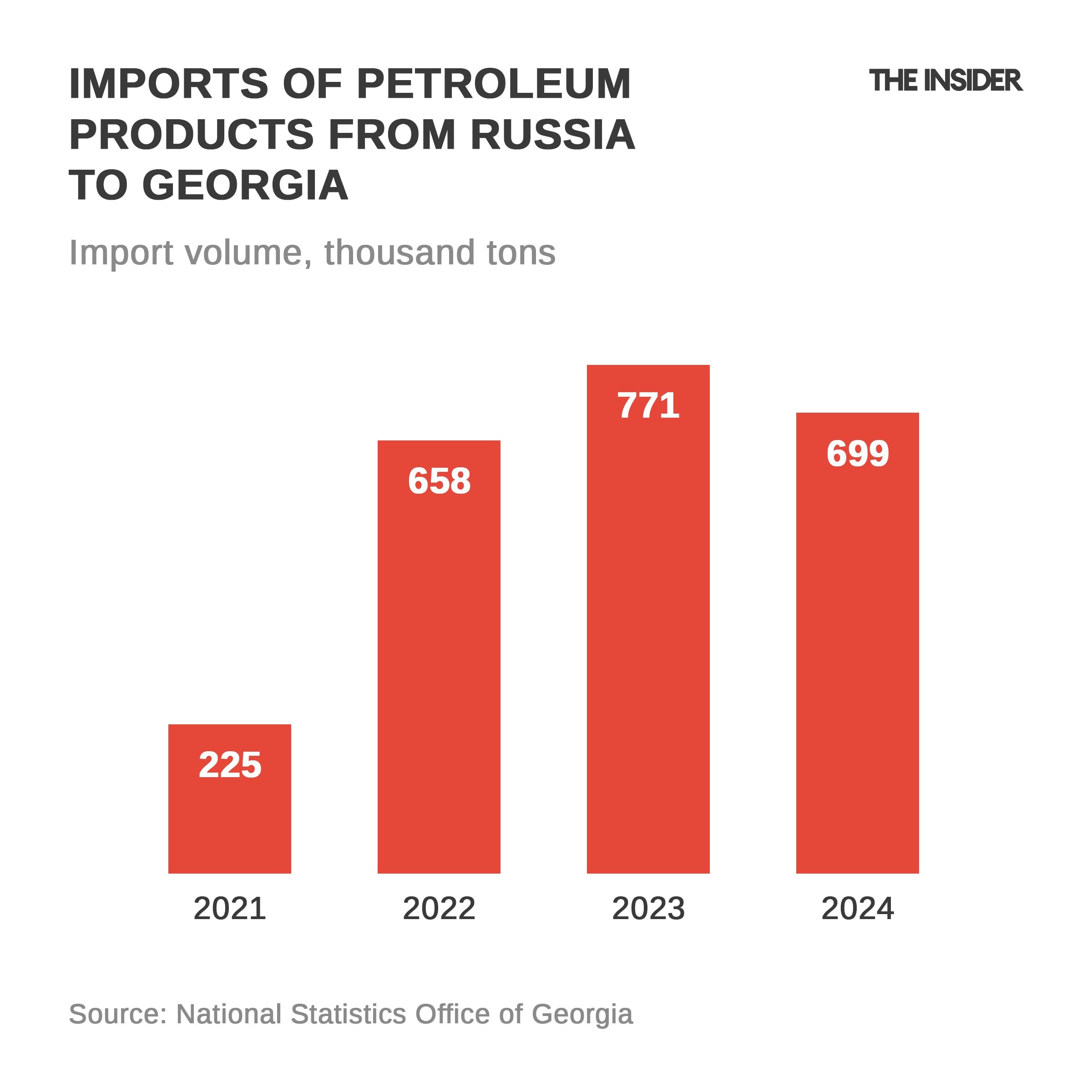
According to data from Georgia’s national statistics office Geostat, in 2021 the country imported 225,000 tons of petroleum products from Russia worth $135 million. In 2022, the volume nearly tripled — to 658,000 tons worth $622 million. In 2023, the total was 771,000 tons, and in 2024 it was 699,000 tons. As a result, the share of Russian petroleum products in Georgia’s imports rose from 16.4% in 2021 to 47% in 2022 before falling slightly to 40% in 2024.
Georgian investigative journalists say official figures show an incomplete picture. The outlet IFact analyzed data from international trade databases in early 2025 and found that since the war in Ukraine began, Georgia’s exports of oil to European countries had increased by a factor of nearly fifteen. At the same time, Geostat’s data did not fully reflect those imports. For example, official data say Georgia did not export oil to Spain in 2023 and 2024, yet international databases show that Spain imported 99,000 tons of oil from Georgia worth 49 million euros.
Investigators noted similar discrepancies in the figures for Greece, Italy, Belgium, and the Netherlands. Geostat explained the differences as possible three-way trade with resale (for example, when Georgia buys oil in Russia and sells it to another country without the cargo entering a Georgian port). However, under international standards, the country of origin should be the country where the oil was either produced or refined, not the country from which it was delivered to the destination. If the trade database figures are accurate, far more “Georgian” oil and petroleum products are being sold in Europe than Georgia is capable of producing.
Russian oil can be “Georgianized” in different ways. Sometimes, investigators say, it is enough to simply prepare new documents. In other cases, Russian oil is mixed with that of other suppliers so its origin cannot be determined. Or part is refined and exported as a Georgian petroleum product. IFact analyzed Georgian shipments to Switzerland and Greece from ZD Oil Company and Rustavoil, companies that also buy Russian crude.
The opening of the Kulevi refinery could fundamentally change the situation. It is the only facility in the country with a full crude oil refining cycle. In the first stage, the plant’s capacity is expected to be 1.2 million tons of crude per year, though that figure is slated to grow to as high as 3 million tons. By comparison, ZD Oil Company’s capacity is 130,000 tons, and Rustavoil’s is 180,000.
Exports up 3,300%
On Oct. 6, 2025, less than a year after the refinery project was presented, the tanker Kayseri delivered the first shipment — 105,000 tons of oil — from Russneft to Kulevi. Georgian authorities did not deny the fact, saying neither Russneft nor Kayseri were under sanctions. Only three weeks after arriving in Kulevi, the tanker was added to the EU sanctions list as part of the “shadow fleet,” and on Feb. 25, 2026, it was also sanctioned by the UK. Two months after the delivery, Britain also imposed sanctions on Russneft.
Additionally, in October 2025 Georgian imports of crude oil from Russia began rising sharply, a surge widely covered by Russian state media. In 2024, Georgia imported only 10.5 tons of crude oil from Russia worth $6 million, while in 2025 Georgia imported 225,000 tons of Russian crude worth $96 million. Those 225,000 tons arrived in the last three months of the year, when the Kulevi refinery began operating.
In early 2026, exports of petroleum products from Georgia surged. On Feb. 19, Geostat published foreign trade data for January — oil and petroleum products ranked second by export volume. In the first month of 2026, Georgia exported petroleum products worth $58.7 million (or 12.2% of total exports), an increase of 400% compared to January 2025, when Georgia’s petroleum exports amounted to $11.71 million (2.9% of the total).
A full 95% of that total, or $56 million, was covered by exports of petroleum products produced in the country. That figure also began rising in the last quarter of 2025, and compared with January 2025 the increase was more than 3,300%.
Experts note that the sharp rise in the numbers coincides chronologically with the possible start of operations at Black Sea Petroleum’s refinery in Kulevi. There is no other refinery in the country with comparable capacity.
Grounds for sanctions
After Reuters reported the arrival of Kayseri at the Kulevi terminal, investigators from IFact analyzed information on other vessels that had called at Georgian ports in 2024 and 2025. Based on a range of indicators, they concluded that at least 19 ships can be considered part of the “shadow fleet.” Typically, these are older vessels that have opaque ownership structures, frequently changing flags, falsify coordinates by manipulating their AIS data, transfer cargo in neutral waters, and lack Western insurance.
The “shadow fleet” is also being used to deliver crude oil to the Kulevi refinery. On Jan. 8, the tanker NOSTOS, built in 2003, delivered a shipment of crude oil to the port of Kulevi from Novorossiysk. Ukraine’s military intelligence agency has alleged that the vessel is used in order to bypass sanctions. Georgian authorities told the outlet Batumelebi that the cargo from NOSTOS was intended for the Kulevi refinery but stressed that, at the time of the delivery, neither the ship nor its owner or operator was under international sanctions.
Georgian authorities have claimed that nothing was happening in Kulevi that “contradicts sanctions policy.” However, because of its role in transporting crude oil and petroleum products produced in Russia or exported by Russian ships using irregular and high-risk shipping schemes, the port of Kulevi nearly ended up in the European Union’s 20th sanctions package. Adding the refinery to the list could become the first case of sanctions against a Georgian infrastructure facility, though Hungary and Slovakia are blocking the proposal for now.
Additionally, sanctions could threaten the interests not only of Georgia but also of Azerbaijan, since the terminal at Kulevi belongs to SOCAR. Bloomberg reported that Italy, which receives Azerbaijani gas through this terminal, also opposed sanctioning Kulevi.
The use of the “shadow fleet” is not the only reason for suspicion about Kulevi. “Now it becomes clearer why the European Union included the port of Kulevi on the sanctions list. The country is being drawn into a major scandal,” economist and former president of Georgia’s national bank Roman Gotsiridze wrote on Facebook.
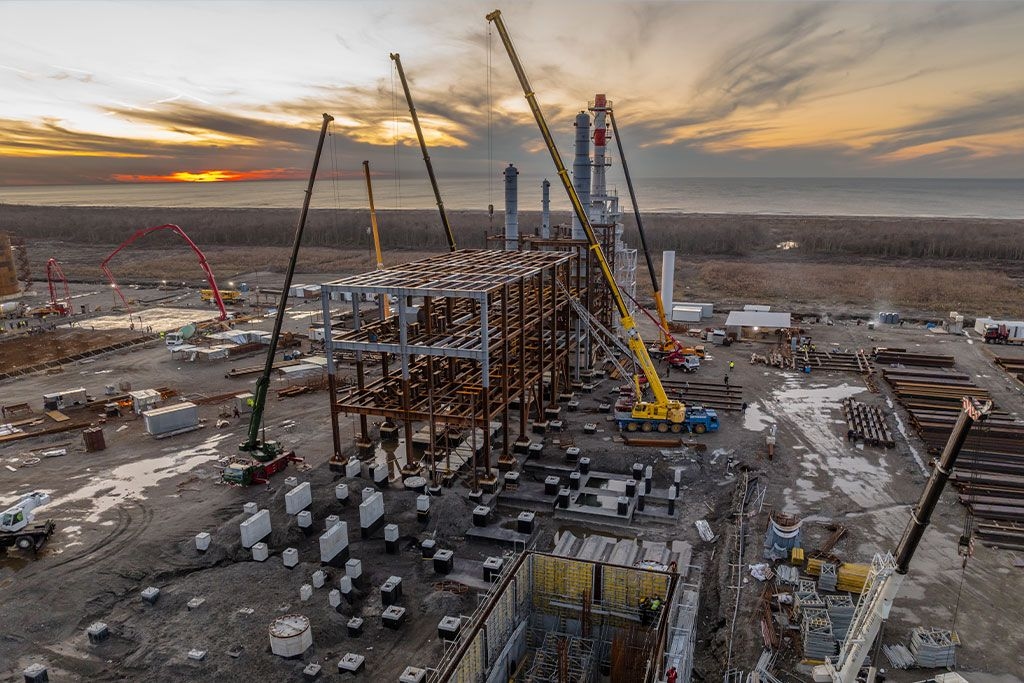
Despite record figures, there is doubt in Georgia that the Kulevi refinery is actually operating. Questions arose immediately after the first delivery of oil from Russia, but Black Sea Petroleum representatives did not respond to journalists’ inquiries. In the Khobi municipality, where Kulevi is located, officials told Batumelebi this past November that “trial-type works were underway” at the refinery and that the facility “has not officially opened yet.” The company’s website only features photos from the construction phase. “If we could go in right now and look at the refinery with our own eyes, we would see that processing that amount of oil there is impossible,” Besik Donadze suggested.
Sandro Kevkhishvili of Transparency International Georgia said Black Sea Petroleum “always said they would start small and then increase volumes.”
“If you have a legal business and you are not involved in suspicious schemes, you can make a statement: ‘Here is what we are doing, here is how much we are refining, here is our plan.’ But they are silent, and the government is silent. That increases suspicions.”
Gotsiridze wrote that there are several possible explanations for the striking export statistics. “Instead of the crude oil listed in the documents, Russian-produced diesel fuel or gasoline was imported and then exported as Georgian products,” or “a semi-finished product for producing diesel fuel was imported, although it was recorded at customs as crude oil, and then other substances were added in small amounts, meaning the quality was ‘adjusted’ with additives.” Both scenarios amount to falsifying customs documents, a criminal offense and a sanctions violation, since the petroleum products were sold to an EU country, Malta.
Another possible explanation, Gotsiridze said, is a scenario in which “Russian crude oil arrived at the Kulevi terminal, and Azerbaijani finished petroleum products went out for export” while being declared as produced in Georgia. In that case, SOCAR, which owns the Kulevi terminal, would also be drawn into the scandal.
Donadze stressed that under conditions in which “state institutions have been captured” by the pro-Moscow Georgian Dream party, it is impossible to find out the origin of oil entering the terminal. ”What was written on paper is one thing, and reality is another,” he said.
If sanctions are imposed, it would further damage Georgia’s reputation, Kevkhishvili said, adding that “it could become an additional problem in relations with the United States, which is not as hard-line toward Russia, but uses oil sanctions as a tool of pressure.”
In the Geostat data that ranks petroleum products as second by export volume, a product that Georgia does not even produce domestically — passenger cars — has topped the list for several years. The largest market for re-export remains Kyrgyzstan, where only 2% of the cars shipped from Georgia are registered. The rest likely go to Russia.
In his conversation with The Insider, Donadze cited car re-exports as an example of sanctions evasion. Nevertheless, he says that imposing restrictive measures against Kulevi would have a positive effect. “Sanctions are a process. You cannot close one door and that is it. On the other side, they are constantly looking for holes, and you have to gradually close every loophole,” he said.