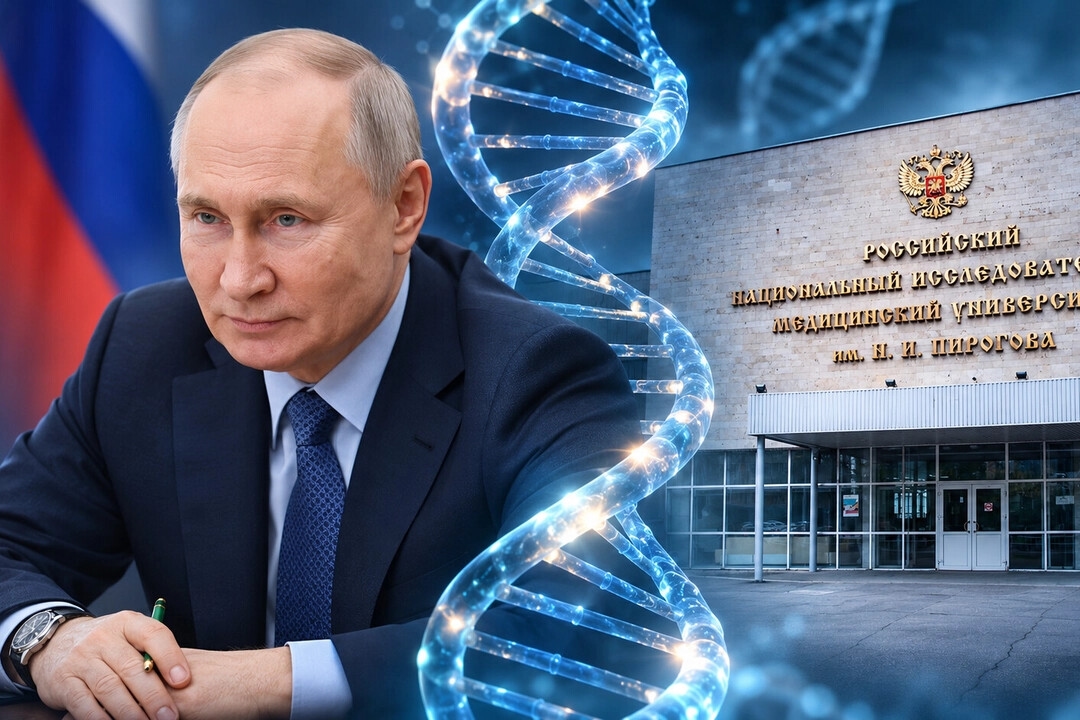
The Russian government has transferred Pirogov Russian National Research Medical University, one of the country’s leading medical schools, from the Ministry of Health to the Federal Medical-Biological Agency (FMBA), which reports directly to Vladimir Putin. Prime Minister Mikhail Mishustin signed the order confirming the move on Nov. 3. In statements from the FMBA and the university, the transfer was described as creating a “unified framework for the development of Russian biotechnology.”
The FMBA was placed under Putin’s direct authority in June 2024 by presidential decree No. 522. The agency, headed by former Health Minister Veronika Skvortsova, had previously reported to the Russian government. Among other responsibilities, the FMBA provides medical services for employees in Russia’s nuclear, space, and defense industries, as well as workers at organizations facing heightened radiation, chemical and biological risks.
Authorities said the university’s transfer was intended to consolidate scientific and educational resources. According to the FMBA, Pirogov University departments already operate at 12 of the agency’s research centers, while the institutions have jointly established 36 academic departments. Areas of cooperation include gene therapy, immunomedicine, neurotechnology, and bioinformatics. Deputy Prime Minister Tatyana Golikova said the consolidation would help develop educational programs in biomedical and genetic technologies. The FMBA said the university would not become a closed institution serving only the agency.
The transfer comes as Russia develops large-scale state programs in biotechnology and life extension. As The Wall Street Journal reported in May 2026, Russian authorities are funding a $26 billion anti-aging program that includes organ bioprinting, gene therapy, and transplantation of organs from genetically modified animals. The newspaper said the program is overseen by Putin’s daughter Maria Vorontsova, along with Mikhail Kovalchuk, the head of Russia’s Kurchatov Institute, a major state nuclear and scientific research center,
Research in related fields is also underway within the FMBA. The agency’s medical genomics department, for example, studies biological age and the genetic characteristics of aging, while its Center for Biomedical and Additive Technologies works on regenerative medicine and methods for bioprinting organs and tissues.
In September 2025, Putin discussed the possibility of achieving immortality through biotechnology during a hot mic conversation with Chinese President Xi Jinping and North Korean leader Kim Jong Un. ““With the development of biotechnology, human organs can be continuously transplanted, and people can live younger and younger, and even achieve immortality,” an interpreter was heard translating Putin as saying. “Predictions are, this century, there’s a chance of also living to 150,” Xi replied.