The U.S.-based think tank Middle East Forum has recommended that the U.S. Treasury Department treat cryptocurrency platforms used by Russia and Iran as a single interconnected system, according to a report published by the organization on Oct. 25. The report’s authors said Iran-linked Shelbit, Russia’s A7 network, and Kyrgyzstan-based crypto exchange TokenSpot all use shared infrastructure built around the USDT stablecoin, and that Sberbank, Russia’s largest bank, acts as the key link between the exchanges, as it “coordinates and legalizes” the final transactions.
The report outlined how Sberbank’s role expanded after Vladimir Putin signed Federal Law No. 282-FZ on Aug. 4, allowing Russian companies to settle foreign trade transactions using digital currencies. Kaplan Panesh, deputy chairman of the State Duma’s Budget Committee, said the law allows companies to pay foreign partners while “circumventing sanctions.”
Sberbank, which has been under full U.S. sanctions since 2022, began processing crypto payments of this kind immediately after Putin’s signature brought the law into effect. According to the report, that gave Russia access to state-backed payment channels operating in parallel with the A7 network.
Shelbit, which has companies in Georgia, Poland, and the United Arab Emirates, was sanctioned by the United States in August for transferring funds linked to Iran’s Islamic Revolutionary Guard Corps (IRGC). TRM Labs estimates that $6.3 billion passed through Shelbit-linked wallets, including $318 million connected to A7. In September 2025, the platform transferred $2 million to a wallet that Israel later identified as being part of Hamas’ financial infrastructure. TRM Labs cautioned, however, that while blockchain data can show the path of funds, it does not establish what participants knew about the ultimate destination or purpose of the transactions.
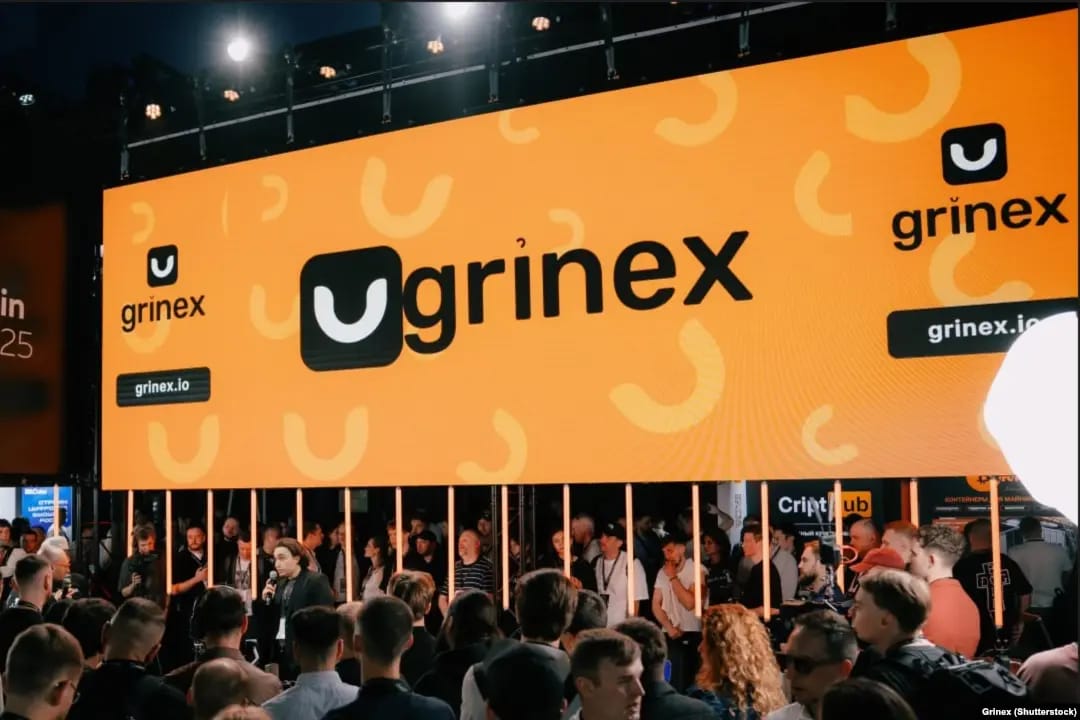
TRM Labs also assessed that TokenSpot serves as a front for Grinex (the successor to the sanctioned Russian crypto exchange Garantex), and that it had transferred around $680 million to A7. The United Kingdom imposed sanctions on TokenSpot on Oct. 8. The United States has not yet done so, and as of Oct. 10, Kyrgyzstan’s financial regulator still listed the exchange as licensed.
The authors separately pointed to Putin’s August law allowing digital-currency settlements in foreign trade, after which Sberbank immediately began facilitating such payments.
The Middle East Forum recommended that the United States sanction TokenSpot and also proposed targeting Russian banks that process cryptocurrency payments for Iranian counterparties. Its authors suggested warning those banks that they could face the same treatment as VTB, which was sanctioned in September over its involvement in payment channels using rubles and Iranian rials.
The report also said the U.S. Treasury should seek to freeze USDT held in wallets linked to A7. According to a report by the Democratic minority in the U.S. Senate, 84% of 846 sanctioned crypto wallets linked to Iran used USDT.
On Oct. 1, the U.S. Treasury Department designated A7 as a transnational criminal organization, while the Financial Crimes Enforcement Network (FinCEN) proposed cutting the network’s subagents off from the U.S. financial system.
According to the Treasury Department, more than $17 billion passed through those intermediaries between January 2025 and June 2026. The network was used by Iran’s central bank, the IRGC, and Hamas.
A7 was created in late 2024 by Russia’s Promsvyazbank and fugitive Moldovan oligarch Ilan Shor.