Russia’s state-owned United Microelectronics Company (OMK) plans to acquire stakes in Chinese semiconductor factories, according to a report by the Kremlin-aligned newspaper Kommersant, which cited sources familiar with the organization’s plans. The move is intended to make it easier for Russian customers to secure manufacturing capacity.
One source said OMK wants to buy one or more stakes in “small and nonprestigious” factories that would serve both the Chinese domestic market and Russia. Chinese manufacturers themselves have also proposed such arrangements. “It is possible to agree that one or several production lines would work for Russian needs,” the source told the newspaper.
Maxim Slugin, a partner at the Jinshi law firm, said Chinese factories generally allow Russian investment but may reject an investor linked to the Russian state or subject to Western sanctions.
Alexei Yershov, deputy director of a research and education center run by Russia’s Federal Tax Service and Bauman Moscow State Technical University, noted that many Russian microelectronics companies, including Baikal, Modul, and Elvis, already have chips manufactured in China. Buying stakes in Chinese factories would help reserve production capacity for Russian customers. “It is easier for a shareholder to obtain quotas and a predictable price,” Yershov said.
OMK was established in January 2026 to develop Russia’s microelectronics industry. Its stated goals include consolidating resources, creating a full-cycle microelectronics manufacturing complex, and training qualified personnel.
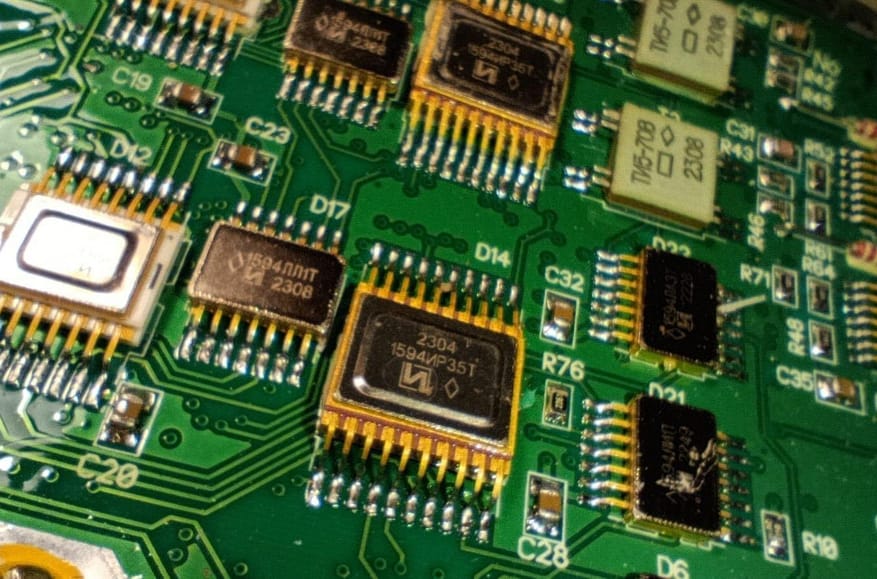
The Russian industry publication CNews reported that as of September 2026, Russian semiconductor plants were unable to manufacture chips using current-generation process technologies. The most advanced process available domestically is 90 nanometers, a technology dating to 2003, according to the outlet. Taiwan Semiconductor Manufacturing Co. (TSMC), the world’s largest contract chipmaker, began producing chips using a 2-nanometer process last year. South Korea’s Samsung also has access to the technology. Both companies stopped working with Russia in 2022 after the start of the full-scale invasion of Ukraine.
Chinese factories do not yet have 2-nanometer process technology but are approaching that level, according to CNews.