The Russian government has authorized the duty-free export of up to 6,000 metric tons of sunflower oil produced in the occupied part of Ukraine’s Zaporizhzhia Region. The Insider discovered the measure in government decree No. 1190, signed by Prime Minister Mikhail Mishustin on Sept. 18.
For products covered by the quota, the export duty will be set at zero rubles per metric ton. Russia’s standard export duty on sunflower oil in September is 14,377.7 rubles per ton ($170), nearly twice the August rate. If the full 6,000-ton quota is used, exporters could save upwards of 86.3 million rubles ($1 million) compared with the September rate. The actual value of the exemption will depend on the duty rates in effect during the months when the oil is exported.
The decree establishes a separate procedure for the exports. The quota will be distributed among foreign-trade companies by the Russian-appointed head of the Zaporizhzhia Region or an authorized official no lower than a deputy chair of the regional government. The distribution rules must be coordinated with Russia’s ministries of Economic Development, Agriculture and Industry, as well as the Ministry of Trade. Once an exporter receives part of the quota, it will need a one-time license from the Industry and Trade Ministry. The Federal Customs Service has been instructed to process shipments on the basis of those licenses.
The decree itself does not identify which companies will receive portions of the 6,000-ton quota. The official allocation form requires the Russia-installed authorities in Zaporizhzhia to list each company’s name, taxpayer identification number, the type of product, and its allocated volume.
One of the largest producers of sunflower oil in the Russian-occupied part of the Zaporizhzhia Region is the Melitopol Oil Extraction Plant, or MMEZ. The company is listed under taxpayer number 9001005262 and state registration number 1229000009435 in Russia’s corporate register, with oil and fat production designated as its main line of business. Serhiy Zhelev is listed as owning 60% and Liudmyla Zheleva 40%, while Svetlana Chernykh is listed as general director. In 2024, the Russian legal entity reported revenue of 571 million rubles ($6.8 million) and a net profit of 73 million rubles ($870,000).
The plant itself has said it produces and sells 30,000 to 35,000 metric tons of oil a year. The new 6,000-ton quota therefore amounts to roughly one-fifth of its stated annual output. The Insider has not found documents showing that MMEZ has received or will receive the new quota.
The same owners before and after Russian occupation
The history of MMEZ differs from many other cases in which Ukrainian assets came under Russian control after the start of the occupation, as Serhiy and Liudmyla Zhelev were connected to the Melitopol Oil Extraction Plant long before Russia’s full-scale invasion. Liudmyla served as a member of the Zaporizhzhia Regional Council for President Volodymyr Zelensky’s Servant of the People party, and Serhiy at various times sought election to Ukraine’s parliament and to the Zaporizhzhia Regional Council. In 2018, he was appointed Honorary Consul of Bulgaria in Ukraine for a consular district covering the Zaporizhzhia, Donetsk, and Luhansk regions (an appointment confirmed by Bulgaria’s Foreign Ministry).
Serhiy Zhelev’s declaration in Ukraine’s public asset registry states that he and his wife owned shares in PJSC Melitopol Oil Extraction Plant. It also records their investments in LLC Melitopol Oil Extraction Plant. According to current data from Ukraine’s corporate register, Serhiy and Liudmyla Zhelev are still listed as the ultimate beneficiaries of the joint-stock company and hold large stakes in the enterprise.
After the occupation of Melitopol, the company also appeared under Russian jurisdiction. The owners of the Russian LLC were again the Zhelevs, with Serhiy receiving 60% and Liudmyla 40%.
Ukrainian law enforcement authorities are examining the circumstances of the re-registration. A March 3, 2026, ruling by Kyiv’s Solomianskyi District Court cites investigators as alleging that Serhiy Zhelev, together with his wife and another person, worked with representatives of the Russian occupation authorities to re-register a number of Ukrainian companies in the Russian tax system.
Investigators specifically named the Ukrainian LLC Melitopol Oil Extraction Plant and its corresponding Russian entity, LLC Melitopol Oil Extraction Plant, registered under state number 1229000009435. The criminal case is being investigated under an article covering assistance to an aggressor state.
From Melitopol to the international market under the Russian flag
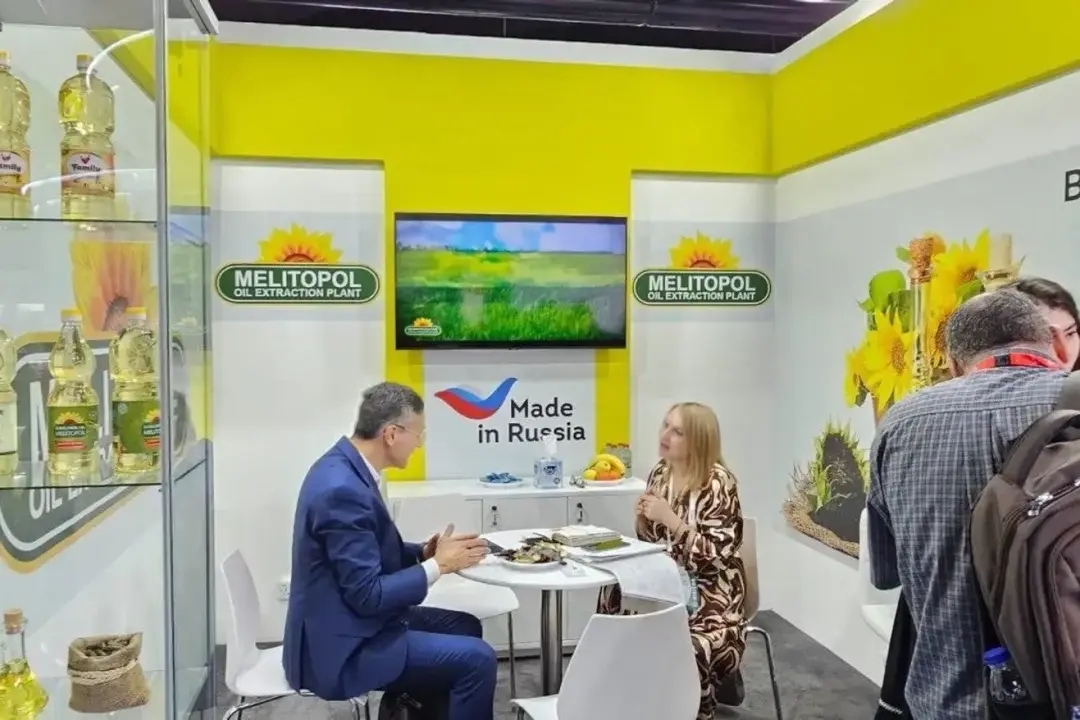
After the occupation, the company did not limit itself to the Russian domestic market. In February 2024, the Melitopol Oil Extraction Plant appeared at the Gulfood international food exhibition in Dubai as part of the Russian exhibition.
Photos from the stand showed the name Melitopol and the company’s logo. Ukrainian media reported that the plant took part in the Russian Export Center’s Made in Russia pavilion. Ukrainian publication LIGA.net also noted that Serhiy and Liudmyla Zhelev were listed as the owners of the relevant companies in both Ukrainian and Russian corporate registers.
The Russian legal entity later registered the Zdravoliya trademark, which is now used for the plant’s products.
This is not the first duty-free quota
The Zaporizhzhia Region was a major center of sunflower oil production before Russia unleashed its full-scale invasion of Ukraine. In 2021, companies in the region produced approximately 544,000 metric tons of unrefined sunflower oil and an additional 61,000 metric tons of refined sunflower and safflower oil. The current Russian duty-free quota of 6,000 tons therefore amounts to only about 1% of the region’s prewar annual production.
The latest government decision is not the first time Russia has introduced a special export regime for agricultural products from occupied Ukrainian territories. For 2025, the Russian government established separate duty-free export quotas for four occupied Ukrainian regions that Moscow claims as Russian territory — Donetsk, Luhansk, Kherson, and Zaporizhzhia. The quotas for the Zaporizhzhia Region were especially large: up to 1 million metric tons of wheat, barley, and corn, 25,000 tons of sunflower oil, and 35,000 tons of sunflower meal.
The quotas were in effect from Jan. 1 through Dec. 31, 2025. As under the current system, the right to distribute the exemptions among exporters was given to Russian-appointed regional authorities, while each shipment required a one-time license from the Industry and Trade Ministry. In March 2025, Russian-installed Zaporizhzhia governor Yevgeny Balitsky approved separate rules for distributing those volumes.