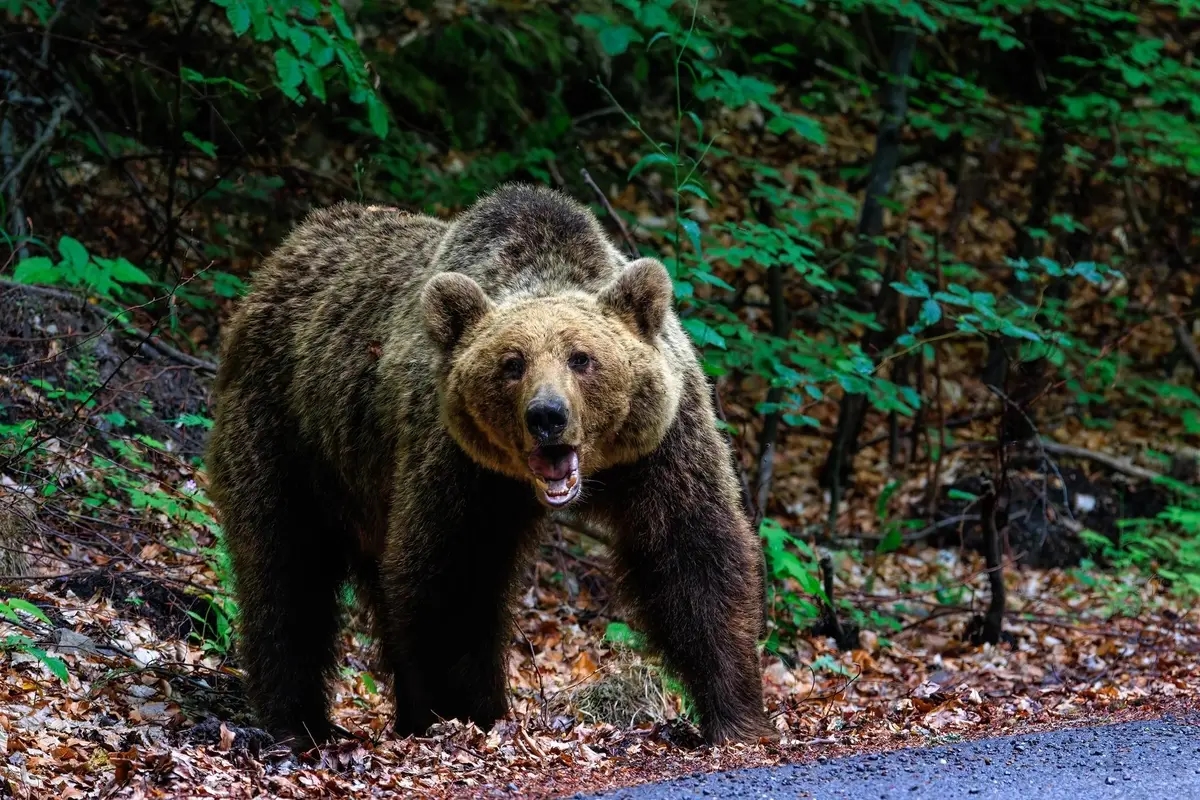
Since late August, Russian media outlets and Telegram channels have been reporting almost daily on new bear attacks against people. Regional authorities have declared a heightened alert and closed tourist routes, while Magadan Region Governor Sergei Nosov called for legislation to be revised to allow stricter controls on the bear population.
At the same time, the Natural Resources Ministry insists that 20–30 bear attacks a year is normal and that in recent years, only 2014 — when 166 cases were recorded — has been anomalous. But the current wave is nevertheless unusual in both intensity and geography: bears have been reported near populated areas in 41 regions, including places where they had not been seen for years. In late August, for example, a bear attacked a woman near Novosibirsk – a rare occurrence for the region.
The issue received widespread attention after a bear burst into a tent at the Istok tourist camp near the village of Artybash in Altai on the night of August 19 and, in full view of her fiancé, dragged 29-year-old Snezhanа Koroleva, an Emergency Situations Ministry employee from Novosibirsk, into the forest. She had accepted her boyfriend’s marriage proposal the day before. The woman was killed.
Chronicle of incidents
Russian media subsequently began reporting extensively on bear attacks:
- August 26, Novosibirsk Region. A bear mauled a cow and then charged at a woman who had gone to check on the herd near the village of Malchikha in Kolyvan District. She survived.
- August 30, Novgorod Region. A female bear attacked a hunter who had fired in her direction. The man survived with injuries to his head, arms, and legs.
- August 30, Kemerovo Region. A bear attacked a 68-year-old woman in Novokuznetsk. A police officer who arrived at the scene shot the bear.
- August 31–September 2, Krasnoyarsk Krai. Two women, aged 67 and 73, went missing in the forest near the settlement of Podtyosovo while picking mushrooms. They were later found dead, and investigators documented signs of a bear attack.
- September 6, Krasnoyarsk Krai. A bear mauled a 40-year-old shift worker in a forest near the settlement of Yuzhno-Yeniseysky. He died at the scene.
- September 7, Buryatia. A bear attacked a man who was accompanying his wife to the bus and stopped to check on livestock in the forest near Khurtaga. Despite surgeons’ efforts, he died in the hospital.
- September 16, Krasnoyarsk Krai. A bear attacked a 66-year-old woman outside her home in the village of Verkhny Kebezh. The bear fled, and the woman died at the scene.
By mid-September, journalists had counted at least 12 people killed in bear attacks since the beginning of the year, along with more than 530 bears shot across the country after being deemed dangerous by authorities and hunters.
Measures introduced by the regions
Authorities largely see mass culling as the main solution to the problem. By mid-September, more than 530 bears deemed dangerous had been killed across the country. In Krasnoyarsk Krai, which has recorded the most incidents, regional authorities introduced a 36,500-ruble reward ($430) for every bear killed in hunting grounds, while shooting bears within populated areas remains the exclusive authority of the police. In Irkutsk Region, authorities formed 81 task forces comprising 209 specialists and hunters, with 142 vehicles, and approved measures to regulate the population of 250 bears. In Buryatia, 149 bears have been shot this season. Local agencies, however, avoid words such as “shot” or “killed” in their reports, instead using the euphemism “regulated.”
At the same time, regions are restricting access to forests and public spaces. In Altai’s Turochaksky District, authorities imposed a curfew from 8 p.m. to 10 a.m. following the death of a tourist. The Krasnoyarsk Pillars national park and some trails in the Ergaki nature reserve have been closed to visitors, while in Irkutsk Region’s Slyudyansky District authorities postponed school ceremonies on Sept. 1 and tightened security measures at educational institutions. In Buryatia, where the republican environmental watchdog receives as many as 32 reports of bears entering populated areas on some days, two schools and a technical college in Zakamensk, as well as schools in the Barguzinsky and Khorinsky districts, have been switched to remote learning.
At the federal level, the Natural Resources Ministry is collecting proposals from the regions on amendments to legislation governing the bear population. Under current rules, regions may reduce the population by no more than 30% a year. Magadan Region Governor Sergei Nosov has already proposed his own approach: establishing sanitary buffer zones around populated areas that bears would be prohibited from entering, with any predators crossing the boundary to be shot without additional approvals.
Why is this happening?
Biologists and wildlife experts attribute the increase in bears venturing into populated areas to a combination of factors: a growing population (according to the Natural Resources Ministry, it has more than doubled since 1990, reaching 307,900 bears), poor harvests of pine nuts and berries, wildfires in Siberia, and bears becoming accustomed to dumps and tourist camps.
In a comment to The Insider, an expert with the Environmental Communications Agency (KEA) who asked to remain anonymous identified two broad groups of causes:
“The increase in bear attacks on people needs to be divided into two types: attacks in and around populated areas, and attacks in remote wilderness areas.
Geography also matters: the causes can vary significantly from one region to another. But generally speaking, in the first case, predators venturing into populated areas – not only bears, but also tigers in the Far East – are linked to a whole range of problems.
Climate change, logging – both legal and illegal – partly uncontrolled hunting, poaching of fish, and what is effectively industrial-scale harvesting of everything in the forest that serves as food for bears – berries, nuts, mushrooms and so on – are all destroying their food supply. As a result, bears start looking for food near populated areas.
The second group of causes is the lack of outreach to local residents and funding for it, the absence of a system for processing food waste, pets kept on chains, and livestock left unprotected from predators. As a result, people have neither the information nor the resources to reduce the number of conflicts.
The second type involves conflicts with bears in the wild. Tourism is growing, while tourists themselves are becoming less prepared; at the same time, conservation programs are being scaled back, pressure on environmentalists is increasing, and funding is directed almost exclusively toward developing tourism in natural areas.
A systematic effort is needed to accurately assess what is happening, but that is currently impossible. Based on my personal experience and analysis of the situation, I believe the number of attacks will increase, and the predators will end up being blamed for it – animals that the state knows how to deal with only by shooting them.”
The Japanese experience
Japan has been experiencing a similar situation for several years. The number of victims there reached a record in 2025: bears killed 13 people and injured more than 100, with 235 attacks recorded and more than 20,000 bear sightings. Predators entered supermarkets and residential neighborhoods and carried out unprovoked attacks.
Experts cite the same causes as their Russian counterparts: poor acorn and beech-nut harvests forced bears to expand their search for food, compounded by a long-term population increase – from 15,000 animals in 2012 to around 54,000 in 2025 – the decline of rural areas, which has left abandoned orchards for bears to forage in, and a shortage of hunters, whose numbers are falling year by year.
To address the problem, Japanese authorities have taken measures that Russia is not yet discussing even as a last resort: in autumn 2025, the army was deployed to Akita Prefecture to assist hunters, police were authorized to use firearms within populated areas, and a record 13,499 bears were shot or captured over the year.
In March 2026, the government approved a roadmap for dealing with the predators through 2030, including regional culling targets. In April, it officially changed its policy toward bears, shifting from treating them as a “protected species” to “actively regulating” their numbers, and allowing bears to be killed in residential and agricultural areas as a standard measure.