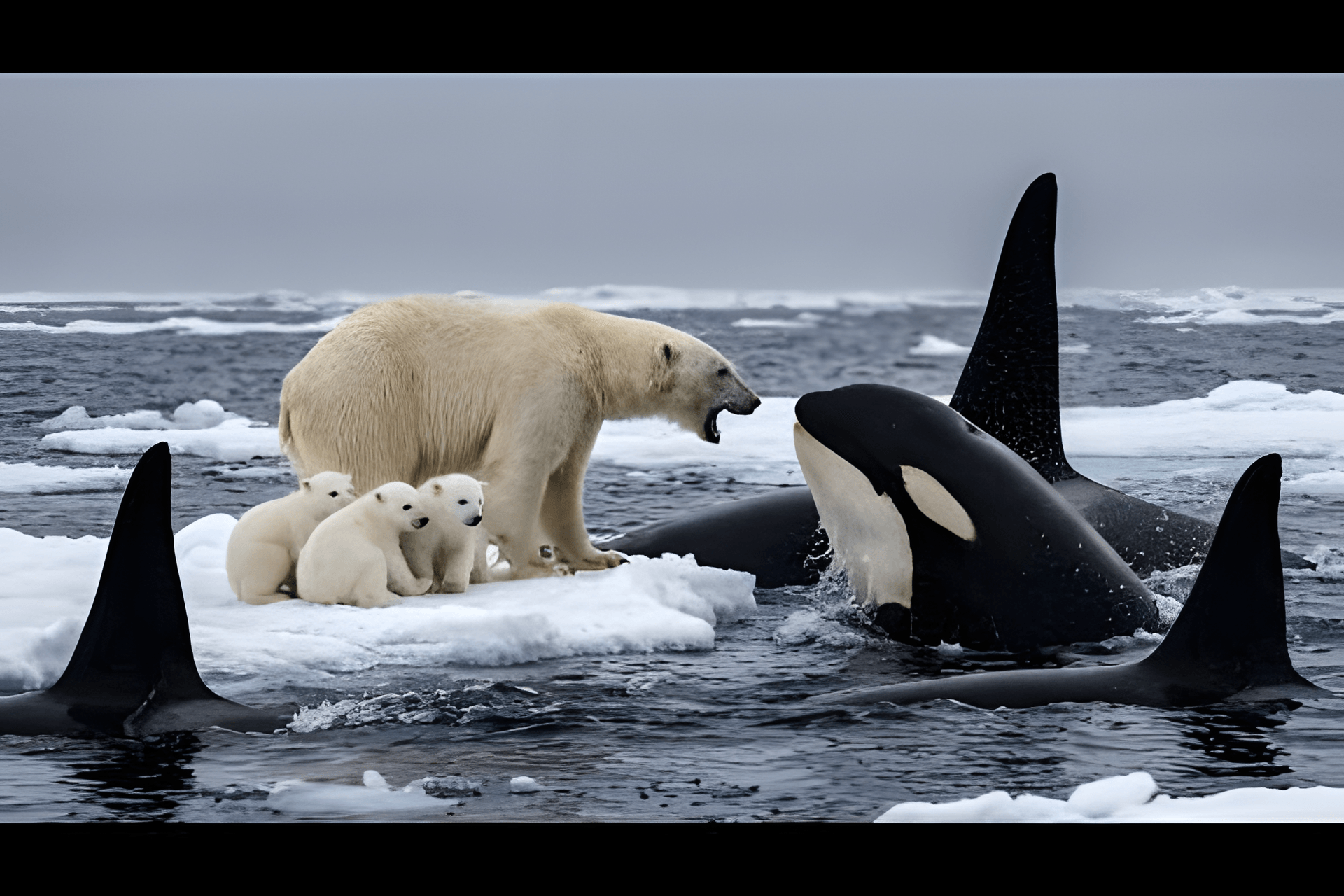
During a meeting with educators and college students on Aug. 29, Vladimir Putin spoke with Dmitry Balanchukov, a Chinese language teacher from the Belgorod Region who had won Russia’s Teacher of the Year award in 2025. Putin was interested in the teacher’s account of his trip to the North Pole, and the following exchange took place:
Putin: Was it interesting at the North Pole?
Balanchukov: Incredible.
Putin: Fascinating. Did you see any polar bears?
Balanchukov: Yes, of course. We saw two.
Putin: Two? Big ones?
Balanchukov: Huge.
Putin: Can you imagine there are orcas living nearby, and they eat these bears like small fry. They just attack in a pack and tear them apart. It’s all very interesting. That’s how the food chain works. Children need to be told about this too, so they understand what kind of world we live in and why we’re conducting the special military operation.

To call Putin’s account fascinating would be an understatement. No cases of orcas hunting polar bears have ever been documented.
As recently as July 2026, an article appeared in BBC Wildlife Magazine: “Can Any Animals Kill a Polar Bear?” by Melissa Hobson. The orca is named first among the six contenders, but as the article makes clear, the only “evidence” of such encounters has all been AI-generated:
“If any Arctic species was to try to take on a polar bear, killer whales might have a good chance of success. After all, orcas are extremely intelligent and are even known to hunt and kill blue whales.
There are different types of orcas, known as ecotypes, which have different characteristics. Bigg’s killer whales – also known as transient orcas – hunt mammals and are known to travel to the Arctic. These massive mammals can grow to more than eight metres and 6,600 kg (females reach around seven metres and 4700kg). Could they be a match for a polar bear (the very largest of which can sometimes grow to around 800kg but usually weigh between 350 and 600kg)?
Perhaps they could, but this is only speculation. There are no confirmed records of orcas hunting polar bears (although plenty of fake AI videos trying to spread this false news).
Similarly, there’s no documentation of polar bears hunting orcas. Nor is there scientific evidence of polar bears eating orca flesh – although that’s not to say that these scavengers wouldn’t tuck into the energy-dense blubber if they came across a killer whale carcass.
One reason we haven’t yet seen orcas and polar bears coming to blows could be because of their different habitats. Although both are found in the Arctic, polar bears spend most of their lives on sea ice while killer whales avoid the ice because they might get trapped.
Will climate change put the two in each other’s path more often – and who would come out the victor? That remains to be seen.”
The article’s author states that the only creature that can kill a polar bear is another polar bear — or a human.
Following Putin’s meeting with teachers, the independent Russian environmental outlet Kedr.media published an article titled “‘No one eats them’: Zoologists on Putin’s claim that orcas ‘eat polar bears like small fry.’” The resulting report cited the expert opinions of professional zoologists (all of whom chose to remain anonymous when discussing the president’s factual error). The article states:
“Contrary to the Russian president’s claims, orcas do not eat polar bears, Kedr learned upon speaking with two zoologists who specialize in marine mammals...
‘Absolutely no one preys on polar bears. They’re at the top of the food chain,’ one of the scientists told Kedr. ‘And so are orcas. The only thing they might theoretically compete over is that both polar bears and predatory orcas feed on seals.’
The zoologist notes that the two species could technically encounter each other, but the only hypothetical scenario in which an orca could eat a bear, or vice versa, is if one of the animals is already dead.
‘You could imagine an orca carcass washing up on shore and polar bears eating it. But that’s about it. Honestly, there is really nothing to comment on here, simply because there have been no cases of an orca attacking a bear,’ the zoologist says.
Scientists note that neither orcas nor polar bears have any natural predators, apart from humans.
‘The only enemy of the polar bear is humans — the human presence in the Arctic. And that really is a serious threat to the species’ survival. The same goes for orcas. People affect them by depleting their food sources — primarily fish — and through tourism. This year, once again, we’re seeing dozens of vessels chasing orcas off Kamchatka. So the human-caused threats they face really are shared,’ one of Kedr’s sources says.
Another scientist suggests that the president may have formed his impression of orcas and polar bears from AI-generated videos: ‘AI enthusiasts have churned out this kind of footage and dumped it online. They post a lot of similar nonsense — like orcas rescuing seals on their backs, or the other way around, fantastically pulling someone out of somewhere. There is similar content with other animals: lions and wolves living together as one pack, bears and other animals sleeping in the forest in an embrace. Seriously speaking, though — orcas, like all predators, prefer to attack prey they’re familiar with and know how to handle. That could be seals, walruses, or fish, depending on the group’s dietary specialization, which depends on the region where they live. But it’s not polar bears.’
Another zoologist with field experience notes on social media that orcas and polar bears use the same habitats, but there are no actual observations of them interacting. And theoretical speculation, the zoologist writes, should not be presented as fact — ‘not until there are observations in the wild.’”