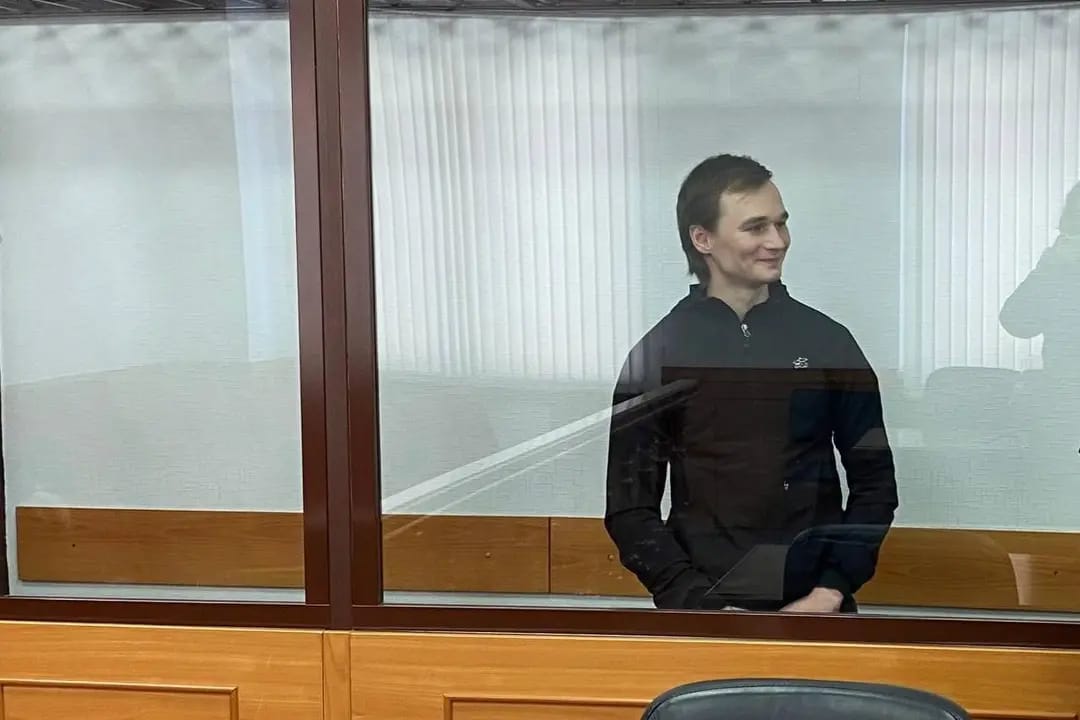
The Federal Penitentiary Service (FSIN) branch for Russia’s Yamalo-Nenets Autonomous District has told Elena Gorban, the wife and legal defense team member of jailed mathematician Azat Miftakhov, that it found no signs of poisoning in her husband — even though his defense had not once mentioned poisoning in its complaint against the institution. The Insider reviewed Gorban’s appeal and the agency’s official response.
Gorban appealed to the regional prison service on Aug. 4 after Miftakhov was not connected by video link to a hearing at the Lyubertsy City Court outside Moscow. The defense feared that officials at IK-18, a penal colony in the Arctic settlement of Kharp, may have deliberately prevented him from taking part in the process in order to conceal possible signs of new violence used against him. In her appeal, Gorban asked officials to conduct a medical examination of Miftakhov and check him for “bodily injuries, signs of the use of physical force,” and to assess his emotional and psychological state.
The appeal did not so much as mention poisoning. And yet, the response that came back from the prison service after a medical examination carried out on Aug. 28 read:
“During the examination, no bodily injuries, trauma, or poisonings were identified.”
Gorban told the Telegram channel Ekspertiza i Insaidy (“Expertise and Insights”) that neither Miftakhov nor his defense had ever complained of possible poisoning. Instead, their complaints concerned only beatings and torture with electric shocks.
“Personally, it seems to me that this was an allusion to Navalny’s death in nearby IK-3. The word immediately jumped out at me in the response. I thought I had more or less gotten used to the fact that Azat is in this place, but every reminder of those events causes fear. It is clear that the local prison service branch does not decide the fate of political prisoners in Kharp, and this could only have been a mocking allusion, if it was really written with that purpose.
The idea that ‘checks’ for poisoning have become routine since 2024 is a good one, but earlier, during the review of a torture complaint, there was no mention of checking for poisoning, even though a medical examination was conducted.”
On Sept. 3, Gorban asked Miftakhov himself during a court hearing how he had been checked for poisoning. The political prisoner could only guess that the conclusion had been based on a blood pressure measurement. He said he had not noticed anything unusual during the medical examination.
Yevgeny Smirnov, a lawyer with the human rights project Pervy Otdel (lit. “Department One”), told The Insider that he had never encountered such wording in Federal Penitentiary Service responses, and another human rights defender (who spoke to The Insider anonymously) also said they had never seen a case in which the prison service reported an absence of signs of poisoning without first receiving a corresponding request.
Miftakhov is being held at IK-18 “Polar Owl” in Kharp, in the Yamalo-Nenets Autonomous District. The same settlement is home to IK-3 “Polar Wolf,” where the late opposition leader Alexei Navalny was being held when he died as a result of poisoning on Feb. 16, 2024. Both colonies are under the authority of the Federal Penitentiary Service branch for the Yamalo-Nenets Autonomous District.
In 2024, The Insider obtained documents indicating that before his death, Navalny had complained of sharp abdominal pain and suffered vomiting and convulsions. Those details later disappeared from the final version of the Russian government’s decision explaining its refusal to open a criminal investigation into his death. In February 2026, the UK, Sweden, France, Germany, and the Netherlands reported the results of tests on Navalny’s biological samples, with multiple independent laboratories confirming the presence of epibatidine, a powerful neurotoxin. Those findings confirmed The Insider’s prior conclusion that Navalny had been poisoned in prison.
Azat Miftakhov, an anarchist and mathematician, is serving his second consecutive sentence in a politically motivated case. He was transferred to Kharp in April 2026 and subjected to severe torture by prison officials and inmates under their control. Despite appeals from Miftakhov and his defenders, no torture case has been opened. Miftakhov himself is being held in a PKT punishment unit due to his status as a “persistent violator” of prison rules.
On Sept. 3, the publication RusNews reported that Miftakhov’s confinement in the PKT had been extended. According to the outlet, the stated reason was the alleged presence of dust in his cell. Miftakhov also said that prison staff still do not always turn on body cameras when speaking with him, and that letters he sent to his wife in August, as well as a power of attorney for his other lawyers, had not reached their intended recipients.