- 1.Decisive Russian military advantage. Probability: 7%. Time horizon: 12–24 months
- 2.“Western exhaustion” — peace on Russia’s terms. Probability: 12%. Time horizon: 12–18 months
- 3.“Trump deal” — frozen conflict with partial sanctions relief. Probability: 32%. Time horizon: 6–12 months
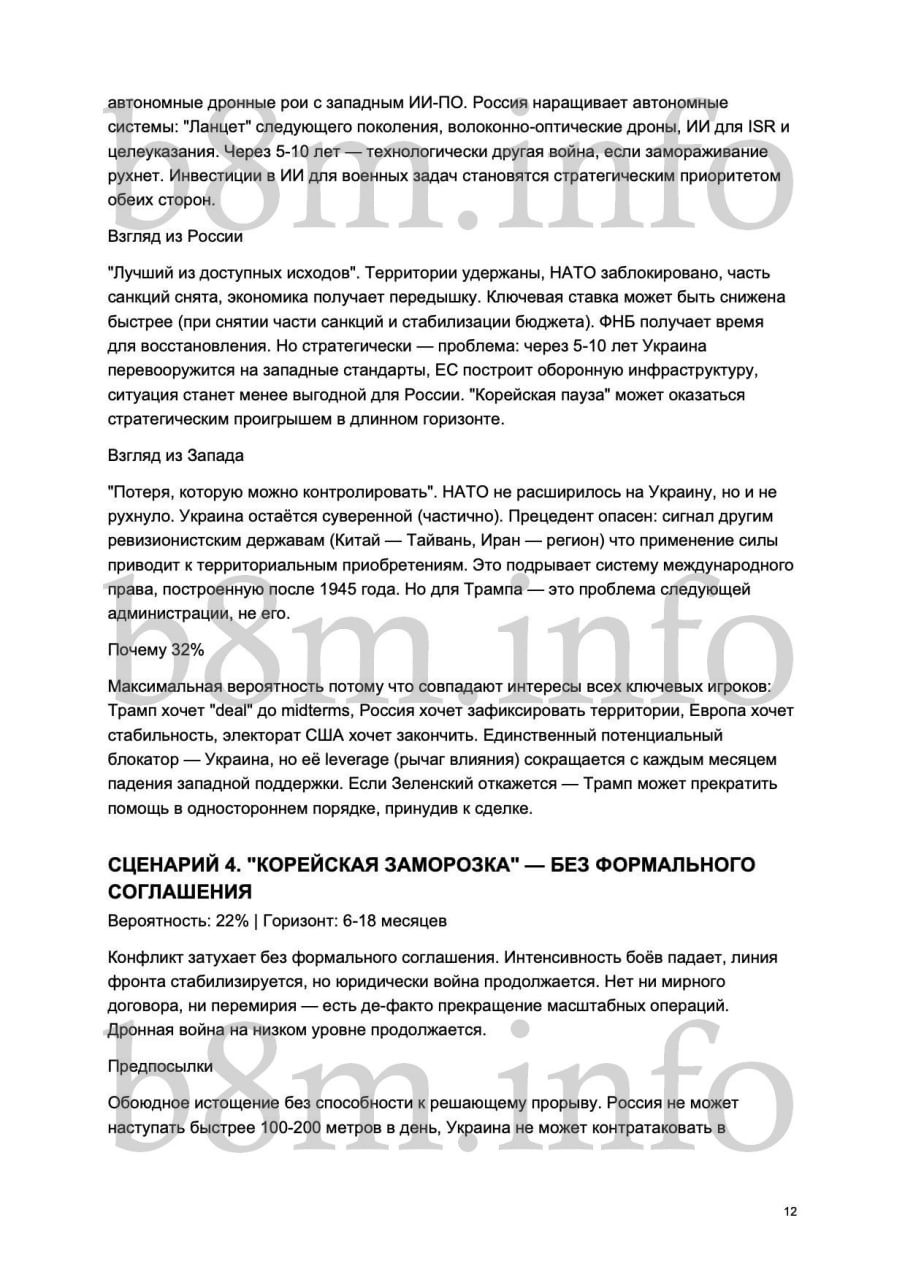
- 4.“Korean freeze” — an end to the fighting, but with no formal agreement. Probability: 22%. Time horizon: 6–18 months
- 5.Protracted war (another 2–3 years). Probability: 15%. Time horizon: 24–36 months
- 6.Peace on compromise terms. Probability: 5%. Time horizon: 12–24 months
- 7.Peace on Ukraine’s/Europe’s terms. Probability: 2%. Time horizon: 24–36+ months
- 8.“Wild card” — black swans. Probability: 5% (combined for all sub-scenarios). Time horizon: unpredictable
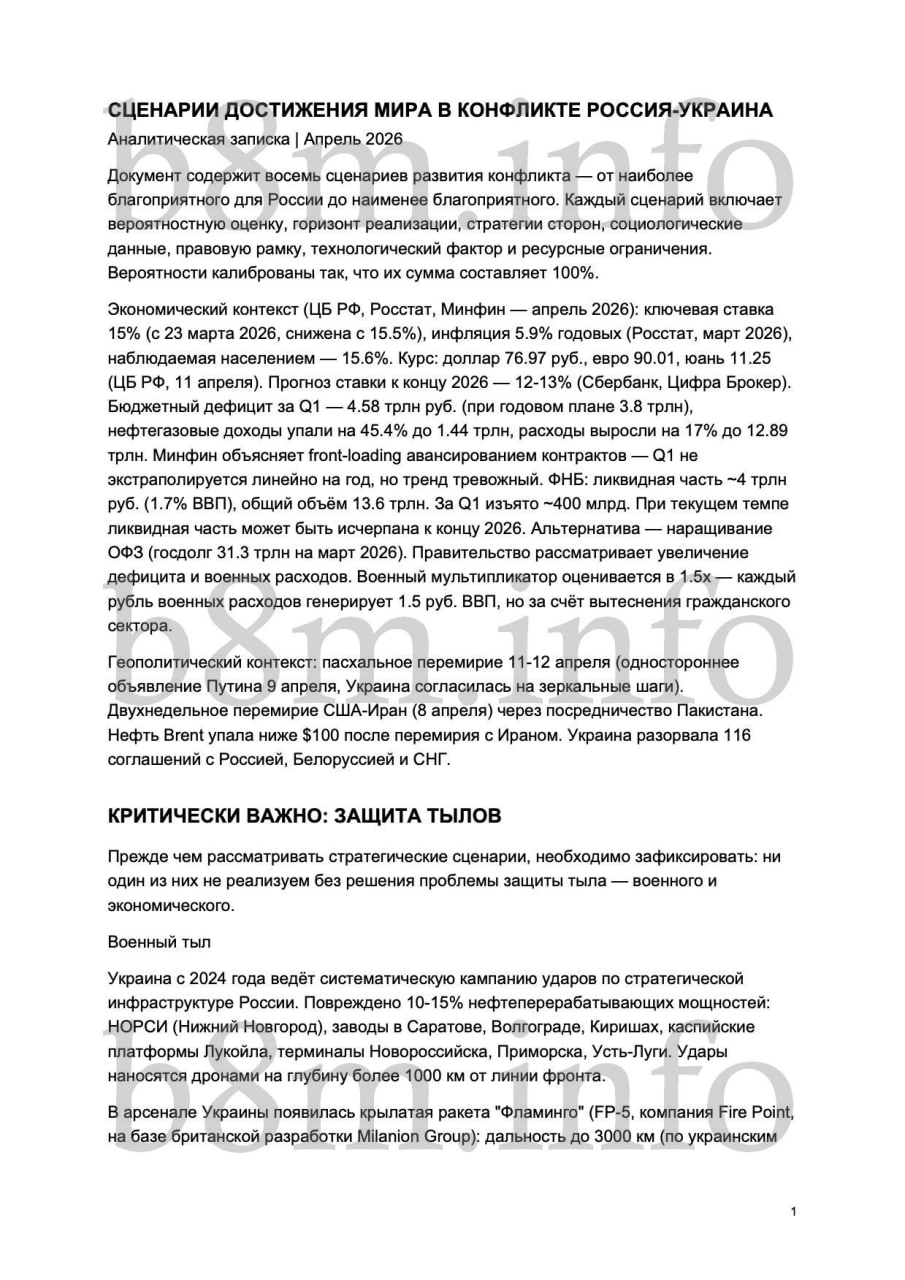
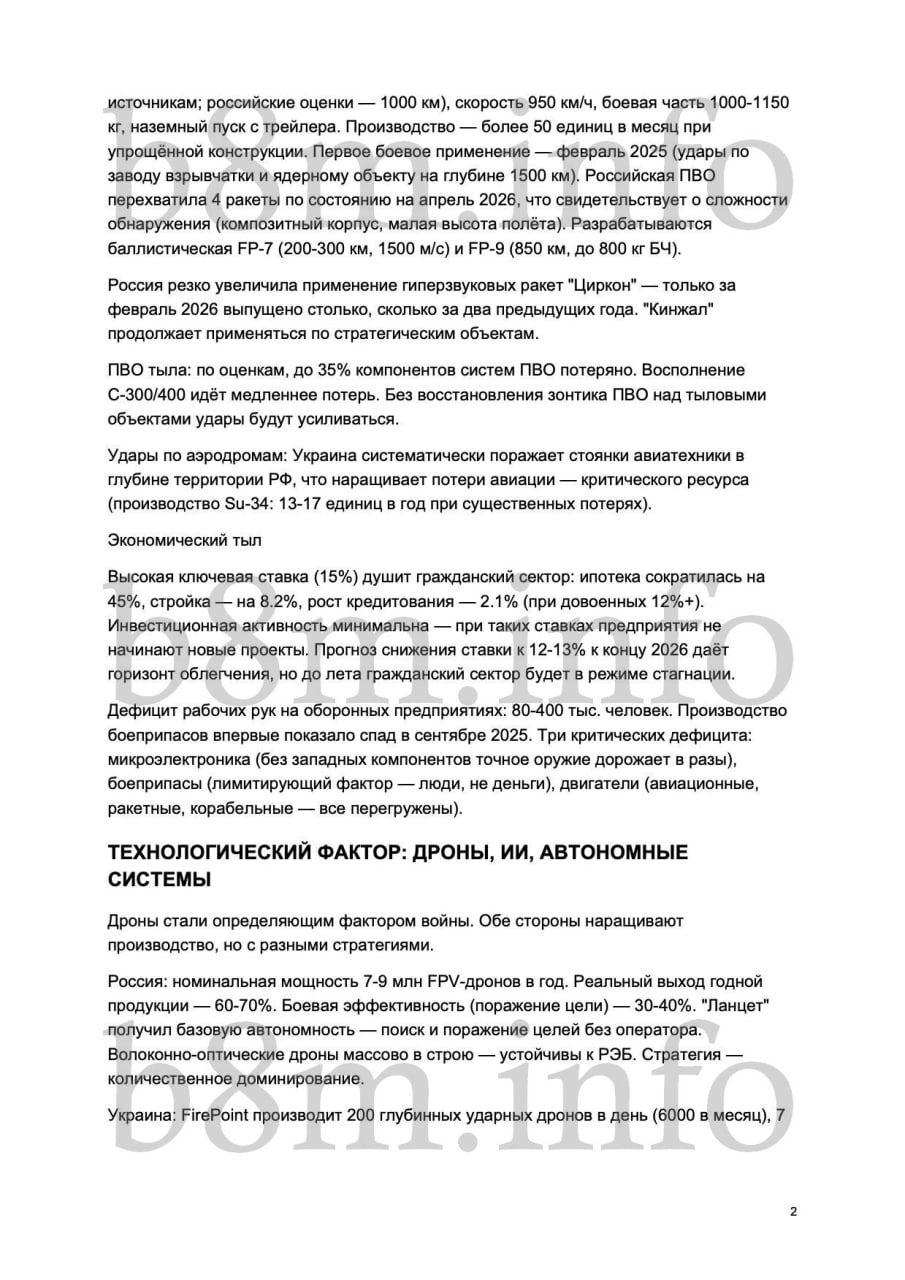
The Black Mirror hacker group has published (1, 2, 3) a Sberbank analytical memo outlining various hypothetical scenarios for and end to the war in Ukraine. The document, titled “Scenarios for Achieving Peace in the Russia-Ukraine Conflict,” is dated April 2026, and it contains data on the relative likelihood of all potential outcomes. Black Mirror claims that Sberbank CEO German Gref sent the memo to an unnamed interlocutor who is also "among the top 50 most influential in Russia."
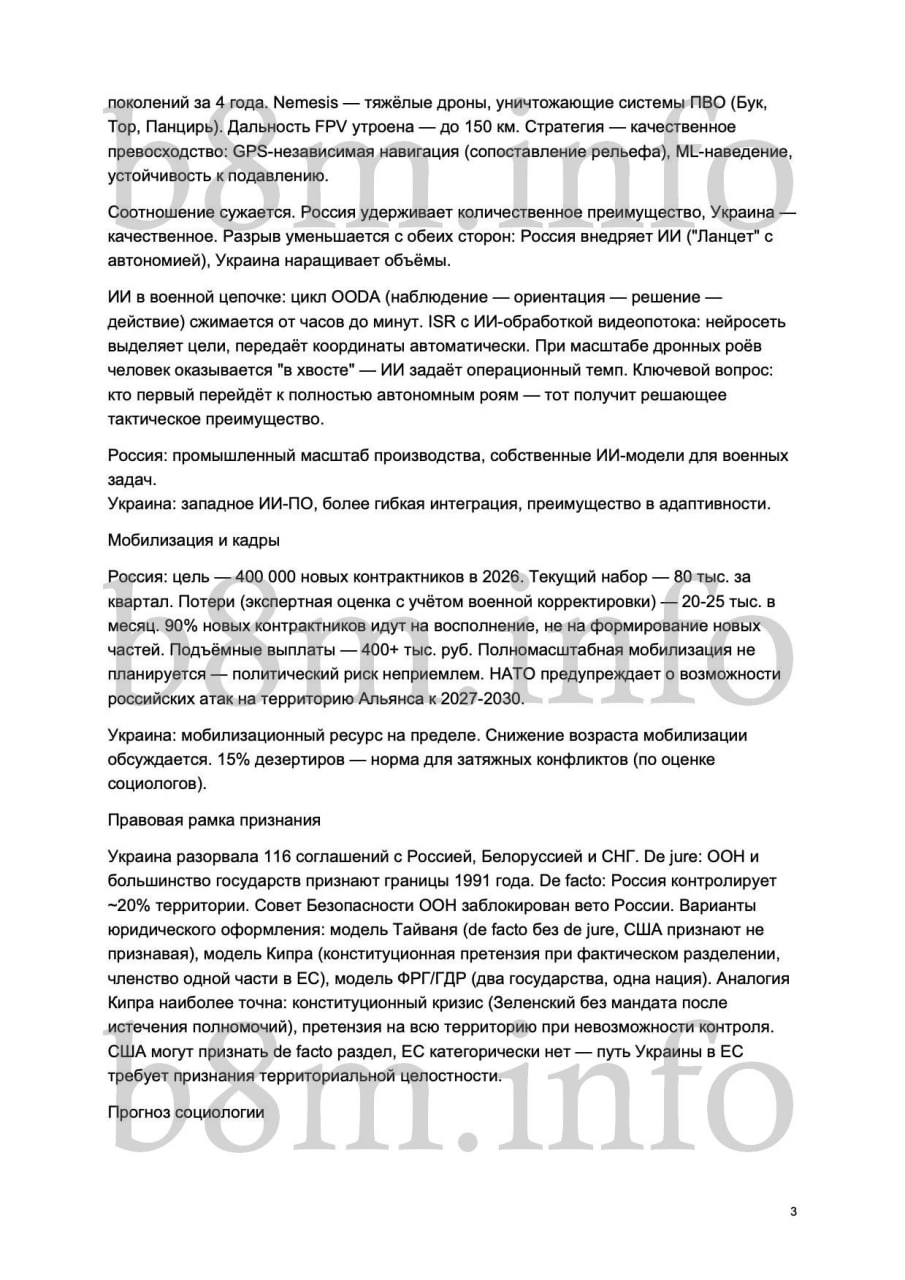
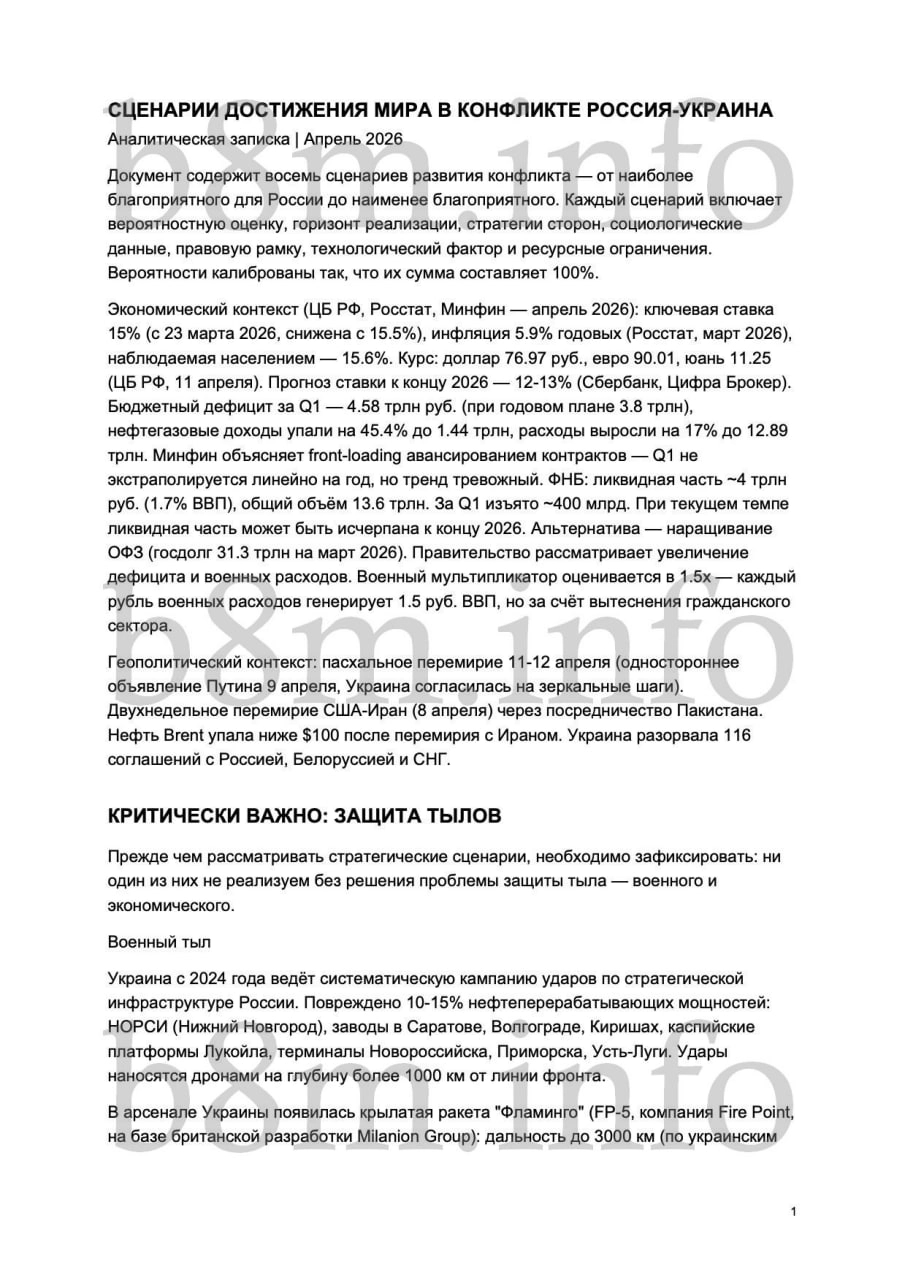
The memo’s introduction lists the economic difficulties Russia has faced amid the war, with all figures current as of April: a budget deficit of 4.58 trillion rubles in the first quarter (against an annual target of 3.8 trillion rubles), a high key interest rate of 15% (which is “choking the civilian sector”), a 45.4% decline in oil and gas revenues (down to 1.44 trillion rubles), and the disruption caused by Ukrainian drone strikes on oil refineries (taking 10–15% of refining capacity offline).
“The government is considering increasing the deficit and military spending. The military multiplier is estimated at 1.5x — every ruble of military spending generates 1.5 rubles of GDP, but at the expense of crowding out the civilian sector.”
The document also says that Russia has lost “up to 35% of the components of air defense systems,” while the replacement of S-300/400 systems is proceeding more slowly than the losses. “Without restoring the air defense umbrella over rear facilities, strikes will intensify,” the memo says. It also lays out a range of other problems areas:
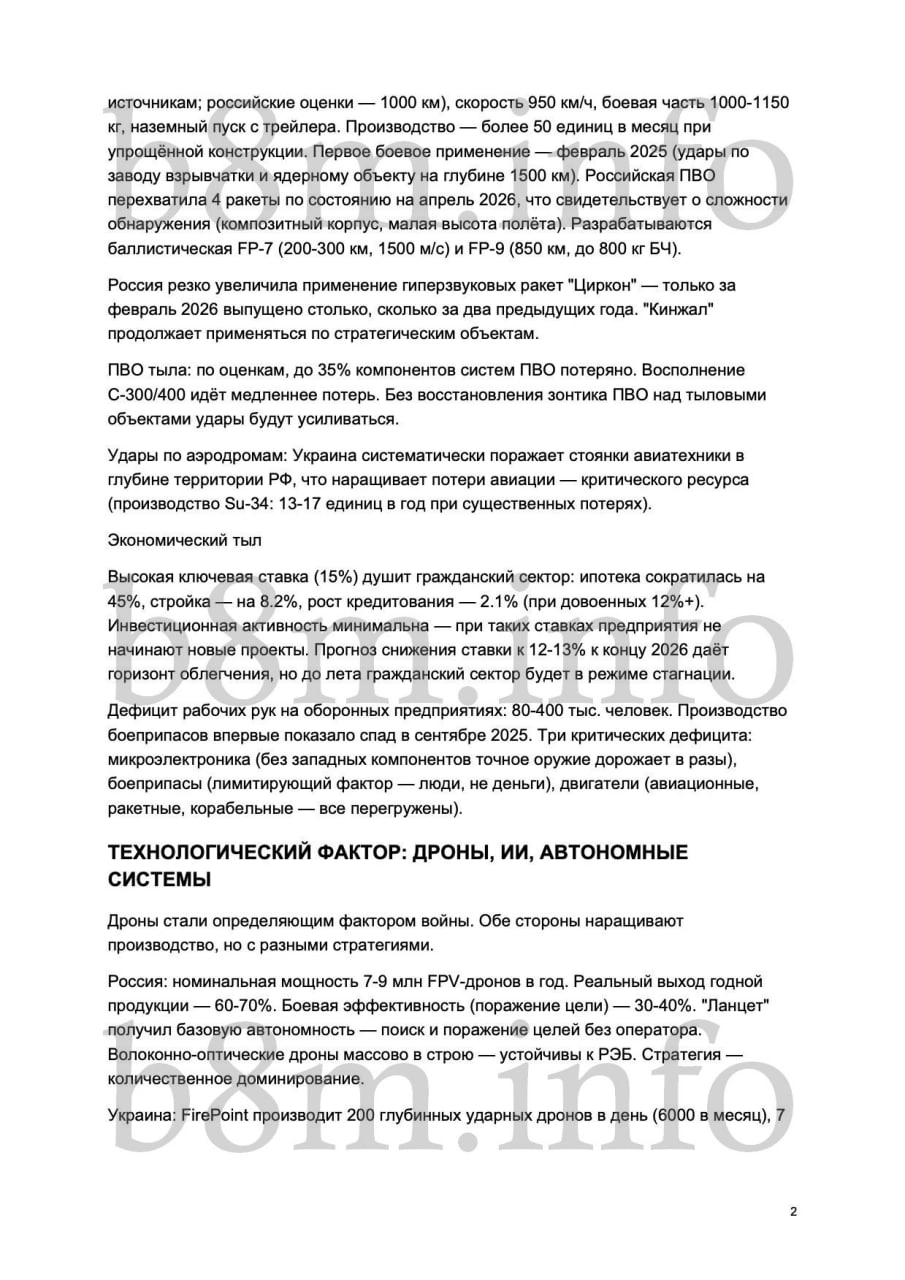
“Labor shortages at defense enterprises: 80,000–400,000 people. Ammunition production showed a decline for the first time in September 2025. Three critical shortages: microelectronics (without Western components, precision weapons become several times more expensive), ammunition (the limiting factor is people, not money), and engines (aircraft, missile and naval engines are all overloaded).”
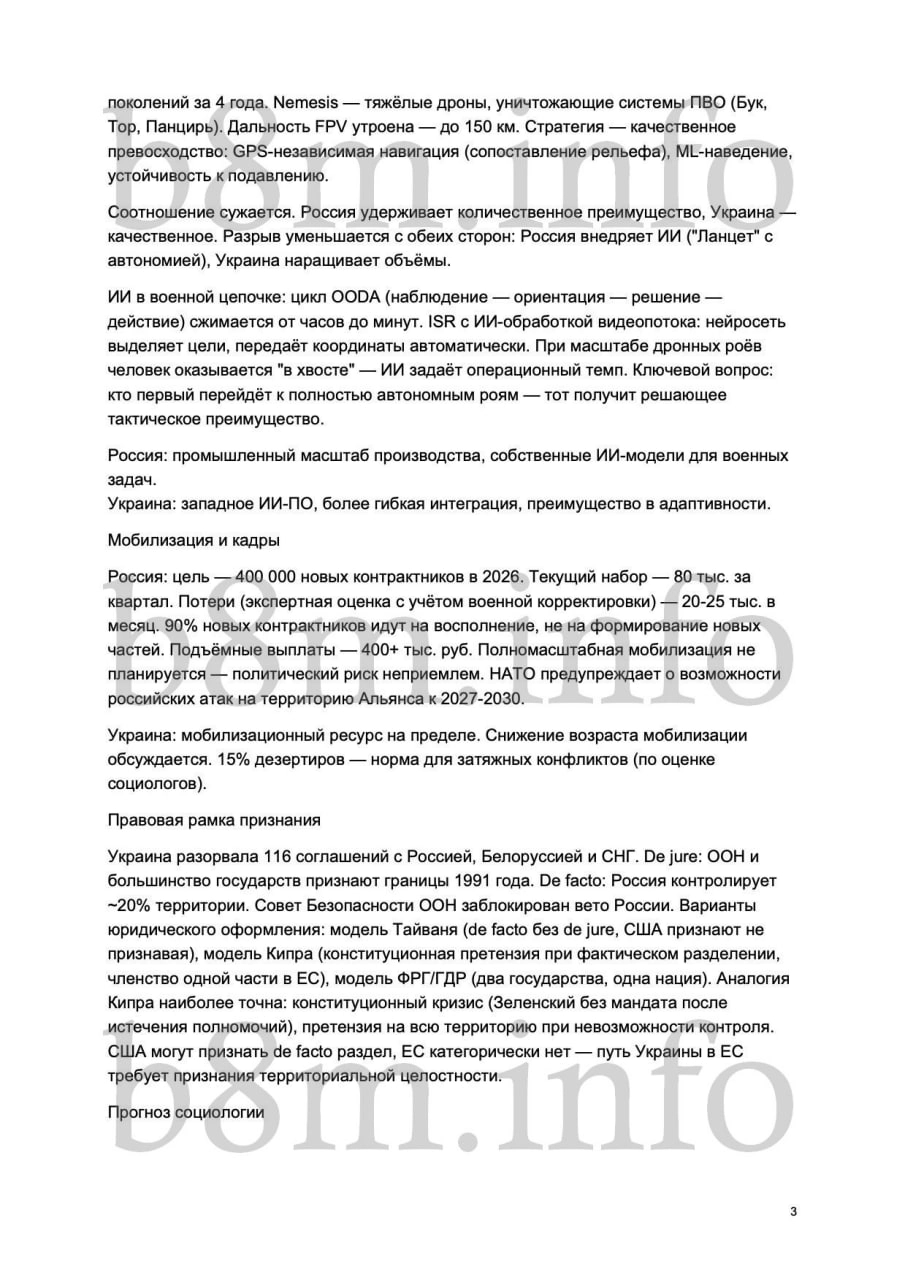
The document estimates Russia’s military losses at 20,000–25,000 people per month. “90% of new contract soldiers are used to replenish losses, not to form new units,” the memo says. However, it notes that a full-scale mobilization is not currently planned due to the fact that "the political risk is unacceptable.”
Eight scenarios for ending the war
Decisive Russian military advantage. Probability: 7%. Time horizon: 12–24 months
What this entails:
Full Russian control over Ukraine's Kharkiv region, in addition to the four “new regions” (the “Donetsk People’s Republic,” the“Luhansk People’s Republic,” and Ukraine's Zaporizhzhia and Kherson regions within their administrative borders) that Russia claimed to have annexed in 2022. Under this scenairo, Kyiv would be forced into negotiations due to Moscow's position of absolute military dominance on the battlefield. Without capturing the Ukrainian capital, Russia would nevertheless create conditions in which continued resistance no longer makes military sense.
What would be required to achieve this outcome:
- A second wave of mobilization — at least 300,000–500,000 people. Without it, the manpower needed for a large-scale offensive is unattainable.
- A several-fold increase in Russia's capacity to wage the war from the air, with the production of UMPK glide-bomb kits and glide bombs representing the current bottleneck.
- Solving the problem of rear-area air defense — without it, Ukrainian strikes on Russian oil refineries and airfields will continue.
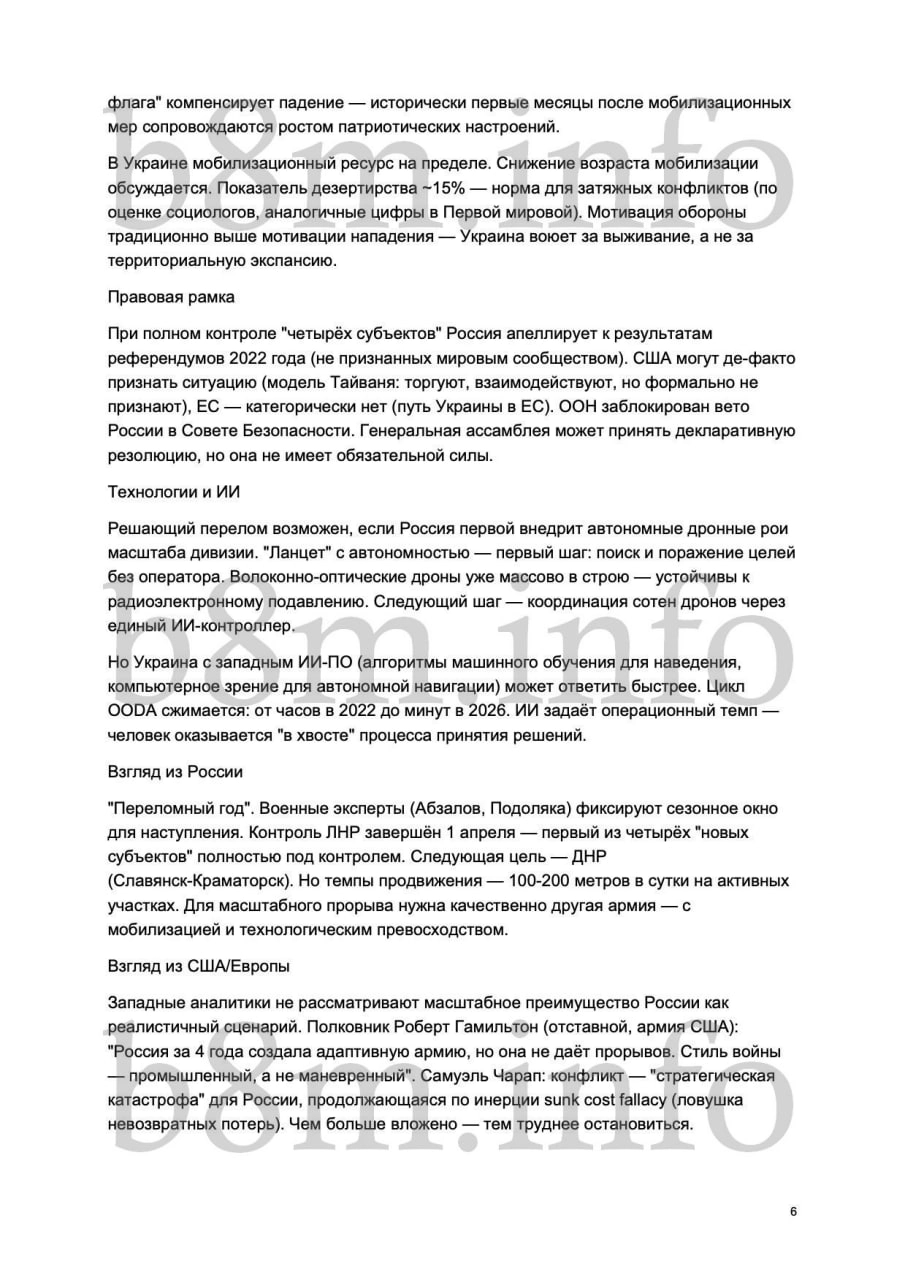
- A breakthrough in autonomous drone swarms — the first side to deploy fully autonomous swarms on a divisional scale (thousands of units coordinated by AI, without operators) would gain a decisive tactical advantage.
Conclusion: Russia needs a large-scale offensive, while Ukraine’s goal is to make the cost of such an offensive unacceptable for Russia.
“The motivation to defend is traditionally stronger than the motivation to attack — Ukraine is fighting for survival, not territorial expansion.”
“Western exhaustion” — peace on Russia’s terms. Probability: 12%. Time horizon: 12–18 months
What this entails:
Ukraine loses a critical mass of Western support, and its allies stop financing Kyiv's defensive efforts. This would not be a military defeat, but a political one. Russia would retain the territories it currently occupies, secure the lifting of some sanctions, and obtain guarantees that Ukraine will not join NATO.
What is required:
Three factors would need to converge: support for Ukraine in the United States falling below 30%, an energy crisis in Europe during the winter of 2026–2027, and a domestic political crisis in Ukraine.
“Time is Russia’s trump card: every month of waiting means less Western support, less Ukrainian mobilization, and less European unity.”
“Trump deal” — frozen conflict with partial sanctions relief. Probability: 32%. Time horizon: 6–12 months
What this entails:
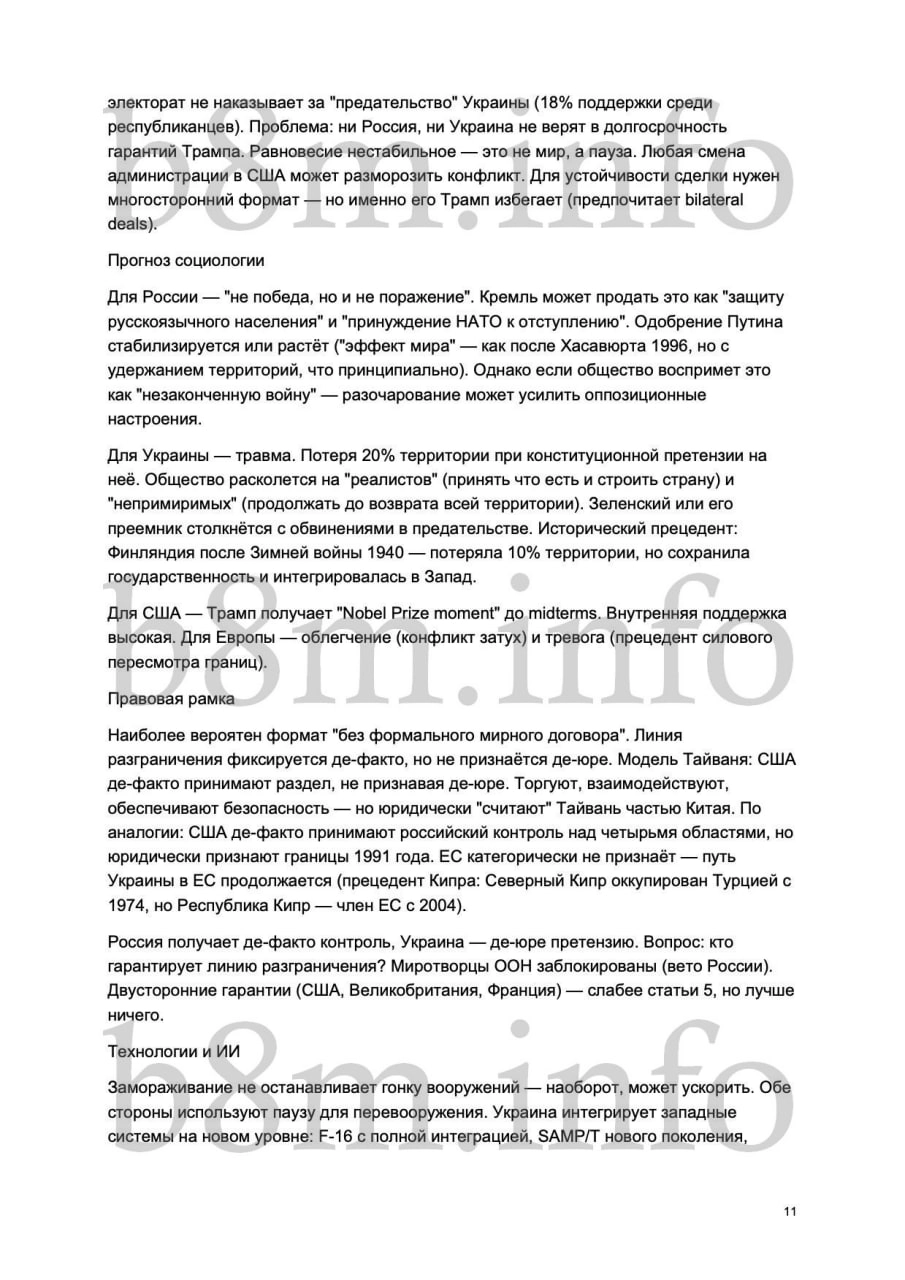
Donald Trump pushes through a deal ahead of the U.S. midterm elections (November 2026) by using U.S. aid to Ukraine as leverage against both sides. The conflict is frozen along the current lines, some sanctions are lifted, and NATO remains closed to Ukraine.
“Trump called the 10-point Iranian peace plan ‘workable.’ The model has been confirmed: ultimatum + deadline + mediator = deal. After Iran, Ukraine is the next target.”
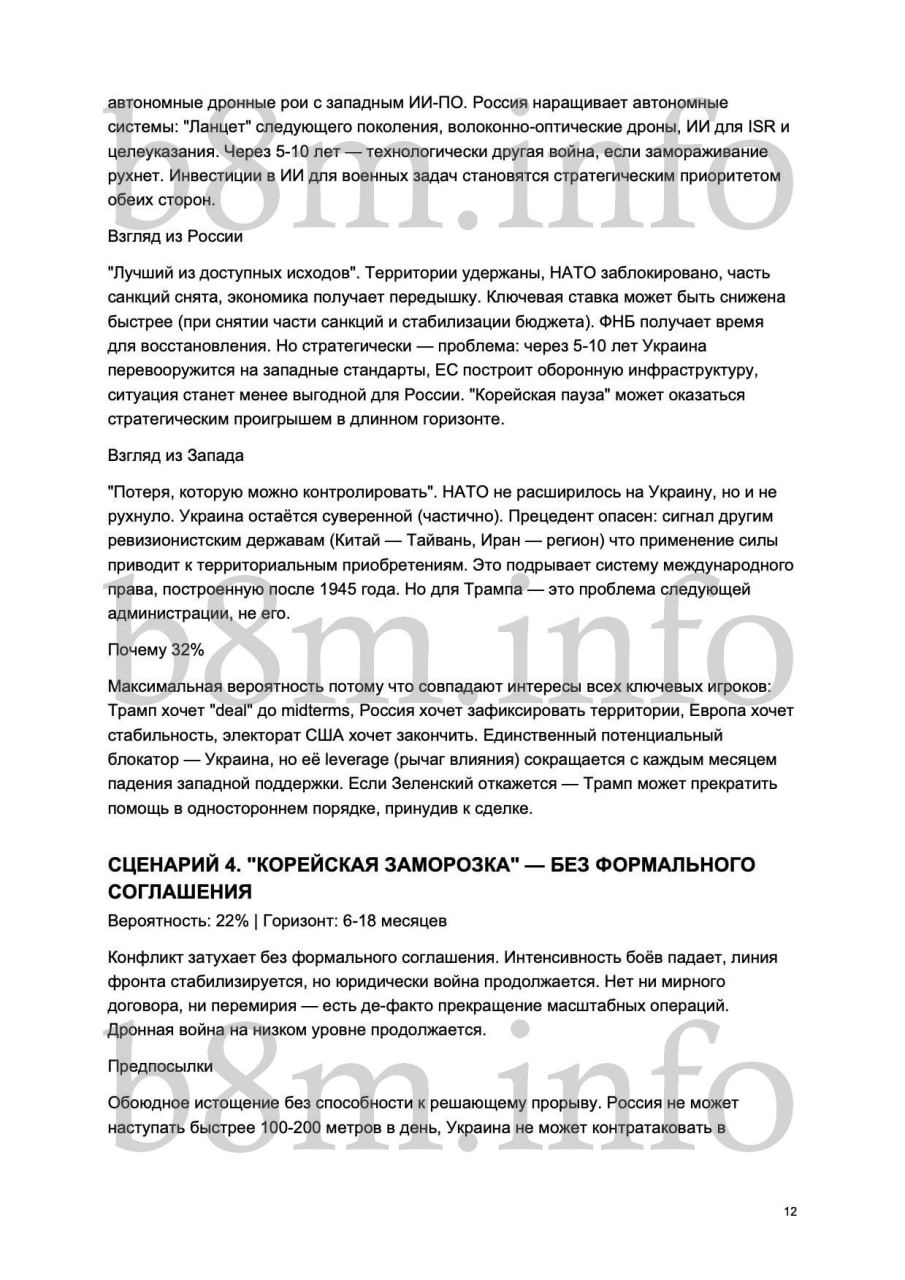
“Korean freeze” — an end to the fighting, but with no formal agreement. Probability: 22%. Time horizon: 6–18 months
What this entails:
The conflict winds down without a formal agreement. The intensity of fighting decreases and the front line stabilizes, but legally the war continues. There is neither a peace treaty nor a ceasefire — only a de facto halt to large-scale military operations. Low-level drone warfare continues.
What is required:
Mutual exhaustion without either side having the capacity to achieve a decisive breakthrough.
Protracted war (another 2–3 years). Probability: 15%. Time horizon: 24–36 months
What this entails:
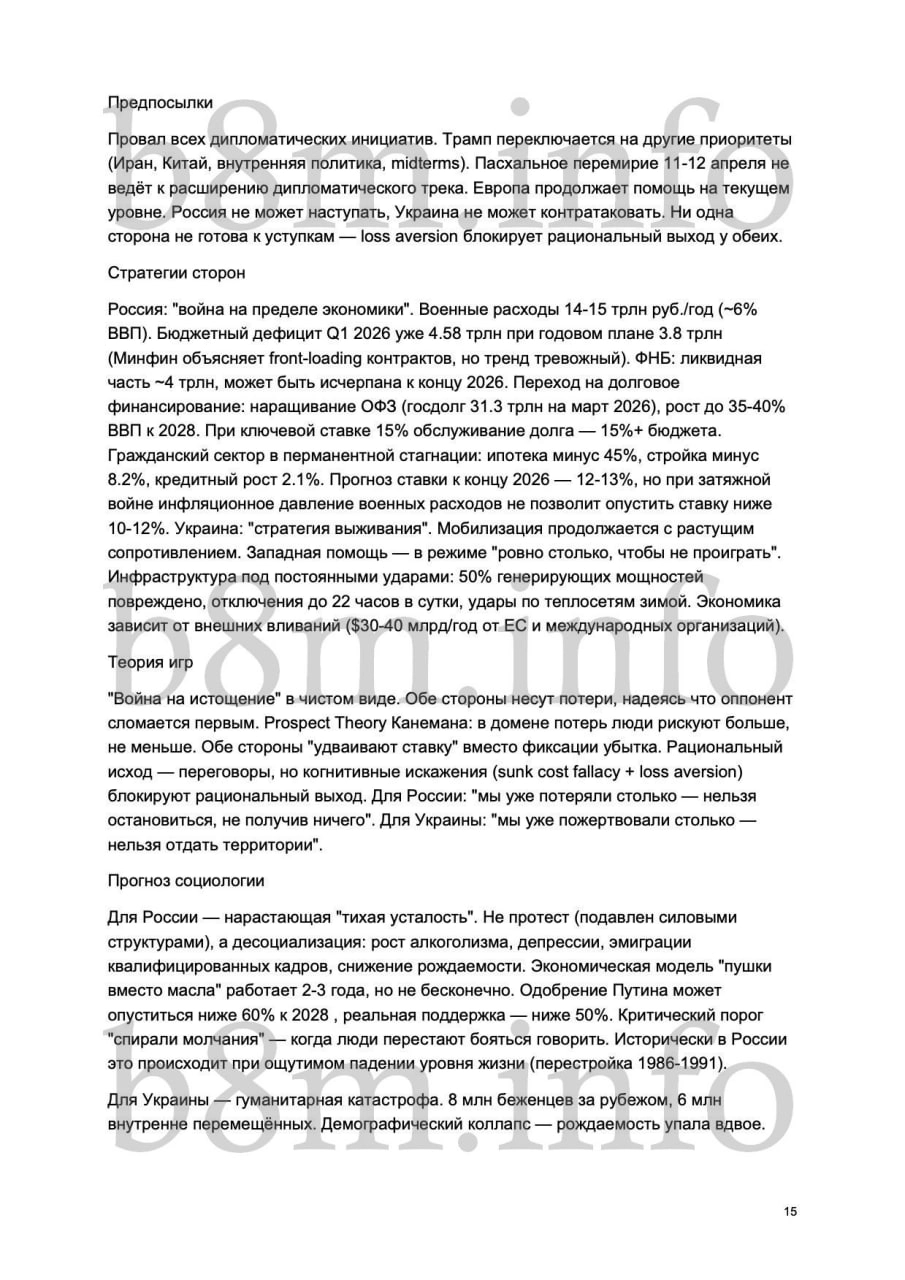
The conflict continues at something resembling its current level of intensity. There is neither a freeze nor a breakthrough. Russian monthly losses remain at 20,000–25,000, and creeping advances of 100–200 meters per day continue, along with long-range strikes against infrastructure on both sides. The strategy is one of attrition.
“If diplomacy fails, the war continues by inertia. Both sides have invested too much in the conflict to stop absent an external push.”
The memo offers the following sociological forecast for this scenario:
“For Russia — growing ‘quiet fatigue.’ Not protest (suppressed by the security services), but social disengagement: rising alcoholism, depression, emigration of skilled workers, and declining birth rates. The economic model of ‘guns instead of butter’ works for 2–3 years, but not indefinitely. Putin’s approval rating could fall below 60% by 2028, with actual support dropping below 50%. The critical threshold of the ‘spiral of silence’ is reached when people stop being afraid to speak out. Historically, this happens in Russia when living standards fall noticeably (perestroika, 1986–1991).
For Ukraine, it means a humanitarian catastrophe — eight million refugees abroad, six million internally displaced, a demographic collapse resulting from falling birthrates, and the loss of an entire generation of men aged 25–45 (mobilization + emigration + casualties).”
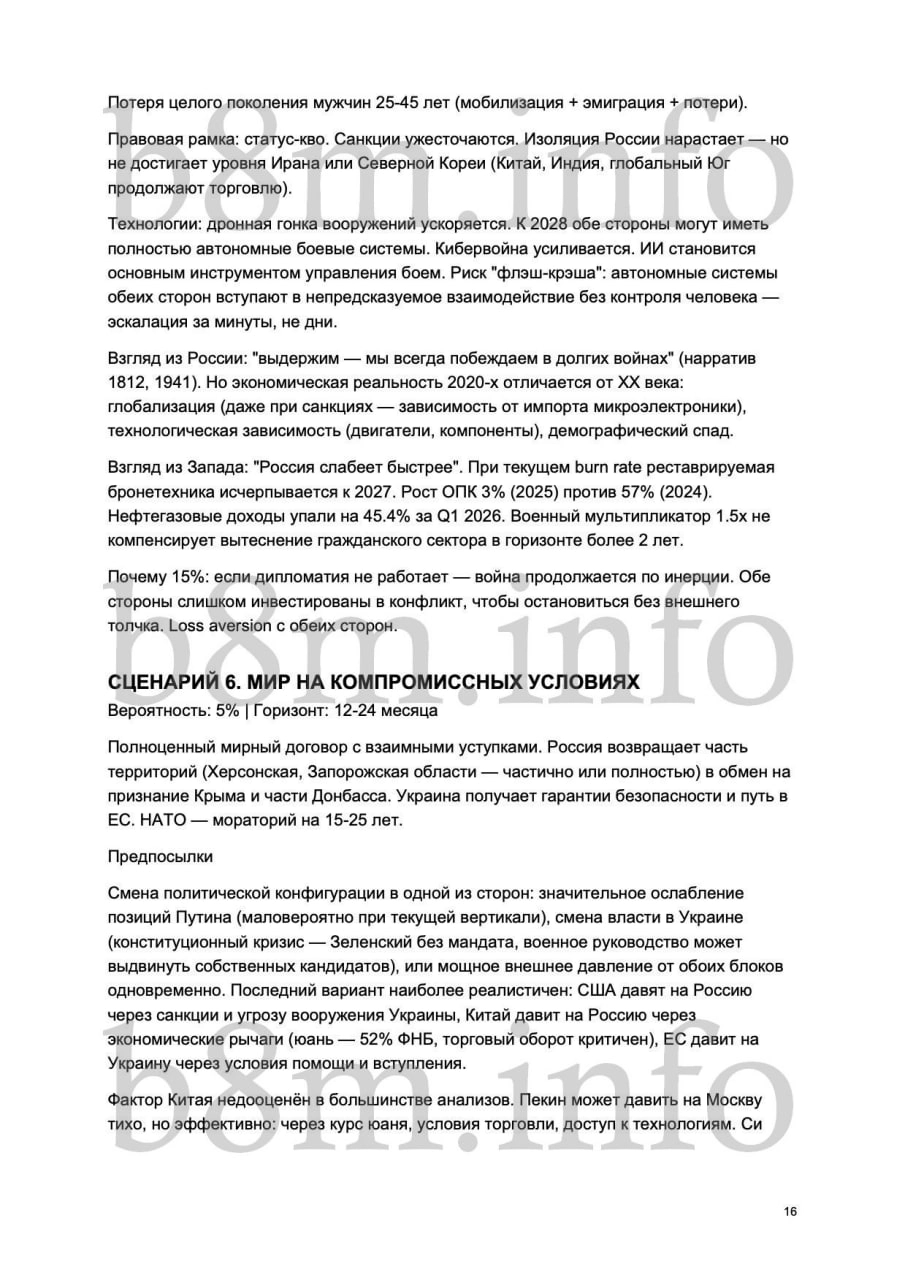
Peace on compromise terms. Probability: 5%. Time horizon: 12–24 months
What this entails:
A comprehensive peace treaty involving mutual concessions. Russia returns some territory (parts or all of the Kherson and Zaporizhzhia regions) in exchange for recognition of Crimea and parts of Donbas. Ukraine receives security guarantees and a path to EU membership. NATO membership is subject to a 15–25-year moratorium.
What is required:
A change in the political configuration on one side, such as a significant weakening of Putin’s position (unlikely under the current power structure), a change of government in Ukraine (possibly via a constitutional crisis), or strong external pressure against both sides simultaneously. If the United States pressures Russia through sanctions and the threat of arming Ukraine, China pressures Russia through economic leverage, and the EU pressures Ukraine through the conditions attached to aid and future membership, such a scenario at least becomes possible.
Peace on Ukraine’s/Europe’s terms. Probability: 2%. Time horizon: 24–36+ months
What this entails:
Russia is forced to withdraw to its 2014 or 1991 borders. Crimea becomes a subject of negotiations or is returned to Ukraine. Ukraine joins NATO. Russia pays reparations. An arms-control regime is established.
What is required:
An economic collapse in Russia (GDP contracting by 15% or more, hyperinflation, and a default on domestic debt), a catastrophic military defeat, or a change of regime that brings “negotiators” to power. All three scenarios are extremely unlikely.
“Wild card” — black swans. Probability: 5% (combined for all sub-scenarios). Time horizon: unpredictable
What this entails:
Unlikely but high-impact events capable of radically altering the trajectory of the conflict. None of these sub-scenarios can be predicted using standard analytical methods, as they lie beyond the “probability cone.” However, their consequences could be significantly more extreme than those of all the other scenarios combined.
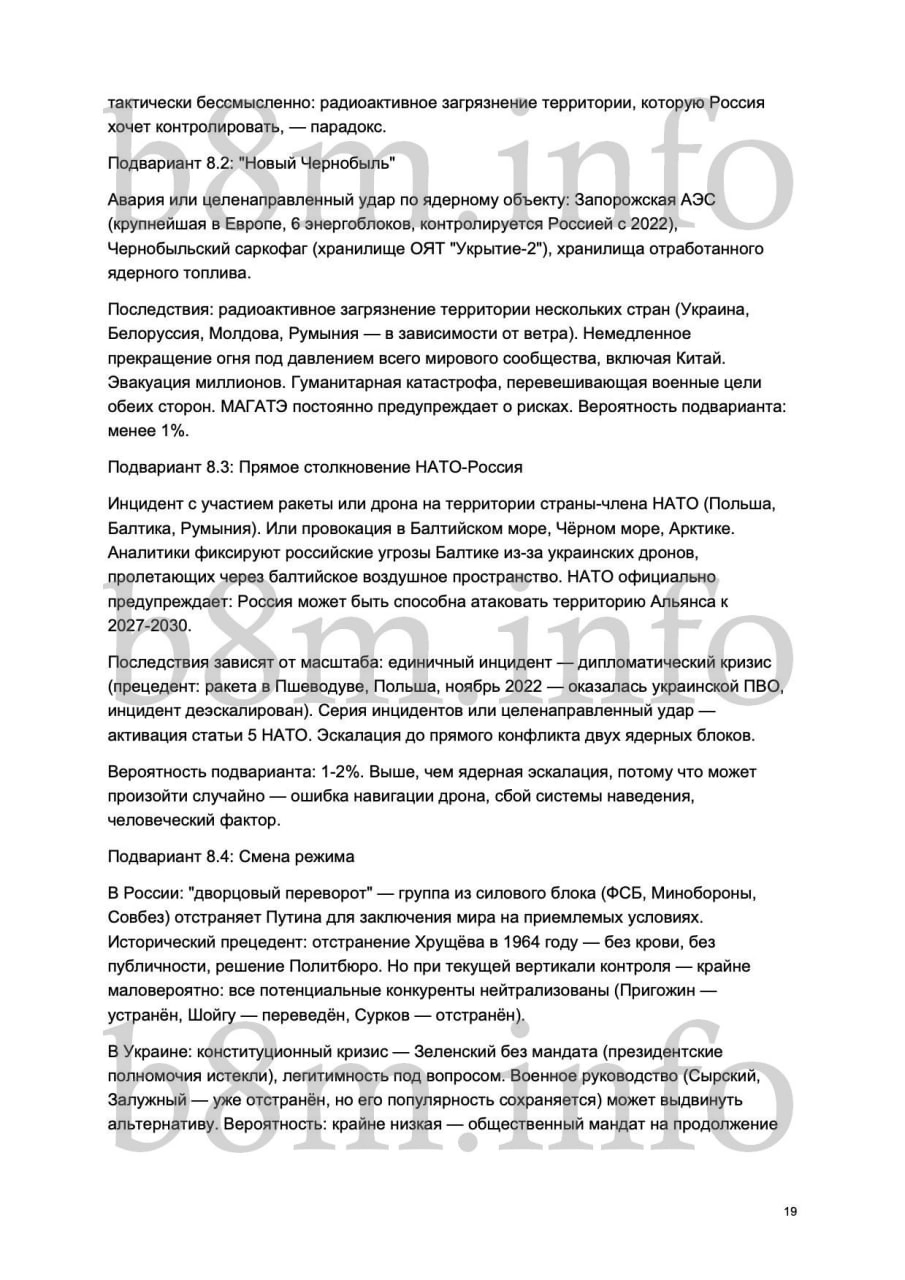
- Nuclear escalation. Russia uses tactical nuclear weapons in a demonstrative strike on an unpopulated area or Ukrainian military facility. The logic: a limited nuclear strike would convince the West that continued support for Ukraine risks an apocalypse, thereby forcing its opponents to back down. The consequences would be immediate and would likely lead to Russia's total isolation diplomatically.
- “A new Chernobyl.” An accident or deliberate strike on a nuclear facility — the Zaporizhzhia Nuclear Power Plant, the Chernobyl sarcophagus, or spent nuclear fuel storage facilities located in Ukraine. The consequences would include radioactive contamination spreading across several countries, an immediate ceasefire under pressure from the entire international community (including China), and a humanitarian catastrophe involving the evacuation of millions of people.
- Regime change. In Russia, a “palace coup” in which a group from the security establishment (FSB, Defense Ministry, Security Council) removes Putin in order to conclude a peace deal on acceptable terms. In Ukraine, a constitutional crisis putting Zelensky's legitimacy into question, possibly resulting in the military leadership putting forward an alternative candidate to head the country.
- Iran cascade. The U.S.-Iran ceasefire (April 8) collapses and talks in Pakistan fail. Israel continues its strikes on Lebanon and Iran. Iran closes the Strait of Hormuz. Brent crude rises above $200, triggering a global recession and sharply increasing Russia’s oil revenues at the same time the West faces an energy crisis and industrial recession. With Western attention and resources redirected towards the Middle East, Ukraine would lose its place of priority on the Western agenda.
- Technological surprise. A breakthrough in AI-controlled drone swarms creates an absolute tactical advantage for one side or the other. Alternatively, a cyberattack on critical infrastructure (the power grid, banking system, or military command) could cripple one side’s ability to wage war. Other possibilities include a fundamentally new AI architecture (not based on transformers), quantum computing capable of breaking military encryption, or directed-energy weapons (laser air-defense systems capable of intercepting drones at $0.01 per shot instead of $100,000 per missile).
Conclusions
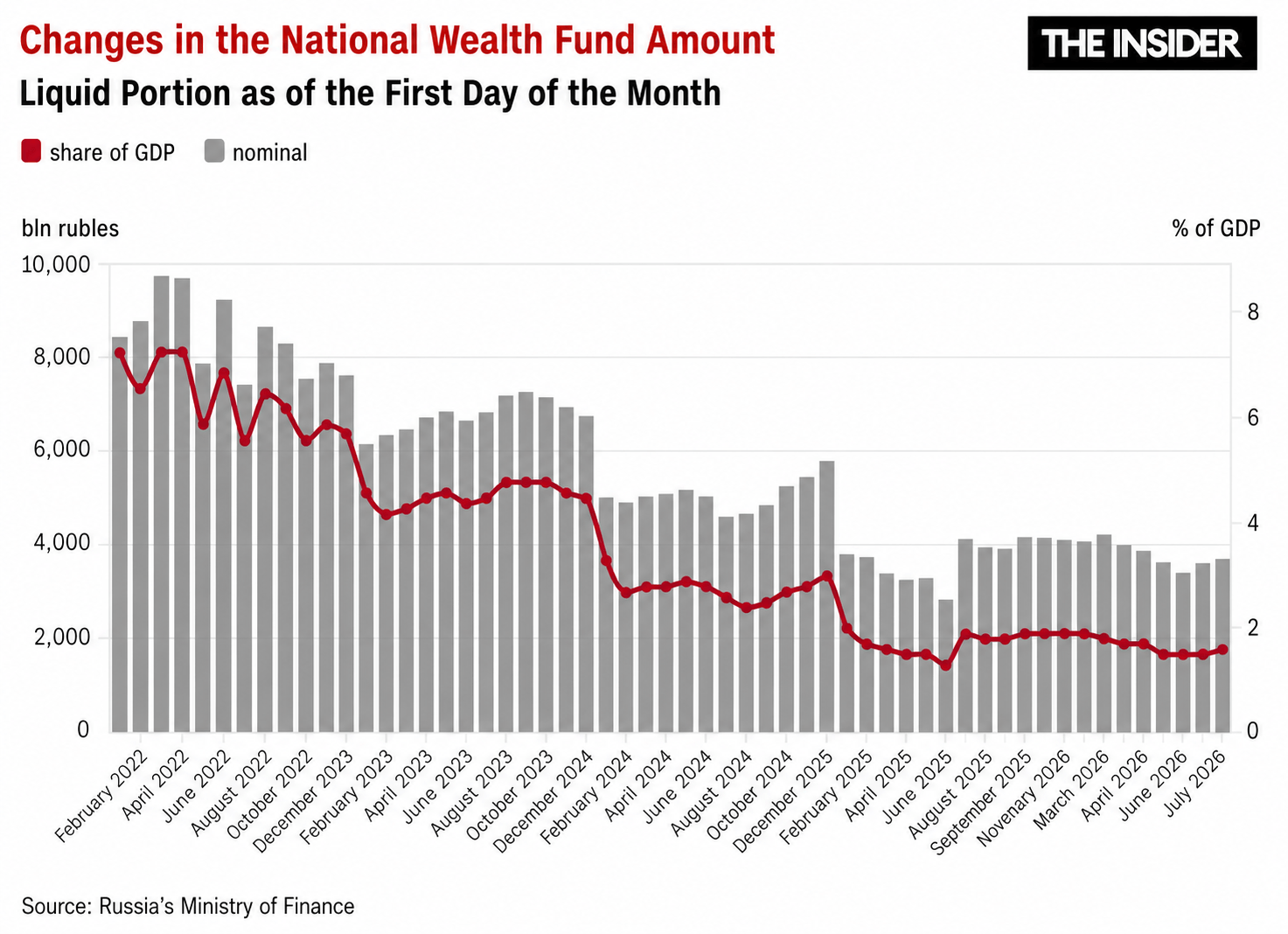
Moscow's window of maximum negotiating leverage will be open until the fall of 2026. After that, the balance is expected to shift as the liquid portion of Russia's National Wealth Fund (~4 trillion rubles) continues to be depleted by withdrawls of around 400 billion rubles per quarter, Europe’s rearmament is gathering pace ($50–60 billion by 2027), and Trump is turning his attention to the midterm elections and may lose interest in a “deal.”
The optimal strategy from the Russian perspective would be to secure the maximum achievable outcome through diplomacy while maintaining military pressure. Both efforts should be pursued simultaneously.
The most likely outcome is not “victory,” but “the best available option.” Scenarios 3 and 4 (“Trump deal” + “Korean freeze”) account for a combined 54% — more than half of the probability space. Preparing for negotiations is no less important than maintaining military pressure. The diplomatic and military tracks should operate in parallel, not sequentially.