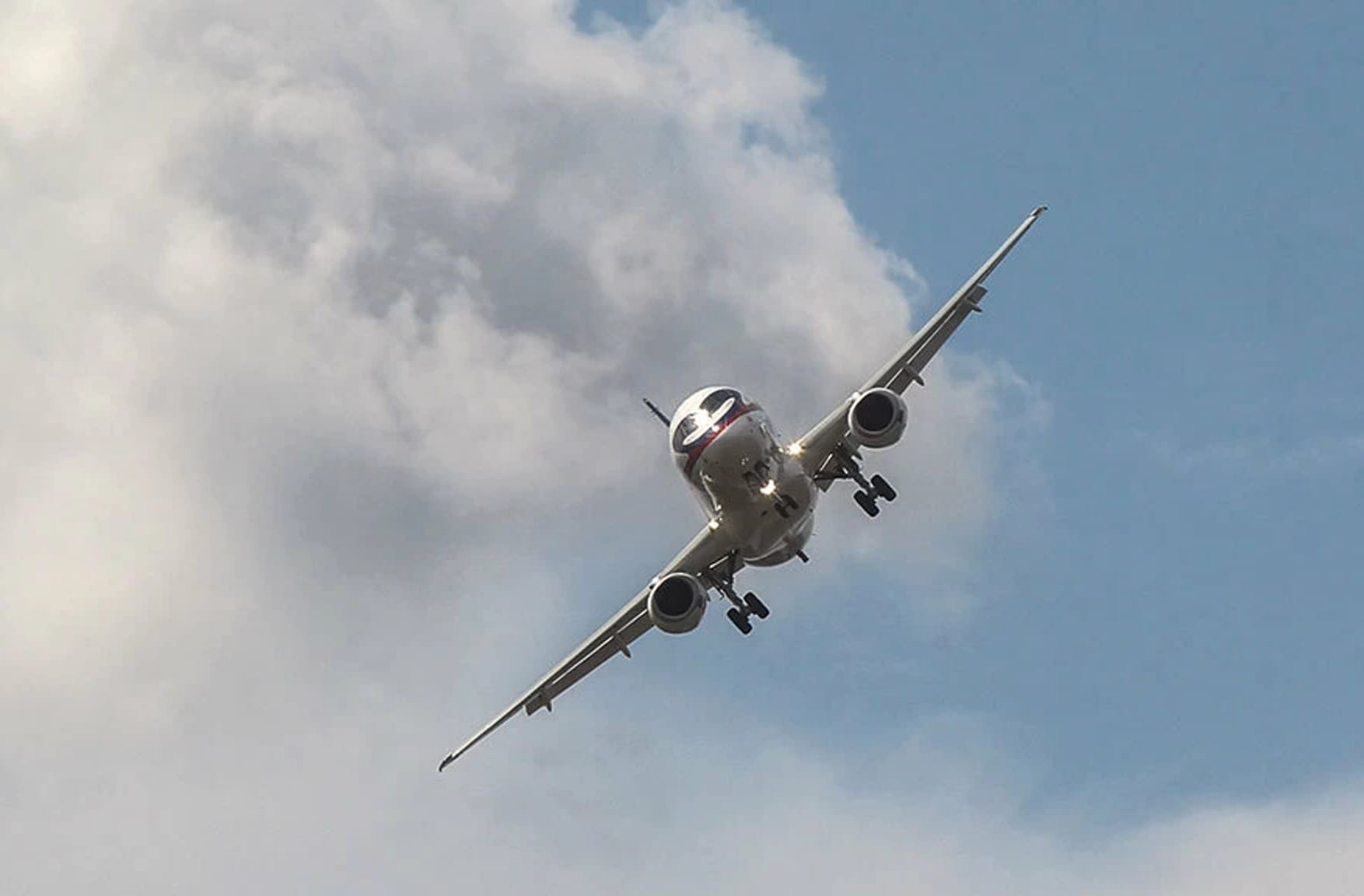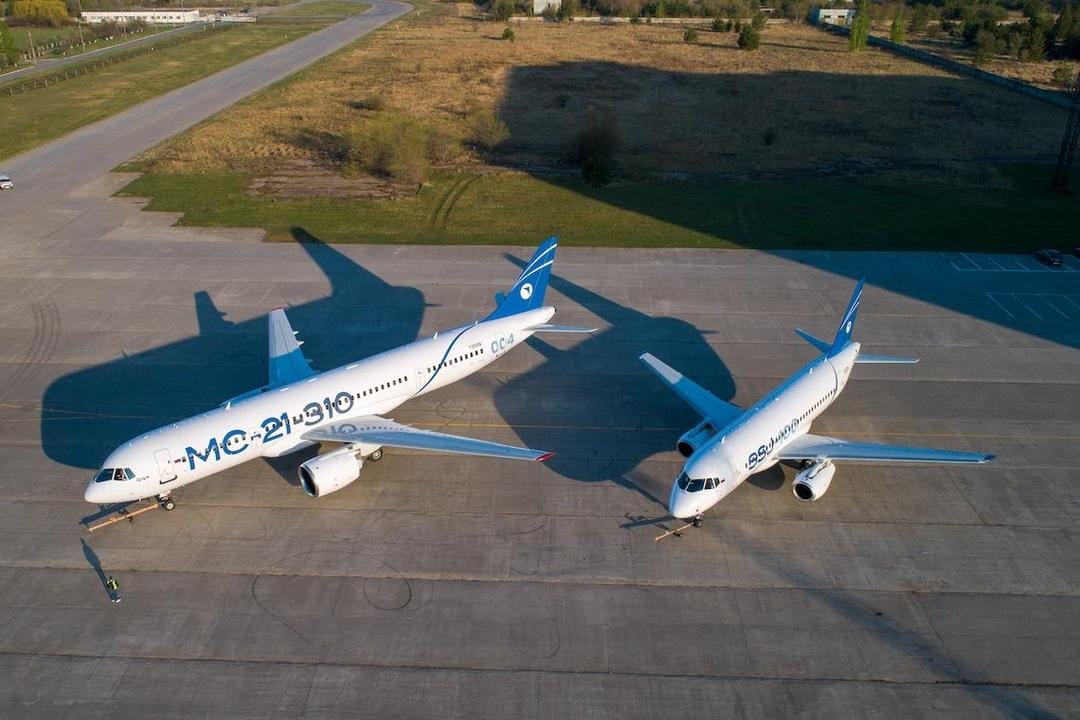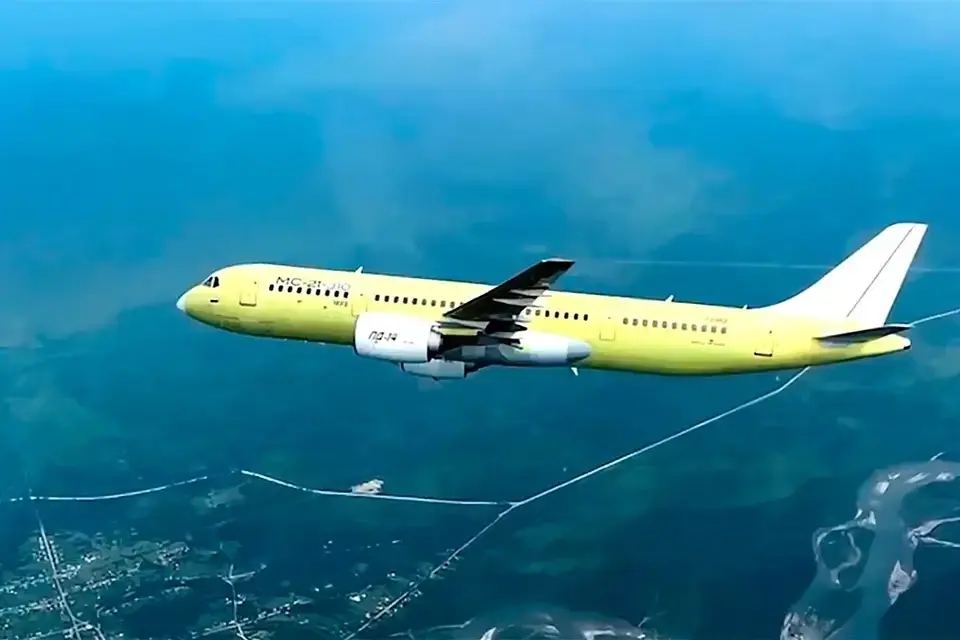
The import-substituted serial version of Russia’s MC-21-310 passenger airliner made its first flight from the airfield of the Irkutsk Aviation Plant, spending 1 hour and 23 minutes in the air, the Russian state corporation Rostec announced on Telegram on Aug. 3.
“Import-substituted” is the Russian term for replacing foreign-made parts and systems with domestic alternatives, a policy Moscow has accelerated due to Western sanctions.
“The aircraft reached an altitude of 6,000 meters and an indicated airspeed of 600 kph. The crew checked stability, controllability in various configurations, and the operation of Russian-made onboard systems. The aircraft performed well, and the flight assignment was completed in full,” Rostec said.
The Irkutsk Aviation Plant is preparing serial production of the aircraft, with the first batch said to consist of 18 planes. The Kremlin-aligned business newspaper Vedomosti wrote that the MC-21-310 has now completed half of its certification flights. Rostec previously said it planned to produce 36 MC-21 aircraft annually, with deliveries expected to begin in the second half of 2027.
Aviation expert Andrei Menshenin told The Insider that it is more accurate for now to speak of the beginning of the process of mastering serial production, not full-scale serial output.
“The first flight of a serial aircraft is an important milestone, but the program still has to confirm production stability and complete the remaining certification procedures,” Menshenin said. “This is an important stage because the aircraft being tested has already been assembled using technology as close as possible to the one that will be used for aircraft delivered to airlines. Unlike prototypes, this tests not only the design but also the readiness of the production line.
The serial configuration still needs to complete testing, receive all necessary amendments to the certificate, confirm production reliability, and transfer the first aircraft to customers. The plan for 18 aircraft looks ambitious. It is achievable, but only if there are no serious delays in component supplies and production.
The main risk today is completing the import substitution program. The MC-21 was initially created as a broad international cooperation project using a large number of foreign systems and components. After sanctions were imposed, many of them had to be replaced with Russian equivalents, or else sourced from new suppliers. This concerns not only engines and avionics, but many other systems, including cabin equipment. So the key question now is whether the entire supply chain can ensure stable production of fully equipped aircraft in the planned volumes. Risks also remain in completing certification and bringing production up to the announced pace.”
David Kaminski-Morrow, air transport editor at FlightGlobal, explained that the start of serial production is the point at which aircraft begin to be built to a single “blueprint” approved by regulators for delivery to customers. As he told The Insider:
“Aircraft manufacturers initially build prototypes which serve as test platforms and used to resolve issues or refine particular aspects of the design, including matters relating to production. As this work converges towards a final, acceptable design, it is not unusual for a manufacturer to begin constructing several ‘serial’ aircraft, once it is confident that any outstanding changes to the the design will be minimal.
The import-substituted MC-21 aircraft which has just made its first flight is a ‘production standard’ aircraft, which Rostec hopes will serve as the blueprint for the first batch of serial production – although, of course, the aircraft still needs to secure certification, the approval necessary before these ‘production standard’ aircraft can be delivered to customers.The first flight of any modified design is significant, but this one is particularly important because it’s representative of the aircraft that Rostec hopes to deliver to customers. Much of the basic flight-test work will have been carried out by the prototypes already, and testing of this latest aircraft will focus on finer details to ensure that the aircraft is ready for the demands of airline operations. Not a lot of detail has emerged over the specific technical milestones, although Rostec said in May that one-third of the certification flights had been completed, which suggests a substantial amount of work still to complete.
Certification is a complex process, and import-substitution means there are multiple new systems which have been introduced since the original MC-21 design, and all of this must be taken into consideration.Certification of the MC-21 is the most immediate challenge – nothing will be delivered to customers until this is achieved. The next challenge will be to start delivering the aircraft, and seeing how it performs in actual airline service, and whether any teething problems can be addressed quickly and efficiently. Rostec will also need to ensure it can ramp-up production once certification is achieved, because there is a pressing need for capacity among Russian airlines, and Russian aircraft production rates tend to be very low compared with other manufacturers such as Airbus and Boeing. This will test the ability of Russian supply chains to manufacture systems and components in sufficient numbers if MC-21 production rates are to reach the sort of levels previously mentioned by Rostec and United Aircraft Corporation.
While there are 18 aircraft in various states of assembly, it is hard to estimate how long it will take before all of them are finished, delivered, and flying. Early-build aircraft also tend to be suboptimal (designs improve as experience increases), and the MC-21 is particularly challenged because it has undergone a lot of late changes that weren't originally intended, and the extent to which the aircraft will meet airline customers' expectations is yet to become clear.”