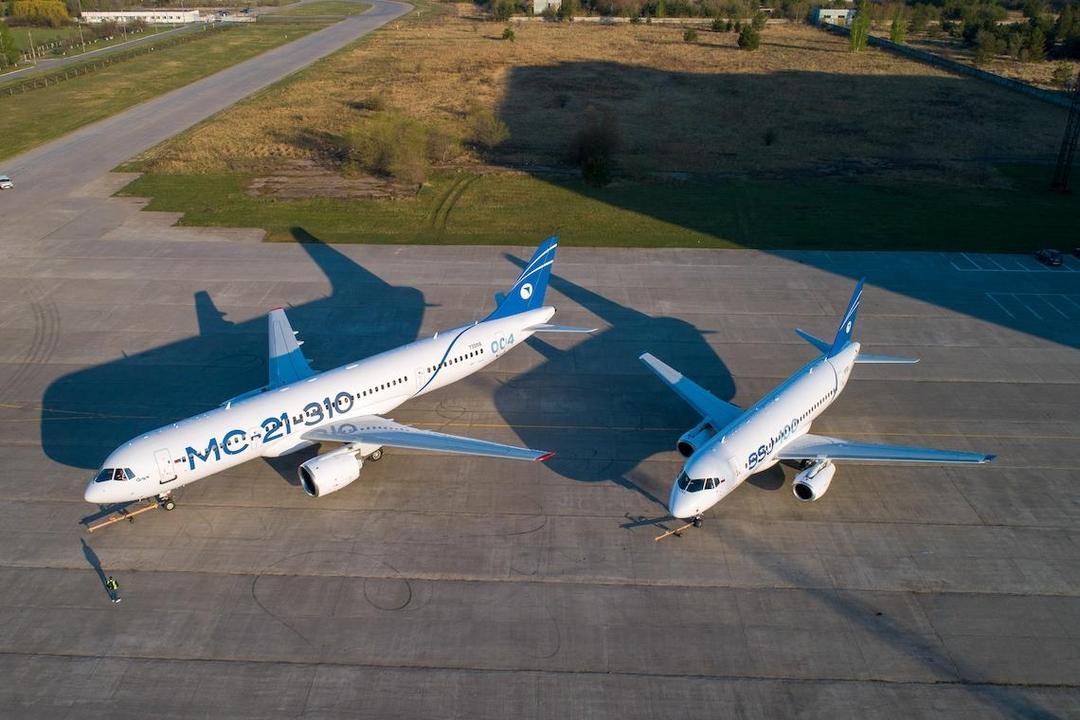
PJSC Yakovlev, the manufacturer of Russia’s MC-21 and SJ-100 civilian aircraft as well as Su-30 fighter jets, has faced a sharp increase in arbitration lawsuits. The Insider counted 363 lawsuits filed against the company as a defendant since the start of 2024. Their total value exceeds 21.2 billion rubles (about $265 million), while the plaintiffs include aviation industry suppliers, including manufacturers of engines, metals, components and avionics. An industry source told The Insider that Yakovlev does not have the money to pay its suppliers.
On May 7, Rostec CEO Sergei Chemezov told Vladimir Putin that serial production of the MC-21 and SJ-100 would begin in 2027. A day earlier, Industry and Trade Minister Anton Alikhanov said the SJ-100 could begin regular flights before the end of 2026. This is not the first delay for the SJ-100 and MC-21. In 2024, Chemezov said production of the MC-21 had been pushed back to 2025 and the SJ-100 to 2026. At the time, United Aircraft Corp. attributed the delays to sanctions, the replacement of imported systems and the need to repeat testing.
Court statistics show that Yakovlev’s problems go beyond certification and postponed serial production. According to the SPARK database, 363 lawsuits totaling more than 21.2 billion rubles were filed against the company as a defendant between 2024 and 2026. Most of the disputes are tied to contractual obligations within the production chain, including supplies, contracting work, services and energy. Aviation experts who spoke to The Insider on condition of anonymity said these disputes point to payment problems within the aviation and defense production networks.
The largest plaintiffs include suppliers of titanium, engines, metals, components and avionics, all key parts of the aircraft production chain. According to SPARK, TD VSMPO-AVISMA Corp. filed claims worth 5.7 billion rubles, UEC-UMPO 1.8 billion rubles, Gidromash 1.1 billion rubles, KUMZ 825 million rubles, AMR 395 million rubles and UKBP 278 million rubles. The companies that most often sued Yakovlev were Gidromash, with 30 cases; KUMZ, with 15; Izhstal, with 11; AMR, with 10; Strela Production Association, with eight; and UKBP and ELARA, with six each.
An industry source told The Insider that the wave of supplier lawsuits is linked to the company’s shortage of funds.
“PJSC Yakovlev does not have the money to pay suppliers for services provided and components delivered. Money is allocated from the budget for the most urgent needs, but the situation with contractors arose because no new aircraft are being produced, meaning there is no revenue. Debts have accumulated over previous years and apparently will now be covered from the state budget,” the source said.
An aviation expert who spoke to The Insider on condition of anonymity said the lawsuits against Yakovlev cannot be clearly linked only to the civilian MC-21 and SJ-100 programs. A significant share of the claims, the expert said, may be connected to military production.
“Yakovlev’s main real product, not its project-stage product, is Sukhoi Design Bureau fighter jets. They are literally produced at the same plants in Irkutsk and Komsomolsk-on-Amur where the MC-21 and SJ-100 are assembled, in neighboring workshops and, broadly speaking, by the same people. Fighter jets break down and crash. They need parts, repairs and new aircraft, which means money is needed from the Defense Ministry. But the Defense Ministry is not allocating enough money. It has even stopped giving money to shipbuilders. I am sure a significant share of the lawsuits is connected to this, not to civilian aircraft.
At the same time, the list of plaintiffs shows the lawsuits are mixed. The UEC-UMPO lawsuit is definitely about civilian aviation: it is the developer of the PD-14, the engine for the MC-21. But that claim is within a single structure: both Yakovlev and UEC are part of Rostec. The Gidromash lawsuit is military: at least one ruling concerned spare parts for Indian fighter jets. KUMZ, Izhstal, AMR and VSMPO-AVISMA deal in metals, alloys and titanium, which are used everywhere. With suppliers like that, it is impossible to say whether the cooperation is civilian or military.
These are definitely mixed claims, but the proportion cannot be determined from open data. Aircraft contracts in Russia are a gray area, and that was true even before the war. Even in the civilian sector, the Defense Ministry often appeared around the financial side. For the past two years of the Russian economy, this has been the normal backdrop for enterprises involved in the state defense order: payment problems are widespread there, and contractors are actively complaining about them. Of course, this is not normal, and it is not normal for the aviation industry in particular.
If you set aside the separate Aeroflot story, I would explain this group of lawsuits as payment delays under contracts: there is no money because customers for military aircraft are not making payments, because loans are expensive and because the civilian aviation program has failed. Aircraft deliveries were supposed to have begun already, but they have not. There is no money for them, and the gaps are being covered with loans. Chemezov has already complained about this, without singling out United Aircraft Corp., but UAC looks like the weakest link in this arrangement.”
The court data therefore do not make it possible to clearly attribute all the lawsuits either to the civilian MC-21 and SJ-100 programs or to military production. Some claims are tied to clearly civilian cooperation, some to military contracts, and a significant share concerns suppliers of materials and components that serve both sectors.
PJSC Yakovlev is part of Rostec’s United Aircraft Corp. The company produces the SJ-100 and MC-21 passenger aircraft, as well as military aircraft including the Su-30SM fighter jet and Yak-130 advanced jet trainer. After Western suppliers left Russia, Yakovlev became one of the key contractors in the civilian aviation import-substitution program.
Despite the latest delay in serial manufacturing, Rostec is maintaining ambitious plans for producing civilian aircraft. At the meeting with Putin, Chemezov said the corporation plans to produce 36 MC-21 aircraft, 20 SJ-100s and 12 Il-114s a year by 2030.