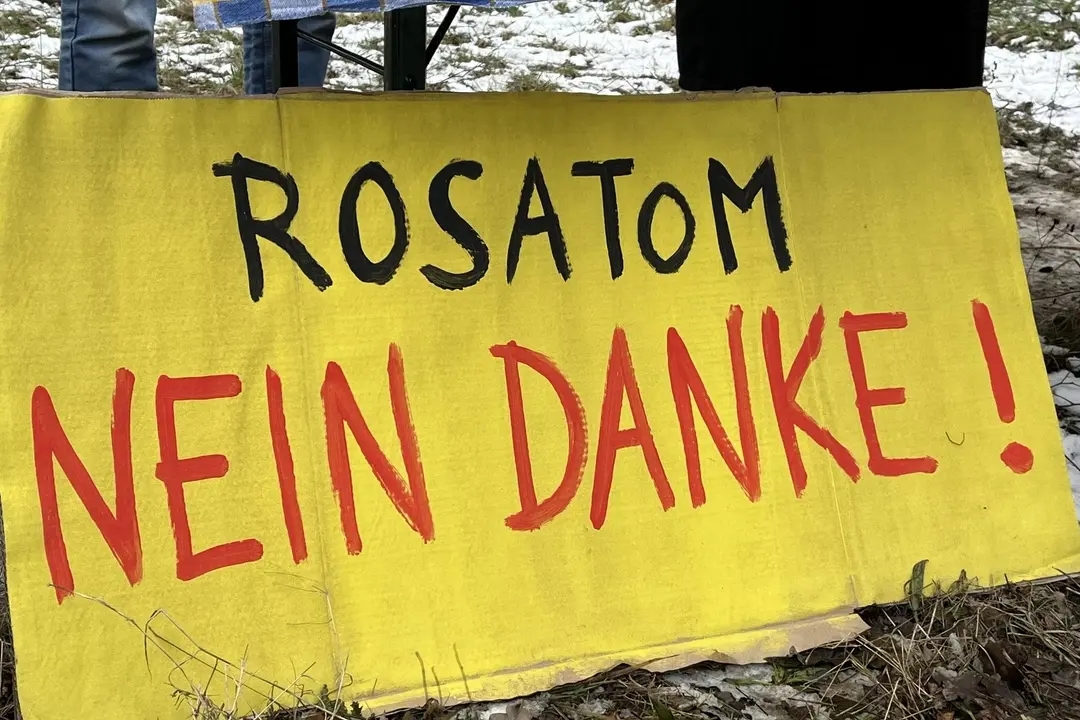
On July 22, Germany’s federal government and the Environment Ministry of Lower Saxony approved the expansion of a nuclear fuel plant in the town of Lingen. According to a statement on the ministry’s website, the authorities approved an application from Advanced Nuclear Fuels (ANF), a subsidiary of France’s Framatome GmbH, to produce nuclear fuel under a license from TVEL, a company that is part of Russia’s state nuclear corporation Rosatom.
ANF is expected to work with TVEL to produce hexagonal fuel assemblies for Soviet-designed VVER pressurized water reactors, which are common in Eastern Europe. Fuel assemblies, known by the Russian abbreviation TVS, are bundles of fuel rods used in nuclear reactors.
Lower Saxony Environment Minister Christian Meyer said that because the European Union has not imposed sanctions on Rosatom, German authorities had no legal grounds to reject ANF’s application.
“I have always said that I consider business and close cooperation with Putin’s nuclear company fundamentally wrong,” Meyer said. “The aim must be to reduce and not increase dependencies on Russia, especially in the sensitive nuclear sector. Ukraine has also warned against cooperation with Rosatom, especially since this nuclear company, which is directly subordinate to Putin, is involved in acts of war and is accused of serious human rights crimes. Unfortunately, there is also no clear signal from Framatome or the ANF to end cooperation in the nuclear field with Russia. And in the EU, there is still no majority for sanctions on Russian uranium and fuel assemblies, although Ukraine and other Eastern European countries, for example, have shown that hexagonal fuel assemblies for VVER reactors can also be produced without Russian participation.”
The Russian environmental group Ecodefense! condemned the German authorities’ decision, saying cooperation with Russia in the nuclear sector threatens the security of Germany and other EU countries, as it allows the Kremlin to expand control over critical energy infrastructure in Europe.
Vladimir Slivyak, co-chair of Ecodefense, told The Insider that Hungary, Slovakia, Bulgaria, the Czech Republic, and Finland remain heavily dependent on Russian technology. France is also involved, he said.
“France never stopped cooperating with Rosatom,” Slivyak explained. “Its company Framatome, for example, imports uranium from Russia, and now it will also produce nuclear fuel jointly with Rosatom for nuclear power plants in other countries.
As for the Lower Saxony Environment Ministry, what is interesting is that the minister himself, Christian Meyer, is from the Greens and had opposed this decision the whole time. Now he says he is forced to approve it because the government in Berlin is demanding it.”
According to TVEL’s website, the Rosatom subsidiary is the sole supplier of nuclear fuel for all Russian nuclear power plants, as well as Russia’s naval and research reactors. TVEL includes enterprises specializing in gas centrifuge production, uranium enrichment, and nuclear fuel fabrication, as well as research and design organizations.
In February, the UK imposed sanctions on several other Rosatom subsidiaries.