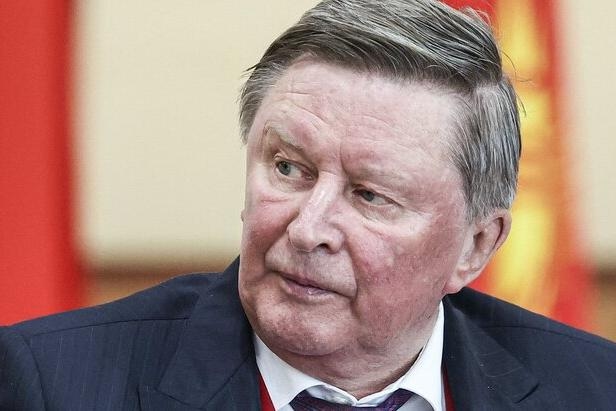
Sergei Ivanov, a former Russian defense minister and former head of the presidential administration, has died at the age of 73. His death was announced by the VTB United League, a Russian basketball organization where he served as honorary president. The cause of death was not specified.
Ivanov was one of the most prominent Russian officials of the Putin era. He was born in Leningrad, now St. Petersburg, graduated from the philology department at Leningrad State University, and later completed the KGB’s Higher Courses in Minsk and the Soviet KGB’s Red Banner Institute outside Moscow. From the mid-1970s, Ivanov served in the state security agencies, including in posts abroad. He had known Vladimir Putin since their time in the Leningrad KGB.
In the late 1990s, Ivanov was deputy director of the FSB, Russia’s domestic security service, when Putin headed the agency. After Putin came to power, Ivanov became the secretary of Russia’s Security Council. In 2001, he was appointed defense minister. He later served as deputy prime minister and first deputy prime minister, overseeing the defense industry. From 2011 to 2016, he served as head of the presidential administration, a powerful Kremlin post often described as the president’s chief of staff.
In 2007, Ivanov was widely seen as one of the most likely successors to Putin as president. The Kremlin ultimately backed Dmitry Medvedev instead.
After leaving the presidential administration in 2016, Ivanov served as Putin’s special representative for environmental protection, ecology and transport. In 2026, Putin dismissed him from that post and later removed him from the Security Council.
Ivanov was under sanctions imposed by the United States, the United Kingdom, the European Union, and several other countries.
Long before the start of the full-scale war in Ukraine, a handful of American officials made note of him in their memoirs. In 2011, former National Security Advisor (2001-2005) and Secretary of State (2005-2009) Condoleezza Rice published No Higher Honor, where she wrote of Ivanov:
“Sergei was tough and somewhat suspicious of the United States, but he was dependable. He never told me that he would do something that he did not do. He was an unfailing conduit to Putin on the most sensitive matters through changes in positions and titles…[and] our channel remained the most important and discreet one between the White House and the Kremlin… Owing to our long association, I was able to talk with him candidly. He was no Jeffersonian democrat, but he was — and still is — a modernizer. That was always the true divide in Russia: Slavophiles versus modernizers, not democrats versus authoritarians… Ivanov, it turned out, was one of the two men whom Vladimir Putin pitted against each other to decide who would succeed him as president. Ivanov would lose.”
Additionally, in 2018, future CIA Director (2021-2025) and former U.S. Ambassador to Russia (2005-2008) William Burns published a diplomacy handbook, The Back Channel, that described Ivanov as:
“…a longtime friend and former KGB colleague of Putin. A fluent English speaker, able to charm or bludgeon as circumstances required, Ivanov had aspirations to succeed Putin…[but] his steely personality and ambition unsettled others in Putin’s orbit, and the fact that he had been a far more accomplished KGB officer than his friend may have unsettled Putin a little too… As 2007 drew to a close, Putin finally tipped his hand and declared he would support Medvedev as his successor in the March 2008 presidential election. The logic of that choice became clearer in the next couple of months, as rumors swirled that Putin would remain in government as prime minister — perfectly acceptable under the Russian constitution. It made sense to have the more malleable and less experienced Medvedev as his partner in the new “tandem” arrangement; it was hard to see Sergei Ivanov being comfortable in that role, or Putin comfortable with him.”