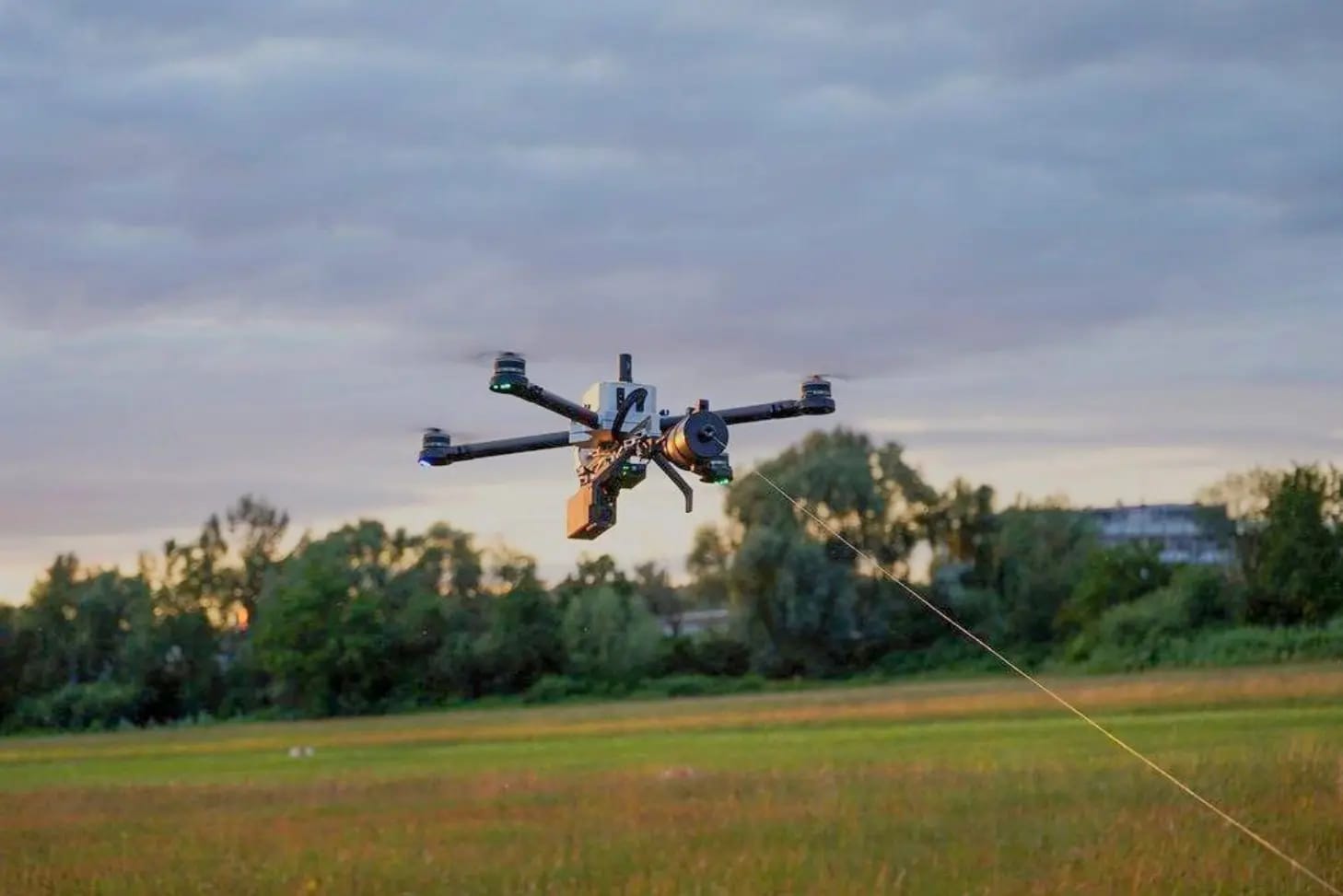
In February, Vedomosti reported that imports of Chinese fiberglass into Russia had increased tenfold. Meanwhile, The Insider found that $9 million worth of fiber-optic cable was imported in the first quarter of 2025, roughly twice as much as in the same period a year earlier. Additionally, in April 2025 a Ukrainian drone strike on a Russian production facility in Saransk likely further increased Russian demand for imported fiber-optic cable.
Exporters
According to data obtained by The Insider, almost all the fiber-optic cable sent to Russia in 2025 came from two Chinese companies: Foshan Beyond Import and Export and Hubei Guanqun Import and Export. The companies were also listed as fiber manufacturers; however, no such manufacturers exist on the market. Other suppliers accounted for a negligible share, and around $600,000 worth of shipments listed a sender that was hidden in the documentation.
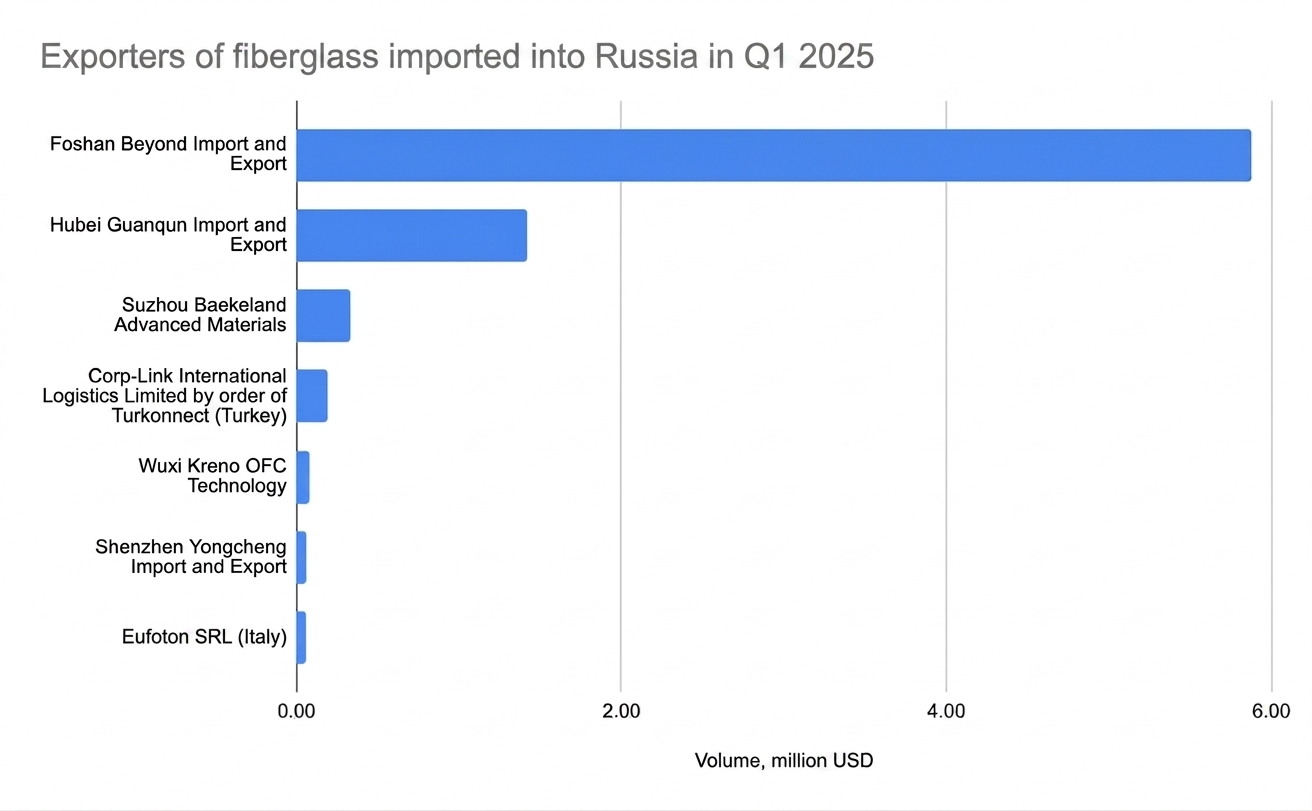
The first company’s name was listed in Russian documents with a deliberately distorted transliteration. In reality, it is called Foshan Bangyang Import and Export Co. Ltd. The distorted name does not necessarily indicate an attempt to conceal the nature of the business. It is more likely a practice common in China, where companies choose English names based on how they sound rather than as an exact translation.
Foshan Bangyang Import and Export Co. Ltd. has an account at China Bank of Communications. In response to an inquiry from The Insider, China Bank of Communications replied: “After careful consideration, our bank has decided not to accept the interview at this time.” This apparently means it declined to comment.
Importer
More than 80% of the fiberglass imported into Russia went to two recipients: individual entrepreneur Yermek Amandykovich Suyundukov and the company Inkab LLC (ООО «Инкаб»).
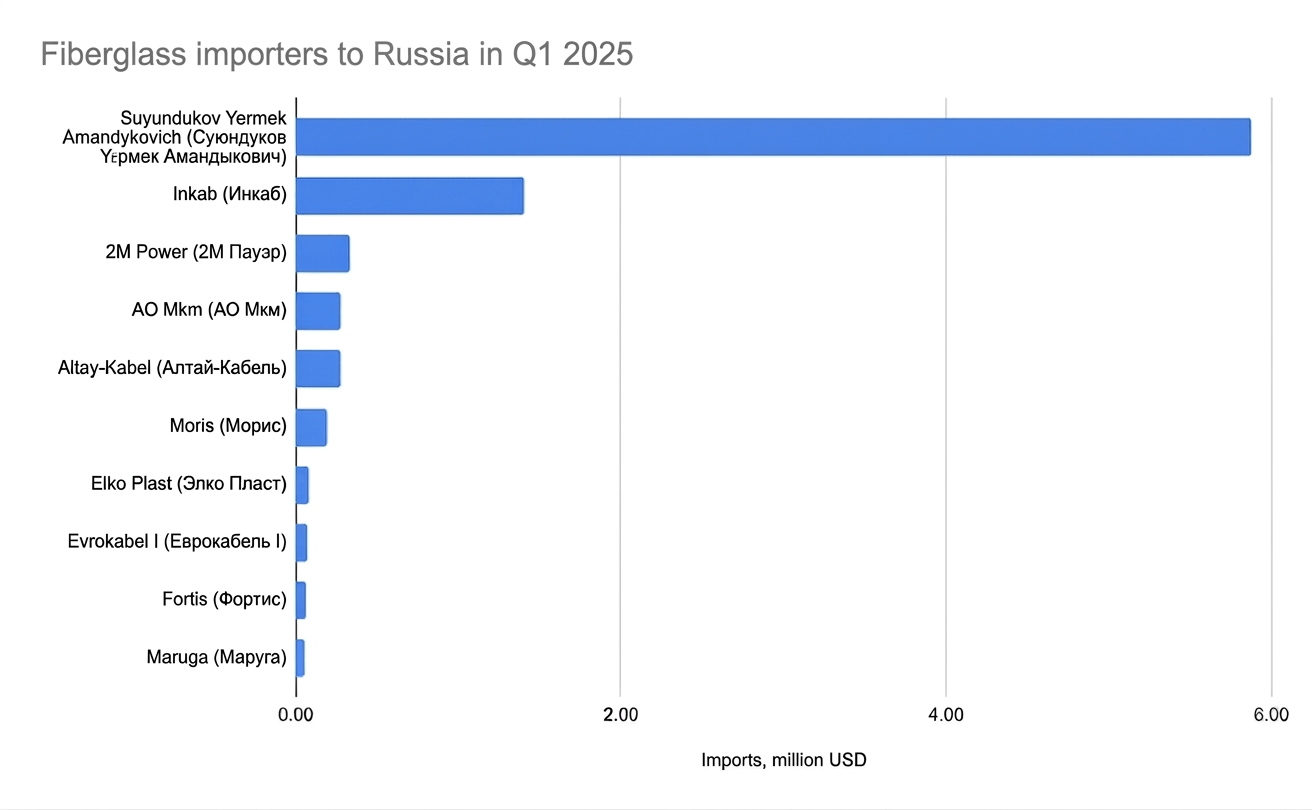
Suyundukov appears to be a citizen of both Russia and Kazakhstan who is living in Chelyabinsk and is involved in the business of steel trading. The delivery address for the fiber was listed as the territory of the Shusha («Шуша») enterprise near the St. Petersburg customs office in Shushary. In total, Suyundukov imported 120 tons of fiber into Russia from January through March 2025. A drone fiber-optic spool weighs about 2 kilograms, meaning that amount would be enough to provide communications for tens of thousands of drones.
In addition, in the first quarter of last year alone the Kazakh businessman imported 140,000 lithium-ion batteries worth a total of $3.5 million and 50,000 electric motors with a capacity of 1 kilowatt (i.e., a type suitable for drones). During the same period, Suyundukov also imported 65,000 “fiber-optic communication devices,” 450 kilograms of electronic boards for video cameras (each measuring 38 by 38 millimeters), 15,000 optical lenses, and 160 kilograms of propellers.
In Russia, Suyundukov certified equipment matching the profile of his imports: batteries from Dongguan Henghui Electronic Technology, battery chargers from Dilong New Energy Technology Hebei, and machines from Shanghai Rui Tai Photoelectric Technology for winding fiber-optic cable onto drone spools. He also certified specific “old-fashioned Soviet” ONTS-BS-1(2) bayonet connectors. Suyundukov did not respond to The Insider’s inquiries.

Inkab LLC is a major manufacturer of optical cables for civilian use, and drone spools are not formally listed among its products. In 2024, according to VAT data reviewed by The Insider, Inkab LLC had transactions with military enterprises, including JSC VNII Signal and the Tula-based JSC Instrument Design Bureau. A journalist for The Insider called Inkab LLC and was told the company could sell ready-made drone spools.
The Insider’s journalist also found out that the Inkab plant produces not only optical cables for civilian use but also cables for aerostats of the sort that are used by the Russian military to install jammers, relay systems, and surveillance stations. Inkab also makes cable terminations and connectors of any type, from protected to standard models.
An earlier investigation by The Insider and Nordsint found that Chinese companies continue to sell Russian companies critical components for the production of military drones, despite Beijing’s severe restrictions on exports of such goods since 2023. Chinese suppliers have built supply schemes using payments in national currencies through Chinese banks and Russia’s VTB, as well as in cryptocurrency, the SWIFT network, and Western financial systems. The Insider found that most of the Chinese supplier companies listed in invoices for such purchases do not appear in recent customs data, even though some of their goods are already physically present in warehouses in Russia.