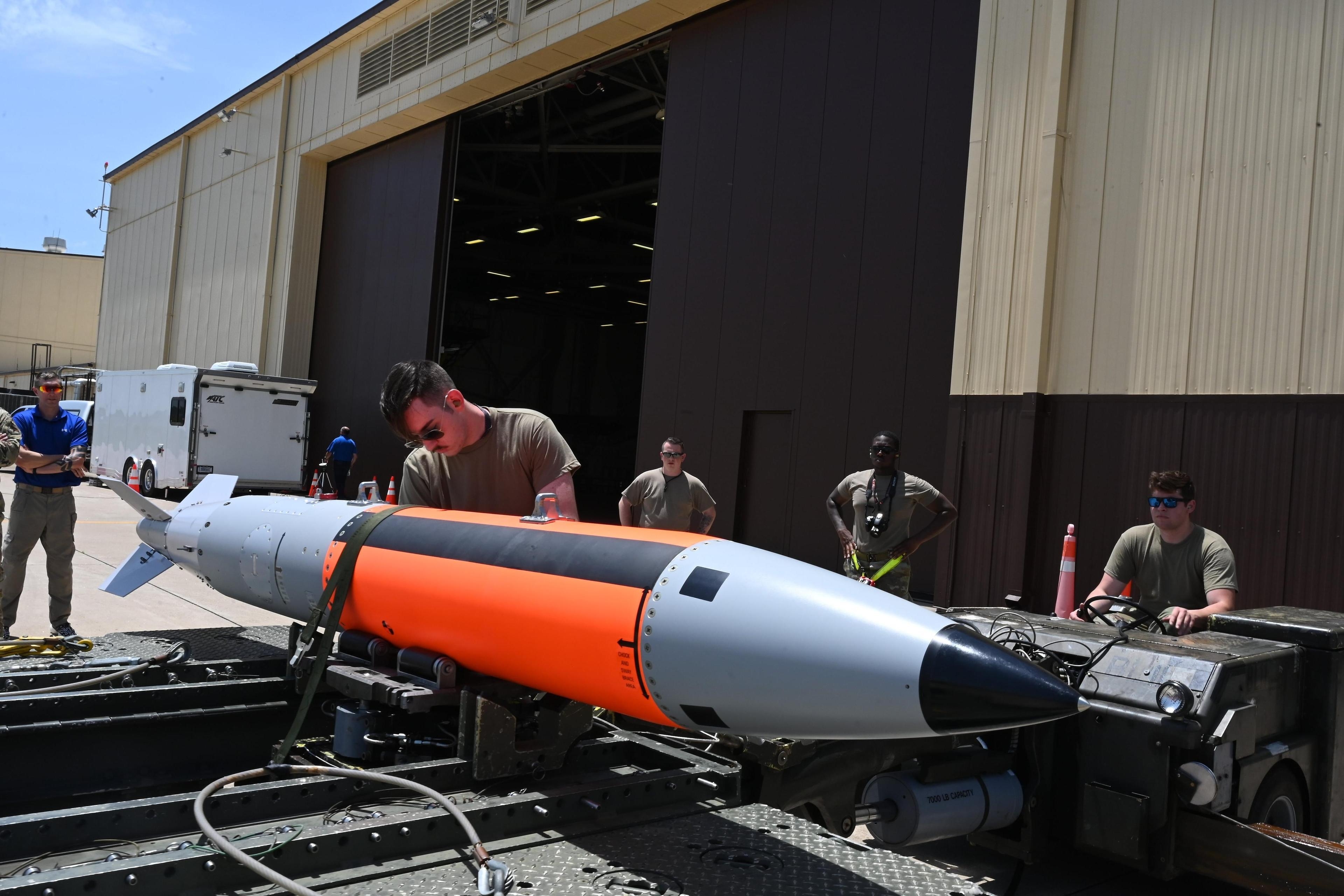
The hypothetical deployment of U.S. nuclear weapons or dual-capable aircraft in Lithuania would do little to change the military balance between NATO and Russia, but could serve as an additional guarantee for Vilnius of American involvement in the event of an attack. Defense policy and nuclear weapons experts told The Insider that the United States and NATO already have sufficient means for a nuclear strike against Russia, meaning the main purpose of such a step would not be to expand strike capabilities, but to signal that a Russian attack on Lithuania would entail a direct risk of confrontation with Washington.
As the Financial Times reports, the U.S. is discussing the possibility of expanding the deployment in Europe of aircraft that can carry either conventional or nuclear weapons. According to the outlet, Poland and several Baltic states have expressed interest. Lithuania’s Defense Minister Robertas Kaunas later confirmed that Vilnius is in negotiations with Washington about the possible deployment of American nuclear weapons.
Military expert David Sharp believes that in practical military terms, the possible appearance of American nuclear weapons in Lithuania would hardly make a difference. According to Sharp, the main impact of such a deployment would be the political message saying that Lithuania's security is directly linked to the United States:
“In practical terms, little changes for Russia and NATO from nuclear weapons appearing in Lithuania. The moment American nuclear weapons appear in a given country, the possibility of attacking it — whether through hybrid or non-hybrid means — becomes questionable due to the presence of U.S. nuclear weapons. Whether or not there are tactical nuclear components in Lithuania does not matter much.
Does this increase real deterrence capabilities? It is more of a political gesture. The point is that if they deploy [nuclear weapons], ‘Lithuania is out of reach because our nuclear bombs are there and we will stand up for Lithuania.’
The deployment of U.S. nuclear weapons would theoretically expand strike capabilities, but only if we are talking about a large-scale nuclear war. The United States and NATO have so many ways to wipe Russia off the map that having something closer is not particularly necessary. Taking off from Lithuanian airfields with nuclear bombs does not offer much of an advantage; the proximity to Russia even creates an inconvenience. Technically, it does not expand any particular capabilities.
All this talk is more about Lithuania’s and Poland’s desire to secure American backing — to show Russia that the Americans are very close to them, that they are now untouchable, and that if anything happens, Russia will be dealing with the Americans. This is done for the security of these countries.”
Pavel Podvig, a researcher at the United Nations Institute for Disarmament Research (UNIDIR), also says that the military rationale for American nuclear bombs in Europe is limited. According to Podvig, this practice has existed since the Cold War, but the appearance of U.S. weapons in the Baltic states or Poland would represent a new political step:
“The practice of stationing American weapons in Europe has existed since the 1950s. In the early 1990s, almost all of this weaponry was taken back to the U.S. under presidential initiatives, leaving around 200 gravity bombs — and even those were subsequently withdrawn. There are now six countries in which American nuclear weapons are stationed. For a long time, there were five, but the United Kingdom recently reclaimed these U.S. nuclear weapons. And these weapons have been in those countries since time immemorial.
So the idea is not new. What is new is that countries in Eastern and Central Europe periodically raise the question of extending this practice, volunteering to host U.S. nuclear weapons. Poland still has many enthusiasts of this idea. The Baltic states have made no explicit calls, but ideas have been expressed along the lines of ‘It would be nice.’ I have not heard of any concrete discussions; so far they all come down to expressions of readiness. I think the probability of any actual deployment in the Baltic states, Poland, and so on, is minimal. I do not think this will happen.
Even if nuclear weapons were to appear in Lithuania, it would not change NATO's military capabilities in any way. The military rationale for having all these U.S. bombs in Europe is practically non-existent. There are almost no military tasks that these bomb-equipped aircraft could perform. In this sense, the primary purpose is symbolic, as acknowledged by both the Americans and their allies. American warheads on a country's territory ostensibly place this country under greater protection. That is the main idea. It is hard to call this initiative entirely useless, because it is still nuclear weaponry and can cause damage. But in terms of actual use, it makes almost no difference whether the weapons are in Germany or in Lithuania. Perhaps the biggest difference is that in the Baltic states or Poland, these storage sites are more vulnerable to strike operations, reachable by a figurative ‘Iskander,’ unlike in Germany or Belgium.”
Podvig emphasizes that deploying dual-capable aircraft is not the same as deploying nuclear warheads themselves. Such aircraft may be certified to carry nuclear bombs, but they do not normally fly with them on board.
“Dual-capable aircraft can carry nuclear bombs, and they are certified to do so. Some aircraft cannot, simply because there is nowhere to mount the bombs, but these can. To carry a nuclear warhead, a jet needs a special wire running to the warhead and a corresponding electronic device to send commands. The presence of such components is implied by the certification.
Take an F-15 and an F-16: they are essentially the same, but one is certified and the other is not. Having the certification means having a wire and a panel on the console, which provides the only connection between the aircraft and the warhead. You can have 10,000 aircraft and 150 warheads. I remember discussions about some dual-capable aircraft flying to Estonia and causing a lot of fuss, but there was nothing on the plane except a wire and a device on the console. They never fly with warheads. In this sense, the deployment of dual-capable aircraft [without nuclear warheads] in the Baltic states or in Poland is an empty gesture. There is no practical purpose to it.”
Maxim Starchak, a researcher at the Centre for International and Defence Policy at Queen’s University (Canada), draws attention to a different risk: if American nuclear weapons were to appear closer to Russian borders, such facilities themselves could become the first targets in the event of a crisis:
“There have been no U.S. nuclear weapons under NATO arrangements in Lithuania. Should the United States deploy nuclear weapons there, it will undoubtedly be a new factor in European security. What matters is whether this would be a relocation of U.S. nuclear weapons from other European countries or an additional deployment. The latter would push Moscow even more strongly toward retaliatory measures — but not an in-kind response. What is being deployed in Belarus is Russian nuclear weaponry that was already in the European part of Russia. If the United States were to deploy new nuclear bombs, it would be a transfer from the United States to Europe, closer to Russia's borders. Meanwhile, Russia cannot move nuclear weapons closer to U.S. borders.
By contrast, a transfer from one European country to Lithuania would not significantly change the situation. On the one hand, nuclear weapons would be closer and the time available for their use could be reduced; on the other hand, such a forward deployment is risky, since in a crisis this base would be the first to come under attack. Understanding these risks, the military could operate under a ‘use it or lose it’ strategy whereby using the nuclear weapons deployed in Lithuania first would be the only way to preserve them. In other words, the risks of nuclear escalation could increase.
U.S. nuclear capabilities could increase because Lithuania is closer to Russia and Belarus, meaning that a faster nuclear strike becomes possible. However, the risks also increase. If new nuclear weapons were to be deployed in Lithuania in addition to those already stationed in Europe, U.S. capabilities would be enhanced through an increase in the number of warheads. Formally, there would probably be a small number of bombs in Lithuania. The increase would not be significant, but it would certainly inflate the potential for nuclear escalation. Russia might respond by abandoning formal compliance with New START and deciding to increase its nuclear stockpiles. Or it could carry out a demonstrative deployment of nuclear weapons in Kaliningrad, strengthen its military presence in Belarus, and so forth.”
Currently, American nuclear weapons under the nuclear sharing program are deployed in six NATO countries: Belgium, Germany, Italy, the Netherlands, Turkey, and the UK. As Starchak explains, these are primarily B61 gravity bombs. In peacetime they are stored separately from their delivery aircraft in specialized vaults guarded by American military personnel. For nuclear missions, the host countries are expected to use their own F-16 or F-35 aircraft, while the decision to use them remains with the United States. At the same time, according to Starchak, the “dual key” principle applies. The host country can withhold its consent to the use of the bombs stored on its territory or its own aircraft for such a mission.