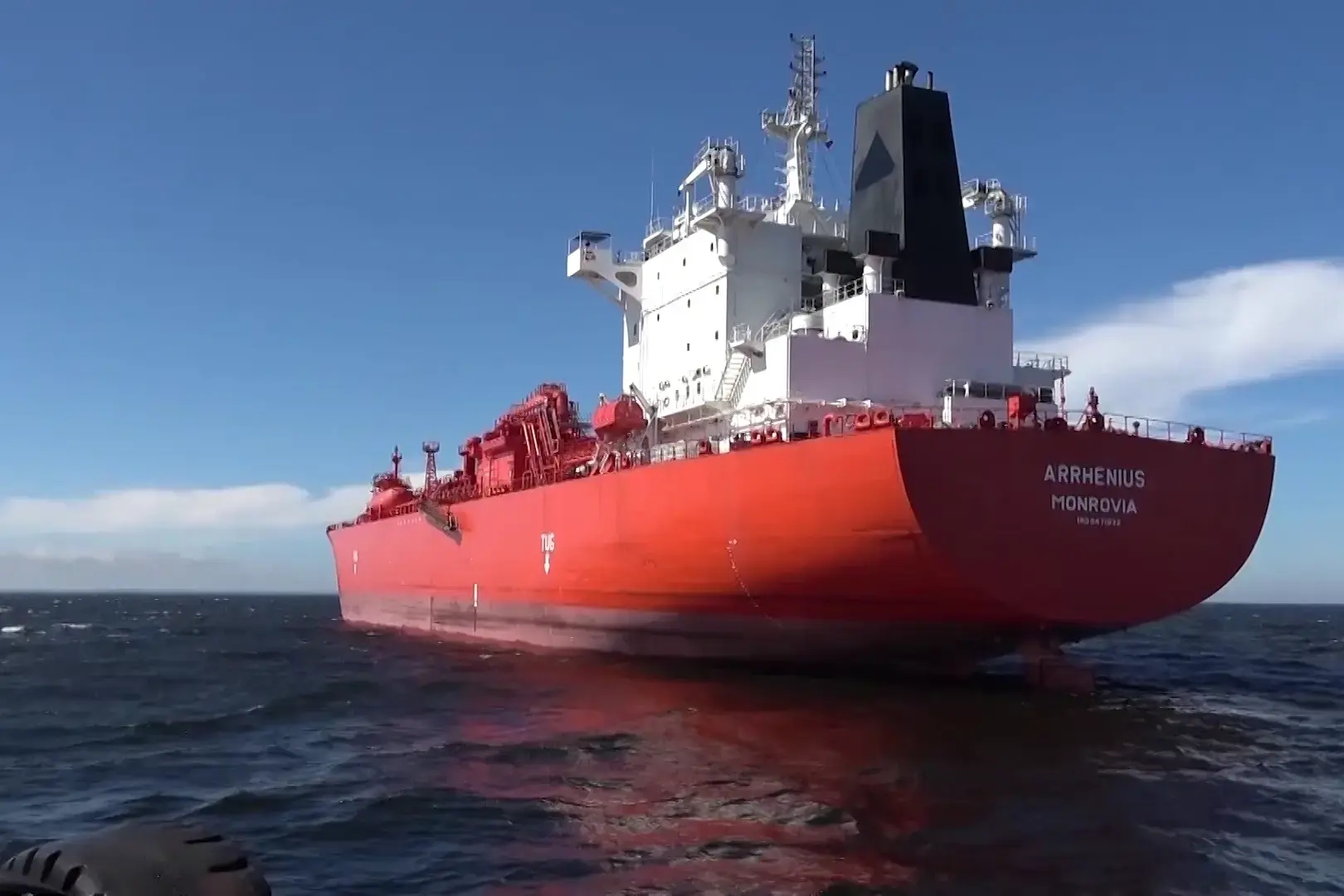
Russia’s Federal Security Service (FSB) claimed on May 25 that magnetic mines weighing about 7 kilograms each were found on the hull of the gas carrier Arrhenius (IMO: 9471032), which arrived at the port of Ust-Luga from Antwerp, Belgium. The FSB also stated, although without providing any details, that the explosives were manufactured “in one of the NATO countries” and planted on the vessel outside Russian territorial waters.
The explosives were defused by FSB specialists together with personnel from the Defense Ministry and the National Guard, according to a report by Russia’s Investigative Committee. A criminal case was opened over illegal trafficking in explosives and an attempted terrorist attack on a vessel that, according to Russian security officials, was bound for the Turkish port of Samsun after refueling in Russia.
Belgium has not yet commented on the allegations. An emailed statement to Reuters from a NATO official said the organization “has not mined any tanker.”
In a video published by the security service, a man identified as the gas carrier’s captain says the vessel spent almost two days anchored in Belgium because of a port strike before entering Antwerp.
“The vessel moored at the pier, and unloading began. It lasted about 25 hours. The vessel was at the terminal. Everything was proceeding normally. We left the port in the morning. We spent the night by the pier. After arriving at the port of Ust-Luga for the next loading, the vessel underwent an underwater inspection. Two mines were found attached near the stern, in the area of the engine room,” he said.
Starboard Maritime Intelligence data reviewed by The Insider shows that the overall timeline of the Arrhenius voyage matches the captain’s account. From the evening of May 12 until the morning of May 14, the vessel was anchored for about 38 hours on the approaches to Antwerp. Corroborating reports of a strike in Belgium during those days are also available, as the port of Antwerp-Bruges had warned of possible disruptions due to a nationwide strike on May 12.
The gas carrier then entered the port of Antwerp, where it remained until May 16, before heading toward the Baltic Sea. The data show no other port calls before Russia.
The Arrhenius approached the port of Ust-Luga in Russia’s northern Leningrad Region on May 20. The vessel had reached the port area by midday and spent a long time stopped or drifting nearby, at times with its signal disappearing. Starboard does not record a full port call in Ust-Luga until the morning of May 22. The data do not make it possible to determine where or when the devices could have been attached to the hull.
The Arrhenius is a Liberia-flagged natural gas carrier built in 2010. Tracking data shows that the vessel regularly travels between Ust-Luga and the Antwerp area. Over the past year, those ports appeared most often in its movement history. Besides Ust-Luga and Antwerp, the vessel was recorded over the past year near Tuzla, the Dardanelles and Istanbul in Turkey; Port-Jérôme in France; Skagen in Denmark; and Primorsk in Russia.