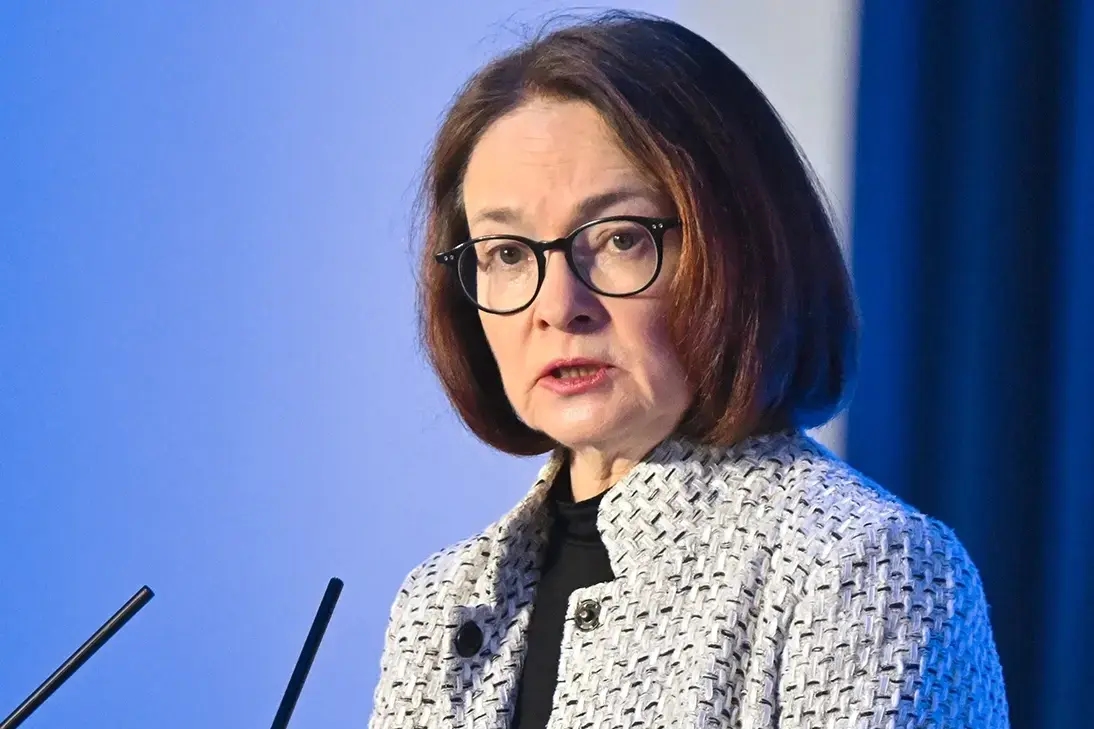
On April 16, Russian Central Bank Governor Elvira Nabiullina said at the Moscow Exchange Forum that the bank has kept its key interest rate high due to an overheated economy, according to remarks published on the central bank’s official Telegram channel.
“Previous episodes of high rates were linked to temporary worsening of external conditions. And when the situation normalized, we reduced the rate fairly quickly. Now the deterioration in external conditions can be described as almost permanent, both for exports and imports. Unemployment is 2%, and that, together with the fact that inflation had accelerated to 10% by the beginning of last year, is evidence of an overheated economy. It is not high growth rates that characterize the state of the economy, but precisely these factors.”
Business-focused publications RBC and Vedomosti published headlines voicing concerns that “Nabiullina said Russia is facing a labor shortage for the first time in its history” and “Nabiullina: Russia’s economy has encountered a labor shortage for the first time.”
However, economist Tatyana Mikhaylova told The Insider that Nabiullina’s warnings offer little new information. “Layoffs and furloughs have already begun,” she said.
Similarly, Ruben Enikolopov, an economist and professor at Pompeu Fabra University, also told The Insider that labor shortages in Russia are a long-standing problem.
“It is true that people have been talking about labor shortages for a long time. The reasons include demographic problems, the fact that some people have gone to the front [line in Ukraine], and a very sharp tightening of migration policy. And the fact that some companies are laying people off while others cannot find enough workers can be explained by the fact that an economic crisis has apparently begun, and that always means a redistribution of labor from some companies to others. So there is no contradiction here. Some are firing, others are trying to hire.”
According to a forecast by the Russian Union of Industrialists and Entrepreneurs, the labor shortfall could ultimately exceed 3 million workers and last through 2030. Central Bank data for April showed the biggest shortages at agricultural businesses, as well as in the energy and water supply sectors. A Bank of Russia analysis read that “the labor shortage continued to gradually ease in the first quarter of 2026, but staffing levels remain extremely low compared with the period before 2022.”
The Central Bank set its key rate at a peak of 21% in June 2025. Since then, the regulator has lowered it several times, and the figure now stands at 15%.