Russia’s production of explosives has tripled when compared with prewar levels, The Insider has found after analyzing recent freight shipment data. But even that is not enough to meet the needs of the front. As a result, Russia is importing ammunition. From August 2025 to February 2026, around 60,000 tons of explosive materials were imported into Russia from the Far East – apparently from North Korea. Since 2020, Russia has been expanding its domestic production of ammunition-related materials – propellant for small-arms cartridges and artillery shells, solid rocket fuel, and high explosive materials. The Bratsk Pulp and Paper Mill has become a new player in the defense industry’s ammunition sector by supplying chlorates, while RDX production has been mastered in Biysk.
- 1.What is being shipped, and from where?
- 2.Who produces energetic materials and how?
- 3.It all starts with nitric acid
- 4.Brisant explosives
- 5.Gunpowder
- 6.Where do the explosives go?
- 7.A special case: solid rocket propellant
- 8.Who consumes the explosives?
- 9.What was it like before the war?
- 10.What does this tell us?
According to the legend, Russian chemist Dmitry Mendeleev was able to uncover the secret of French gunpowder by using railway data. “Taking the railway company’s annual report on freight movements, I found the ratio of the substances used in the production of gunpowder that I needed,” Mendeleev’s son Ivan recalled his father saying. Although historians have questioned whether the younger Mendeleev could have accurately recalled what his father had told him as a child, more than a century later railway data are indeed proving to be a valuable source of information about the activities of Russia’s defense industry — and of gunpowder production in particular.
The Insider examined railway freight data for August 2025 through February 2026 and determined the balance between Russia's production and consumption of explosives and explosive materials.
What is being shipped, and from where?
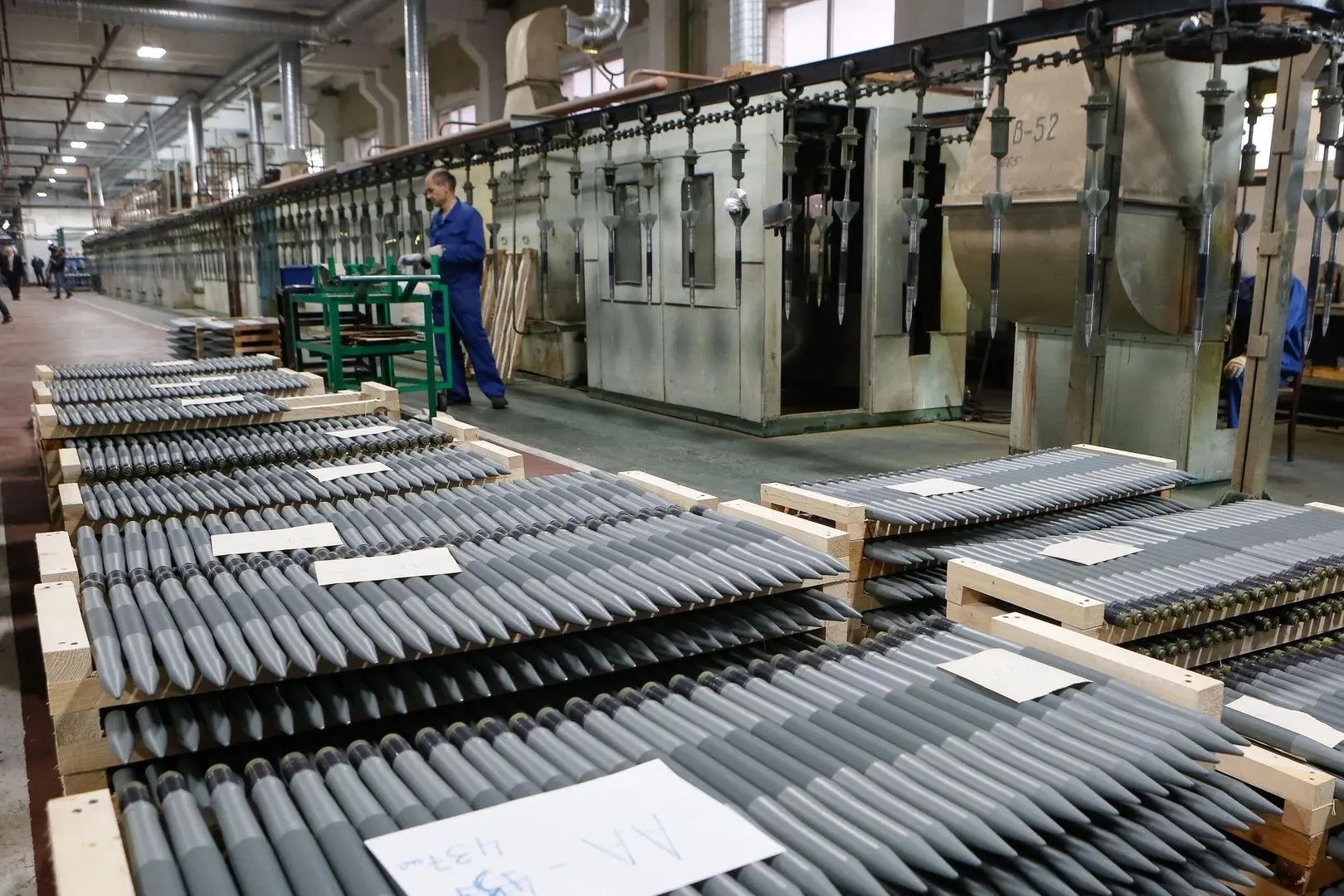
In railway reporting, everything related to explosives is classified as “explosive materials.” This includes both the chemical substances themselves – gunpowder and brisant explosives (trinitrotoluene, RDX, HMX) – and finished ammunition (cartridges, artillery charges, and artillery rounds).
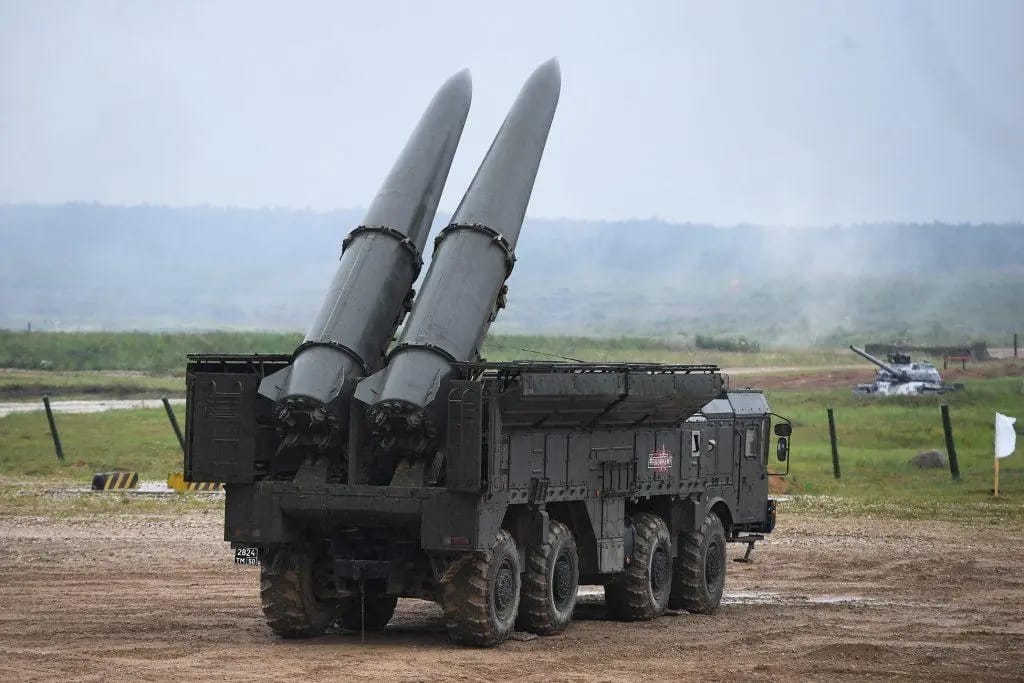
The Insider has found out that from August 2025 through February 2026, a total of 59,000 tons of explosive materials were imported into Russia from the Far East, mostly through Nakhodka. Imported ammunition generally does not go directly to the war zone but is first sent to military warehouses in the rear. North Korea remains the most likely source of this cargo. The ammunition imported from North Korea consists of artillery rounds and charges, as well as KN-23 missiles.
North Korea remains the most likely source of explosive materials imported into Russia
Shipments of ammunition from North Korea to Russia were previously detected by a consortium of Western investigative outlets. In 2024, researchers at CSIS concluded, based on high-resolution satellite imagery, that around 2.5 million artillery rounds had been delivered to Russia by early 2024, mainly through the Far Eastern ports of Vostochny and Dunay. According to a 2025 investigation by the British NGO Open Source Centre, over the twenty months from August 2023 to March 2025, between 4.2 million and 5.8 million rounds were imported into Russia.
According to estimates by South Korea’s intelligence service cited in the media, around 12 million rounds had been delivered from North Korea to Russia by July 2025 – roughly two to two and a half times the number estimated by the Open Source Centre. These reports provided no specific evidence beyond sources South Korean intelligence; as such, The Insider considers the Open Source Centre’s lower estimate to be the most accurate and best-substantiated figure for the period in question.
At the end of 2025, Vadym Skibitsky, deputy head of Ukraine’s military intelligence agency, told Reuters that North Korea had run out of artillery shells. As a result, there were reportedly no deliveries at all in September 2025, and North Korea shifted to supplying drones instead. South Korean media also reported a sharp decline in ammunition deliveries in early 2026. However, The Insider’s investigation found that, judging by cargo descriptions and destinations — namely, artillery ammunition depots — shipments marked “explosive materials” were still being actively sent through the port of Nakhodka in 2026.
Who produces energetic materials and how?
To pinpoint the locations where energetic materials (brisant explosives, propellants and solid rocket fuels) are produced, one can follow the shipments of "civilian" reagents: nitric acid, concentrated sulphuric acid, nitration agent (mixture of nitric and sulphuric acid), toluene, urotropine, acetic acid, chlorates.
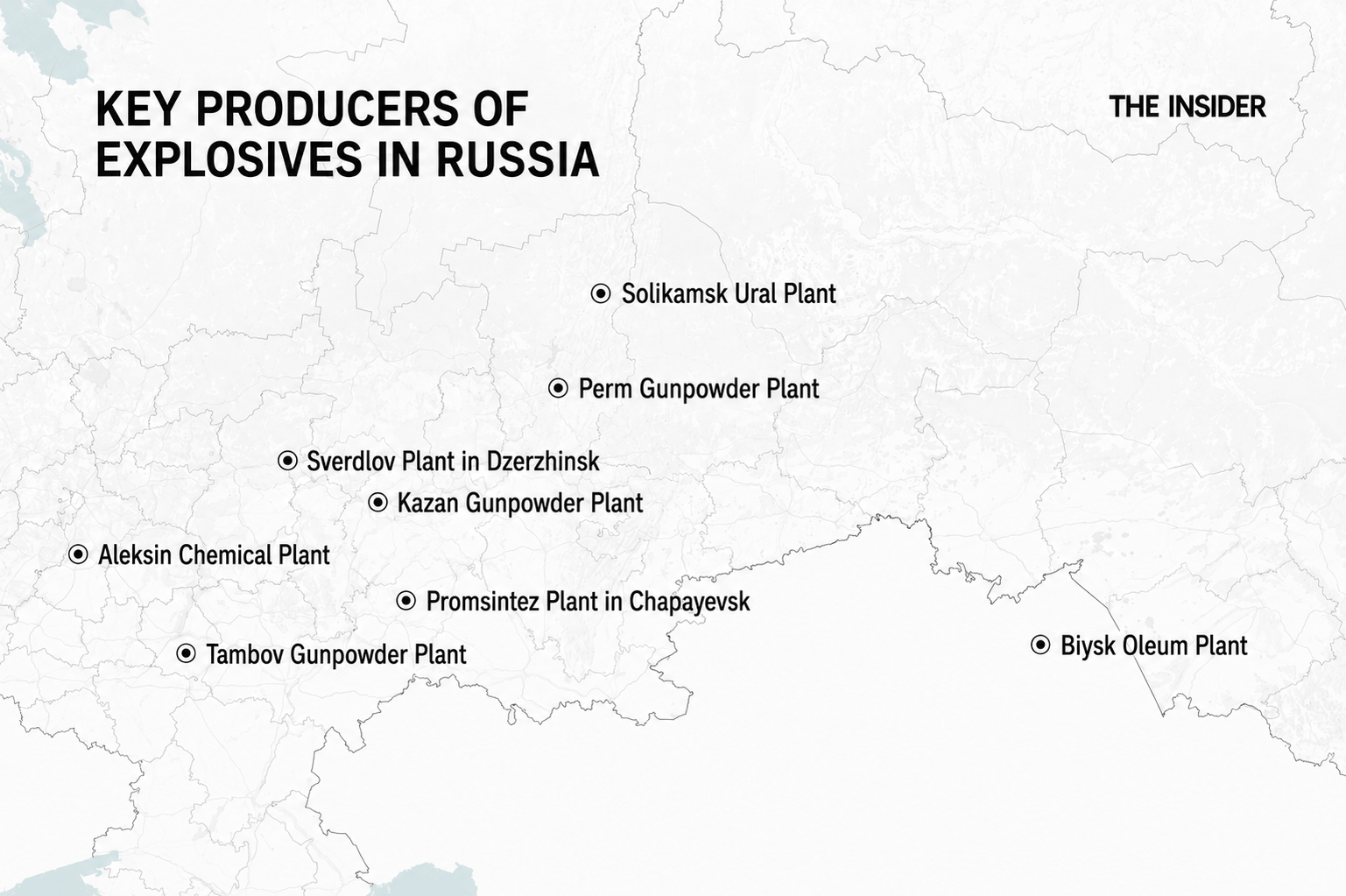
The freight data on these chemicals tell us that the manufacturing of energetic materials and products containing them is concentrated on a few plants. These include the Biysk Oleum Plant in Altai Krai, which, judging by its shipments, is likely producing large quantities of trinitrotoluene and smaller quantities of RDX; the Sverdlov Plant in Dzerzhinsk, Nizhny Novgorod Oblast, which is the leading producer of RDX in Russia and, according to its shipments, also produces some trinitrotoluene; and Promsintez in Chapayevsk, Samara Oblast, which primarily produces trinitrotoluene.
Nitric acid, oleum, nitration agent, and toluene are also received in large quantities by the Kazan and Tambov Gunpowder Plants, the Aleksin Chemical Plant, the Kamensky Chemical Combine, the Solikamsk Ural Plant, and the Avangard Plant in Sterlitamak. The Anozit plant in Kuibyshev, Novosibirsk Oblast, receives chlorates and produces ammonium perchlorate, a propellant used in solid-fuel rocket engines.
It all starts with nitric acid
The production of brisant explosives and gunpowder for military purposes is impossible without nitric acid.
The only two suppliers of nitric acid to Russia’s defense industry are EuroChem in Novomoskovsk (owned by Andrey Melnichenko, who recently made headlines with a widely discussed article in The Economist), and the Azot plant in Berezniki. Both facilities have been targeted by drone attacks, with the Novomoskovsk plant hit repeatedly.
Plants in Kazan, Dzerzhinsk, Chapayevsk, and Aleksin primarily receive nitric acid from Novomoskovsk, while the Biysk plant sources most of its supply from Berezniki. The Perm Gunpowder Plant, the Solikamsk plant, the Aleksin Chemical Combine, and Avangard receive a ready-made mixture of concentrated sulfuric and nitric acids used for nitration – directly from Berezniki.
Brisant explosives
Between August 2025 and February 2026 the Biysk Oleum Plant received 16,000 tons of toluene and 1,000 tons of urotropine. This points out to a intensive production of trinitrotoluene and to a launch of a new separate production line of RDX (which needs urotropine), thus breaking the Dzerzhinsk monopoly.
During the same time, 3,000 tons of toluene were brought to Chapaevsk - apparently indicating production of trinitrotoluene.
Beside the primary production of explosives, Russian explosives and ammunition plants apparently processed into finished ammunition 15,000 tons of explosive materials produced by their colleagues, from August 2025 to February 2026. This is seen from shipments that went from the Biysk Oleum Plant to the Sverdlov Plant in Dzerzhinsk and the Polymer plant in Chapayevsk.
Gunpowder
The output of the gunpowder makers – the Kazan, Perm, and Tambov Gunpowder Plants, the Aleksin Chemical Plant, and the Solikamsk Ural Plant – can be estimated judging by the amount of nitric acid and nitration agent they received. (The freight data also contain no information on deliveries of cellulose to these plants or deliveries from the plants to the military warehouses).
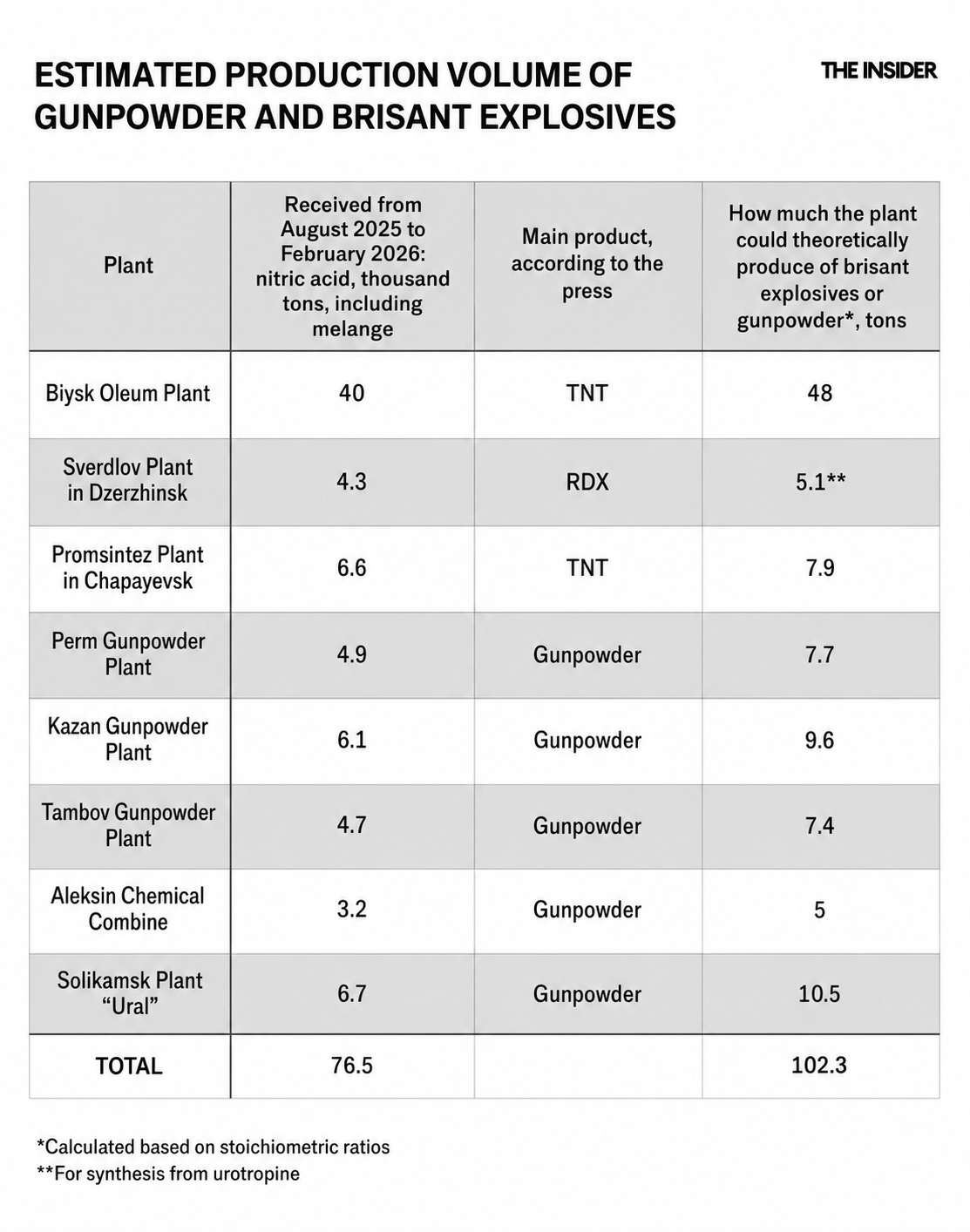
The total volume of explosives potentially produced looks quite large compared with prewar levels. In the first half of 2019, for example, military plants received just 21,800 tons of nitric acid, including melange; in the second half of 2019, they received 24,500 tons. In the first half of 2020, the figure was 21,200 tons, and in the second half, 23,000 tons.
It should be held in mind that the efficiency of all technological processes in real life is less than 100% - for example because not all of nitric acid is regenerated or recuperated. According to experts in chemistry The Insider has talked to, a typical outcome efficiency that can be expected in the Russian plants is around 90%. Hence the total production of gunpowder and brisant explosives between August 2025 and February 2026 was below 90,000 tons, or 154,000 tons per year.
Still, the production trend is clear even with this rough estimate. Annual nitric acid consumption by military plants now stands at 131,000 tons, compared with 44,200 tons per year before Russia’s full-scale invasion of Ukraine. Thus the intensity of operations at Russia’s gunpowder and brisant explosives plants has increased threefold on average.
Where do the explosives go?
According to cargo movement data, 14,000 tons of explosives were shipped from warehouses and plants to civilian enterprises, mainly mining companies, between August 2026 and February 2027. This figure has changed little compared with the prewar period. In the second half of 2020, for example, mining companies received around 18,500 tons.
Some substances intended for military use are turned into finished products — i.e. ammunition — at the same plant where they are synthesized. Others are produced at one plant and only become part of a finished product at another.
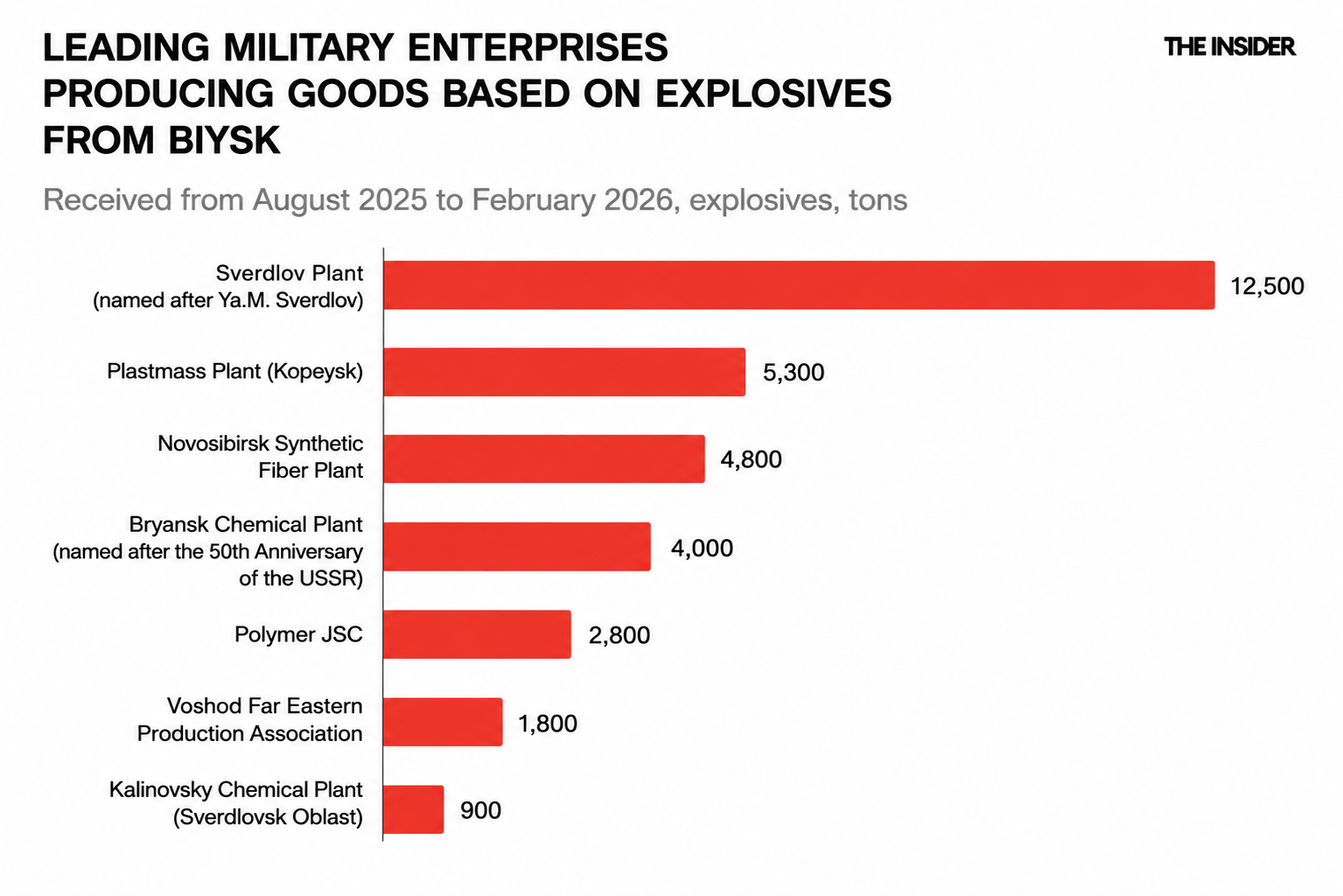
For example, the Sverdlov Plant both synthesizes brisant explosives itself and receives 12,000 tons of explosive materials from Biysk to manufacture military products, while the "Plastmass" Plant in Kopeysk, the Novosibirsk Synthetic Fiber Plant, the Bryansk Chemical Plant named after the 50th Anniversary of the USSR, Polymer JSC, the Voskhod Far Eastern Production Association, the Kalinovsky Chemical Plant in Sverdlovsk Oblast, and the Amur Cartridge Plant all receive materials from Biysk.
A special case: solid rocket propellant
Guided missiles generally use solid-fuel rocket motors for boosters or sustainer engines. This is the case for the 57E6E missile used by the Pantsir-S1 air defense system, as well as missiles for the Buk, S-300, S-400, Iskander-M, Kinzhal, and Oniks systems, and the Topol, Bulava, and Yars intercontinental ballistic missiles.
Ammonium perchlorate is used as the oxidizer in solid rocket propellant. The only plant in Russia producing this substance for use as an oxidizer in solid rocket propellant is Anozit in Kuibyshev, Novosibirsk Oblast. According to available railway data, the only recipients of ammonium perchlorate in Russia are the Perm Gunpowder Plant and the "Kamensky Kombinat" plant. Anozit is the only supplier of ammonium perchlorate.
Ammonium perchlorate is relatively easy to produce from ammonium chlorate and sodium perchlorate. The latter, in turn, is produced from sodium chlorate, which is a widely used chemical employed in the pulp and paper industry for bleaching.
Solid rocket propellant is a special case in the explosives supply chain. The Insider examined Anozit’s shipments of bulk chemicals. According to cargo movement data, in January 2026 the plant received just four substances in large quantities: hydrochloric acid, ammonia, caustic soda, and sodium chlorate.
Anozit received sodium chlorate exclusively from the chlorine plant at the Ilim Group’s pulp and paper mill in Bratsk – several railcars a month. In total, Anozit received 1,600 tons of sodium chlorate during the period in question. The pulp and paper mill thus became a direct participant in military production.
The ammonium perchlorate produced by Anozit (4,200 tons) was sent primarily to the Perm Gunpowder Plant (3,300 tons), with the remainder going to the Kamensky Combine.
Who consumes the explosives?
Railway stations that consume explosive materials but are not themselves military plants can be divided into four groups:
Military warehouses
“Military” stations
“Mining” stations
Unidentifiable stations
Railway stations that can be clearly identified as directly serving the military consume 64,000 tons of explosives and ammunition.
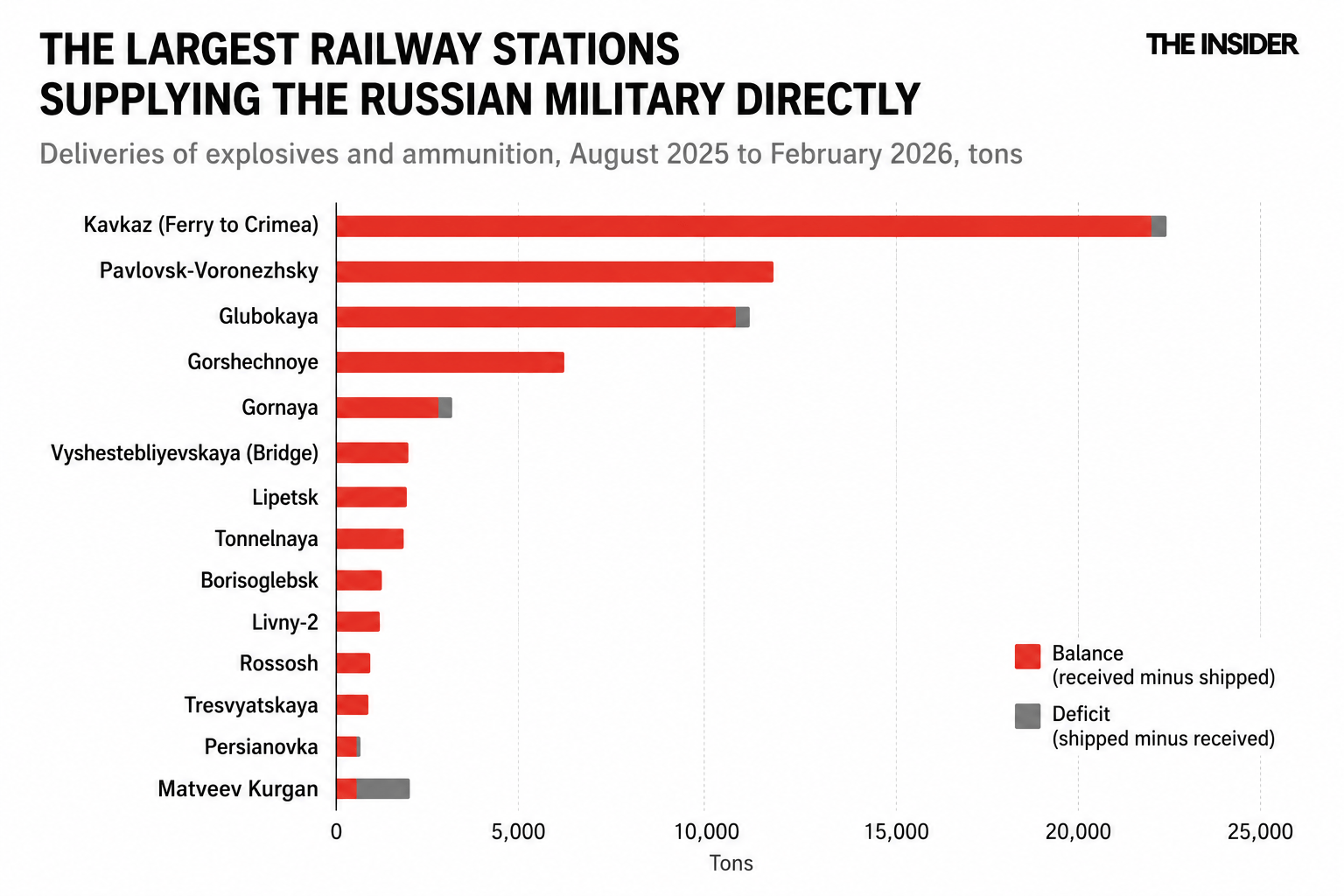
As these data show, the largest volume of ammunition arrives at "Kavkaz" station for onward shipment to Crimea by ferry.
At the same time, the net balance for stations that could not be identified – and which may serve either military or civilian warehouses or enterprises – was virtually zero over the same period, as total traffic through destinations in this category amounted to only around 1,000 tons.
Military warehouses that could be clearly identified on Google Maps with storage buildings plainly visible, shipped 182,000 tons of ammunition by rail during period from August 2025 to February 2026, and received 189,000 tons. Their net balance – a total of 7,000 more tons received than shipped – therefore has little effect on the overall balance of explosive materials. However, these figures should be treated with caution, as initial shipments from military plants, whether to warehouses or directly to the front, appear to be classified.
Mining – that is, civilian enterprises and warehouses belonging to the mining industry – accounts for the consumption of around 14,000 tons of explosive materials.
Additionally, around 4,000 tons of explosives and ammunition were exported to Belarus, while the remaining imports and exports involving Kazakhstan and Azerbaijan were negligible
What was it like before the war?
In the second half of 2020, Russian plants sent to their customers around 40,000 tons of explosive materials. Imports were negligible, and the mining industry consumed 18,500 tons.
The output of gunpowder and brisant explosives plants was significantly lower before the war: their consumption of nitric acid, including melange, amounted to 21,000 tons over six months, compared with 76,500 tons between August 2025 and February 2026. This is also reflected in shipments from gunpowder plants, which apparently had not yet been concealed at the time. For example, the Kazan Gunpowder Plant shipped just 146 tons in the second half of 2020.
What does this tell us?
Russia’s main high-volume production chains for gunpowder and brisant explosives are not dependent on imports. At the same time, they are heavily concentrated among a small number of monopoly producers. All nitric acid supplied to military plants comes from Novomoskovsk and Berezniki. All TNT production is concentrated in Biysk, Dzerzhinsk, and Chapayevsk, and until recently, virtually all RDX was produced in Dzerzhinsk.
However, the bad news for Ukraine is that, judging by cargo movement data, Biysk has successfully brought its own RDX production online – a project that had previously only been announced. Dzerzhinsk has therefore lost its monopoly in this market.
Biysk has successfully brought its own RDX production online
Judging by nitric acid consumption at explosives plants, Russia has managed to increase explosives production roughly threefold since 2020. One possible explanation is that the only factor constraining further growth is the fact that production lines are already operating at full capacity – after all, much of the chemical-processing equipment used in Russia was, until recently, itself imported.
Even with Russia’s chemical plants operating at such high capacity, North Korean assistance remains critical when it comes to the supply of artillery ammunition. The estimated North Korean shipments of 59,000 tons between August 2025 and February 2026 roughly correspond to the volume of ammunition being expended at the front – at least 64,000 tons over the same period. These deliveries allow Russia to avoid significantly depleting its own stockpiles. In fact, Russian ammunition depots show a positive balance (according to the incomplete data available). It appears that Russia’s explosives plants were heavily underutilized before the full-scale war.
Statements by Ukraine’s military intelligence agency at the end of last year asserted that North Korea’s stockpiles had long since been depleted and that Russia would have to return to self-sufficiency. However, as The Insider has established, this was not the case. North Korea continued to actively supply ammunition to Russia until this spring, with the shipments being sent to the war from the port of Nakhodka.