As The Insider has discovered, Russia is rapidly developing the domestic production of lithium-ion batteries for FPV drones. This is evidenced by a sharp rise in imports of materials needed to assemble this component, with several areas showing manifold growth. The development of the industry in Russia will significantly undermine the West’s ability to influence the supply of drones to Moscow’s military.
At a minor industry trade show in Yekaterinburg in the summer of 2025, Anastasia Mikhailova, director of Rosatom’s subsidiary Renera, announced Russia’s revolutionary ambitions in the field of drone component manufacturing. Her statement went almost unnoticed — even among federal media, only TASS quoted Mikhailova. But her words amounted to nothing less than a declaration that Russia had set a course toward full production autonomy in manufacturing the most lethal weapon of modern warfare.
Captured deposit in Ukraine
Russia’s plans to fully localize the production of lithium-ion batteries by 2030 were announced just a couple of weeks after Russian forces captured the Ukrainian village of Shevchenko, which happens to hold the only major lithium deposit under Russia’s physical control.
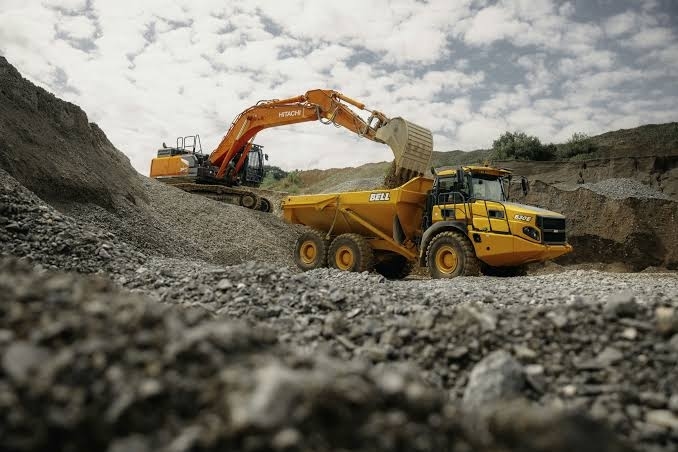
Ukraine long considered this lithium deposit to offer real potential for development, with Kyiv’s State Service of Geology and Mineral Resources estimating the lithium oxide content of local rock at 1.24%. For comparison, major deposits in Australia, where lithium is also primarily extracted from minerals, have a lithium oxide content of approximately 1–3%.
Russia was so eager to seize the deposit that the first reports of its capture appeared as early as January 2025. In reality, however, Russian forces did not bring it under control until half a year later.
Russia was so eager to seize the deposit that it announced its capture six months before actually establishing control
Russia does not mine lithium domestically in quantities sufficient for independent battery production. Before the start of the full-scale war, lithium was procured from Chile (in carbonate form) via the companies Albemarle Limitada and SQM. It was then processed into lithium hydroxide before being re-exported. However, a few years ago this business shut down, and Chinese companies stepped in to help Russia build a battery industry.
According to estimates from the Conflict Intelligence Team, drones are the most lethal weapon of war in Russia’s ongoing invasion of Ukraine, responsible for 42% of civilian deaths (in 2025) and more than 80% of military casualties (2026). At the front, FPV drones are the primary offensive weapon and the main tool for controlling the “infiltration zone.”
As The Insider previously reported, Russia assembles FPV drones primarily from Chinese parts on a construction-set basis — an approach that formally violates Chinese law, since Beijing prohibits the export of military components to both Russia and Ukraine. FPV drones require electric motors, flight controllers, fiber optics, and batteries.
Russia is not yet able to produce certain basic drone components — lithium-ion batteries in particular — in a commercially viable, efficient, and timely manner. But it is steadily moving in that direction.
Growth in electrolyte supplies
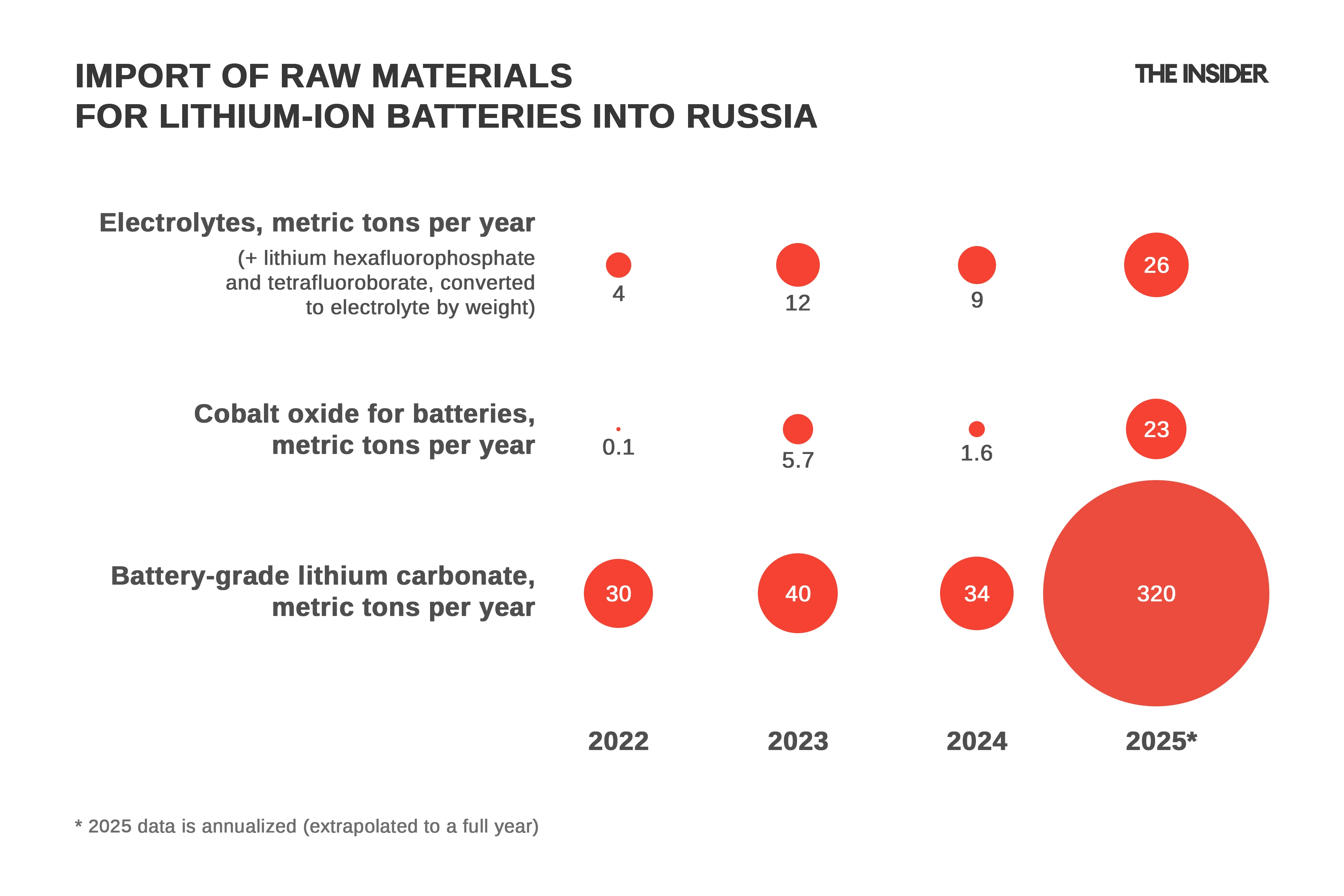
Lithium-ion batteries use a specific electrolyte based on lithium hexafluorophosphate or tetrafluoroborate. The Insider found that in the first quarter of 2025, Russia imported more than 6.6 metric tons of lithium-ion battery electrolyte and tetrafluoroborate (expressed as electrolyte equivalent), suggesting annual imports of around 26 metric tons.
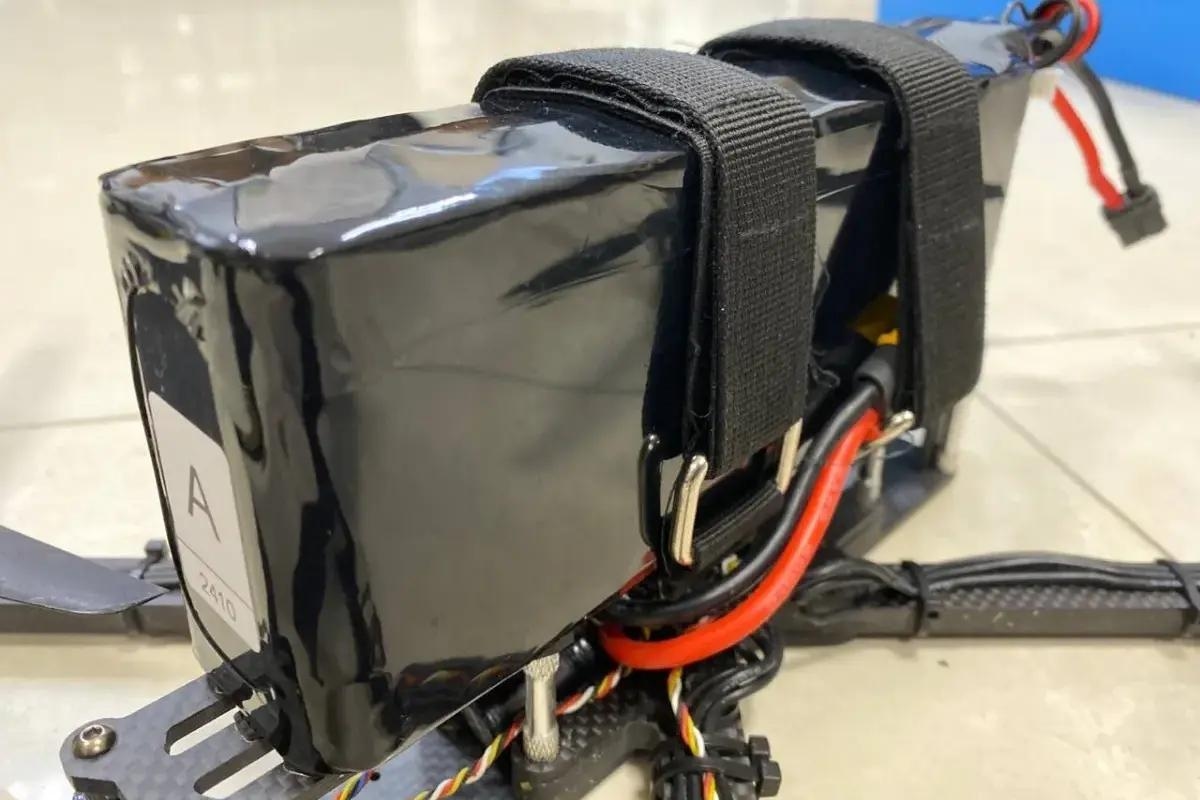
The share of lithium hexafluorophosphate electrolyte in the finished product is approximately 15% of the battery’s total weight. Assuming a typical battery weighs roughly 1 kilogram, 26 tons of electrolyte would be sufficient to manufacture batteries for approximately 150,000 FPV drones.
To compare, in 2024 Russia imported 9 metric tons of electrolyte and hexafluorophosphate (expressed as electrolyte equivalent); in 2023, the figure was 12 tons; and in 2022, it was only 4 tons. The recent growth may indicate a serious ramping-up of the country’s battery industry.
The main manufacturers of the imported products were the Chinese companies Huizhou Capchem Chemicals, Jiujiang Tinci Materials Technology, Weifang Tianyuan Battery Material, and Huzhou Kunlun Enchem Battery Materials. The suppliers were Shenzhen Capchem Technology, Shanghai Ginger Logistics International, Hainan Goodwin Trade, and Gensync Chem.
The primary Russian importer of electrolytes for lithium-ion batteries was Obruch DV LLC. Recently, electrolytes have also been imported by AK Rigel JSC, NPO Lenergomash LLC, and Uraltekhimport LLC.
Back in 2011, Uraltekhimport signed a contract to supply equipment for the project “Reconstruction of the Chemical Power Sources and Special-Purpose Battery Production Complex” under the federal targeted program “Development of the Defense-Industrial Complex.” In recent years, its main counterparty was Uralelement JSC, which is owned by the Tactical Missiles Corporation (through MPO Gidropribor Concern JSC).
In addition, Uraltekhimport also imported battery trays, along with cathode material from Tianjin Guoan Mengguli New Materials Science & Technology and anode material from Shanghai Shanshan New Material. The company also procured Shenzhen Hongrui Keji polypropylene separators and drying ovens. This list is essentially a complete set of components for battery assembly — the only missing items being aluminum and copper electrodes (which are presumably sourced domestically). In all other respects, the “localization” here is organized like a construction set: all materials and equipment are brought in from China and then assembled into a finished product at facilities inside Russia.
The fact that Uraltekhimport is specifically interested in drone-related equipment can also be inferred from the purchases of thin sheets of a magnesium (90%) and aluminum alloy, which are used in aviation to manufacture lightweight yet sturdy airframes.
Cathode material
Ready-to-use cathode material for batteries consists of a mixture of oxides of lithium, cobalt, and other metals. Imports of cobalt oxide intended for the battery industry amounted to 5.8 metric tons per quarter in 2025, against 400 kilograms per quarter the previous year. In other words, imports grew by a factor of 15 in just one year. The main buyers were Obruch DV LLC and Tradecom LLC.
In 2025, Russia brought in 93 metric tons of pure lithium hydroxide and 130 metric tons of carbonate per quarter. The latter was imported both as lithium carbonate for construction purposes (a cement-setting accelerator) and for the battery industry. Battery-grade lithium carbonate imports amounted to 80 metric tons.
The main manufacturer of battery-grade lithium carbonate imported into Russia was Sichuan Zhiyuan Lithium Industries Inc. The buyer was reseller company Promtorg-Invest LLC. Based on the approximate weight of a typical drone battery and the proportion of lithium in it, the lithium feedstock supplied could have been sufficient for several hundred thousand batteries.
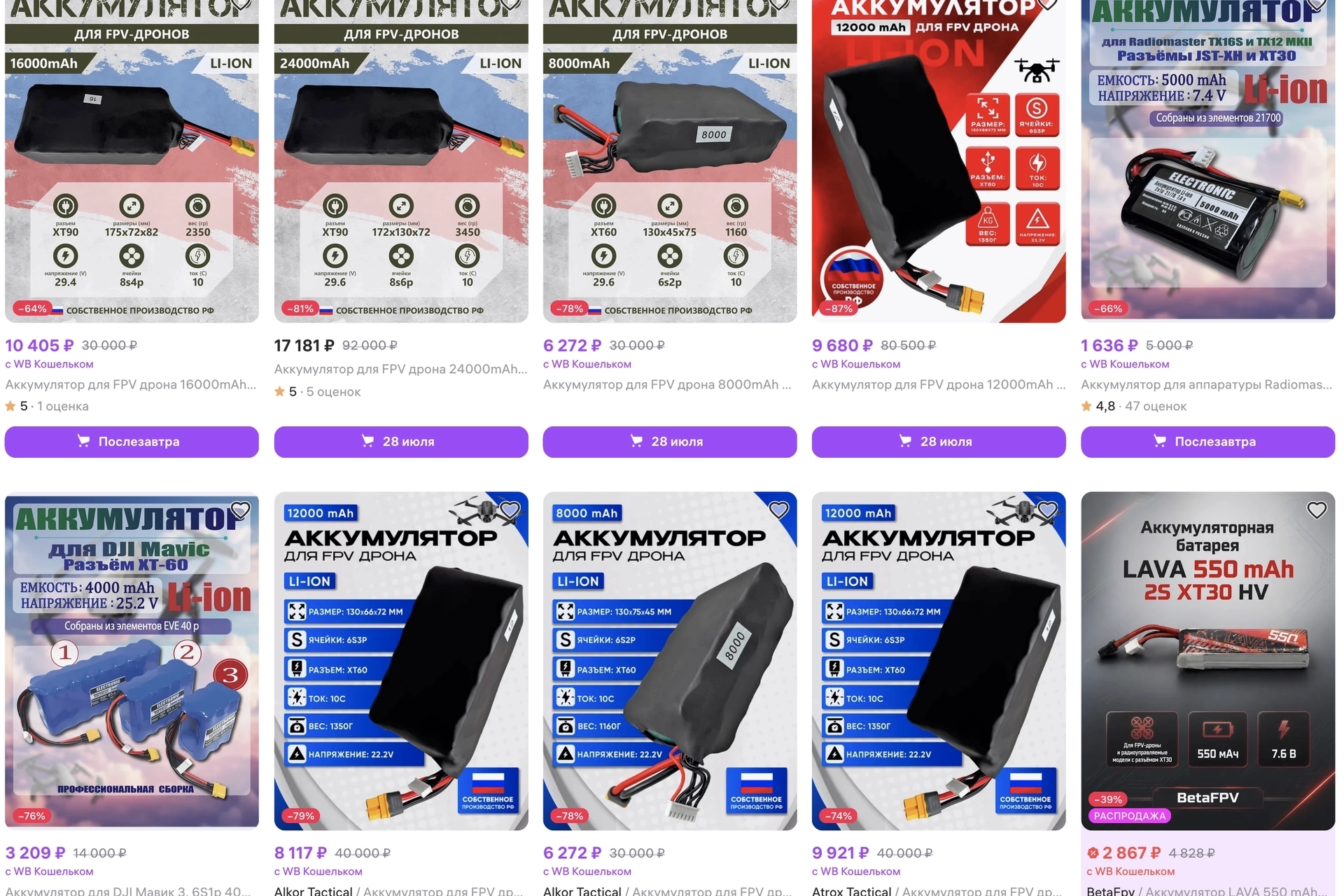
Uraltekhimport and its partners appear to be attempting to work with primary raw materials. As for the production localization announced by Rosatom at the RENERA factory in Neman, Kaliningrad Region, this effort currently looks like it is in a relatively early stage of development. The company has purchased ready-made lithium-ion battery cells in South Korea from its subsidiary Enertech International (56 metric tons in the first quarter of 2025 alone) and assembled them into battery packs. Judging from the purchase of drying ovens from the Korean company Jktech, the Russian side appears intent on developing fully domestic production as quickly as possible.
However, pro-war propagandists add a caveat: the plant in Neman is “not yet” geared toward producing “defense-grade batteries.” The factory, they say, will manufacture traction batteries for electric vehicles and batteries for stationary energy storage systems.
In short, a sharp two-year rise — by a factor of ten or more — in imports of electrolyte and cathode material allows us to say with confidence that Russia’s battery industry is emerging, starting practically from scratch. Moreover, its actual development is, in all likelihood, even outpacing the triumphalist announcements of regional officials. One can only assume they are afraid of falling under additional sanctions before the production process can be fully established.