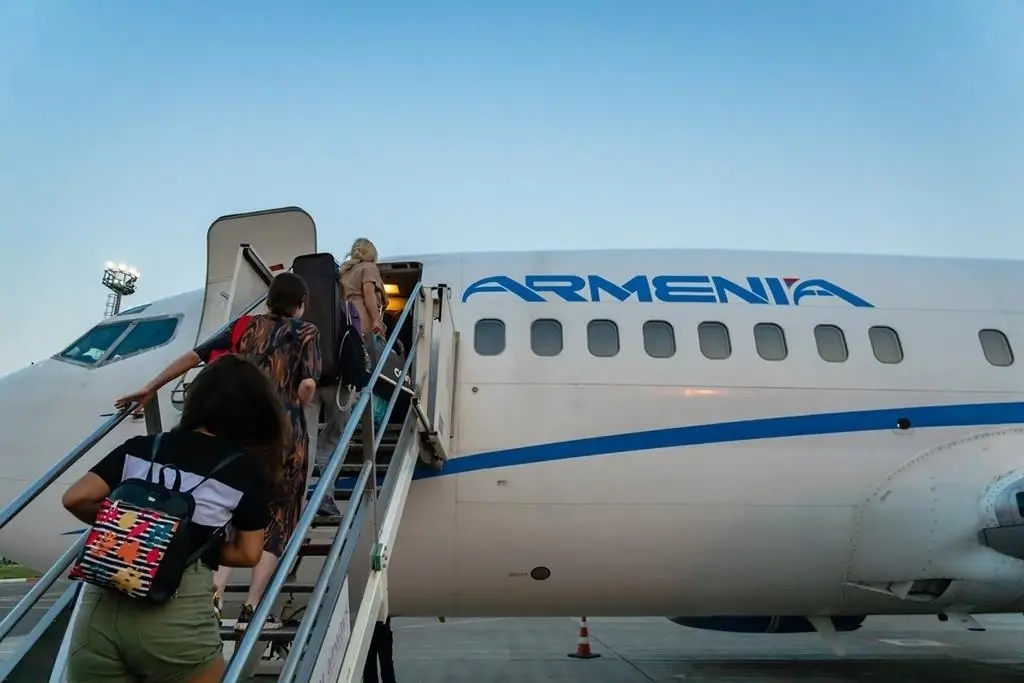
Several hundred thousand people left Russia after February 2022, and their arrival has already affected GDP growth in smaller popular destinations such as Armenia, Georgia, and Serbia. IT specialists brought an influx of foreign currency, investors heated up real estate markets, and entrepreneurs started thousands of companies. In parallel, emigrants are transforming the local cultural environment — opening their own bookstores, theaters, and clubs, often making a nice addition to the local context. The flip side of these changes has been a surge in housing prices, which is now forcing some local residents to migrate as well.
Where Russians settled
Reliable data on the total number of Russians who left the country after February 2022 is hard to come by. Statistics of the Federal Security Service count the number of border crossings — 23.2 million exits by Russian citizens in 2022 and 31.5 million in 2025. However, these figures mostly count the number of tourists as their travel destinations confirm: in 2025 the leaders were Turkey (6.6 million), the UAE (1.7 million), Egypt (1.6 million), China (1.3 million), and Thailand (886,000). Among these countries, only Turkey and the UAE are also popular for emigration.
Based on data from host countries, the number of Russians who emigrated in 2022 can be estimated at 600,000—650,000 people. Kazakhstan led in terms of inflow (146,000), followed by Armenia (110,000), Turkey (77,000), Israel (75,000), Georgia (74,000), and Serbia (around 30,000).
However, the statistics here are not entirely accurate either, as each country counts immigrants differently: Georgia includes stays exceeding 180 days, Armenia focuses on the registration of social services cards and banking activity, Kazakhstan counts the number of individual identification numbers issued, Turkey looks at residence permits, while Israel only counts passports obtained by migrants.
Methodology changes in Armenia only add to the confusion. In 2022, the country recorded 110,000 emigrants from Russia, but in 2025 the number of newcomers dropped to 1,400 — simply because they switched to counting by residence permits, which are much harder to obtain. Serbia has issued 67,000 one-year temporary residence permits, but it is unknown how many of them were renewals. In short, all estimates of the number of Russian emigrants should be considered approximate at best.
To track the emigration trajectories, the independent think tank Center for Analysis and Strategies in Europe (CASE) developed three models: transit (arriving in one country with a plan to move to another within 6—18 months), anchoring (deciding to stay in the host country, obtaining a residence permit or passport, integrating into the local labor market), and circulation (frequently moving between two or three countries without a clear plan of settlement). According to the research findings, while the “transit” model dominated in 2022—2023, in 2024—2025 the share of those “anchoring” began to grow.
Importantly, the majority of Russians who left their home country in 2022—2024 were highly skilled professionals, according to the 2025 report of the OutRush project, which based its findings on a survey of 8,500 emigrants across more than 100 host countries. 41% of respondents turned out to be from the IT sector, and another 21% worked in culture, science, and media. According to the findings, approximately 7% of those who left started their own business after relocating, and 28% plan to do so in the future.
Moreover, the researchers conclude that, “contrary to official statements about the number of returnees, reversing the brain drain in the short term appears unlikely”: from summer 2023 to summer 2024, only 8% of respondents moved back to Russia. Among those who do not plan to return in the near future, 54% said doing so would be possible only if there is political change in the country.
How the immigrants are affecting host economies
As a rule, an influx of immigrants accelerates GDP growth, increases productivity, and stimulates innovation in host countries — both developed and developing ones. But this is conditional on people being able to work legally and the state conducting an active integration policy. A meta-analysis of 41 studies published in Economies (MDPI) illustrates this reality.
In Armenia, Georgia, and Serbia, Russian émigrés have occupied a noticeable share of the labor market and consumer demand. As a result, the average annual GDP growth rate in Georgia from 2022-2024 spiked to 9.4% after averaging 4.4% between 2012 and 2021. Since the start of the war, Armenia’s average annual GDP growth rate increased from 3.6% to 9%, and Serbia’s, from 2.1% to 3.5%.
Newcomers are often “fiscally positive” — meaning they bring additional revenue for the budget, CASE writes. After all, aside from very rare exceptions, they do not receive social benefits, but they do pay indirect and sometimes direct taxes (especially in Serbia).
Migrants from Russia do not receive social benefits, but they pay indirect and direct taxes
Furthermore, Russian émigrés are noticeably wealthier than the population of the host countries listed above. Their average monthly household income in Serbia borders on €3,500 despite a national average of around €900. In Georgia, it’s €3,300 per household versus €650 for local residents, and in Armenia it is €2,500 versus €300. This difference increases the economic value of Russian emigrants as consumers, especially in the upper segment of the services market.
The income gap is explained not only by the newcomers’ higher levels of education, but also by the fact that for the majority of relocants to these countries (63%), their main source of income is located in another country — and for 31%, it is not even Russia, but a third country. This fact can be explained by the high proportion of IT specialists in the sample. By comparison, for 79% of those who emigrated to the EU, the source of income is located in the country of residence. Therefore, in Georgia, Armenia, and Serbia, Russians contribute less to competition on the labor market.
Serbia: Russians are not willing to overpay
Following the start of the full-scale war, thousands of Russians moved to Serbia, attracted by the visa-free regime. From February 2022 to December 2024, Russians received 67,236 temporary residence approvals. The newly arrived Russian population in the country is usually estimated at around 100,000 people, with most of them settling in the capital, Belgrade, and the northern city of Novi Sad. It is to these cities that many Russian IT companies relocated their employees.
Russians are actively investing in Serbian real estate and have become the leading group of foreign buyers in the country. Demand peaked in 2022, but purchase and rental prices remained at a high level before the market began to cool off in 2026.
“There is a perception that all Russians are rich, that they don’t care how expensive the rent is, and that the landlord can ask for the maximum possible price, but based on my experience both here and in Montenegro, that no longer works,” a local real estate agent says, as quoted by a Serbian publication. In addition, some Russians have returned to their home country, while others have moved on, also contributing to the decline in rental rates.
Entrepreneurial activity also gained a boost. According to data from the Agency for Business Registers, in 2022 Russians opened more than 2,000 legal entities in Serbia and another 3,000 registered as sole proprietors — mostly in the tech sector, but also including consulting firms, coffee shops, kindergartens, and beauty salons. By 2024, the country had already registered 8,000 sole proprietors of Russian origin.
According to the map of physical spaces opened by Russian immigrants, coffee shops and restaurants (over 140 venues) dominate, with bars (over 50 venues) also high on the list. The third most popular sector was beauty salons, and the popular chain TT includes bistros, restaurants, and barbershops.
Kirill, an emigrant who spent several years in Belgrade, says that TT “are the go-to guys whose services everyone used.” TT co-founder Yevgenia Kaminskaya told Forbes that local commerce is “perfectly suited for the hospitality industry.” According to Kaminskaya, the clientele of her establishments is now evenly split between Russians and local residents.
In Serbia, Russians mostly opened coffee shops, restaurants, bars, and beauty salons
Kirill also mentioned the Stories chain: “The owners opened several trendy little restaurants in the center. After a couple of years I noticed that Serbian places were already trying to copy them.” The couple who opened Stories — Vadim Nikitin and Katerina Iksanova — moved to Serbia in the spring of 2022. There is also the Sloj cafe, Kirill adds, “one of the few places with Easter kulich cakes.”
Another emigrant, Andrei, speaks of the demand newcomers have brought for national cuisines. For example, emigrants from Kazan opened the Fomin Bar Beograd, offering Tatar dishes. And both Russians and Serbs come to the Russian-owned Process bar.
In a conversation with The Insider, émigré Yana noted that one of the innovations Serbian cafes picked up from Russian-owned establishments was mate tea, which has become a hit among locals. Following the appearance of emigrant venues, some Serbian establishments also began opening smoke-free coffee shops and bars, Yana observes.
Serbia also has bookstores opened by emigrants — Auditoria, which has several branches in the Balkans (another store in the Montenegrin city of Budva); Lav i Žabac, specializing in children’s literature; Dobar Dabar, combining a bookstore and cafe; and Bela Vrana stores in Novi Sad and Belgrade.
Armenia: the rental split
Russians can enter Armenia with nothing more than a domestic ID — a crucial benefit for those fleeing political persecution who did not already have an international passport. According to Armenia’s Minister of Economy Vahan Kerobyan, in 2022 alone, around 110,000 Russians moved to Armenia.
But Armenia received more than just political activists. According to data from the Arca agency, in 2022 more than 800 Russian companies opened offices in Armenia, and in 2023 that figure increased to 3,000 companies (around 40% in the IT sector).
In addition, many Russian IT specialists found jobs in Armenian companies — 5,000 of them by July 2022 alone, according to a Modex study, accounting for 14% of the overall positions in the country. In total, in 2022 the sector grew by 20% and accounted for 4.5% of Armenia’s GDP.
As a result of the influx, the Armenian dram was able to appreciate, thereby significantly slowing inflation. Money transfers from Russians to Armenia in 2022 amounted to $1.75 billion, twice as much as in the pre-war year of 2021 ($856 million).
Money transfers from Russians to Armenia in 2022 amounted to $1.75 billion, twice as much as in the pre-war year of 2021
Moreover, the rise in rental prices made real estate a desirable asset, leading to a construction boom. The rise in rents also invigorated the secondary housing market. “People with savings were buying real estate on the secondary market to rent it out. Currently, the highest demand is for properties renting at $300—500, which reflects the income level of the population,” explains Andranik Harutyunov, founder of the Silver REA real estate agency and a member of the Armenian Association of Real Estate Agencies. It was the immigrants, especially those working in IT, who drove up the rates, and cases of landlords terminating contracts with local tenants in order to rent apartments to newcomers at several times the price became common in the local media.
However, IT specialists have now started to move elsewhere — around 3,750 left the country in 2025. Of them, 2,586 (69%) are Russians, Ukrainians, and Belarusians. One of the reasons is the increased rental rates, argues economist Sevak Hovhannisyan: “Even in Tallinn, renting an apartment will cost 22% less.”
Local residents have also been forced to look for cheaper housing. Yerevan resident Suzanna complains that she and her family had to leave the apartment they were renting after the landlord doubled the price: “In 2022, when Russians arrived in Armenia, the rent for this apartment doubled. We offered the landlord a long-term contract for 120,000 drams [$300], but he refused.” For a year, a family of four was forced to live in one room in a dormitory, paying 100,000 drams ($250) per month.
By 2025, the rental market had stabilized. Experts note a 30% decline in rates compared to the peak at the start of the full-scale war. However, these “shock” years have contributed to the growth of the Armenian economy through the payment of a 10% rental income tax.
Georgia: money came, prices rose
Neighboring Georgia is another popular destination for Russian immigrants, and even four years after the start of the full-scale war, a considerable number of newcomers have chosen to stay there. Media, citing sources in the country’s Interior Ministry, report that by 2026 immigrants from Russia, Ukraine, and Belarus totaled 108,222 people, a figure representing 2.6% of Georgia’s population. Of these, 72,000 are Russians.
According to the National Statistics Office, by 2024 more than 37,000 companies founded by Russians had been registered in Georgia. The overwhelming majority of them (89%) are small businesses. The situation in the IT sector overall resembles that in Armenia: a boom in 2022—2023 and a 12% decline in 2024. The same trends apply to GDP growth: a sharp rise (10%) in 2022, followed by a slowdown in 2023 (7%) and a decline to 4% in 2024.
The Gnomon Wise research institute names money transfers from Russia as one of the main growth drivers. In 2022, the number of transfers grew by a factor of 6.3, with the total sum amounting to $2 billion. However, total transfers decreased by 26% the following year.
The rental market in Georgia also saw a major boost during the first year of the war. According to a TBC Bank study, in May 2022 year-on-year rental prices had more than doubled (+101.4%), and rental yield reached 11.4%, exceeding the May 2021 figure by 4.6 percentage points. Russians have also contributed to the real estate market. According to the Georgian Ministry of Justice, 4,520 Russian nationals purchased 6,062 properties in the country in 2022, and another 1,679 Russians bought 2,187 properties in the first quarter of 2023. Direct Russian investments in Georgia in 2022 reached a historical high, with Russians ranking sixth after citizens of the United Kingdom, Spain, the Netherlands, the United States, and Ireland.
If we assess the overall impact of Russian emigration on Armenia, Georgia, and Serbia, their economic benefit is undeniably positive. Among the benefits are an increase in real estate transaction volumes and tax revenues. The overall upturn is probably not entirely attributable to the newcomers, but denying their contribution would be a mistake. Even if we explain this effect by pointing to other factors (for example, Georgia’s and Armenia’s GDP could have been influenced by grey imports of sanctioned goods into Russia), one cannot fail to notice the connection between IT sector growth and the arrival of Russians.
At the same time, some of the potential downsides are largely neutralized by the specifics of this migration wave. One cannot say that the newcomers have caused a crisis in the labor market, as the majority of immigrants work remotely, often for foreign companies and clients. Some earn a living locally, of course, but in many cases such workers are hired by their fellow immigrants — for example, in bars or Russian-language private schools.
Cultural life
Russian emigrants have influenced not only the economies of host countries, but also the cultural milieu and public environment. In Armenia over the years of war, emigrants have opened vegan restaurants, bars, bookstores, theaters, and branches of streetwear brands.
Among the new cultural projects is the Common Ground bookstore-cafe in Yerevan, which, according to co-founder Grigory Karelsky, aspires to “enter the local context without abandoning its Russian past.” The project’s team consists mainly of Yerevan humanities students, with a young Armenian writer, Aram Avetis, working as a sales consultant. Journalist Mark Grigoryan compared Common Ground to Yerevan’s cafes of the 1970s — “islands of freedom” where people would discuss the latest news and pass around samizdat books.
The troupe of the Arten international theater sees its mission as introducing the audience to a new theatrical language, says co-founder Alexander Teterev-Kosach — “because Armenia, like everywhere throughout the post-Soviet space, is faced with a problem of a heavy institutional legacy,” he explains.
The theater seeks to enter the local context without pretending to have completely abandoned Russian culture and its Russian roots:
“We can simultaneously put on productions related to the political situation in Russia and gradually immerse ourselves in local contexts. Armenian culture absorbs many different things without losing its identity. Therefore, if your presence here maintains a creative flow, you will not feel out of place even speaking about things not directly related to Armenia.”
The theater has also hosted performances by Armenian artists. Among them, the work “Planned Power Cut” stands out — a documentary production about a difficult childhood in the 1990s and power cuts against the backdrop of the Karabakh wars.
Georgia also experienced a boom in Russian cultural and social spaces after 2022. Tbilisi has at least four émigré bookstores: Auditoria — a blend of bookstore, bar, coworking space, and event venue; Itaka — a bookstore by Stas Gaivoronsky, creator of the once-popular Moscow bookstore Khodasevich; and the recently opened stores Kenekethem and Odradek. Kenekethem has a large selection of feminist literature and autofiction, while Odradek carries titles not only in Russian, but also in Ukrainian, Belarusian, Georgian, and English.
Besides bookstores, Tbilisi has seen the launch of multiple music venues. The best-known is a bar located under the Baratashvili Bridge with the ironic name Revolution. It hosts jazz jams and noise evenings featuring Russian and local underground performers, as well as internationally acclaimed foreign musicians.
The electronic music scene has seen a particularly powerful émigré influence. Moreover, since the capitals of Georgia and Armenia are only a few hours apart by car, the processes taking place in these countries overlap considerably: Russians living in Armenia often organize events in Georgia, and touring Western artists frequently include concerts in both Tbilisi and Yerevan.
Matvei Vysochkin, co-founder of the BAN club and the DOD promo group, told The Insider that the arrival of a new wave of professionals and audiences from Russia in recent years has acted as a powerful catalyst:
“The main outcome is that an environment emerged in which local artists and organizers had to compete and collaborate far more actively. The musical landscape of Armenia and Georgia has become more complex, more diverse, and, if you will, more ferocious. Immigration brought fresh air, new competencies, and a demand for complexity. We, DOD Promo, focus on unconventional experiences — we have brought in Container, Elvin Brandhi, Jozef van Wissem. This often happens in conjunction with Nazlo Records (a noise and ambient label), which creates an environment for those who find standard techno too confining.”
At the same time, according to Vysochkin, concert organizers face a range of challenges, often of financial nature:
“Demand has grown, but touring acts still barely break even, and the classic sponsorship market is often limited to the ‘scam sector’ (casinos, dubious fintech). Nevertheless, some cases of skillful resource management have emerged. For example, the MOST / Hayfilm venue: these guys demonstrate the highest level of skill in working with partners. Thanks to them, Yerevan hosts legends of the caliber of Miss Kittin, Juan Atkins, and DJ Stingray. Importantly, they create a bridge not only with Europe but also with Tbilisi, providing a platform for Georgian DJs who currently find it harder to perform at home due to political pressure and club closures.”
In fact, according to Vysochkin, the most interesting developments are unfolding at the grassroots level, where music serves as a tool for building connections between people: “There is SEC (Sound Enthusiastic Community), an independent educational platform and community. The guys are building sound systems with their own resources, conducting synthesis lectures, and helping newcomers enter the industry. In addition, Armenia is becoming a hub not only for music but also for instruments. Slava (VG Line) and SOMA (Vlad Kreymer), together with local craftsmen like Art Tadevosyan (Spielwiese), Madsound Factory, Sound Labs, and Microrack, design and assemble synthesizers of world-class quality.”
Tightening the rules for immigrants
Overall, the influx of Russian immigrants has had a positive effect on the economic growth of the host countries. However, a sharp rise in prices and the newcomers’ weak integration into local society are causing serious discontent.
Authorities in Georgia are reacting to this most noticeably, with a systematic tightening of immigration policy and business regulations. In mid-April, the Georgian parliament adopted amendments to the Law on Labor Migration, which require foreigners to obtain a residence permit and a work permit before gaining employment with Georgian companies or performing services for clients inside the country. At the same time, many immigrants fear fines and complain about unclear application timelines and the absence of clear responses from the Ministry of Justice after submitting a work permit application.
Immigrants fear fines and complain about unclear application timelines and the absence of clarity from the Ministry of Justice
Maxim, co-owner of the Odradek bookstore, describes the current situation: “News about the regulation changes started appearing last year. A little later, a wave of inspections swept through Tbilisi. Discrepancies were identified, warnings and fines were issued.”
The main problem, says Maxim, is the absence of legal clarity:
“The more you try to figure it out, the deeper you sink into an almost Kafkaesque process: different sources contradict each other, and there are no clear instructions. For example, at the House of Justice, I was told that if the work permit application process has already been started, one can continue working. At the same time, the employee added that it would be better to additionally clarify this with the migration service, but it turned out to be impossible to get through to them: all of their phone numbers either do not answer or are blocked. The lawyers we consulted gave the diametrically opposite recommendation: working without an approved permit is not allowed. As a result, we have diametrically different interpretations of the same situation. It creates a feeling of artificially created chaos — a classic ’go do that thing, I don’t know what.’’”
For now, Maxim is trying not to dwell on the negatives. However, on May 1, when the amendments to the law came into force, Odradek nonetheless closed temporarily, until the Georgian Ministry of Justice processes the submitted application.