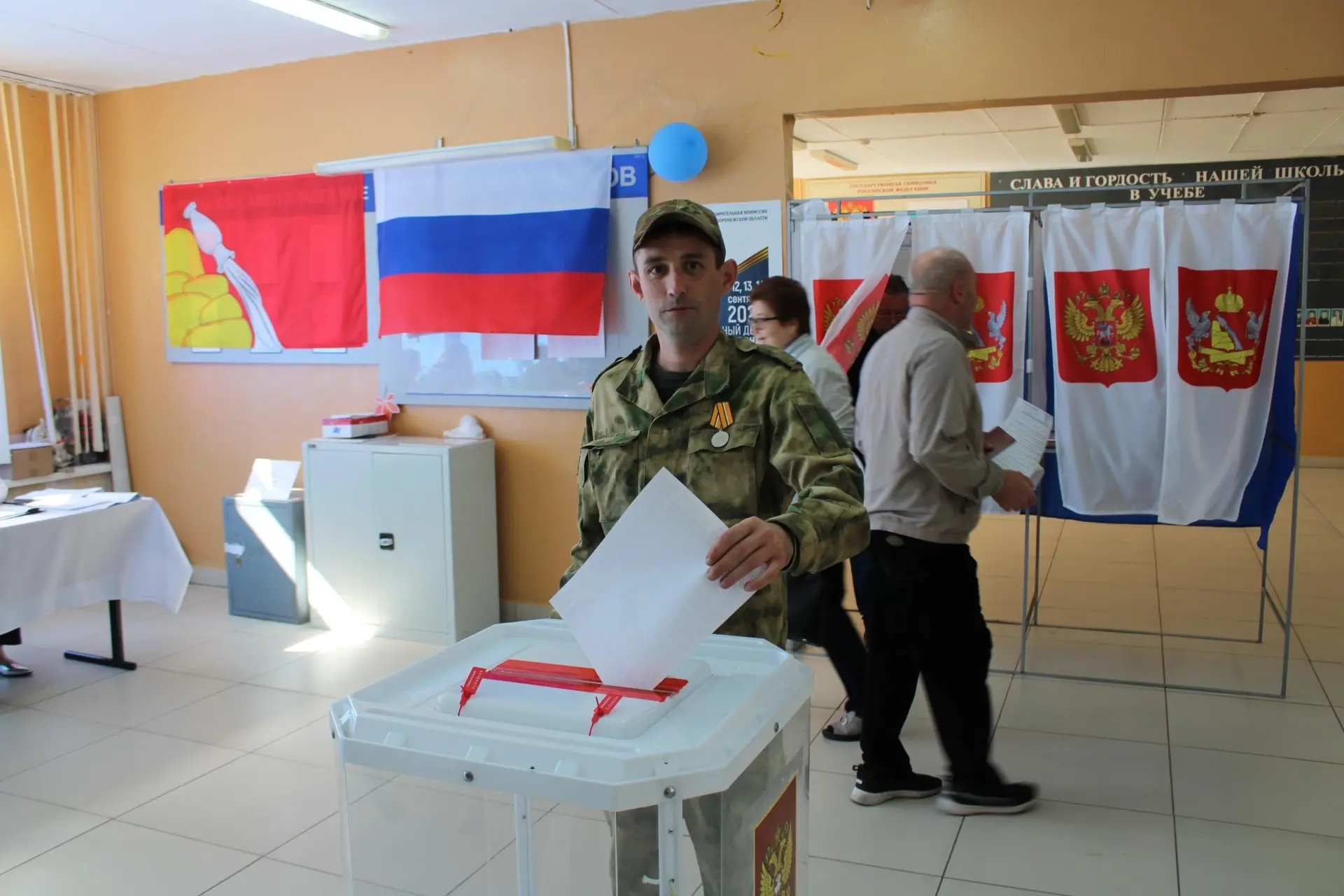
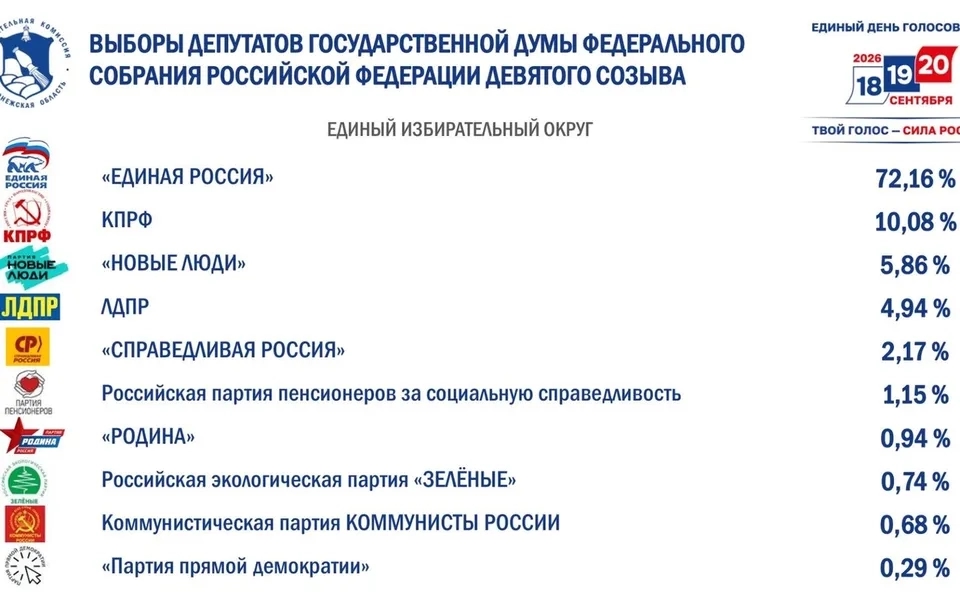
From the Kremlin's perspective, one of the top performers in the 2026 State Duma elections was leadership of the Voronezh Region, where the ruling United Russia party claimed a whopping 72% of the vote. Only four national republics – Chechnya, Dagestan, Ingushetia and Tuva – and the Russian-occupied territories of Ukraine posted higher figures. In previous years, Voronezh — the second-most populous city in the Central Federal District after Moscow — had delivered far less impressive results, and as a local official responsible for liaising with election commissions told The Insider, it was no accident that the region achieved such extraordinary figures this time around. Election commissions were ordered to ensure that at least a third of voters cast their ballots either at home or early, and opposition observers were barred from almost all of the region’s 500 polling stations. In their place, students from Colombia, Chile, and Pakistan were brought in. Unsurprisingly, official turnout nearly doubled, as did United Russia’s share of the vote.
“They dismantled election monitoring the day before the vote”
I’ve worked in this system for more than 25 years, over 20 of them organizing elections.
By the evening of September 20, when the polling stations closed and the count began, I found myself wondering why I was still in this job. What good could any of this do for the city? If I spoke out, they’d laugh at me, then find a reason to fire me – or even build a criminal case against me. But staying silent would mean proving my colleagues right. They’re now congratulating themselves on how neatly we pulled it off in terms of information management. So let my confession at least remain on the record for posterity.
How many votes did United Russia receive in Voronezh and Voronezh Region?
Turnout in Voronezh in State Duma elections had never topped 40%, while United Russia typically won 35–42% of the vote.
The region’s rural districts showed a very different level of loyalty. Turnout exceeded 65% almost everywhere, and in two districts – Anninsky and Bobrovsky – United Russia’s share of the vote approached 100%, with turnout similarly high.
Across the region, the ruling party won 58% of the vote in 2016 and 55% in 2021. In 2026, however, the region unexpectedly gave United Russia 72%.
In May of 2021, Ilya Ivanov, a former deputy head of the regional department for domestic policy, took over as head of the regional election commission. He was reportedly well regarded there because his guiding principle was that all the paperwork and figures had to be in order.
Ahead of the 2021 State Duma elections, he was still finding his feet. By this year’s vote, however, he already had a detailed plan: regional officials set targets for vote share and turnout (presenting them as recommendations), and the mayor then turns them into strict requirements.
This time, there was no direct order to deliver a specific percentage for United Russia. Instead, the requirement was that at least a third of voters cast their ballots either at home or early.
A deliberate purge of election commissions to remove “undesirable” members began last autumn. The regional commission replaced its Communist Party representative, swapping an election-law expert for a “vegetable.” Several heads of territorial election commissions (TECs) were also replaced.
In Voronezh’s Sovetsky District, a notorious stronghold of protests and controversy, the commission was taken over by a former TEC chair from some remote rural district where United Russia gets the “right” result in every election — more than 80% of the vote.
Next came the grassroots level: the chairs of precinct election commissions. Here, too, the pattern was clear. Relatively independent people — a kiosk owner, a construction foreman, or an ordinary pensioner — were replaced by school deputy principals. Many had never taken part in an election before and didn’t know even the basics. They came to us for instructions, looking bewildered and afraid of everything.
CEC, TECs and PECs – how Russia’s electoral system works
Those they couldn’t get rid of were simply intimidated. The night before voting began, one precinct election commission chair received a call from the “higher-ups,” who threatened him: refuse to rig the vote, and you’ll be shipped off to fight in Ukraine. He told the caller to go fuck himself and counted the votes honestly. Several polling stations were housed in the same school. At his station, United Russia received just over 30% of the vote, with the Communist Party and New People close behind. At the other stations, the deputy principals delivered the “right” results.
The day before the election, they crushed election monitoring. More than 400 Communist Party observers were barred from polling stations across the city over a paperwork error – the same error in all their documents. The Communists corrected it in 15 minutes and returned to the election commission with revised lists. But then it was lunchtime, or the door was locked. And then the deadline passed. They really did a number on our Bolshevik comrades – and on the city’s voters, too.
Foreign “observers,” meanwhile, were hauled in by the busload: students from Colombia, Chile and Pakistan. They had no official status as election observers, weren’t stationed at polling stations and had never even observed elections in their own countries. They were given a guided tour and told that ballot boxes were brought to anyone who had difficulty walking. The organizers had supposedly made voting convenient for people by giving them a whole 12 days to cast their ballots. The students were only too happy to repeat all this on camera.
“The key manipulation occurred in the first few days”
What followed was unprecedented in my 20 years of working on elections in Voronezh.
The main manipulation took place in the first few days. You have three days to vote, an order to visit voters at home, and no election observers. It couldn’t be simpler: stuff the mobile ballot box with the required number of ballots, and there’s your result. We’re talking dozens, if not hundreds, of ballots. With no observers around, you can also wait until voting ends and forge the signatures of voters who never turned up, making it look as though they collected their ballots and voted.
Commission chairs fell into two camps: those who fabricated the results and those who refused. They could even be working in the same gym.
One chairwoman said, “I’m not falsifying anything. I have no desire to spend the 20,000 rubles [$238] I’ll earn for working the election dealing with courts and investigators.”
Incidentally, this year almost all payments were official — no cash in envelopes. The only exception was that district administrations allocated a couple of million rubles to each territorial election commission, supposedly to feed commission members during the voting days.
But the chairwoman’s neighbor took a different view: “Well, the city administration called, didn’t they? We have to do it if the motherland asks.” Quite the patriot.
This time, commission chairs who worked in the public sector were actually calling us to ask, “My turnout is 45%. Is that enough, or does it need to be higher?” And this was Saturday afternoon, with another day and a half of voting still to go.
Commission chairs with public-sector jobs were actually calling us this time to ask, “My turnout is 45%. Is that enough, or does it need to be higher?”
Later, when those same school deputy principals submitted their results protocols to the territorial election commissions and were told to their faces that they had obviously falsified the results, they burst into tears and swore they would never, ever take part in elections again. But they were reassured: “You’ve done a great job. The motherland won’t forget you.”
One TEC told me about a commission chair who actually called during the vote count to ask how he should rig the results. When they replied, “Rig them however you like,” he protested: “But I was promised support at every level!” The answer was: “Then take it up with whoever made you that promise.” That polling station was one of the last in the city to submit its results, and United Russia scored a complete triumph there, taking nearly 80% of the vote. Help had arrived after all — they finally explained how to fill in the paperwork.
You could identify the vote-riggers even before their results protocols arrived by how long they spent counting. Actual turnout in Voronezh ranged from 20% to 30%, depending on the polling station, and it reached 40% at the highest. This was despite precinct election commissions spending nearly two weeks going door to door, persuading people to vote at home or vote early. They had been given a clear target: at least a third of voters had to cast their ballots at home.
Those who counted honestly submitted their results protocols to the territorial election commissions first. There wasn’t much to count – just 400–500 ballots. The vote-riggers had a harder job: after the polls closed, they had to forge the signatures of several hundred people who hadn’t shown up, making it appear that they had received ballots and voted.
They couldn’t put this off until later: under the rules, a territorial election commission cannot accept a precinct’s results protocol if the turnout figures don’t match the voter lists. As a result, the vote-riggers submitted their protocols at around dawn — or even later on Monday morning.
The “wrong” exit polls
That morning, Ivanov and our political analysts were officially declaring that the elections in Voronezh had gone smoothly, with no violations reported. It was quite something to hear.
Of course, we’d done everything to ensure that no violations were reported. But even a cursory look at the figures would tell anyone with a basic grasp of math that something was wrong. Results don’t vary that wildly between neighboring polling stations serving the same residential complex. At one, United Russia narrowly trailed the Communists and even New People, getting just 150 votes. Yet right next door, where residents of the building across the street voted, it received more than 1,000!
That morning, we learned that the regional department for domestic policy had commissioned exit polls from a reputable research agency. They showed that United Russia actually had no more than 35% support in Voronezh. The findings were never published. They probably had no intention of publishing them anyway: the point of the exit polls was to get a reasonably accurate picture of the actual vote and use it to manage the voting process.
Exit polls conducted by a reputable local research agency showed that United Russia had no more than 35% support in Voronezh
One of my fellow officials, a rather naive man, even complained at a meeting: "why pay the agency if its findings didn’t match the official results? They were amateurs," he said. How do you respond to that? You can either laugh or cry.
There were rumors that Moscow might call Ivanov and his subordinates to account for such blatant vote-rigging, but I find that hard to believe. The figures and paperwork all line up perfectly. Everything is formally in order. Nobody cares about the substance.