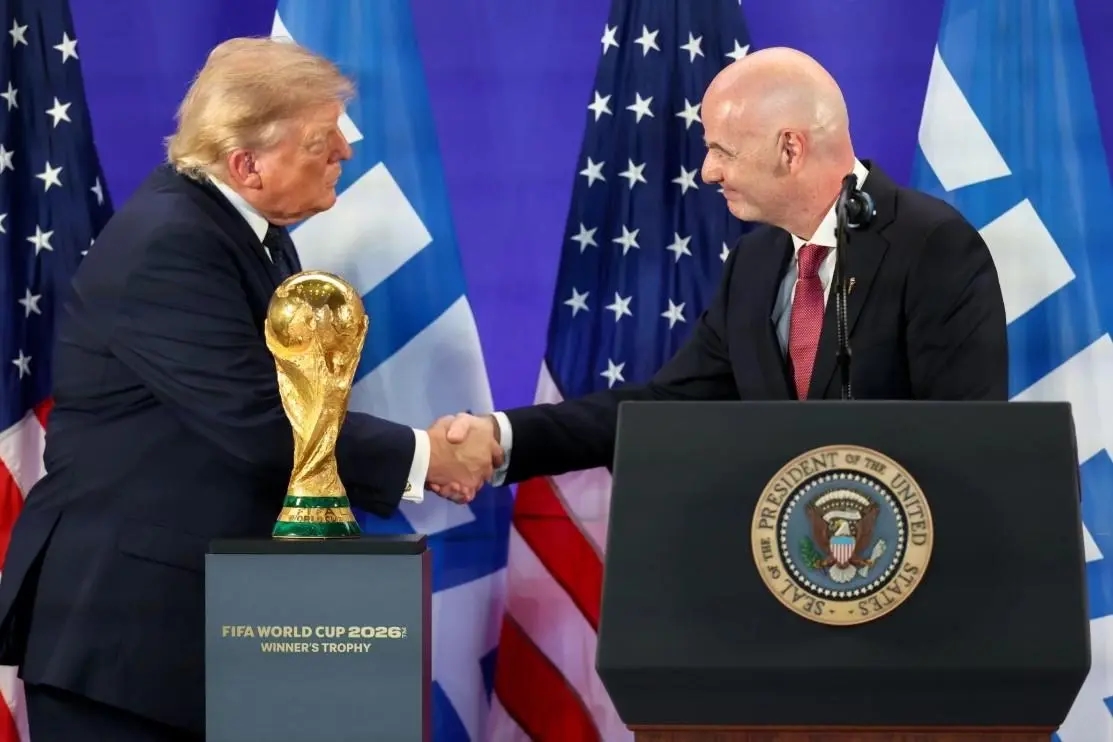
A secret attempt by FIFA President Gianni Infantino to sell the Trump family a stake in the rights to the World Cup has outraged football federations worldwide. Infantino has been forgiven for past indiscretions thanks to the fact that FIFA’s revenues kept growing, but this failed hostile takeover shocked everyone. Infantino could now lose his position, but even if he does, the issue goes far beyond one high-level official.
- 1.Football Watergate
- 2.Resetting in Putin’s style
- 3.The world against Infantino
- 4.Countries withdraw their support
- 5.A system of indirect bribery
- 6.A friend and favorite of dictators
- 7.Even his deputies are shocked
- 8.Total monetization continues
- 9.Shadowboxing: FIFA and UEFA are remarkably alike
- 10.In search of a new leader
In the summer of 2026, fans around the world followed the biggest World Cup in history: Lionel Messi’s last dance, Kylian Mbappé’s record-breaking goals, and Lamine Yamal’s bid for the trophy as the greatest prodigy in the history of the game were all on exciting display. Few knew, however, that behind the scenes at FIFA, a deal had been taking shape for almost a year that would soon shock the football world.
Football Watergate
The 2026 World Cup generated a record $15 billion in revenue for FIFA, making it the most profitable tournament in the sport's history. On July 17, appearing alongside Donald Trump at a Trump Tower event attended by multiple billionaires and football federation officials, FIFA President Gianni Infantino called the tournament “the greatest event in the history of humanity.”
However, less than two weeks after the final whistle, it emerged that Infantino had spent nearly a year negotiating the sale of one-third of the commercial rights to the men’s, women’s, and Club World Cups – behind the backs of the 211 national federations that own those rights.
On July 28, The Times published a shocking report: the FIFA president was planning to spin the World Cups off from FIFA into a new private company, to be known as FIFA Forward Enterprises (FFE). Around one-third of the company would be sold to private investors for $4.2 billion, with the largest shareholder set to be Joshua Kushner’s Thrive Capital, founded by the younger brother of Trump’s son-in-law.
In effect, Gianni Infantino proposed moving the World Cups out of the sphere of formally nonprofit FIFA in order to make them easier to monetize. Under FIFA’s statutes, the organization is required to use all its revenues to develop football around the world. A commercial “subsidiary,” by contrast, could distribute them as dividends to its owners.
FIFA is required to use all its revenues to develop football around the world. A commercial “subsidiary,” by contrast, could distribute them as dividends to its owners
Each national federation that agreed to back the plan was promised $40 million. At the same time, Infantino not only pressured them to respond within 53 days (by Sept. 19), but also openly blackmailed them: if they refused, he threatened to distribute 75% less money to the countries.
Resetting in Putin’s style
Gianni Infantino saw himself as the future head of the new FFE, which promised not only to increase his salary tenfold (from $3 million to $30 million a year), but also to give him a way to stay in power after a third presidential term. The resourceful Swiss has already reset the clock once. Infantino became FIFA president in 2016 after his predecessor, Sepp Blatter, resigned amid corruption allegations. But FIFA’s Council ruled that those years should not count as a full term, meaning Infantino’s presidency is officially dated from 2019 — even if, by the time of the 2018 World Cup in Russia, he was already firmly in charge of the federation, standing along alongside Vladimir Putin at the medal ceremony in Luzhniki Stadium.
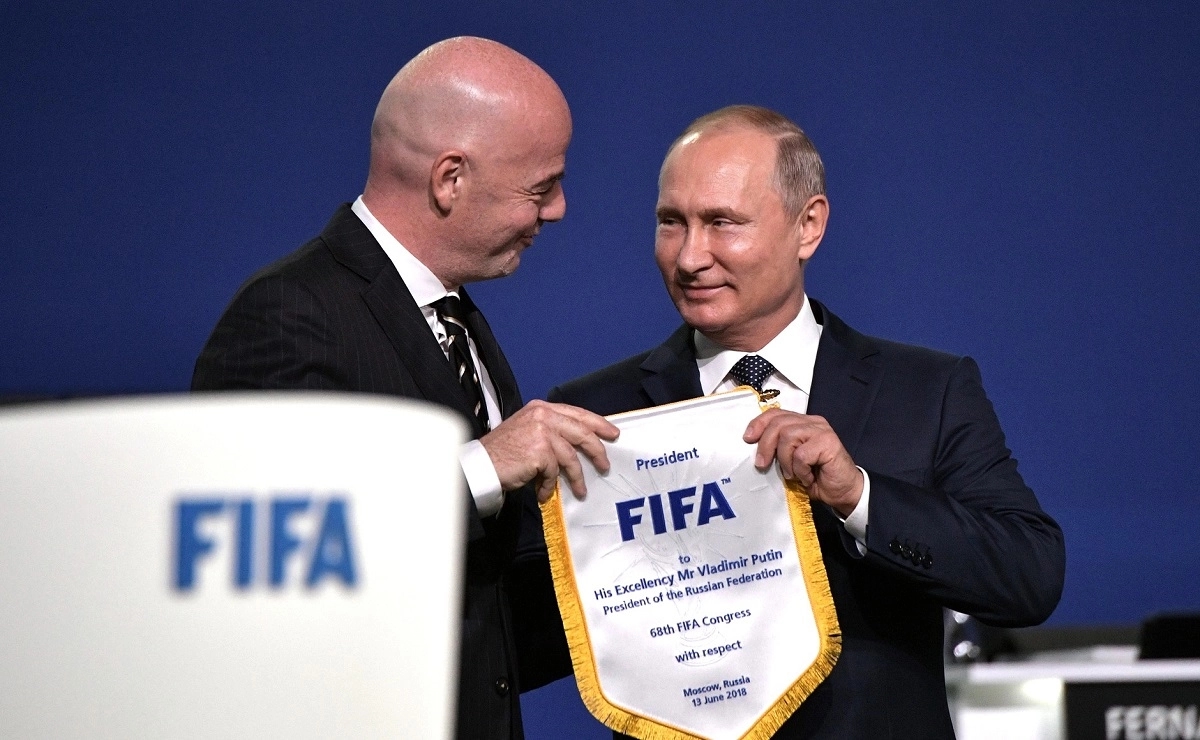
Under FIFA’s statutes, its president can serve a maximum three four-year terms. Infantino is now nearing the end of his second full term, meaning if he wins the elections set to be held in March 2027, he could theoretically remain in office a total of 15 years.
However, by taking the helm of the new company, Infantino would move into a position created specifically for him, with no term limits whatsoever. This would allow him to retain control of the financial flows, since FIFA was expected to keep a controlling stake in FFE along with the majority of its commercial rights.
The world against Infantino
The football world’s reaction to Infantino’s plan was severe. On July 30, the Union of European Football Associations (UEFA) announced a unanimous boycott of the World Cup – and all FIFA tournaments – by all 55 member associations for as long as the proposal remained on the table.
“The World Cup cannot be treated as an investment product, no part of it should ever be surrendered to private investors. The World Cup is not for sale...
It is both irresponsible and indefensible that a proposal of such significance for football was conceived in secret and brought to the brink of approval without any meaningful consultation with those entrusted with stewarding the game. This is not merely a profound failure of leadership, but an abdication of FIFA’s duty as the custodian of world football...
National associations around the world are now presented with an ultimatum: accept the irreversible capture of football’s greatest competitions or bear the consequences. This is governance by intimidation...
This model has no place in world football. Football’s future cannot be dictated by the expectations of those whose first duty is to maximize financial return. We will never lend this model our legitimacy...
UEFA and its national associations will oppose these plans with absolute determination. Some things are simply too important to sell.”
All 41 CONCACAF member associations (the confederation representing North and Central America and the Caribbean) also rejected the project due to its lack of transparency, the demand for an excessively quick response, and the leadership’s attempt to bypass FIFA’s traditional governance structure. There were public signs of opposition to Infantino as well. For example, a petition launched by the Reboot FIFA project, which was created before the 2026 World Cup, gathered more than 100,000 signatures amid the scandal over the deal. Infantino was quickly forced to back down, confirming that the project existed while beginning to qualify and soften his language.
“FFE is a proposal, an offer. It’s part of a democratic process, a consultation process, and, above all, it is an opportunity, not an obligation – a golden opportunity to turbocharge the development of the game globally,” the FIFA president said. “But again: it is just an offer, not an obligation. It would simply commercialize and organize all FIFA-owned competitions for the benefit of FIFA's 211 member associations.”
On the night of July 31, FIFA responded by announcing that the project would not go ahead. Infantino explained that he had listened carefully to all the views and realized that the idea had created divisions that were no longer in the interest of the project’s original objective. “Our purpose has always been – and will always be – to unite and improve.”
Joshua Kushner summed it all up on August 31: “Had we known what this would devolve into, we would not have gotten involved.”
Countries withdraw their support
As of July 17, two days before the World Cup final, The Guardian reported that more than 200 countries around the world would back Infantino in the FIFA presidential election despite the disgraceful rescinding of a red card shown to Folarin Balogun of the U.S. national team, a reversal that had seen Infantino personally intervened at Donald Trump’s request.
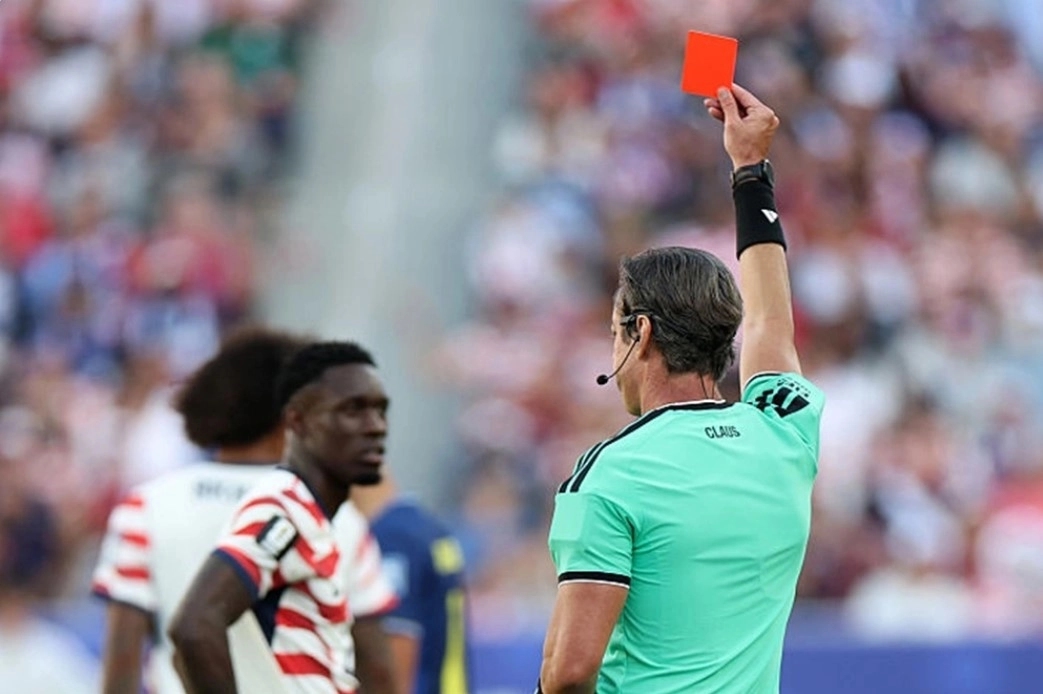
The Balogun affair could have been seen as an isolated episode of influence peddling. However, the proposal to sell a stake in the World Cups fundamentally changed attitudes toward Infantino.
Over the course of a month and a half, around two dozen countries withdrew their support for Infantino’s upcoming reelection. Among the largest and most influential were France, Italy, the Netherlands, and Belgium.
On Aug. 11, Donald Trump came to his friend’s defense. “FIFA would be making a terrible mistake if, for any reason, it even considered removing Gianni Infantino,” he wrote on Truth Social. “He is fantastic, and just presided over the most successful World Cup ever – four times more successful than all previous ones. If he leaves, the tournament will never be as successful or profitable.”
This post likely came in response to a joint statement by UEFA, CONCACAF, and the Asian confederation, which described FIFA’s tactics as intimidation and while identifying a deeper problem:
“FIFA's recent letter to its Vice-Presidents and 211 Member Associations acknowledges that mistakes were made in the process. It treats this as a failure of communication, when what football witnessed was a failure of judgement. A proposal advanced on a compressed timeline, without meaningful consultation, and pushed towards a deadline before Member Associations could properly review its terms is not the product of an oversight – it is the product of a design intended to limit scrutiny. It did not acknowledge that the proposal itself was inherently wrong. There remains no recognition that attempting to sell an interest in the FIFA World Cup was a profound failure of judgement.”
Of course, Trump’s support tends to provoke widespread antipathy, and unsurprisingly, organizations representing 143 national federations demanded that FIFA commission a full report on the affair from an independent investigator. The only major federations to support Infantino publicly were those of Argentina, Mexico, Qatar, Cameroon, Egypt, and Morocco (the latter of which has been linked to a purported quid pro quo: a vote for Infantino in exchange for hosting the 2030 World Cup final in Casablanca, an announcement that FIFA called premature).
A system of indirect bribery
The Telegraph reported on Aug. 1 that UEFA was threatening Infantino with a vote of no confidence and issuing an ultimatum: resign voluntarily or face legal proceedings that could force him out.
The FIFA statutes do not explicitly provide for such a scenario, but UEFA can convene an extraordinary congress and raise a no-confidence motion against Infantino — and it has enough votes to do so. However, the most the congress could do is refer the matter to FIFA’s Ethics Committee.
But Infantino’s strength lies precisely in his influence over the federation’s internal bodies, including its judicial bodies. The system he has built has been described as a form of patronage – Infantino’s power rests largely on the votes of small national federations for which outlays from FIFA's record-high revenues represents a significant share of their budgets. In any vote, Haiti, Cape Verde, and Curaçao each have the same weight as France, Spain, or England.
The judicial structure of the Ethics Committee includes representatives from Ghana, American Samoa, Nigeria, Turkey, the Philippines, Jamaica, Papua New Guinea, and Chile, with a chair from Colombia. It is entirely possible that Infantino could find ways to pressure the football authorities in these countries so that their representatives cast their vote in his favor.
That is why the most effective way to remove Infantino as FIFA president is through next spring’s election. The problem, however, is that UEFA and the other forces opposing Infantino still have no alternative candidate. The 2019 and 2023 elections were both uncontested, and no new prominent football politician has emerged the challenge the incumbent.
A friend and favorite of dictators
Infantino’s growing closeness to Morocco fits a broader pattern: the FIFA head seems eager to cultivate friendships with monarchs and heads of state with authoritarian tendencies.
Infantino seems eager to cultivate friendships with monarchs or heads of state with authoritarian tendencies
Infantino grew close to Vladimir Putin during the 2018 World Cup and then organized the 2022 World Cup in Qatar. In recent years, he has also deepened his ties with Donald Trump.
Catering to Trump’s wishes has been part of Infantino’s strategy since the start of the U.S. president’s second term. He not only congratulated Trump on his election victory – something Blatter had also done with heads of state – but also attended his inauguration, something previous FIFA presidents had never done.
Infantino then became a regular visitor to the Oval Office, where he gave Trump a personalized World Cup ball, presented him with a symbolic ticket to a tournament match, and let him touch the World Cup trophy. He even promoted the U.S. president for the Nobel Peace Prize — and when the president failed to win it, Infantino created a FIFA Peace Prize specifically for him (which he presented at the 2026 World Cup draw). Infantino lavished so much praise on the president that he earned the nickname “Syco-fantino."
Of the three hosts of the 2030 World Cup – Spain, Portugal, and Morocco – Infantino has the closest ties with authoritarian Morocco. The 2034 World Cup, meanwhile, will be hosted by authoritarian Saudi Arabia.
There is reason to believe that FIFA moved up the schedule to accommodate the Saudi bid and ruled out other options so that the tournament could be held there before the expiration of Infantino’s third presidential term.
Under the rules, a World Cup cannot be held on continents that hosted either of the previous two tournaments, but FIFA devised a unique formula for 2030. Its three main host countries are located on two continents – Europe and Africa. In addition, matches will be played in South America, in Uruguay, Argentina and Paraguay. This left only Asia and Oceania eligible to host the 2034 World Cup – and Saudi Arabia was the only country from those regions to submit a bid.
Even his deputies are shocked
At the start of the World Cup, The New York Times published a major article under the striking headline “The Man Trumpifying FIFA.” The phrase caught on as a concise description of many of the changes taking place (and this was a month and a half before the controversial proposal to sell a stake in the World Cup became public).
When Infantino took over as president, he was well aware of the red flags. In the second half of 2015, FIFA’s Ethics Committee banned two presidents from football for eight years: Sepp Blatter of FIFA and Michel Platini of UEFA, over Blatter’s transfer of 2 million Swiss francs to Platini’s account in February 2011. The officials were later acquitted, but by then their careers had been ruined.
Infantino had been Platini’s right-hand man before taking over Blatter’s position and choosing a different strategy. He consolidated his power by increasing revenues and building government-relations ties, creating a hierarchy of loyalty within FIFA. But even that record could not overcome his audacious idea to sell a stake in the World Cup.
The loudest reaction came from FIFA Chief Operating Officer Kevin Lamour (effectively the association’s third-highest-ranking official), who had worked alongside Infantino for nearly 20 years. His statement was especially striking. “This is one man’s project,” he said three days after the report of the secret deal with the Trump family broke. “It’s not enough to stop this project – it is time for football’s political leaders to ask themselves the right questions and make the right decisions. If that means I lose my job, so be it. At least tonight I will sleep soundly.”
Three weeks later, Lamour did indeed leave his post, and Infantino’s senior adviser, Carlos Cordeiro, FIFA’s representative on the White House Interagency Task Force for preparations for the 2026 World Cup, also resigned, saying he could not be associated with an organization that was considering such deals. Both statements confirm that Infantino kept the idea secret even from his top executives. According to Lamour, people inside the organization saw this as deception by the president, which undermined one of the pillars on which the FIFA head's power rested.
Infantino kept the idea secret even from his top executives
Infantino is also facing criticism from several figures who remain in senior positions. In mid-September, for example, Football Association chair and FIFA Vice President Debbie Hewitt called on him to publish all documents related to the plan to sell off the World Cup rights.
Total monetization continues
Infantino himself, meanwhile, has switched to a much friendlier tone. On Sept. 21, he sent a letter to all 211 national federations promising to propose an independent assessment of the effectiveness of his management system, gather ideas for improving the development of new projects, and strengthen accountability in the development of major strategic initiatives. In effect, he indirectly acknowledged that he had been wrong at every stage of preparing the World Cup deal.
“Democratic processes, independence, and FIFA’s sporting authority have never been up for negotiation. They are not for sale and never will be,” Infantino now writes with characteristic pathos.
Still, his overall strategy has not changed. On July 28, when presenting his plan to transfer the World Cup rights to FFE, FIFA said that it was “undermonetized compared with other leagues” and that “football is not generating enough money relative to its audience.” Infantino is still pursuing the same policy, seeking to take FIFA’s megalomania to a new level – this time by boosting revenue from a youth tournament.
In December 2025, FIFA announced the first-ever World Cup for players under 15, with no qualifying process – allowing all 211 teams to participate. According to The Athletic, the FIFA president hoped to attract investors separately and, following the model of the U.S. Little League World Series, stage the tournament with Disney’s backing at its sports complex in Orlando.
The tournament will instead take place in Baku from Oct. 24 to 30, 2026, with 191 teams having applied. Russia’s national team will be among them – using its flag and anthem. The Russian Football Union notes separately that this will be the country’s first such tournament since 2022.
Infantino initially envisioned an Israel-Palestine match as the opening game, but the Israelis and Palestinians were ultimately placed in different groups, and the tournament will open with Azerbaijan vs. East Timor. Meanwhile, concerns that commercialization is displacing the substance of big-time sport are growing louder.
Perhaps the essence of those concerns was best captured by Siddharth Srirama, a sports columnist for Indian channel News18. “For more than a century, football also has survived being weaponized by those in power,” he wrote in July. “Hitler’s Germany used it for propaganda. Military dictatorships wrapped themselves in it. Qatar and Saudi Arabia have spent fortunes using it to reshape global perception through sportswashing. Yet the game always endured because, at its core, it belonged to the fans. Now, though, the game faces perhaps its greatest threat yet — becoming just another investment portfolio for crony capitalism. If Sepp Blatter exposed football’s ugliest face through corruption, Gianni Infantino seems determined to finish the job by turning the sport itself into a financial product.”
Shadowboxing: FIFA and UEFA are remarkably alike
UEFA particularly dislikes FIFA, and Gianni Infantino personally. After all, throughout his 10 years in power, Infantino has sought to reduce European football’s influence on the global game.
One of Infantino’s first ideas after taking over FIFA was to expand the World Cup from 32 to 48 teams. But the 16 additional places were distributed disproportionately: Europe received only three, while the rest went to less developed – and therefore more grateful and dependent – countries.
From the outset, Infantino pushed to reform the Club World Cup, a low-profile tournament that started in the 2000s. At first the idea was blocked because the schedules of the biggest teams were already overloaded, but by 2025, Infantino had managed to push it through. The Club World Cup was staged in the US.. as a test tournament ahead of the World Cup (replacing the Confederations Cup for national teams).
Thanks to a clever qualification formula, FIFA managed to bring many top teams together for the month-long summer tournament, including Real Madrid, Manchester City, Chelsea, Bayern Munich, Paris Saint-Germain, and Inter Milan. Thanks to commercial deals, even the winner’s prize money was brought closer to Champions League levels, with Chelsea receiving $125 million. Donald Trump was so reluctant to leave after presenting Chelsea with the trophy that he remained at the center of all the victory photos.
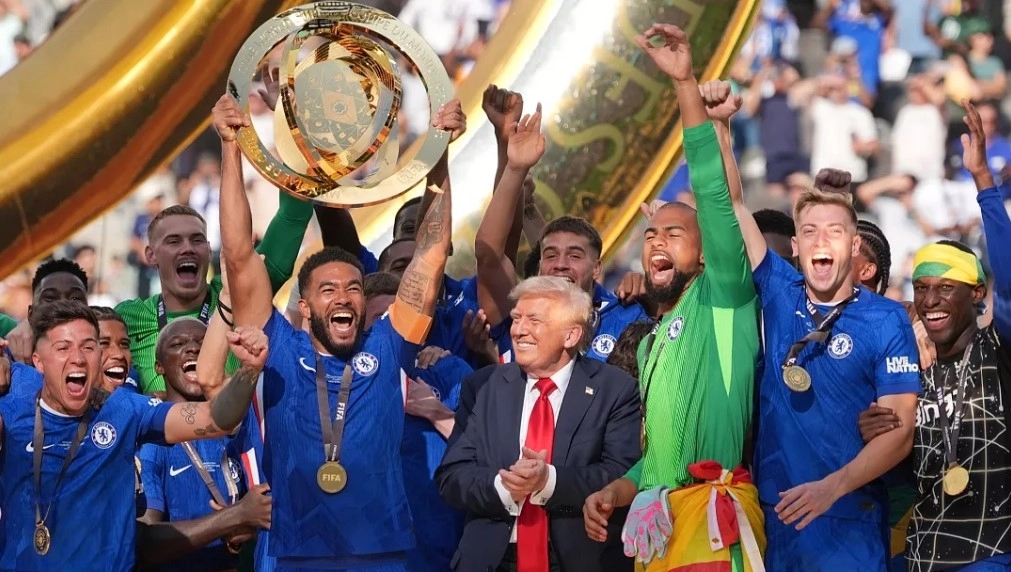
European clubs still received far more money than teams from the other confederations, but in some cases the amount was comparable as a share of their budgets and annual spending. FIFA also managed to include Inter Miami as a host club, meaning Lionel Messi played in the opening match and three more games. In this way, FIFA challenged UEFA’s monopoly over matches featuring Europe’s football elite.
One sign of growing tensions that caught the industry’s attention was that UEFA President Aleksander Čeferin did not attend a single match. He had already spoken out against FIFA and even threatened a boycott long before the idea of selling the World Cup emerged.
In 2021, when Infantino was pushing a plan to hold the World Cup every two years, Čeferin responded: “We can decide not to play in it. As far as I know, the South Americans are on the same page. So good luck with a World Cup like that. To play every summer a one-month tournament, for the players it’s a killer. The value is precisely because it is every four years. I don’t see our federations supporting that.”
But despite the disputes, the methods used by the two main football organizations to increase their revenues are actually quite similar. UEFA has also expanded its flagship national-team tournament, the European Championship (from 16 to 24 teams in 2016), and expanded the Champions League as well (36 teams instead of 32 since 2024).
In search of a new leader
UEFA is still grappling with the fallout from an external crisis: in 2021, 12 top European clubs announced plans to create the Super League, a tournament of their own outside UEFA’s jurisdiction (FIFA was also opposed). The idea was poorly thought out, and under public pressure many of the clubs quickly withdrew. Still, UEFA had to respond by taking steps to increase its revenues. The result was the revamped Champions League format.
European football is now united at the level of the national associations: UEFA kept the pressure and boycott threat alive for more than a month — then, immediately after the Champions League draw, announced that it was temporarily suspending the boycott. In the same statement, Infantino’s idea was described as an abuse of presidential powers, and UEFA called for consideration of financial support for national associations from FIFA’s multibillion-dollar reserves. According to Sky News, European and North American football leaders are insisting that Infantino make a one-off payment of $10 million to each national association for infrastructure development.
Clearly, UEFA is the main force capable of confronting Infantino by backing a candidate for the March FIFA election. The problem is, UEFA president Aleksander Čeferin does not want to pursue a political career and almost certainly will not run. Still, even if he wins the March vote, the result of the FFE fiasco has been the opposite of what Infantino sought. He has gone from being an uncontested candidate for another presidential term to a man who many influential figures in the football world would like to see out of office as soon as possible.