In May 2026, Russia’s Ministry of Justice filed a lawsuit seeking to designate the “Alliance of Heterosexuals and LGBT People for Equality” as an extremist organization. More than a dozen LGBT organizations in Russia have already been declared extremist, and the process continues to expand. Russian courts handle all such cases very quickly and behind closed doors. At the center of every case is an “expert assessment” produced by the Nizhny Novgorod Academy of the Ministry of Internal Affairs. The Insider reviewed the document. The “experts,” whose familiarity with LGBT issues appears to be superficial at best, reach paradoxical and often absurd conclusions.
- 1.“Educational and propaganda-oriented language material”
- 2.How feminine word forms became proof of extremism
- 3.“Associations with the colloquial word ‘cop’”
- 4.“Celebrations of exceptionality and superiority”
- 5.“Missionary activity”
- 6.“Demonstrating resistance to Russia’s communications regulator”
- 7.Linguistic gender scholars in uniform
- 8.112 questions from the defense
- 9.Consequences
- 10.What comes next
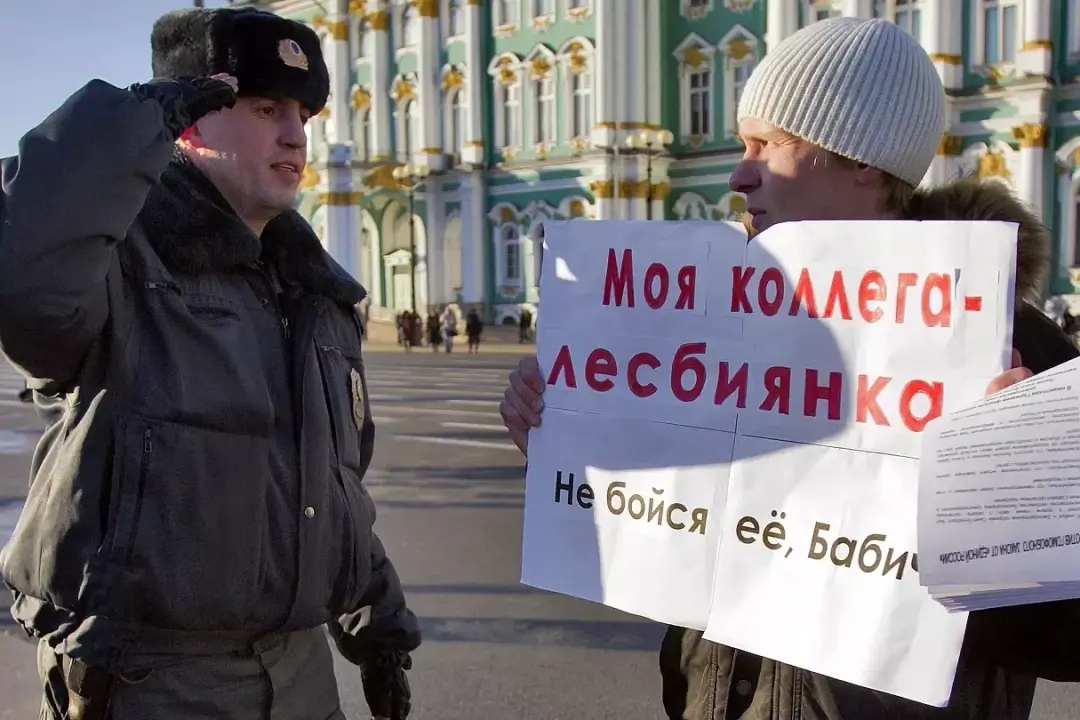
This summer, a Russian court will decide whether the “Alliance of Heterosexuals and LGBT People for Equality” constitutes an extremist organization. The signs of “extremist activity” cited by the authorities include “informal meetings for non-binary people,” the “Online Festival of Equality, Freedom and Gender Diversity,” and events connected with “International Coming Out Day.” The case is being heard in St. Petersburg behind closed doors.
The Alliance was founded in 2012 by two cisgender heterosexual people: Natalia Tsymbalova and Sergei Kondrashov. “At the time, the authorities claimed that all heterosexuals supported discrimination against LGBT people. We wanted to show that this was not the case. It was clear that today they were targeting LGBT people, and tomorrow they would target others. That is exactly what ended up happening,” explains Alexei Nazarov, the group’s media coordinator.
After the Supreme Court ruled in November 2023 that the “international LGBT movement” was extremist, more than ten queer organizations were banned in Russia. Those already officially designated as extremist include the Russian LGBT Network, Irida, the transgender support project T9 NSK, the Moscow Community Center, Coming Out, the queer media outlet Parni+, Center T, the LGBT Resource Center, and the Callisto initiative.
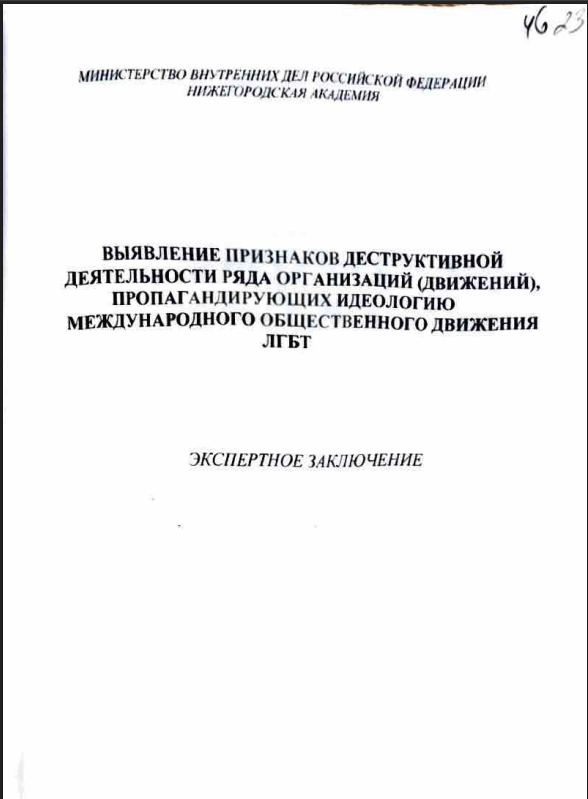
The proceedings in those cases, too, were held behind closed doors, meaning that the prosecution’s full reasoning remained unknown until recently. In every case, however, the same document appeared: an expert report prepared by the Nizhny Novgorod Academy of the Ministry of Internal Affairs. The report is titled “Identifying Signs of Destructive Activity by a Number of Organizations (Movements) Promoting the Ideology of the International LGBT Social Movement.”
The conclusions drawn in this document form the basis of all court rulings on the matter. “Without this criminological assessment, the Ministry of Justice would not be able to properly substantiate its request [to have an organization declared extremist]. Judges themselves often try to avoid responsibility and do not conduct their own analysis if a case already contains an expert opinion,” explains Maxim Olenichev, a lawyer specializing in LGBT rights cases.
The Insider obtained and reviewed the full text of the document.
“Educational and propaganda-oriented language material”
The document was authored by staff members of the Nizhny Novgorod Academy of the Russian Ministry of Internal Affairs, where the study itself was conducted. The expert report runs to about 50 pages and, according to its authors, is based on an analysis of more than 1,500 screenshots from the websites and social media accounts of LGBT organizations.
The report exists in two nearly identical versions, differing only in the surname of one author and the list of organizations under review. According to its compilers, their purpose is to “confirm or refute” whether the movement is “large-scale,” to determine whether it is engaged in the “transformation” and “destruction of fundamental Russian spiritual and moral values, particularly traditional family values,” and whether it promotes the “exceptionality, superiority, or inferiority of a person” on the basis of sexual orientation or gender identity.
Notably, one of the report’s central arguments rests on hidden meanings that its authors claim to find in the informational materials published by LGBT organizations. As the document explains, the experts examined “verbal (textual),” “presuppositional (contextual),” and “subtextual” forms of information. Most often, they identified material as belonging to the latter category, which is defined as “information about certain aspects of an event that is not directly expressed in the text but is nevertheless possessed by participants in the speech event.”
In one version of the report, the term “presupposition” appears seven times, serving as a catch-all justification for attributing hidden meanings to words. For example, when evaluating the title of the “Online Pride Festival for and About LGBT People,” the researchers determined that use of the words “pride” and “person” constituted “the promotion of exceptionality and superiority at the presuppositional level.”
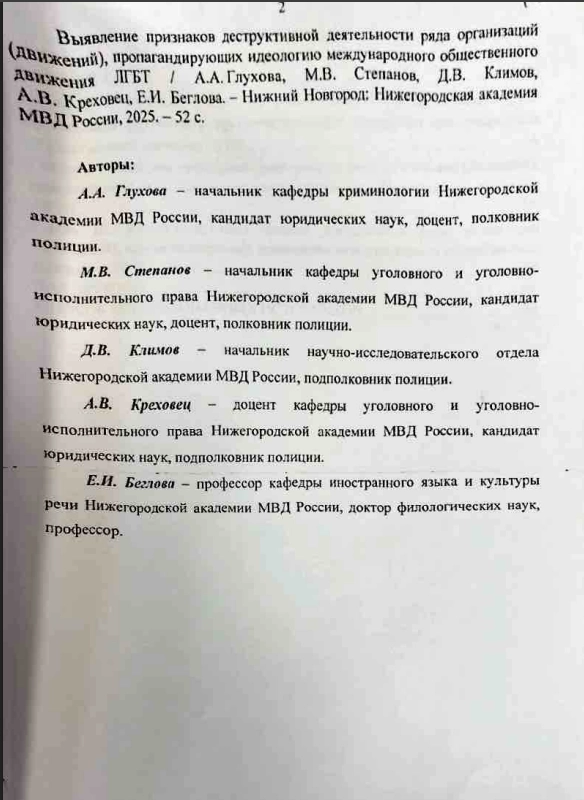
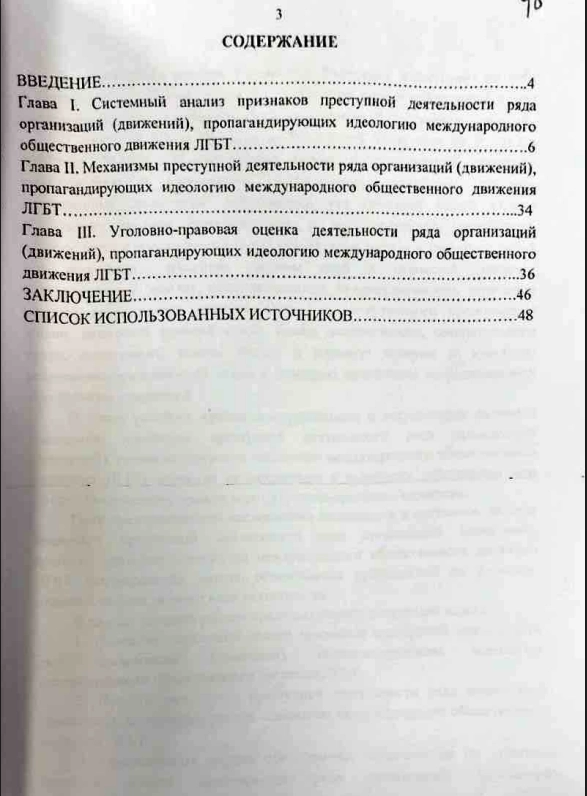
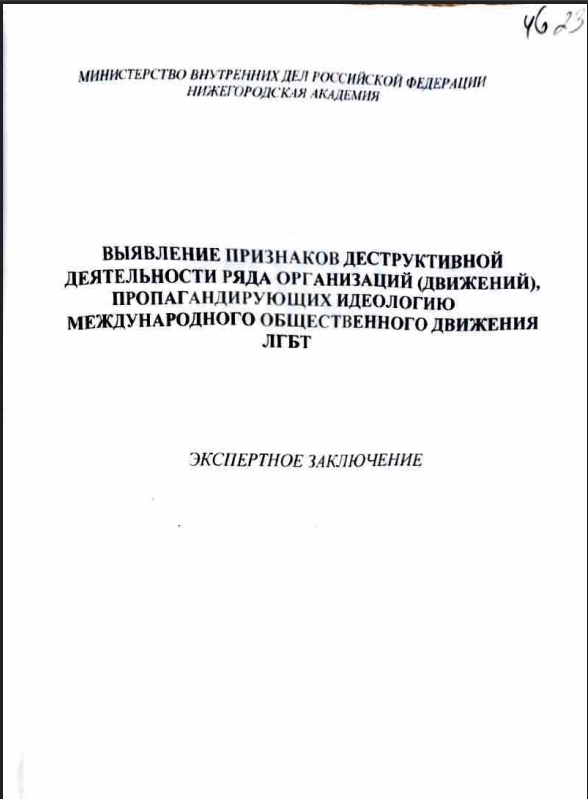
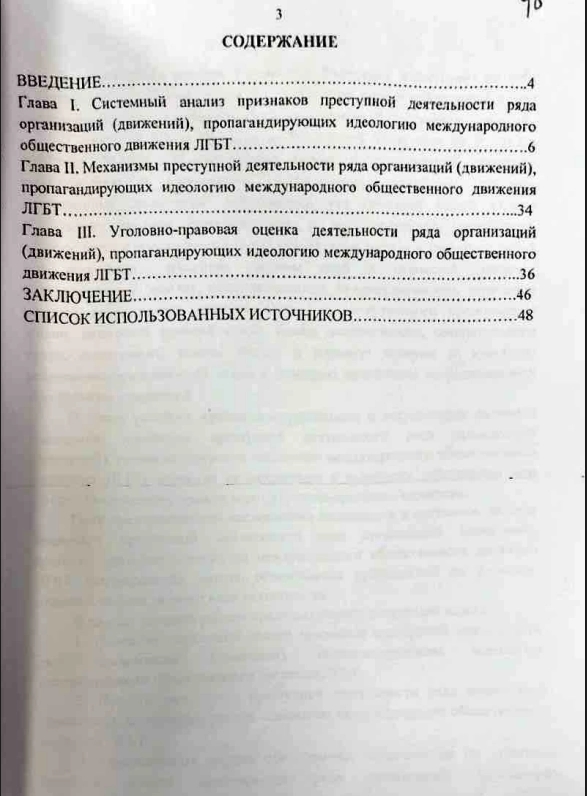
One of the key “negative indicators” of LGBT movements identified by the report is the existence of a “new community language distinct from the state language.” Examples include the use of feminitives in job titles and forms of address, the word “person,” the term “queer,” and various Anglicisms, all of which are presented as evidence of “the promotion of ideas of superiority over other people.”
Any gathering organized by queer organizations was interpreted as posing a threat. The titles of celebratory events were described as promoting “the exceptionality and superiority of LGBT people,” and even tea parties were described as “implicit propaganda” and a means of “recruiting new people.” In the materials of nearly every organization examined, the experts identified what they called “resistance to Russian legislation.” They claimed to find such resistance not only in criticism of government decisions or references to an organization’s “foreign agent” designation, but also in calls for equal rights.
Experts found “resistance to Russian legislation” in the materials of nearly every organization
The sources cited by the report include not only legal texts (the Russian Constitution, its Criminal Code, and similar documents), but also materials whose connection to LGBT issues is far from obvious. “The Criminal Code is, of course, these people’s favorite document. What’s unclear is why they rely on a Criminology textbook from 1984. But the funniest source is probably Revolution 2.0, a documentary novel. The authors also used an explanatory dictionary of the Russian language that includes information on word origins,” noted Yaroslav Sirotkin, leader of the Yaroslavl-based Callisto movement.
How feminine word forms became proof of extremism
While analyzing the collected texts, the experts managed to “discover” links to the LGBT movement even in the most innocuous of phrases. For example, the researchers identified what they described as a “word-formation model” in which suffixes are added to masculine nouns in order to denote that the subject being described is female — a linguistic feature common among Russian speakers of all sexual orientations and outlooks, similar to the way English makes the distinction between “actor” and “actress.” According to the report, queer people use such vocabulary to demonstrate their “superiority.”
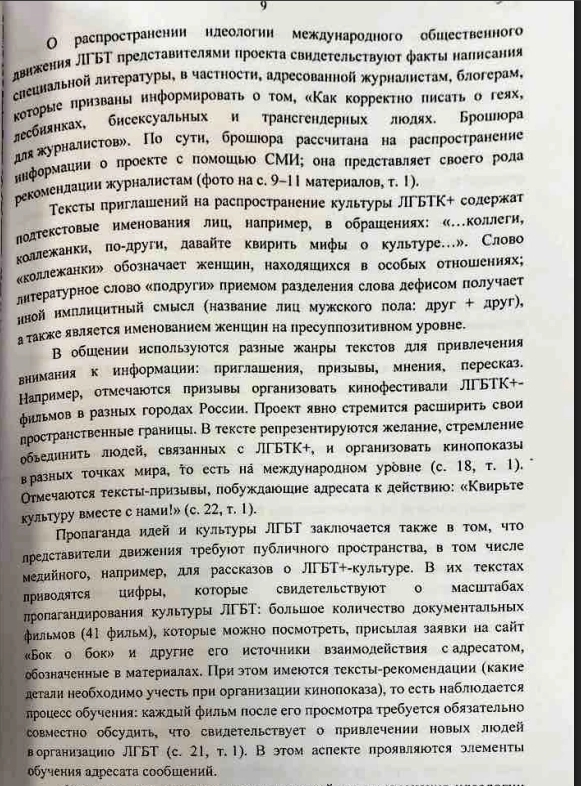
The term “queer” and its derivatives — long accepted by LGBT people and the academic community — were described as a “lexical code for entry into the organization.” According to the experts, “queers are people who have not yet decided how to identify themselves and who do not follow traditional values regarding sex and love.” Citing unnamed LGBT activists,the criminologists further claim that there exists a special “ritual of initiation into the queers,” though they provide no details about the supposed ritual entails.
The metaphors “lesbian lioness,” “trans birdie,” “bi bee,” “pan panda,” “asexual koala,” and “gay queer-bear,” according to the authors of the study, are used by queer activists to draw attention to the “LGBTQ+ subculture.” In their assessment of the Callisto organization, meanwhile, the mere use of terms such as “gay,” “lesbian,” “bisexual,” and “transgender” was presented as evidence of “the separateness of the LGBT movement, which seeks uniqueness and superiority over other people who do not belong to LGBTQ+.”
Queer activists supposedly use metaphors such as “lesbian lioness,” “trans birdie,” “bi bee,” “pan panda,” “asexual koala,” and “gay queer-bear” to draw attention to the LGBTQ+ subculture
In their “Report on the Situation of LGBT People in St. Petersburg in 2021,” the experts identified a glossary of terms that, in their view, “soften the perception of the activities of LGBT+ representatives and the characterization of people on the basis of sex, their interests, and the ‘infringement’ of their rights by society and state legislation.”
According to the report, this “new community language, distinct from the state language,” constitutes evidence of “the promotion of ideas of superiority over other people,” as illustrated by terms such as “outing,” “bisexuality,” and “gender dysphoria.” (Notably, “gender dysphoria” is a term that is widely accepted in Russian academic literature.)
The Interior Ministry’s experts managed to discern claims of superiority even in terms that have no direct connection to LGBT people. For example, defining sexualized violence as coercion into sexual acts was said to be presented “without regard for the norms of Russian legislation” and allegedly emphasized the superiority of “queer people over others, who are not allowed to touch them.”
When analyzing the event “Bodily Boundaries: Consent and Agreements, Myths and Prejudices,” the researchers interpreted the phrase “bodily boundaries” as “implicitly referring to sexual touching.” A survey on how comfortable people feel setting boundaries and agreements around physical contact was characterized as “the promotion of sexual deviance and the demonstration of the importance of sexual activity.”
The experts also leveled accusations of a “philological” nature against the queer media outlet Parni+. The project began as the HIV-service initiative Phoenix Plus and grew into a platform that publishes articles about the lives of LGBT people, attracting tens of millions of views each year.
Vadim Vaganov, a journalist with the publication who was designated a “foreign agent” in 2024, described what the authors of the report found objectionable in its materials:
“We wrote that the state is actually waging a campaign against the Russian language and Russian culture. One of our articles was titled Izrossilovanie [a play on words meaning “raped by all things Russian”]. The experts claimed that this headline meant we were attacking the state because we were expressing verbal aggression toward Russia and Russian society.”
According to Vaganov, most of the accusations boil down to the idea that if a person disagrees with the current authorities, they must necessarily “want to overthrow the political system.” Some of the allegations contained in the report were familiar to him from previous proceedings:
“In the administrative cases against me for ‘LGBT propaganda,’ which were churned out over the course of a year, the same language appeared that is now being used in the extremism cases. For example, I wrote that homophobia is terrible and posted a photo with my boyfriend. Law enforcement authorities interpreted that as a ‘threat to national security.’”
“Associations with the colloquial word ‘cop’”
Perhaps the most paradoxical conclusion reached by the experts concerned an organization that no longer exists. The trans mental health project “Person to Person” (Chelovek – cheloveku) was founded in 2014 by psychiatrist Dmitry Isaev. At the time, Isaev also headed a commission for transgender people in St. Petersburg. Through the initiative, he provided psychological support, conducted academic research, and trained other medical professionals.
A representative of a partner organization, Anton (name changed), told The Insider that the project was not public-facing but that its impact was nevertheless considerable: “We did a great deal to help create the simplified certificate for gender transition. Our connections and cooperation with both the medical community and people involved in legal decision-making were instrumental.”
The regulations governing that document were approved by the Russian Ministry of Justice in 2018. However, in 2023, the ministry declared the order to be “no longer in force.” Isaev died in 2022, and the project subsequently suspended its activities.
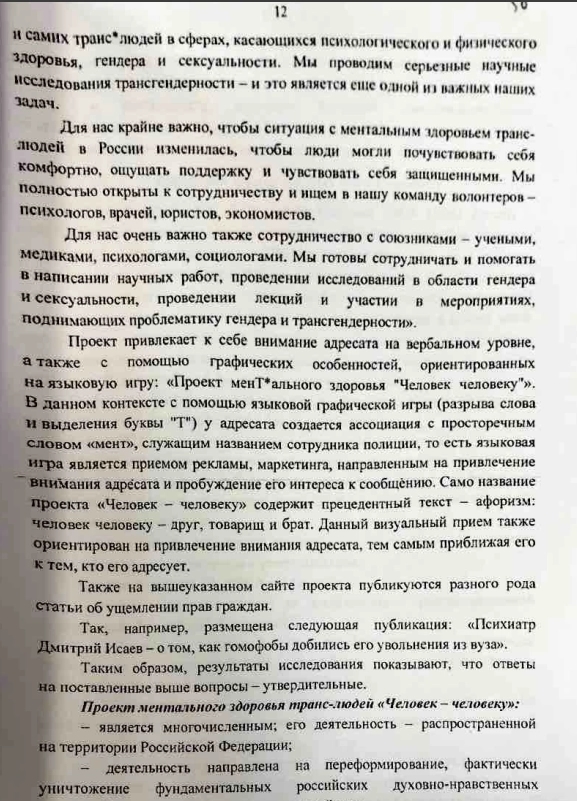
In their assessment, the authors devote an entire paragraph to the initiative’s name, “The MenTal Health Project Person to Person.” In Russian slang, “ment” means “cop,” and the authors describe the name as a marketing device: “splitting the word and highlighting the letter ‘T’ creates an association in the reader’s mind with the colloquial word ment,” thereby “arousing interest in the message.”
Anton says the document is impossible to take seriously: “How could they mangle the word mental so badly? How do they not know that the letter ‘T’ with an asterisk signifies transgender identity? And this is supposed to be a linguistic analysis?”
The report also draws attention to publications containing “various kinds of articles about the infringement of citizens’ rights,” including coverage of Dmitry Isaev’s dismissal from a university following complaints by critics. These materials, the authors concluded, demonstrated the project’s involvement in “extremist activity.”
According to Anton, the report was prepared unprofessionally: “It’s obvious that a few security-service people sat down and put this together — people who normally deal with things like handwriting analysis. They don’t really understand language, they don’t properly understand criminology, and they have no medical expertise. The whole thing is shockingly poor, completely far-fetched. In short, it’s a commissioned hit job.”
“Celebrations of exceptionality and superiority”
The assessment of T9 NSK, a Novosibirsk-based initiative focused on supporting transgender people, was built around an analysis of its events — “board game night” and “party” — which the experts argued “intrigued the recipient at the subtextual level.” The report notes that the people who promoted the activities were “very active” and “spend time together in interesting ways.” This fact alone, combined with the organization’s “foreign agent” status, was enough for the movement to be characterized as extremist.
A charitable foundation that provides assistance to people living with HIV (its name cannot be disclosed for security reasons) was accused of regularly organizing events with the “fundamental purpose” of “providing assistance, including medical assistance, to people of non-traditional sexual orientation.”
The authors of the report described the meetings, lectures, and support groups organized by the Moscow Community Center (MCC) as “implicit verbal-level LGBT+ propaganda.” In the case of the MCC, these activities were likewise presented as evidence of involvement in “extremism.”
The report’s compilers focused heavily on event titles, which they argued relied on wordplay and advertising techniques and drew attention to opportunities for spending time together. According to the report, the purpose of in-person activities such as board game nights and film clubs was to recruit new people into the community.
The experts’ “indictment” of Callisto, an organization led by “foreign agent” Yaroslav Sirotkin, was based on a list of event titles. For example, when analyzing “Lesbian Visibility Day: Strong, Proud, Equal,” the experts focused on the three adjectives at the end to support the claim that the organizers “glorify lesbian women.” The researchers also used events with titles including “Transgender Day of Remembrance,” “Day of Remembrance for Victims of Transphobia,” and “Trans People and Mobilization” to support their conclusion that queer people “establish their own holidays that reflect their exceptionality and superiority and celebrate their ideological beliefs.”
The experts also argued that extremism was evidenced by the fact that at the LGBT Resource Center it is “safe to be yourself.” The authors of the report interpreted this as implying that a person might be unsafe elsewhere. They disapprovingly wrote that discussions at the organization’s events “create a warm atmosphere of being among one’s own people, of familial closeness and shared everyday life.”
According to the researchers, another indication of extremism was the claim that at the LGBT Resource Center it is “safe to be yourself”
Based on their analysis of the organization’s materials, the experts conclude that participation in support groups helps people in their lives and relationships — a danger given that “the concept of partnership replaces the concept of family.” As a result, the report recommends that the LGBT Resource Center be designated as extremist.
“Missionary activity”
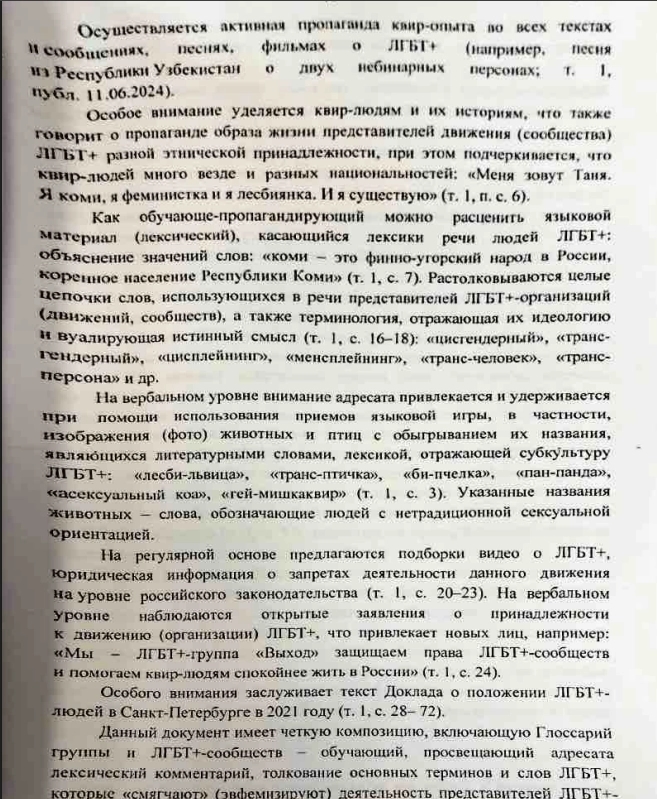
At the very beginning of the report, the authors state that “representatives of the movement demand public space in which to talk about LGBT+ culture” and identify 41 documentary films about queer people, which they say were made in order to “recruit new people into the LGBT organization.” The experts view this as a form of education “at the implicit level,” emphasizing that “small sexual-minority groups teach transgender people, homosexuals, and others how to live.” Music is also characterized as a tool of propaganda — for example, “a song from the Republic of Uzbekistan about two non-binary people.”
Even the mere act of stating biographical details comes in for criticism from the researchers, who cite the apparently unacceptable statement: “My name is Tanya. I am Komi. I am a feminist, and I am a lesbian. And I exist.” As the report explains, “the Komi are a Finno-Ugric people in Russia and the indigenous population of the Komi Republic,” meaning that Tanya’s self-description constituted “educational and propaganda-oriented language material” typical of “the vocabulary used in LGBT+ speech.”
Other ordinary words also raised concerns among the experts. The T9 NSK organization states that “Our mission is to make the world a better place by developing and consolidating T* communities in Siberia and the Russian Federation.” The authors of the report seized on the word “mission,” concluding that “representatives of LGBT movements see themselves as missionaries whose task is to attract the attention of large numbers of people.” This was not an isolated incident: the authors reached a similar conclusion based on the Moscow LGBT Community Center’s use of the phrase “Our mission ensures equality.” (At the same time, the Nizhny Novgorod Academy of the Ministry of Internal Affairs itself uses the word to describe its own activities.)
“Volunteer” comes in for similar scrutiny. Materials published by one HIV-support foundation ask: “Would you like to become a volunteer?” This is described in the report as “an attempt to expand influence at the verbal level.” The experts further stress that the word “volunteer” is “interpreted without reference to the LGBT subculture, thereby concealing its essence.” They also determined that the “About us” section on the group’s website impermissibly “encourages the recipient to provide financial assistance.”
“Demonstrating resistance to Russia’s communications regulator”
The experts identified oppositional attitudes and criticism of the authorities in materials published by most of the organizations under review. In chats and social media posts associated with the initiative group “Coming Out,” for example, they found what they described as “incitement to unlawful actions.” What prompted this conclusion, according to the report, were statements that 2023 had been a year of intensifying repression in Russia — including against queer people — and that the state could not be trusted. The document explains that “the lexeme ‘repression’…means ‘a punitive measure carried out by state authorities (imprisonment, exile, execution).’”
In legal materials titled “What Will Be Considered Extremism?” and “Putin Commented on LGBT Issues,” the experts discerned “resistance by the LGBT+ group to Russian legislation, specifically to the State Duma’s passage of a law banning adoption by people affiliated with LGBT organizations (movements).” In reality, however, no such law has ever been passed or even considered in Russia. The country’s ban on adoptions instead applies to people in same-sex unions and to citizens of countries where “gender transition” is permitted.
The experts also fault Coming Out for publishing “legal information regarding restrictions on the activities of this movement under Russian law.” On its website, Coming Out did indeed publish a report that contained the sentence: “Since 2008, Coming Out has supported LGBT+ communities in St. Petersburg and drawn attention to LGBT people’s struggle for equal rights.” In the experts’ view, the word “struggle” signifies “angry resistance” and “verbal opposition to state prohibitions.”
According to Kiran (name changed), a representative of the Russian LGBT Network, the organization was accused of “opposing state policy because it advocates equal rights for all people, including queer people.” The Network’s main areas of activity include providing psychological, legal, and emergency assistance to queer people, advocating for their rights, and monitoring discrimination. All of these activities were ultimately cited as indicators of extremism.
According to Kiran, the assessment also contained a great deal of inaccurate information: “For example, we suddenly became the founders of a queer-literature publishing house. They also attributed the organization of LGBT balls in St. Petersburg to us.” Kiran believes this happened because the organization is regarded as a major player in the field and is therefore associated with virtually any public activity carried out by others.
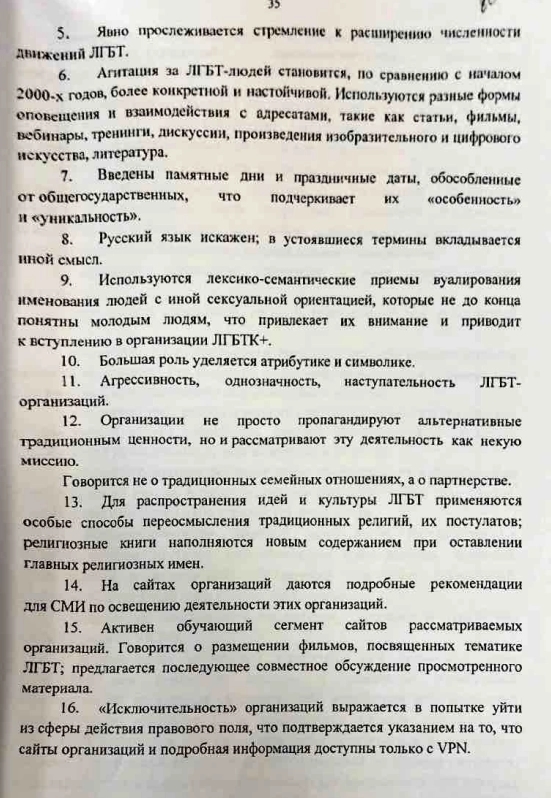
The Callisto movement, from the Yaroslavl region, was described as “actively opposing Russian President V.V. Putin.” According to the expert assessment, this conclusion was based on a Telegram post that referred to a Russian election as a “coronation.” The report concluded that the word choice “conveys contempt for the voting process that resulted in V.V. Putin being elected President of the Russian Federation.” The criminologists also took note of accusations directed at the Russian Supreme Court and the authorities, which they identified in words such as “persecution,” “censorship,” and “unprecedented pressure.” In April 2026, Callisto was designated an extremist organization.
Another foundation that assists LGBT people (its name cannot be disclosed for security reasons and because court proceedings are ongoing) was accused by the report’s authors of engaging in advocacy, monitoring discrimination cases, covering court proceedings, and issuing “calls to fight Russian legislation.” As an example of the latter, the experts cited the headline “Fighting State Queerphobia,” which they claimed demonstrated “the foundation’s opposition to Russian legislation.” According to the report, the term “queerphobia” demonstrates “a negative attitude toward state policy at the legislative level regarding people of non-traditional sexual orientation.”
The experts also objected to criticism of Russia’s law banning gender transition, which activists describe as “transphobic.” According to the report, such a characterization shows a “rejection of the law and a negative assessment of it.” Using the statement, “Under Russia’s influence, the course toward ‘traditional values’ has begun to be adopted by post-Soviet countries such as Belarus and Kazakhstan,” the authors conclude that “traditional values are portrayed as hostile to the subculture and ‘values’ of LGBT+ communities.” Criticism of state media and internet regulatory agency Roskomnadzor’s decision to block a website is characterized in the report as an “explicit demonstration of resistance to Roskomnadzor” and a “negative assessment of the activities of state authorities.”
The researchers also point to various LGBT groups’actions that are characterized as “aimed at destroying fundamental Russian spiritual and moral values and undermining the national security of the Russian Federation.” Among the examples cited were the publication of David France’s documentary Welcome to Chechnya, a recording of the webinar “Teenagers and Queer Identity,” and even a statement that an organization’s mission is to provide “assistance to anyone, regardless of sexual orientation, gender identity, or attitude toward drugs.”
According to the authors, publishing books and reports monitoring the observance of queer people’s rights also contributes to the destruction of spiritual values. Examples include real-life stories of LGBT families, a report on the situation of LGBT people during the pandemic, and support programs for transgender sex workers.
Another purported indicator of extremism was the “production and publication of instructional and propaganda materials.” Under this heading, the experts included UNESCO’s technical guidance on sexuality education, the organization of an “Anti-Stress” support group for men and women, and a discussion club on bodily boundaries.
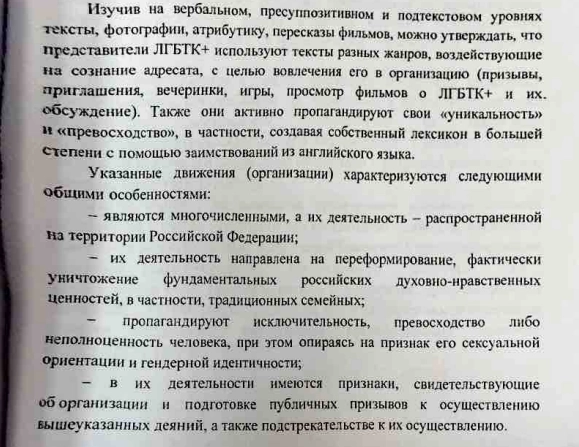
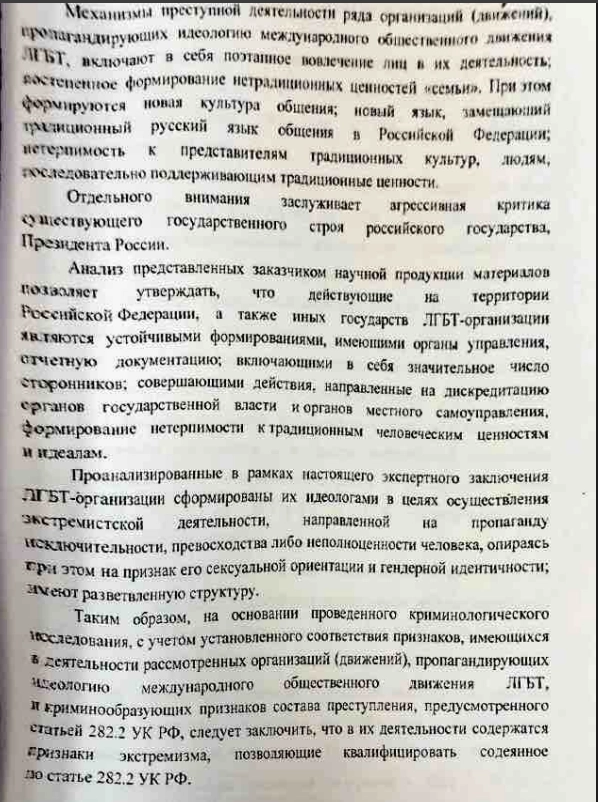
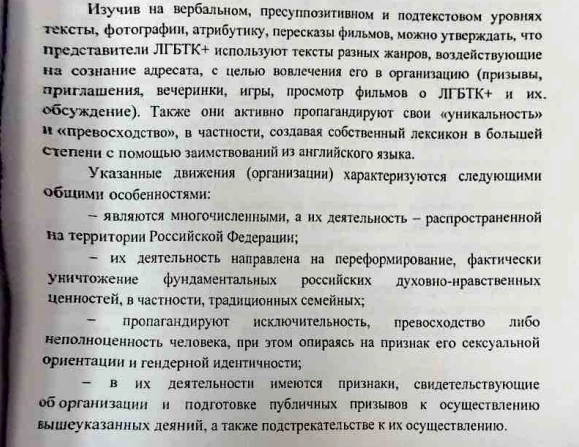
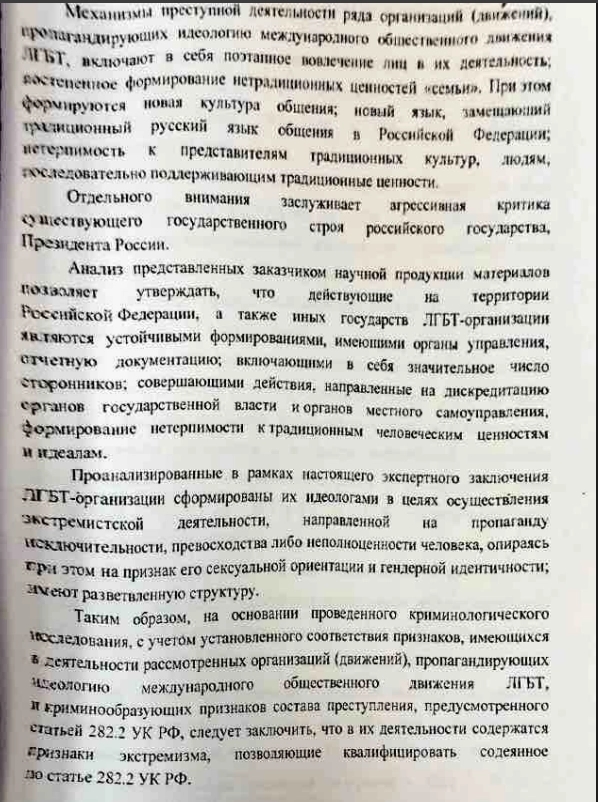
In conclusion, the report states that the LGBT initiatives under review were created by “ideologues for the purpose of carrying out extremist activities aimed at promoting the exceptionality, superiority, or inferiority of people on the basis of sexual orientation and gender identity; they possess an extensive organizational structure and pursue the goal of committing extremist offenses.”
According to lawyer Maxim Olenichev, “There is no analysis in the report. And if there is no analysis, no research methodology, and the conclusions are pulled out of thin air, then there is no substantive argumentation to dispute. Conclusions based on that kind of reasoning are automatically unreliable. The document is not evidence.” In practice, however, Russian courts routinely side with prosecutors when it comes to accepting the validity of the report.
Linguistic gender scholars in uniform
All of the authors of the expert report are employees of the Nizhny Novgorod Academy of the Ministry of Internal Affairs: two colonels, two lieutenant colonels, and one doctor of philological sciences.
Although much of the report is devoted to linguistic analysis, only one of its authors, Elena Beglova, a professor in the Department of Foreign Languages and Speech Culture, has formal training in the field. As a linguist, her interests span a wide range of topics, from criminal slang to the etymology of “quadrobists” to the vocabulary used by law enforcement officers.
As The Insider found, Beglova has repeatedly demonstrated an academic interest in queer-related topics. For example, in her article “Means of Verbal Aggression and Its Euphemization in Political Discourse and Public Speech,” she cited propagandist Dmitry Kiselyov’s reaction to Kamala Harris’s interactions with voters, in which he claimed that Harris “could speak freely only about gender transition and LGBT issues.”
In another study devoted to discursive practices in the digital age, Beglova argues that people use unconventional punctuation and spelling in order to “form negative evaluative attitudes,” “express irony,” and “discredit politicians.” As an example, she cites a passage in which a transgender person is referred to using the neuter gender: “In the United States, a transgender swimmer is seeking through the courts to overturn a ban on competing in women’s events. The swimmer(ess) has filed a lawsuit with CAS.”
Author Anna Glukhova, head of the Department of Criminology, previously studied “the image of the police officer through the eyes of Nizhny Novgorod residents.” In 2024, she reflected on whether the internet offers a new opportunity or a source of threats. In the catalog entry for that article, the listed keywords include “Columbine” and “LGBT.” Discussing the consequences of young internet users’ participation in the activities of “destructive” and “extremist” organizations, the legal scholar argues that teenagers may develop an interest in drugs, which is then “supplemented by an interest in erotica and non-traditional sex,” followed by an interest in “extreme leisure activities,” and later by “information about firearms.”
Glukhova’s and Beglova’s colleagues had not previously been noted for any particular scholarly interest in LGBT-related topics. Some of Dmitry Klimov’s work, for example, focuses on sex crimes, including the methods used to recruit people into prostitution and the role of information technologies in the sex industry.
Maxim Stepanov, meanwhile, wrote an article on “information security in the context of the development of modern criminal policy,” in which he quoted a speech by Vladimir Putin arguing that countries that invoke the value of freedom of speech now “prevent the dissemination of objective information and declare alternative viewpoints to be hostile propaganda that must be fought, using methods that are clearly undemocratic.”
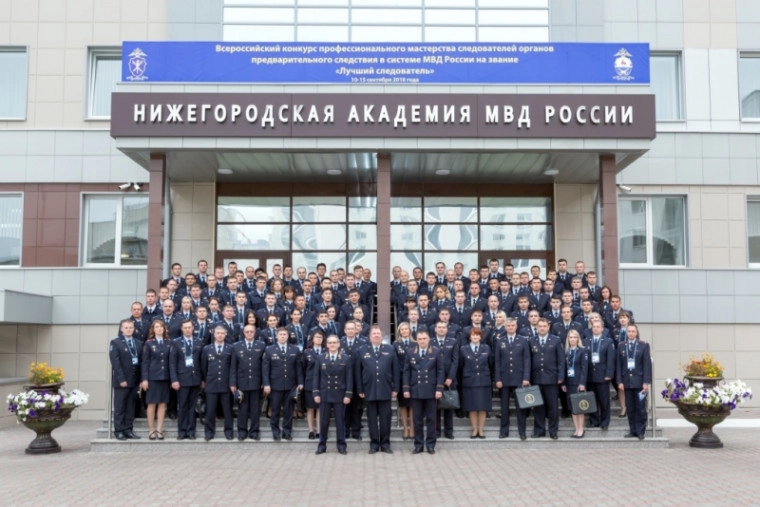
The Nizhny Novgorod Academy of the Ministry of Internal Affairs itself has a mixed reputation. Reviews on Yandex Maps include comments such as: “The male half of the faculty are sexists. They treat people like dirt, and the food is just as bad;” “Girls are repeatedly subjected to unwanted advances at the academy — it’s frightening to send your daughters or sisters there;” and “Not particularly reasonable officers with superiority complexes who assert themselves at the expense of recent high-school graduates, with a sharp divide between the well-connected and everyone else.” On the 2GIS platform, meanwhile, reviewers describe the academy as a prison.
112 questions from the defense
In the case involving the Russian LGBT Network, the defense managed to speak with the “experts” via videoconference. After studying the document, the organization’s lawyers prepared 112 questions for the authors of the criminological assessment. Kiran described their response to The Insider: “They brushed off most of them, claiming they were unrelated to the case under consideration. We received answers to 14 questions.”
In their responses to several of the questions, the experts accused the organization of cooperating with the European Court of Human Rights and the UN Human Rights Committee. “The voices of queer people are being heard outside Russia, and in their view that runs contrary to the state policy of traditional values,” Kiran said.
After reviewing the assessment, the organization’s legal team concluded that it was “not a scientific analysis but an ideological document.” As Kiran described the situation, the authors’ refusal to appear in court reflects an unwillingness to have their conclusions publicly scrutinized and defended: “Extremism is a very convenient label for this — a label to use against those whom the authorities want to erase, imprison, or ban. Most importantly, it is meant to intimidate people and organizations so that they disappear on their own, isolate themselves, and stop doing anything or speaking out about how bad things are.”
Kiran believes that the cases are heard behind closed doors in St. Petersburg courts in order to hamper the work of defense lawyers. “If you don’t know exactly what you’re being accused of, you can’t properly defend yourself,” he explains. “That’s why the hearings are held in secret and behind closed doors, and everything moves through the courts very quickly.”
Consequences
Despite the often absurd nature of the report’s arguments, the repressive measures it has been used to justify have created serious difficulties for the queer community.
Over the past year, three organizations that assist LGBT people — Egida, the Russian LGBT Network, and Sfera — either temporarily or permanently stopped providing direct and emergency assistance. Because of funding shortages, the closure of support programs, and the risk of being prosecuted for “extremism,” ordinary queer Russians are often unable to obtain assistance either to survive in Russia or to relocate to safer countries.
Because of the prosecutions for “extremism,” ordinary queer Russians are unable to obtain assistance — either to survive in Russia or to leave for safer countries
For example, the destruction of the Center T initiative left thousands of people without support. Since 2020, the organization had assisted transgender and non-binary people.
What began as a small therapy group in Moscow grew into a comprehensive support network. Vetted endocrinologists, psychiatrists, and gynecologists handled more than a thousand requests for assistance. A supportive medical commission issued F64 diagnoses, which enabled people to change their identity documents and begin hormone therapy. A shelter in Moscow accommodated more than 80 people facing crisis situations. A network of city-based chat groups across most regions of Russia brought together 10,000 participants. Mutual Aid Services operated in three cities. And the safe dating project “Queer Matchmaker” helped bring together 141 couples.
However, over the past three years, the organization faced mounting pressure in the form of fines for “propaganda,” designation as a “foreign agent,” the blocking of its website, and finally, in May 2026, designation as an extremist organization based on the Nizhny Novgorod Academy’s expert report.
The campaign against alleged “LGBT extremists” dismantled these support services gradually. In 2023, following the ban on gender transition, Center T was forced to shut down its medical commission due to the fact that providing medical care related to “sex reassignment” had suddenly become a criminal offense. After the “international LGBT movement” was designated as extremist, Center T’s shelter in Moscow was forced to close — neighbors repeatedly called the police, and on one occasion someone attempted to break down the door. The court ruling created a real risk that residents and volunteers could be reported to the authorities for “extremism.”
At the end of 2023, several staff members, including director Yan Dvorkin, opted to emigrate, as all of them faced the threat of criminal prosecution for participation in “extremist activities.” In 2025, the Mutual Aid Service was shut down, and in the spring of 2026, both “Queer Matchmaker” and the network of city chat groups ceased operations. Following the court’s ruling in May, Center T was also compelled to end cooperation with all of its volunteers still residing in Russia.
The court accepted the arguments of the Nizhny Novgorod Academy’s argument that signs of extremism could be found in the very existence of chat groups, therapy groups, and mutual-aid services. Based on information about emigration routes for trans people published in one of the organization’s channels, the experts argued that the initiative operated in “32 foreign countries.” They further claimed that the terms “trans person” and “non-binary people” were used to “conceal references to people of non-traditional sexual orientation, thereby attracting young people to join LGBTQ+ organizations.”
During the court hearing, a representative of the Ministry of Justice argued that the initiative’s activities constituted a “destructive ideology that influences public consciousness, including that of minors.” Among the allegations leveled against the organization were the “creation of its own lexicon borrowed from the English language” and the “support for guardianship rights of transgender people.” The case also relied on Dvorkin’s personal Telegram posts, including criticism of the actions of the Russian military. As the ministry’s representative put it: “Well, I think the phrase ‘Glory to Ukraine’ speaks for itself.”
According to Maxim Olenichev, the law does not permit personal statements made by members or leaders of an initiative in their private capacity to be treated as the position of the organization as a whole. Nevertheless, after accusing the initiative of harboring oppositional views, the Ministry of Justice representative stated: “This initiative group, Center T, has no right to exist because of the ideology it spreads among the masses… Moreover, its activities are directed against the state system and against the special military operation.”
Despite financial difficulties and mounting repressive restrictions, Center T has adapted to the new reality. The organization has relocated its shelter to Armenia.
What comes next
The activists and human rights advocates interviewed by The Insider are, for the most part, pessimistic about the future. “The problem is that people can barely even get to know one another anymore. They’re afraid and don’t know what to do, so they’ll flee. Queer people often have little money and aren’t prepared for life on their own. But abroad, where they can find community, they adapt. In Russia, things will become very bad and very frightening,” says Anton.
“On the one hand, this is the natural evolution of a dictatorship — they’re just doing it slowly and inefficiently. But it could escalate into harsh persecution with long prison sentences,” says Yan Dvorkin of Center T. “On the other hand, this may be a campaign ahead of the parliamentary elections, designed to channel hatred and public frustration toward ‘some kind of perverts’ while eliminating any form of collective organization. They can detain virtually anyone because proving that you have no connection to LGBT organizations is practically impossible.”
Kiran agrees that the Russian authorities are currently “selling” voters the myth of a victory over an internal enemy: “Once they’ve labeled everyone they wanted to label as extremists, we’ll see a report on Channel One saying that Russia has defeated all LGBT people on its territory.”
Maxim Olenichev believes that existing digital security tools make it possible to continue at least some activities online: “For example, participants can remain anonymous by joining under pseudonyms, keeping their cameras off, and speaking with altered voices. Even if an informant gets into such a group, there is a high probability that they will be unable to identify the participants. People need to think about their safety at all times and use the available tools — that is simply the reality today. Without such precautions, people may be held liable if law enforcement identifies a violation.”
The lawyer also has advice for those looking to organize in offline activities: “They should not be organized under the banner of LGBT initiatives, but no one has prohibited queer people from coming together, going hiking, socializing, or engaging in activities that are not formally connected to activism. The state is applying pressure, but for now people can still support one another and preserve horizontal networks. That makes it possible to continue some activities while keeping safety in mind.”
Alexei Nazarov of the Alliance of LGBT People and Heterosexuals for Equality believes it is necessary to acknowledge that “the voice of the LGBT community has been silenced,” however painful that may be. “When LGBT characters are erased from films and books, when absurd cases are brought against booksellers and publishers, when criminal prosecutions are launched and people from gay clubs are imprisoned, there is only so much public advocacy you can do to insist on your rights,” he explains. According to Nazarov, for the time being, the most useful initiatives are those that focus directly on psychological and legal assistance — as well as helping people leave Russia.