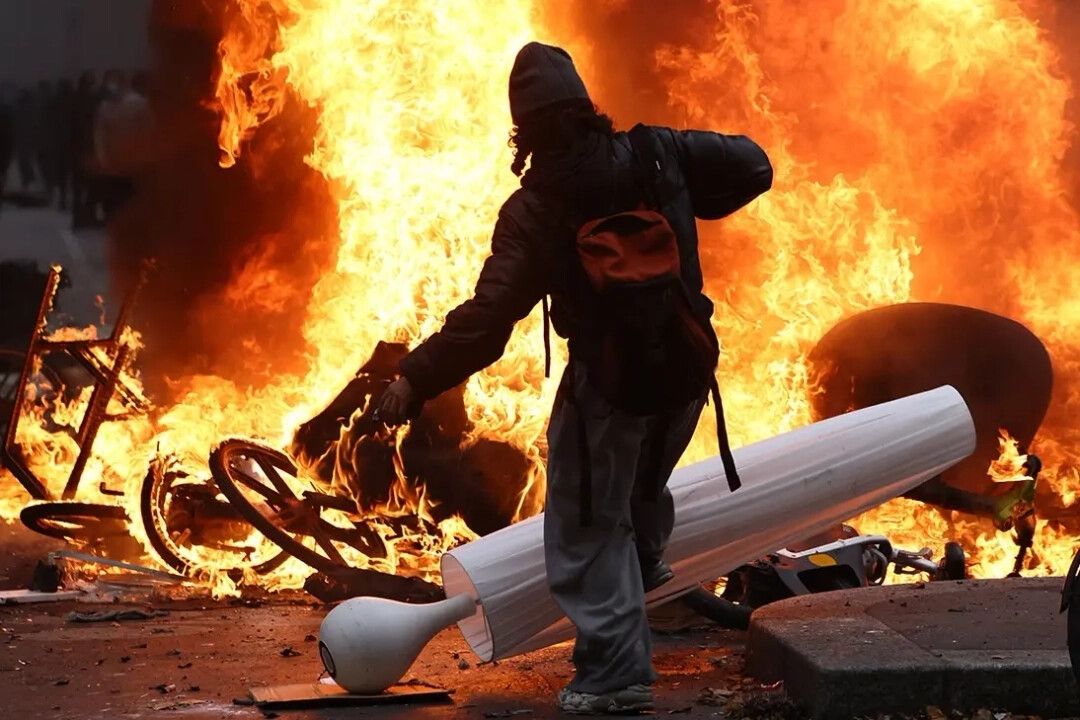
The radical youth protests now taking place in several European countries are part of broader social shifts that experts have been observing for years. The sharpest rise has been in far-right extremism, which increased by approximately 250% between 2014 and 2020, even if the pace of growth has slowed. Meanwhile, the 2025 Global Terrorism Index shows that the number of politically motivated terrorist attacks has risen by 20% since 2024, with children and teenagers carrying out half of them. The radicalization of young people across Europe is taking many different forms, and research suggests that ideology is secondary to socioeconomic factors.
Types of extremism
In the public mind, extremism in Western countries is most commonly associated with Islamic fundamentalism, but the scale of that particular problem is often exaggerated. The Muslim population of the EU numbers 19 million, and according to various estimates — including conservative ones — fewer than 1% of Muslims in Western Europe have any real connection to radical organizations (and even within this tiny subgroup, the overwhelming majority have not committed acts of violence).
Researchers distinguish between two types of radicalization: cognitive radicalization, or the adoption of fundamentalist or exclusionary beliefs, and behavioral radicalization, which involves violence (whether as a participant or merely as a supporter). The two are not clearly correlated, and in the overwhelming majority of cases, ideological radicalization does not lead to illegal action.
A 2021 survey of 8,000 young people in Switzerland (aged around 17) found that agreement with statements by Islamic extremists was lower than agreement with those made by secular radicals of the far-right and far-left. The authors concluded that youth radicalization is primarily cognitive in nature and that cognitive radicalization alone cannot predict actual terrorist behavior.
Although jihadist attacks remain a threat in both Europe and the United States, the fastest-growing form of extremism is far-right extremism. According to the Global Terrorism Index, published by the Institute for Economics and Peace (IEP), far-right extremism among young people in the West increased by 250% between 2014 and 2020.
Far-right extremism among young people in the West increased by 250% between 2014 and 2020
One striking feature of this trend is that the radicals who do cross over into the behavorial camp are increasingly young people acting alone: nearly 92% of terrorist attacks over the past five years were so-called "lone wolf" incidents. In 2025, children and teenagers were suspected in nearly half (42%) of all terrorism-related investigations in Western countries, and in the United Kingdom, Home Office statistics show a record rise in the proportion of teenagers arrested for terrorism-related offenses — from 3% in 2002–03 to 19% in 2023. In France, minors prosecuted for terrorist offenses accounted for one-fifth of all such cases.
Such trends can be observed around the world. Young people are indeed much more likely than before to attempt acts of violence and terrorism (even if most of these attempts fail). In the United Kingdom, official Home Office statistics show an increase in the proportion of children and teenagers arrested for terrorism-related offenses: from 3% of all arrests (eight people) in 2002–03 to 19% (42 people) in 2023, a record for the country. In France, the number of minors prosecuted for terrorist offenses rose from two in 2022 to 15 in 2023 and 18 in 2024, accounting for one-fifth of all such cases there. According to the latest Europol figures, in the EU as a whole almost one in three people arrested for terrorism-related offenses in 2024 was a minor or young adult.
This trend extends beyond lone, ideologically motivated attacks to include organized terrorist activity as well. For example, whereas jihadist groups almost never recruited minors in the early 2000s, since 2015 at least one plot involving children and teenagers has been identified almost every year.
From insecurity to intolerance
The mechanisms terrorist groups use to recruit members differ fundamentally from those inspiring nonviolent, cognitive radicalization. The Combating Terrorism Center (CTC) at the US Military Academy at West Point describes the three-stage strategy that the Islamic State used to recruit young people at the height of its military power in the mid 2010s.
First, the Islamic State involved mothers in radicalizing their own children. Second, its propaganda portrayed militants as both brutal and tender, creating an appealing image of masculinity. Third, the group's media efforts presented extreme violence as “entertainment” through livestreams, execution videos, and combat footage.
The Islamic State involved mothers in radicalizing their own children
CTC analysts note that the educational curricula the Islamic State developed for children and teenagers were “professionally prepared, with pedagogical approaches similar to those used in the West.” At the same time, themes of violence and the apocalypse were deliberately woven into ordinary school subjects.
However, the Islamic State's recruitment methods (and those of other terrorist organizations) are unlikely to have affected the vast majority of young Muslims in the West. In fact, the mechanism at work here more closely resembles the ordinary process of adolescent identity formation under stress.
Singaporean terrorism researcher Kumar Ramakrishna points out that the emotional center of the brain matures faster than the prefrontal cortex, which is responsible for impulse control and rational judgment. Adolescents go through a period of “seeking absolute certainty” — something extremist ideologies can provide, even if the answers they offer are highly dubious from a factual standpoint.
Technological developments have also had a significant impact on how people get attached to radical ideologies. A 2025 review by the U.S.-based Soufan Center, which studies terrorism and armed conflicts, notes that radicalization processes that once could previously take “months or years” now occur in “days or even hours” as a result of social media algorithms, the spread of emotionally charged content, and the isolating effects of online communities. According to the latest figures from the Global Terrorism Index, the average time between first exposure to extremist material and full radicalization has fallen dramatically — from around 18 months in 2005 to just a few weeks as of 2026.
It is important to note that the review describes this as a general feature of contemporary radicalization, not one specific to Islamism, noting that: “Far-right, far-left, nihilist, and Islamist extremists all use social media to influence and radicalize young people.” In fact, the underlying factors pushing young people towards radicalization are are virtually identical, regardless of whether the ideology in question is Islamist, Christianist, left-wing, or right-wing.
In 2013, a group of researchers from the Netherlands published a study based on surveys of young Dutch Muslims. They identified three key factors driving radicalization: personal uncertainty, a sense of injustice, and the perception that one's social group is under threat. These factors contribute to the development of a sense of one's own group's superiority or exceptionalism, distrust of authority, and social alienation. Together, they predict a tolerance of violence committed by members of one's own group, followed by a willingness to engage in violence oneself.
This helps explain the strong correlation between adverse childhood experiences and radicalization identified in the 2025 Global Terrorism Index. According to the report, 87% of radicalized minors had a history of parental neglect or psychological abuse, while 77% had experienced some degree of neglect or lack of parental supervision. Economic pessimism also plays a significant role, as growing social inequality fuels a sense of injustice even when it does not affect a radicalized individual directly.
Another Dutch researcher, Maykel Verkuyten, argues in a 2018 paper that in-group and intergroup dynamics, including those on social media, have a greater influence on radicalization than religion. He also notes that radicalized people's religious backgrounds look nothing like indoctrination — many supporters of Islamist movements received their education in secular schools, while some were even raised in the Christian faith. In other words, religious fundamentalism is often a symptom of radicalization rather than its cause.
The vicious cycle of Islamophobia
A sense of injustice and perceptions of hostility from society are among the key factors in the formation of extremist beliefs. As a result, the rise of xenophobic and anti-Muslim rhetoric in the West can be seen not only as a reaction to the radicalization of young Muslims, but also as one of its causes.
Turkish sociologist Ayhan Kaya made just such an argument in 2021 after conducting 160 in-depth interviews with young Muslims and members of far-right movements in Belgium, Germany, France, and the Netherlands. Kaya concluded that radicalization in both groups was driven not by “civilizational, cultural, and religious differences,” but by a shared sense of socioeconomic, political, and psychological alienation. Kaya described the dynamic as co-radicalization: intergroup conflict, he argues, develops “through cycles of mutual threats and violence.”

Another study — this one co-authored by Kaya in 2023 — identifies factors that contribute to the development of fundamentalist views among Muslims. These include alienation from the dominant culture and society, as well as dissatisfaction with political policies and institutions. The interviewees — young Muslims of Turkish and Moroccan descent living in Paris and Lyon — pointed to xenophobia among conservative politicians and in the press, describing it as an artificially imposed anti-Islamic agenda. The researchers characterize the Islamic radicalism that emerges under these conditions as a “response to nationalism” rather than an independent religious phenomenon.
Increasingly, young people in Western countries blame “outsiders” — mainly immigrants — for their economic problems, viewing newcomers as competitors in the struggle for rapidly dwindling resources. However, this hostility from the majority only strengthens solidarity within the Muslim community, which the wider public, in turn, interprets as evidence of radicalism.
Socioeconomic shocks
Young people today increasingly find themselves living in the precariat — a social class characterized not only by low wages, but also by the constant stress of live on chronically unstable incomes. Among employed 15–24-year-olds in the EU-15, the share working on temporary contracts rose from 25% in 1990 to 40% in 2008 before reashing 47.6% in 2024. The problem also affects the slightly older 15–29 age group: 33.3% of employees in this category were working on fixed-term contracts according to the most recent available data.
Housing is another major challenge. Between 2005 and 2018, the share of young families who owned their homes fell by 21%. Even among households in which young people were in full-time employment, the rate dropped from 52.6% to 41.5%, even as homeownership across the population as a whole remained virtually unchanged.
Between 2010 and 2024, housing prices in the EU increased by 55.4%, while rents rose by 26.7% — a faster pace than in previous decades. This increase has hit particularly hard among young workers with low incomes and less secure employment.
Feelings of instability, insecurity, and injustice stemming from precarious economic circumstances often make people more susceptible to conspiracy theories and more likely to vote for far-right parties, among other social ills.
Muhammad, Jesus, and... Hitler?!
The factors described above — personal uncertainty, a sense of injustice, and the perception that one's social group is under threat — also apply to other radical groups, including Christian ones. In 2021, a group of Swiss researchers concluded that Christian affiliation contributes to the development of far-right views (albeit to a limited extent).
Christian affiliation contributes to the development of far-right extremist views
The authors link this phenomenon to the postwar European narrative of a “Christian West” as a marker of national identity. Parties such as Alternative for Germany (AfD) draw on similar narratives, calling for the “defense of Christian civilization against Islam.”
In the rhetoric of the U.S. far right, demographic and cultural changes are likewise portrayed as a threat to national identity, according to a 2017 study on “nostalgic deprivation.” The term describes a sense of loss triggered by the disappearance of a remembered — often entirely imagined — former social order. Similar mechanisms foster a sense of religious exceptionalism among young Muslims, who seek to establish their identity by “reviving” an idealized “purified” version of their own community amid growing dissatisfaction with their present circumstances.
Why is this surge happening now? Over the past decade, a significant number of young people in Europe's deindustrialized cities have experienced declining social status and the identity crisis that results. This has coincided with the widespread adoption of smartphones and algorithmically curated content. At the same time, rhetoric centered on exceptional victimhood and civilizational threats has entered the political mainstream. The convergence of these forces within a single generation has fueled rapid radicalization.
The Islamic State's educational programs, along with specific attacks carried out by radicalized young people, are indisputably real. However, the psychological path to radical beliefs — through feelings of uncertainty, injustice, and threats to one's social group — is virtually identical, regardless of whether a young person quotes the Quran, the Bible, incel ideology, or the “Great Replacement” theory.
Some grievances are treated as legitimate political concerns, while others are seen as security threats. In Ayhan Kaya's research, a Rotterdam resident angry that refugees are given priority access to housing and a Parisian woman upset that the press portrays her hijab as a threat are describing, in essence, parallel experiences.

